



A recent commentary (A Sarpatwari et al NEJM 2019; 381: 106-8) details the need for reforming the Orphan Drug Act (passed in 1983). To promote drugs for rare diseases, this act offered incentives including exclusive marketing rights for 7 years, a 50% tax credit for costs with clinical testing (reduced to 25% in 2017) and grants for clinical trials.
The problems that need to be addressed related to this act:
Key points:
My take (borrowed from the authors): “The status quo increasingly threatens public health, as rising drug prices present growing access challenges for patients and indication slicing hampers collection of critical preapproval information on safety and efficacy when used in ways that will reflect their most common use in the market.”
Related blog posts:


Park Guell, Barcelona

Park Guell, Barcelona
A recent review (DS Fishman, DB Andropoulos, JR Lightdale. JPGN 2019; 69: 3-5) discusses the topic of sedation and an FDA warning from 2016 that should be familiar to pediatric GI physicians. Related blog post (2017): FDA Warning Anesthesia and Developing Brains
The medications which induce an ‘anesthetic state’ may cause cell death and may be “causing some degree of irreversible cellular injury –at least in developing brains, which are particularly vulnerable to apoptosis… [which leads to the] sobering thought that …sedatives could be associated with long-term neurological effects.” At the same time, the authors caution of the potential for the warnings to cause “a delay in the care of the patient.” The authors advocate the following talking points:
Websites for physicians and families:
My take: These FDA warnings need to be taken seriously and low yield/low value endoscopy needs to be avoided.
Related Posts:

Park Guell, Barcelona
A recent commentary, “Mistrust in Science –A Threat to the Patient-Physician Relationship” (RJ Baron, AJ Berinsky. NEJM 2019; 381: 182-5), addresses the deterioration of trust in the patient-physician relationship and potential ways to improve this.
Shortly before reading this, I read a newspaper article titled “Newtown Parents Fight Back” in Sunday’s AJC (related article online: Newton Parents Score a Win…). In this article, some of the parents of the 20 children who were killed in Newton, Connecticut have brought successful lawsuits against ‘hoaxers’ who claimed that the “rampage had been staged, with crisis actors.” Some of the parents have received death threats subsequently.
In this ‘misinformation’ age, it would be naive to expect that medicine and science would be spared. The alluded commentary makes the following points:
“Given the decline in trust in the institution of medicine, simply asserting medical authority or citing evidence is unlikely to win adherents…Skepticism…is a widespread phenomenon…appealing to a neutral or independent ‘referee’ of the truth…on a given subject–does not actually change minds…attempts by experts to correct misinformation may further entrench erroneous beliefs.”
Pathways to Trust
My take: The authors note that in this age, science s devalued and relationships are more influential. Thus, creating trust goes back to Peabody’s 1927 admonition: “The secret of the care of the patient is in caring for the patient.”
In the newspaper article, a book publisher involved in the promoting the Sandy Hook conspiracy had to meet one of the parents as part of a lawsuit. “At the end of the day, Gahary shook Pozner’s hand and apologized. He offered condolences for Noah’s death.” As in medicine, getting to know each other is the surest way to garner trust.
Related blog posts:

A recent study (C Alessandria et al JPGN 2019; 69: 39-44) enrolled 151 patients to examine for correlation between mucosal disease and autistic children with gastrointestinal symptoms. Patients were prescribed a gluten-casein free diet (GCFD)
Key findings:
My view: The authors suggest that an EGD may help predict who would respond to GCFD. An alternative approach would be to offer a GCFD in those with significant GI symptoms given the unclear clinical relevance of microscopic duodenitis. This view is supported by previous studies which have indicated that the GI findings are similar among children with and without autism.
Related blog posts:

Park Guell, Barccelona


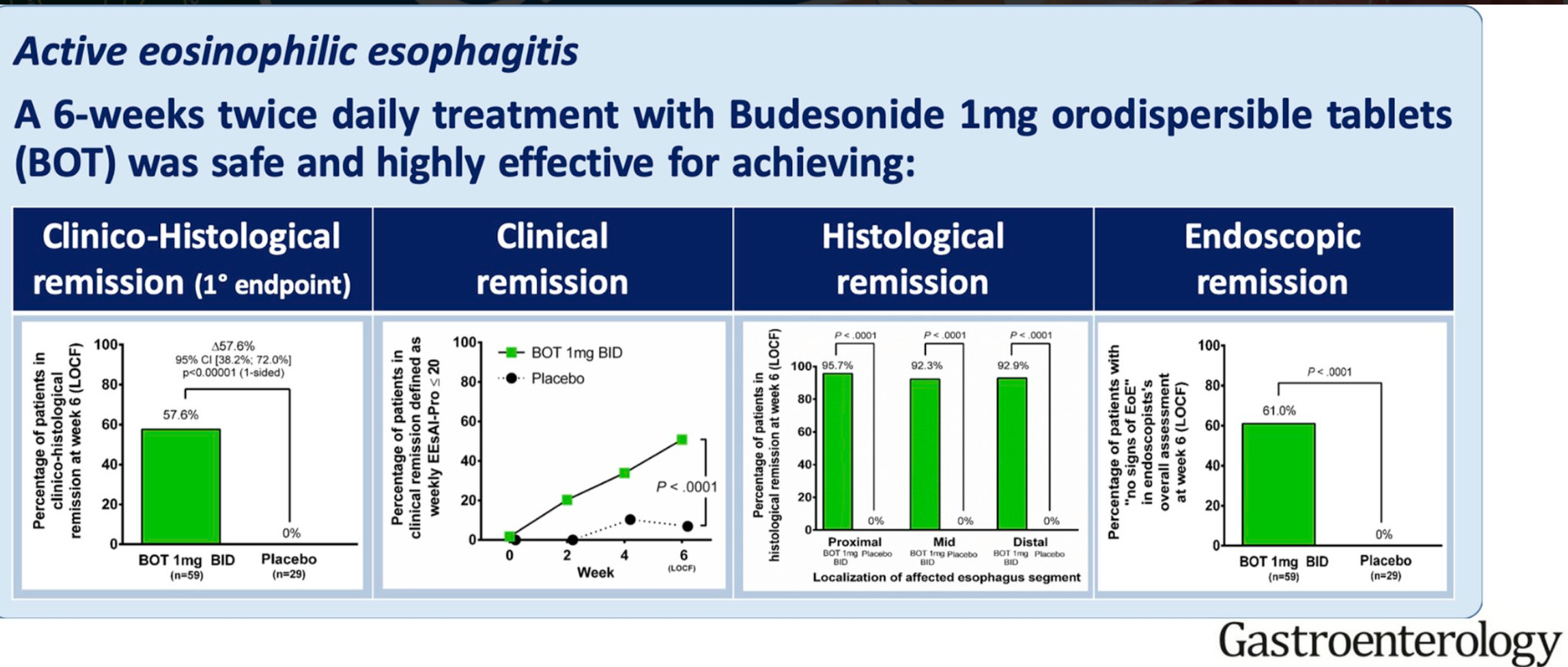
Full Text Link (courtesy of AGA twitter feed):Efficacy of Budesonide Orodispersible Tablets as Induction Therapy for Eosinophilic Esophagitis in a Randomized Placebo-Controlled Trial AJ Lucendo et al. Gastroenterol 2019; 157: 74-86. https://doi.org/10.1053/j.gastro.2019.03.025
Abstract:
Swallowed topical-acting corticosteroids are recommended as first-line therapy for eosinophilic esophagitis (EoE). Asthma medications not optimized for esophageal delivery are sometimes effective, although given off-label. We performed a randomized, placebo-controlled trial to assess the effectiveness and tolerability of a budesonide orodispersible tablet (BOT), which allows the drug to be delivered to the esophagus in adults with active EoE.
We performed a double-blind, parallel study of 88 adults with active EoE in Europe. Patients were randomly assigned to groups that received BOT (1 mg twice daily; n = 59) or placebo (n = 29) for 6 weeks. The primary end point was complete remission, based on clinical and histologic factors, including dysphagia and odynophagia severity ≤2 on a scale of 0–10 on each of the 7 days before the end of the double-blind phase and a peak eosinophil count <5 eosinophils/high power field. Patients who did not achieve complete remission at the end of the 6-week double-blind phase were offered 6 weeks of open-label treatment with BOT (1 mg twice daily).
At 6 weeks, 58% of patients given BOT were in complete remission compared with no patients given placebo (P< .0001). The secondary end point of histologic remission was achieved by 93% of patients given BOT vs no patients given placebo (P < .0001). After 12 weeks, 85% of patients had achieved remission. Six-week and 12-week BOT administration were safe and well tolerated; 5% of patients who received BOT developed symptomatic, mild candida, which was easily treated with an oral antifungal agent.
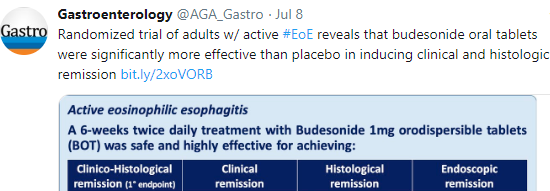
In a randomized trial of adults with active EoE, we found that budesonide oral tablets were significantly more effective than placebo in inducing clinical and histologic remission. Eudra-CT number 2014-001485-99; ClinicalTrials.gov ID NCT02434029.
Related blog posts:
A recent study (JR Dayan et al. JPGN 2019; 69: 61-67) provides some helpful insight into the use of ustekinumab.
Background: The authors conducted a retrospective review of 52 patients (73% younger than 18 years, 27% 18-21 years).
Dosing: 47 (90%) received induction with ustekinumab IV (260 mg if <55 kg, 390 mg if 55-85 kg, 520 mg if >85 kg) followed by 90 mg subcutaneous injections every 8 weeks
Key findings:
Discussion:
My take: This data indicates that ustekinumab therapy was associated with clinical remission in 50% of patients who had received anti-TNF therapy and had higher response in a small sample of biologically-naive patients. More experience is needed to confirm drug safety with long-term usage
Related blog posts:

Barcelona
From Cincinnati Children’s e-Newsletter
An excerpt:
A groundbreaking test developed at Cincinnati Children’s can expedite a diagnosis of biliary atresia (BA), helping physicians decide quickly whether to perform a liver biopsy followed by an operative cholangiogram, the definitive test for BA. The test quantifies the concentration of MMP-7 (matrix metalloproteinase-7), a serum protein that researchers at Cincinnati Children’s discovered in 2017 is a biomarker of BA.
Physicians can order the MMP-7 assay by submitting a requisition form. Test results are available within 48 hours, and a pediatric hepatologist is always available for consultation regarding the interpretation of test results.
Related blog posts:
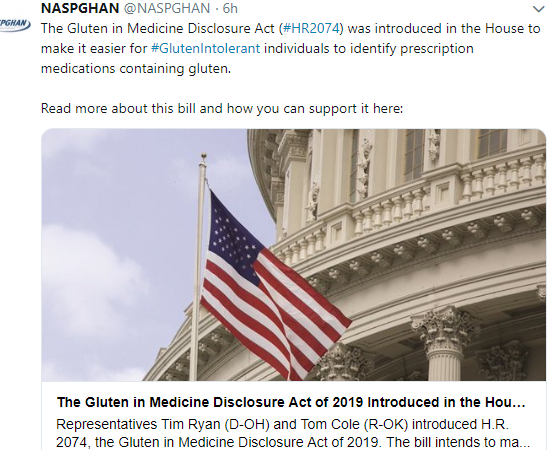
Link: The Gluten in Medicine Disclosure Act of 2019 Introduced in the House
An excerpt:
On April 3, 2019, Representatives Tim Ryan (D-OH) and Tom Cole (R-OK) introduced H.R. 2074, the Gluten in Medicine Disclosure Act of 2019. The bill intends to make it easier to identify gluten in prescription medications by requiring drug manufacturers to label medications with the list of ingredients, their source, and whether gluten is present.
The Celiac Disease Foundation has been working with Representative Ryan’s staff since 2012 on the need for labeling of gluten in medication and is proud to endorse this bill. The Gluten in Medicine Disclosure Act of 2019 was introduced in the House of Representatives and referred to the House Committee on Energy and Commerce. If passed by the House, the bill will move forward for review by the Senate.
Read the full text of the Gluten in Medicine Disclosure Act of 2019 here.
Take a minute to send our letter to your Members of Congress to urge them to cosponsor this bill.
July 1, 2019: Washington Post: CDC warns swimmers about ‘Crypto,’ a parasite that can live for days in pools
An excerpt:
The Centers for Disease Control and Prevention published a report last week about the increased number of outbreaks caused by the fecal parasite Cryptosporidium, more commonly known as “Crypto.”…
The warning came from the CDC’s recent Morbidity and Mortality Weekly Report, which highlighted an average 13 percent increase in cryptosporidiosis outbreaks each year from 2009 to 2017.
The CDC said that over the past decade, there have been more than 400 reported outbreaks in the United States, leading to nearly 7,500 people becoming sick. Of those, more than 200 people were hospitalized, and one person died as a result of the disease, according to the report…
In about 35 percent of the outbreaks, sicknesses were linked to swimming pools and playgrounds, according to the report.
Related blog posts:

Bear and the Strawberry Tree, Puerta del Sol, Madrid
 gutsandgrowth