Patient Educational Video (~2 min) from Cincinnati Children’s: What is Eosinophilic Esophagitis?


Patient Educational Video (~2 min) from Cincinnati Children’s: What is Eosinophilic Esophagitis?
A recent study (PS Myles et al. NEJM 2018; 378: 2263-74, editorial 2335-6) throws some shade on the idea that restricting IV fluids during surgery results in better outcomes.
With ERAS (enhanced recovery after surgery) procedures, one of the components has been restricting IV fluids during surgery due to concerns that excessive fluid will result in bowel wall edema and slower recovery. To better determine if a restrictive IV fluid approach or a more liberal approach was better, this RELIEF study randomized approximately 3000 patients who were receiving major abdominal surgery into two arms: a restrictive group and a liberal group; they received a median of 3.7 liters of IV fluids and 6.1 liters respectively during and up to 24 hours after surgery.
Key findings:
The associated commentary notes that in this age of minimally invasive surgery, a modestly liberal administration of IV fluids does not create substantial fluid retention.
My take: Restrictive fluid regimen during major abdominal surgery resulted in higher rates of kidney injury and surgical site infections. This study indicates that for ‘enhanced recovery’ that a more liberal fluid regimen is safer.
Related posts:

A new report from an ESPGHAN-Led Expert Group (N Thapar et al. JPGN 2018; 66: 9991-1019) provides detailed recommendations for pediatric intestinal pseudo-obstruction (PIPO). In addition, this report serves as an excellent self-assessment of your vision. If you can read figure 1, which has some incredibly tiny font size, then your vision is fantastic.
Aside from that snarky comment, the report offers a great deal of useful advice.
Subsequently, the authors review management: potential medications (Table 6), enteral feeds, gastrostomy and ileostomy, and in more than 80% then need for parenteral nutrition. At the time of therapeutic procedures, it is recommended to obtain full-thickness biopsies to further characterize the PIPO.
Clinical features which distinguish pediatric chronic intestinal pseudo-obstruction (CIPO) from adult CIPO are listed in Table 2. These include the following:
Intestinal transplantation should be considered in patients with PIPO who develop life-threatening complications associated with TPN or poor quality of life/high morbidity.
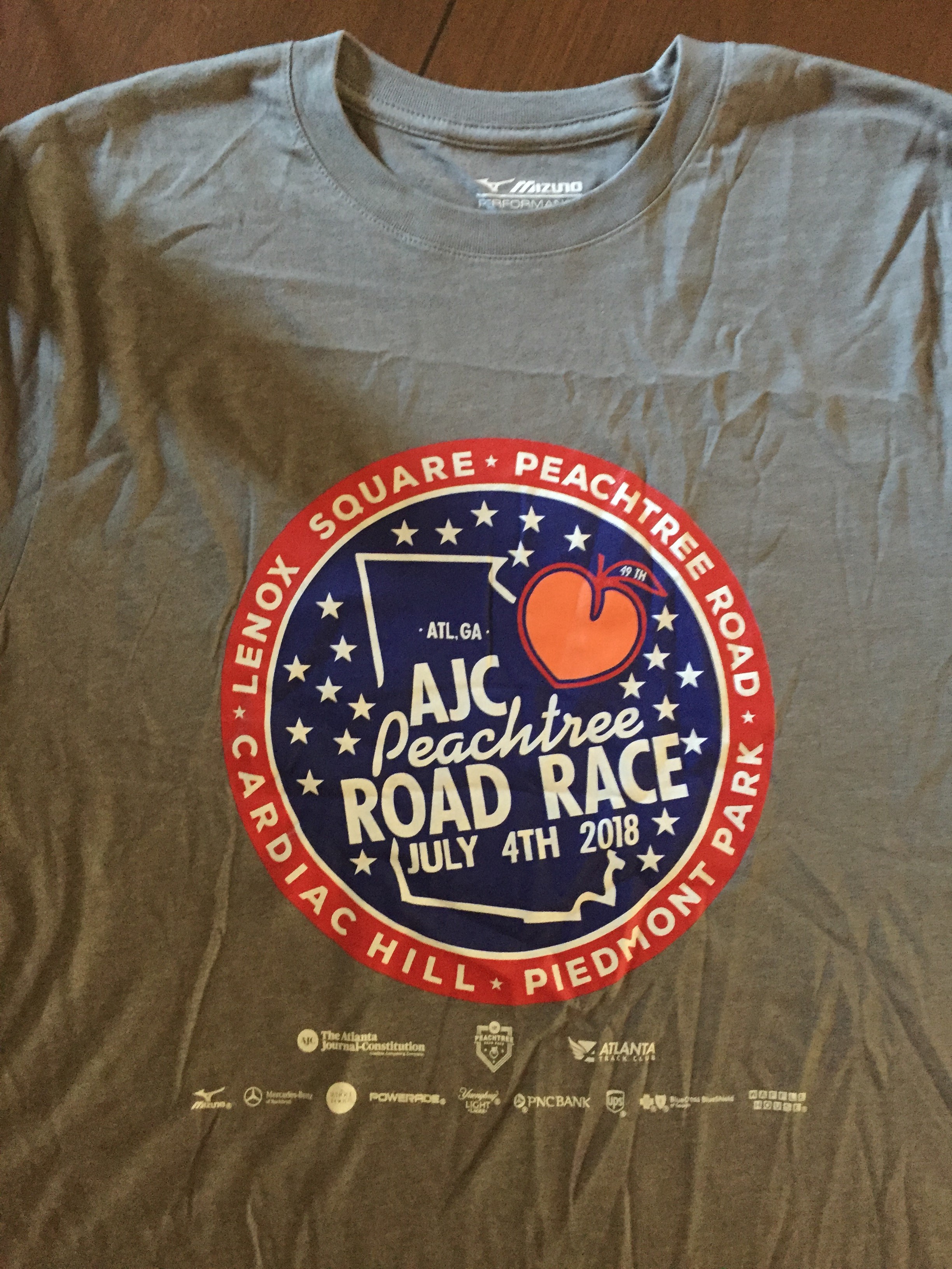
Pictures below from yesterday’s Peachtree Road Race and previous T-shirts from previous years.



Disclaimer: These blog posts are for educational purposes only. Specific dosing of medications/diets (along with potential adverse effects) should be confirmed by prescribing physician/nutritionist. This content is not a substitute for medical advice, diagnosis or treatment provided by a qualified healthcare provider. Always seek the advice of your physician or other qualified health provider with any questions you may have regarding a condition.

Just in time for this year’s Peachtree Road Race…
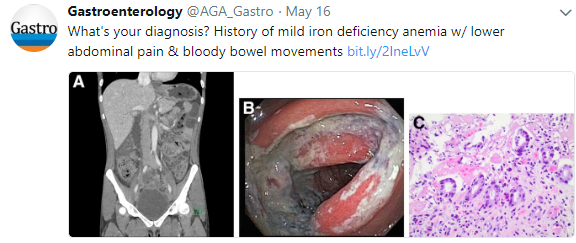
A brief report (RS Robinson et al. Gastroenterol 2018; 154: 1582-83) presents a case of a 28 year old, who had been in training for a marathon, with mild iron deficiency anemia, lower abdominal pain, and bloody bowel movements. The CT scan and colonoscopy showed diffuse colonic/ileal inflammation; the histology showed mucosal necrosis, crypt atrophy and acute inflammation (see below).
Answer to title question: Runner’s Colitis. The authors note that in some long-distance runners an ischemic colitis can develop in part due to rerouting of blood with prolonged exercise. Dehydration may exacerbate poor perfusion. The splenic flexure and the rectosigmoid junction are particularly susceptible due to the ‘watershed’ nature of their blood supply.
The majority of individuals recover fully from this insult, though the literature describes one individual who required a subtotal colectomy after perforation.
A recent study (A Kwong et al. Liver Transplantation 2018; 24: 735-43) and associated editorial (P Martin, pg 727-8) highlight an unintended consequence of HCV therapeutic success –“MELD purgatory.”
The study notes that with the availability of more effective direct-acting antivirals for HCV, there has been a decrease in wait-list mortality and a decrease in disease severity. This was determined by reviewing 3 timed cohorts (2004 n=2408, 2009 n=2402, and 2014 n=2817) from the Organ Procurement and Transplantation database.
The editorial notes that in the five years since the introduction of sofosbuvir, HCV has been displaced as the single commonest indication for liver transplantation by nonalcoholic fatty liver disease. These agents have led to a decrease in advance HCV-related liver disease. In addition, in the past, HCV infection had near universal recurrence after transplantation and this is no longer the situation.
My take: Undeniably, the advent of DAA have made a huge dent in progressive HCV liver disease. However, those with advanced liver disease may be stuck in a purgatory between good health and poor quality of life even after clearance of HCV infection.
Related blog posts:

With this year’s World Cup is in full swing, it is worth noting that watching a tense-filled soccer match could have adverse consequences.


A presentation at the 13th Congress of the European Crohn’s and Colitis Organization (ECCO, Feb 2018) indicated that Vedolizumab had similar effectiveness as anti-TNF agents for both ulcerative colitis and Crohn’s disease. This data has been presented at a recent meeting in our office, some of the GI news magazines, and also ImproveCareNow listserv.
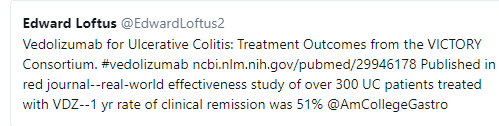
These analyses observed that patients with UC treated with Entyvio compared to TNFα-antagonist therapy had statistically significant higher 12-month cumulative rates of mucosal healing (50% vs 42%, hazard ratio [HR] 1.73, 95% confidence interval [CI] 1.10‑2.73) and clinical remission (54% vs 37%; HR 1.54, 95% CI 1.08‑2.18), and numerically higher steroid-free clinical remission rates (49% vs 38%; HR 1.43, 95% CI 0.79‑2.60). In CD, results reported statistically significant higher 12-month cumulative rates of mucosal healing (50% vs 41%; HR 1.67, 95% CI 1.13‑2.47), and numerically higher rates of clinical remission (38% vs 34%; HR 1.27, 95% CI 0.91‑1.78) and steroid-free clinical remission (26% vs 18%; HR 1.75, 95% CI 0.90‑3.43) compared to TNFα-antagonist therapy. These analyses were conducted by the VICTORY (Vedolizumab Health OuTComes in InflammatORY Bowel Diseases) Consortium.
My take: While the data compare anti-TNFs to vedolizumab in a “real-world setting,” the reported outcomes for anti-TNFs are lower than in other studies. Vedolizumab had the best results in those with colonic disease. Patients with Crohn’s disease with isolated small bowel disease had lower response rates.
Related study: AK Waljee et al Inflamm Bowel Dis 2018; 24: 1185-95. Using phase 3 clinical trial data with 594 subjects, the authors note that the majority of patients who will respond to vedolizumab can be identified by week 6 using a laboratory algorithm based on hemoglobin, albumin, vedolizumab level and CRP. Fformula: Hgb*Albumin*VDZ level/CRP*Weight. A cutoff of 185.96 predicted success with an AuROC of 0.75. Higher hemoglobin, higher albumin, and higher vedolizumab level, and lower CRP are associate with higher response rates.
Related blog posts:

Red Top Mountain, Homestead Trail
While mass shootings are occurring frequently and garner a lot of press, everyday children and adults are dying from more ‘mundane’ tragedies. To reduce some these –a recent AAP message: Is There an Unlocked Gun Where Your Child Plays?
Parents need to ask this question to protect their children.



A recent study (C Stiles-Shields et al. JPGN 2018; 66: 71) reports on 32 cases of median arcuate ligament syndrome (MALS) from a single center, 2011-17. To me, this is an astounding number of individuals who were operated on for this disorder. As the authors note, “MALS remains a controversial and vexing condition. 13% to 50% of healthy patients may exhibit radiographic features of celiac artery compression.”
While the authors note that pain symptoms improved significantly, they report that “comorbid psychological conditions were common, occurring in about half the sample before and after surgery.”
My take: If one finds celiac artery compression and suspects MALS, it is unclear to me if an operation is indicated and how to determine when it is indicated.
Related blog post:


Proctor Creek Trail

