Vaccine for Celiac Disease

A recent study (KM Kemppainen et al. Clin Gastroenterol Hepatol 2017; 15: 694-702, editorial 703-5) showed that gastrointestinal infections can trigger celiac disease (CD) and that immunization with the rotavirus vaccine was protective against developing CD.

This study is part of the TEDDY study: The Environmental Determinants of Diabetes in the Young.  The TEDDY cohort involves more than 8000 children who are part of an international prospective cohort who carry genes (HLA-DR-DQ genotypes) with increased risk for diabetes and CD. In this particular group, the authors identified 6327 children who were 4 yrs old by March 2015.

Key Definition: CD autoimmunity (CDA) -children who tested positive for tTG IgA at their annual visit and remained persistently positive 3 months later

Key Findings:

  • Gastointestinal infections (n=13,881) but not respiratory infections (n=79,816) were associated with an increased risk of CDA.  CDA risk was increased within the 3 months of the GI infection.
  • 732 of 6327 (11.6%) developed CDA.  In this cohort, 318 underwent duodenal biopsy and 283 (90%) had biopsy indicative of CD (Marsh score >1). Thus, in their cohort, there is variability in the onset of CD from the onset of CDA.
  • Risk of CDA was reduced in children vaccinated against rotavirus and introduced to gluten before age 6 months (HR =0.57).
  • The exact risk depending on interaction with multiple factors including breastfeeding, HLA genotype, seasonality of birth, and timing of gluten introduction. Timing of infection plays a role as well, as earlier exposure to GI infections earlier in life was associated with a decreased risk of celiac disease.

This reference should be kept handy for vaccine advocates.  Not only can vaccines prevent infections, but they have now been shown to prevent an autoimmune disease (CD).  In addition, previous studies have shown that vaccines can prevent cancers, including hepatocellular carcinoma and cervical cancer.

My take (modified from editorial): This study “demonstrates the power of rigorously conducted prospective studies to reveal complex interactions among genetic and environmental factors.” In addition, this study shows that preventing rotavirus infection with vaccination lowers the risk of celiac disease.

Related blog posts:

SuperPoopers CCFA Team 2017
IBD Resources for Clinicians/IBD Tweets

Another website with a few useful resources:

  • Steroid taper calendar -helps develop a calendar (can use to print out or take a picture)
  • Imaging risk calculator -this is not that great.  In essence if you have a patient present to ER with a CRP of 1 mg/dL and ESR of 20, it states that risk of a complication like a perforation is “NOT LOW” and to consider imaging
  • IBD School Video collection -links to UM website

Note -therapeutic drug monitoring may be more useful in children due to their changing size.

Disclaimer: These blog posts are for educational purposes only. Specific dosing of medications (along with potential adverse effects) should be confirmed by prescribing physician.  This content is not a substitute for medical advice, diagnosis or treatment provided by a qualified healthcare provider. Always seek the advice of your physician or other qualified health provider with any questions you may have regarding a condition.

Tofacitinib Induction and Maintenance for Ulcerative Colitis

W Sandborn et al. N Engl J Med 2017; 376:1723-1736 May 4, 2017DOI: 10.1056/NEJMoa1606910

Abstract from NEJM:

BACKGROUND

Tofacitinib, an oral, small-molecule Janus kinase inhibitor, was shown to have potential efficacy as induction therapy for ulcerative colitis in a phase 2 trial. We further evaluated the efficacy of tofacitinib as induction and maintenance therapy.


METHODS

We conducted three phase 3, randomized, double-blind, placebo-controlled trials of tofacitinib therapy in adults with ulcerative colitis. In the OCTAVE Induction 1 and 2 trials, 598 and 541 patients, respectively, who had moderately to severely active ulcerative colitis despite previous conventional therapy or therapy with a tumor necrosis factor antagonist were randomly assigned to receive induction therapy with tofacitinib (10 mg twice daily) or placebo for 8 weeks. The primary end point was remission at 8 weeks. In the OCTAVE Sustain trial, 593 patients who had a clinical response to induction therapy were randomly assigned to receive maintenance therapy with tofacitinib (either 5 mg or 10 mg twice daily) or placebo for 52 weeks. The primary end point was remission at 52 weeks.


RESULTS

In the OCTAVE Induction 1 trial, remission at 8 weeks occurred in 18.5% of the patients in the tofacitinib group versus 8.2% in the placebo group (P=0.007); in the OCTAVE Induction 2 trial, remission occurred in 16.6% versus 3.6% (P<0.001). In the OCTAVE Sustain trial, remission at 52 weeks occurred in 34.3% of the patients in the 5-mg tofacitinib group and 40.6% in the 10-mg tofacitinib group versus 11.1% in the placebo group (P<0.001 for both comparisons with placebo). In the OCTAVE Induction 1 and 2 trials, the rates of overall infection and serious infection were higher with tofacitinib than with placebo. In the OCTAVE Sustain trial, the rate of serious infection was similar across the three treatment groups, and the rates of overall infection and herpes zoster infection were higher with tofacitinib than with placebo. Across all three trials, adjudicated nonmelanoma skin cancer occurred in five patients who received tofacitinib and in one who received placebo, and adjudicated cardiovascular events occurred in five who received tofacitinib and in none who received placebo; as compared with placebo, tofacitinib was associated with increased lipid levels.


CONCLUSIONS

In patients with moderately to severely active ulcerative colitis, tofacitinib was more effective as induction and maintenance therapy than placebo.

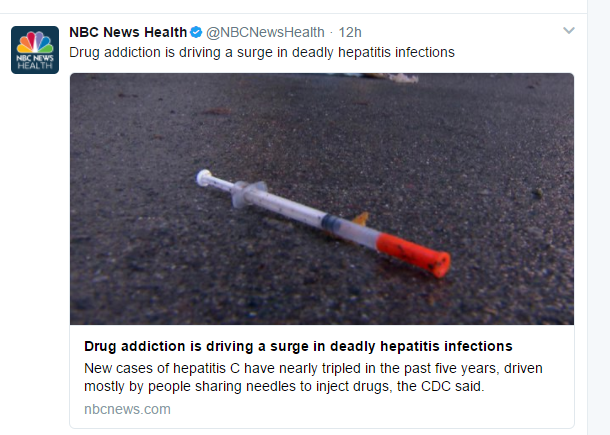
Heroin Epidemic Causing Surge in Hepatitis C Infections

From NPR: Heroin Epidemic is Driving a Spike in Hepatitis C Cases

An excerpt:

The number of new Hepatitis C cases leaped nearly 300 percent from 2010 to 2015, according to a report released Thursday by the Centers for Disease Control and Prevention. And the CDC points to the likely culprit behind the spike in cases of the infectious disease: the use of heroin and other injection drugs.

And despite the existence of therapies that can cure more than 90 percent of infections, the organization says the disease remains a deadly threat. In 2013, for instance, the CDC says some 19,000 people died of their infections.

From CNN: New Hepatitis C Infections Triple due to Opioid Epidemic

The number of new nationally reported infections with the virus swelled from 850 in 2010 to 2,436 cases in 2015, with the highest rates among young people, mainly 20- to 29-year-olds, who inject drugs, according to a new report released Thursday by the Centers for Disease Control and Prevention.

NPR: Safety Problems in 1/3rd of New Medications

From NPR: Safety Problems in 1/3rd of New Medications After FDA Approval

From 2001-2010:

Seventy-one of the 222 drugs approved in the first decade of the millennium were withdrawn, required a “black box” warning on side effects or warranted a safety announcement about new risks to the public, Dr. Joseph Ross, an associate professor of medicine at Yale School of Medicine and colleagues reported in JAMA on Tuesday. The study included safety actions through Feb. 28…

It took a median of 4.2 years after the drugs were approved for these safety concerns to come to light, the study found, and issues were more common among psychiatric drugs, biologic drugs, drugs that were granted “accelerated approval” and drugs that were approved near the regulatory deadline for approval…

“In the 21st Century Cures Act, there’s a push to have the FDA move to further support the use of surrogate markers … [but] they’re more likely to have concerns in the post-market setting.”…

The study included market withdrawals of three drugs: The anti-inflammatory drug Bextra; a drug called Zelnorm that was used to treat irritable bowel syndrome; and the psoriasis drug Raptiva. Bextra and Zelnorm were withdrawn over cardiovascular risk, and Raptiva was withdrawn because of increased risk of a rare and fatal infection that causes brain damage.

My take: FDA approval does not guarantee safety.  All medications have potential risks along with their benefits.


Update: Florida Physician Gag Rule Overturned

In a previous blog post, Politics and Limiting Physician Speech, I discussed the Florida Gag Rule intended to prevent physicians from discussing firearm safety with patients. At the time, I expressed outrage that “there are laws curtailing a physician’s free speech and efforts to dictate practice based on political philosophy.”

It looks my views have been vindicated.  NEJM report (full text): Physicians, Firearms, and Free Speech

An excerpt:

In February, the full U.S. Court of Appeals for the Eleventh Circuit issued its long-awaited ruling in Wollschlaeger v. Governor, State of Florida, invalidating parts of Florida’s Firearm Owners’ Privacy Act (FOPA) and affirming that the First Amendment applies to the speech between physicians and patients. The decision ensures that physicians may continue to make efforts to protect their patients from gun-related injuries, many of which are fatal and which in aggregate account for approximately as many deaths annually as do motor vehicle accidents….

the majority affirmed that laws regulating physician speech must be designed to enhance rather than harm patient safety. The majority took this mandate seriously and required the state to show some meaningful evidence that the regulation was apt to serve the state’s interest in protecting patients.

The state could not do so for two reasons. First, the decision to keep a gun in the home substantially increases the risk of death for all household members, especially the risk of death by suicide, and particularly so when guns are stored loaded and unlocked, as they are in millions of homes where children live.3 Second, the majority of U.S. adults who live in homes with guns are unaware of the heightened risk posed by bringing guns into a home.4 Indeed, by providing accurate information about the risks created by easy access to firearms, as well as ways to modify that risk (e.g., by storing guns unloaded and locked up, separate from ammunition), a physician’s counseling can not only enhance a patient’s capacity for self-determination, but also save lives…

The fact is that most clinicians, including those who routinely encounter suicidal patients, rarely, if ever, provide firearm-safety counseling.5 This reticence predated the FOPA and has persisted since its passage..The court has done its duty. It’s now the physicians’ turn.

Related blog posts:

Capers Island

Mauriac Syndrome (Glycogenic Hepatopathy)

A case report (T Malikowski et al. Gastroenterol 2017; 152: 947-49) provides some insight into a fairly common problem –elevated liver tests in the setting of poorly controlled type 1 diabetes mellitus.  This 18-year-old had presented with a glucose of 497 mg/dL, elevated lactate, aspartate aminotransferase 257 U/L, and alanine aminotransferase 178 U/L.

The authors note that Mauriac syndrome “occurs in young patients as a result of poorly controlled type 1 diabetes mellitus.”  It may result in growth retardation, pubertal delay, and cushingoid features.

“Glycogenic hepatopathy is a underrecognized complication of Mauriac syndrome that presents with abdominal pain, nausea, vomiting, elevated serum transaminases, elevated plasma lactate levels, and hepatomegaly  The pathogenesis stems from an accumulation of glycogen in the liver…The diagnosis…is made …when all other causes of liver disease have been excluded…When glucose control is achieved, prognosis is excellent.”

My take: There are many potential reasons for elevated liver enzymes associated with type 1 diabetes mellitus, including celiac disease, and autoimmune hepatitis.  However, familiarity with glycogenic hepatopathy helps with pattern recognition and helps explain the frequent concurrence of liver disease with poorly controlled type 1 diabetes mellitus.

Another Shady Pharmaceutical Business Practice: Citizen’s Pathway to Delay Competition

First, a comment regarding yesterday’s post: The Truth About Probiotics: Constipation Version

Some readers took issue with my pessimism with probiotics in terms of their effectiveness for several conditions, their safety and the number needed to treat (NNT). It is noted that the number needed to treat (NNT) with probiotics is better than with many other conditions.  For example, the NNT for benefit with the influenza vaccine, Tamiflu for influenza, and mammography for preventing breast cancer are much worse than the NNT for benefit with probiotics for conditions like NEC, antibiotic-associated diarrhea, Clostridium difficile infection, and ulcerative colitis (with VSL#3). If one looks at multiple posts from this blog, there are plenty of posts supporting the use of probiotics (see some of the links yesterday or search “probiotics” on this blog.  Thus, it is important to not overlook the benefits of probiotics for many conditions and to not take a single study and extrapolate too much.

Now for today’s post -perhaps it will stir as much interest:

I must admit I’m fascinated with the way pharmaceutical companies operate and the creative ways they find to magnify their profits.  In previous posts, I’ve detailed how pharmaceutical companies will try to corner the generic market, increase the cost of liquid medicines, and package drugs in a way to force the purchase of additional vials of medicine among other tactics.  Now, a commentary (R Feldman, C Wang. NEJM 2017; 376: 1499-1501) details how pharmaceutical companies have increasingly used “the citizen-petition process that the Food and Drug Administration (FDA) implemented in the 1970s.”  This process was designed as “a way to voice concerns” by individual citizens.

Yet, this pathway is now being used to delay competition/entrance of generic drugs, mainly with frivolous claims.  In most cases, companies file these claims at the end of the approval process, almost always as a delaying tactic.  Approximately 80% of these actions by competitor drug companies are denied by the FDA.

Ultimately, these actions could be countered with antitrust actions; this, in fact, has occurred with Shire ViroPharma.  On February 7, 2017, the Federal Trade Commission filed an antitrust action “alleging that the company abused regulatory processes by filing 43 submissions with the FDA (including 24 meritless citizen-petition filings within one docket) in an effort to hold off generic competition for its gastrointestinal drug Vancocin (vancomycin).”  However, antitrust actions are typically difficult to pursue and expensive.

My take: I think these tactics (and others) will undermine the relationship of pharmaceutical companies with consumers. While their stock holders may see benefits in the short term, I expect that other stake holders will fight back.  There are several targets in that endeavor, including ending limits on Medicare negotiating for better prices.

Related blog posts:

The Truth about Probiotics: Constipation Version

Families are often surprised to learn my opinion about probiotics.  The “truth” about probiotics is that they are poorly regulated/lack rigorous production standards and are mostly ineffective for many of the conditions for which they have been promoted.  Even in conditions in which there is some effectiveness (eg. antibiotic-associated diarrhea), the number of persons needed to treat for one person to benefit is fairly high.

In addition, when someone says that they are taking a probiotic, many families do not understand the idea of “strain” specific effects.  I tell families that if they see a “dog in yard” sign that they do not know if that is a poodle of a pit bull.  With probiotics, similarly you often do not know if you are getting a pit bull or a poodle.

As a consequence, I think negative studies like a recent report (K Wojtyniak et al. J Pediatr 2017; 184: 101-05) are helpful. In this study, the authors examined the effectiveness of Lactobacillus casei rhamnosus Lcr35 (Lcr35) in the management of constipation.

This randomized, double-blind, placebo-controlled trial was conducted in 94 children <5 years of age. Dose: 8 x10 to the 8th CFU twice daily x 4 weeks.

Key findings:

  • “Lcr35 as a sole treatment was not more effective than placebo in the management of functional constipation.” In fact, the placebo group had a greater increase in bowel movement frequency than the treatment group.
  • Both groups had improvement -more than half in each group (total 52 of 81 who completed study) had reached endpoint of 3 or more BMs/week without soiling.

My take: Probiotics often are ineffective.  This study showed that Lcr35 was NOT helpful for pediatric constipation.

Related blog posts:

Claude Monet, La Rue Montorgueil