Deadly Market Forces in Narcotics

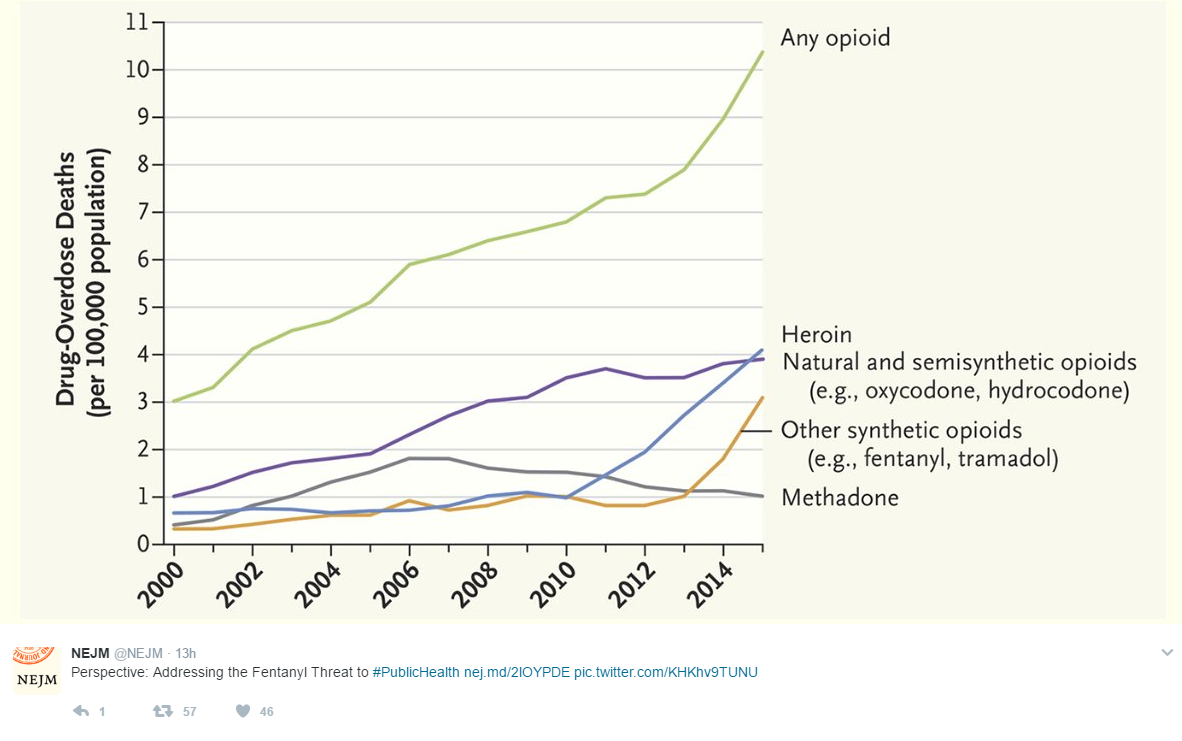
Lately, I’ve been shocked and dismayed by the frequent headlines about the number of overdoses and deaths due to narcotics throughout our country.  A timely article (RG Frank, HA Pollack. NEJM 2017; 376: 605-7) addresses one aspect of this threat to public health that I was not aware of previously.

  • Fentanyl, which is a powerful synthetic opioid, is much cheaper to produce than heroin.  In addition, fentanyl can result in death much more quickly as well.
  • Presumably due to its lower cost, suppliers ‘cut’ heroin with the drug.  As a consequence, fentanyl is increasingly responsible for opioid deaths. The authors estimate that from 2012 to 2014, the number of deaths due to fentanyl doubled to 5544 and that “41% of the roughly 7100 heroin-related deaths during this period involved fentanyl.”
  • Fentanyl has been found in multiple counterfeit illicit drugs.  For example, in a recent analysis from Canada, “89% of seized counterfeit OxyContin tablets” had fentanyl present.
  • Naloxone can reverse fentanyl overdoses but needs to be given more quickly and sometimes multiple doses are needed.

My take: The presence of fentanyl in illicit drugs means that even experimenting once could be fatal.

screenshot-135

Related blog posts:


Narcotic Slippery Slope

In a recent article (NEJM 2017; 376: 663-73), ML Barnett show that opioid-prescribing patterns of emergency physicians may increase the risk of long-term use. By focusing on variation of prescribing practices among physicians at the same hospitals and with a sample size of ~380,000 patients, the authors provide convincing data that starting opioids even for an intended brief period can have lasting consequences. This study focused on medicare beneficiaries (average age ~68 yrs) who received narcotics from either higher-frequency or lower-frequency physician prescribers.

In their discussion, the authors state “if our results represent a causal relationship, for every 49 patients prescribed a new opioid in the emergency department who might not otherwise use opioids, 1 will become a long-term user.”

My  take: Starting a narcotic may be the first step in a long treacherous road.

Related blog posts:

screenshot-134

Briefly Noted: Crash Test Dummies

screenshot-96

Here’s the link: Crash Test Dummies Fatter too!

Related blog posts:

Atul Gawande: “Tell Me Where It Hurts”

In a recent New Yorker article (Jan 23, 2017, pgs 36-45,LINK:  “Tell Me Where It Hurts” –thanks to Stan Cohen for this article), Atul Gawande provides a compelling narrative on the ‘heroism’ of incremental care.

He starts his narrative with the story of Bill Haynes who had had severe migraines for four decades, but eventually improved under the care of Elizabeth Loder (John Graham Headache Center).  Over the course of four years, her ‘systematic incrementalism had done what nothing else had.’

Dr. Gawande explains that chronic illness is commonplace but “we have been poorly prepared to deal with it.  Much of what ails us requires a more patient kind of skill.  I was drawn to medicine by the aura of heroism–by the chance to charge in and solve a dangerous problem.”

Despite the appeal of dramatic medical moments, bigger impacts are noted with more subtle care. “States with higher ratios of primary care physicians have lower rates of general mortality, infant mortality, and mortality from specific conditions such as heart disease and stroke.”  One of the ways mortality is reduced is getting seen sooner for medical problems. Having a relationship with a physician “has a powerful effect on your willingness to seek care for severe symptoms.”

A parallel narrative in this piece regards the Silver Bridge tragedy in 1967.  This bridge which connected Gallipolis, Ohio and Point Pleasant, West Virginia, over the Ohio River, keeled over and resulted in 46 deaths and dozens more who were injured. This tragedy sparked attention towards infrastructure and trying to address problems before a critical collapse occurs.  “We will all turn out to have –like the Silver Bridge and the growing crack in its critical steel link–a lurking heart condition or a tumor or a depression or some rare disease that needs to be managed. This is a problem for our healthcare system.  It doesn’t put great value on care that takes time to pay off.”

Other points:

  • Incremental medicine is “at odds with our system’s allocation of rewards…the lowest-paid specialties: pediatrics, endocrinology, family medicine, HIV/infectious disease, allergy/immunology, internal medicine, psychiatry, and rheumatology.”
  • “More than a quarter of Americans and Europeans who die before the age of seventy-five would not have died so soon if they’d received appropriate medical care for their conditions.”
  • “Data indicate that twenty-seven per cent of adults under sixty-five…[have] conditions that make them uninsurable without protections” form the Affordable Care Act.

My take: Fixing an aging bridge may not be as exciting as building a new one –unless you are the aging bridge or depend on that bridge.

screenshot-147


Patterns and Puzzles with Very Early Onset Inflammatory Bowel Disease

A recent review (S Chandrakasan, S Venkateswaran, S Kugathasan [corrresponding author]. Pediatr Clin N Am 2017; 64: 139-160) provides a surprisingly easy read on very early onset (VEO) inflammatory bowel disease (IBD) (Thanks to Kathleen McNamara for sharing).  Because of the myriad of genetic defects (>50 monogenetic defects), the topic of VEO-IBD can be quite confusing.  The authors of this summary make a number of key points.

  • VEO-IBD is increasing in incidence
  • Many patients with VEO-IBD have an underlying primary immune defect.  Identification of these underlying disorders may allow targeted therapy.
  • In some patients, hematopoietic stem cell transplantation could result in definitive cure
  • VEO features: more often involves colon and often severe course with poor response to conventional immunosuppressives

Besides idiopathic IBD, the differential can be subdivided into subgroups:

  • T-cell defects (IPEX and IPEX-like) (gene defects: FOXP3, LRBA CTLA4, STAT1, STAT3, STAT5B, CD25, CTLA4, )
  • Defects in IL-10 signaling (IL10RA, IL10RB, IL-10)
  • Hyperinflammtory/autoinflammatory disorders (XIAP/SAP (BIRC4), Mevalonate kinase deficiency (MVK), PLCG2, Familial Mediterranean Fever, Familial HLH Type 5: STXBP2, Hermansky-Pudlak: HPS1, HPS4, HPS6)
  • Defects in neutrophil function/phagoycte function (chronic granulomatous disease (CGD) genes: CYBB, CYBA, NCF1, NCF2, NCF4,, Leukocyte Adhesion Defect (LAD) ITGB2, GSD type 1bSLC37A4, congenital neutropenia G6PC3)
  • Epithelial barrier defect (X-linked ectodermal dysplasia and immunodeficiency (NEMO), TTC7A, ADAM17, dystrophic epidermolysis bullosa (COL7a1), Kindler syndrome (FERMT1), mutations in guanylate cyclase c, telomere biology defects like  DKC and RTEL1 )
  • T/B cell defects (X-linked agammaglobulin (BTK), SCID/Omenn (RAG1, RAG2, IL-7Ra, IL-2RG), CVID, IL21, Wiskott-Aldrich (WAS) HIES, HIMS)

The authors provide some vignettes of a typical presentation of each subset along with some commentary.  For example, with T-cell defects: “mutations in FOXP3 result in either absent or decreased Treg cell numbers or a qualitative defect…results in broader immune dysregulation, resulting in multisystem autoimmunity with autoimmune endocrinopathy, autoimmune cytopenia, autoimmune hepatitis, and severe eczema.”  Other IPEX-like mutations include gain of function in STAT-1/STAT-3, LRBA deficiency, and CTLA-4 haploinsufficiency.

The authors recommend an initial immune evaluation in VEO-IBD:

  • CBC
  • peripheral smear evaluation
  • immunoglobulin levels, lymphocyte subsets with T-cell
  • B-cell, and NK-cell enumeration
  • CD45RA/RO enumeration and B-cell panel for class-switched memory B cells
  • neutrophil oxidative burst
  • T regulatory cell (CD4+CD25+FOXP3+) cell enumeration.

Due to the increasing complexity of the immune evaluation, the necessity of a pediatric immunologist is apparent.  In addition, the role of genetic panels that test for all of these disorders simultaneously is becoming routine.  Genetic testing can help improve diagnosis and allow for early targeted intervention.  With the emergence of new defects, selecting the right lab with an up-to-date panel is another caveat.

Examples of targeted therapies include the potential role of anakinra for CGD, abatacept for LRBA deficiency, toclizumab (IL-6 receptor blocking antibody) for STAT3 gain-of-function mutation, and sirolimus for Treg disorders.  Hematopoietic stem cell transplantation is an established therapy for IL-10 signaling defects.

My take: Collaboration with immunology is an important consideration in young children with IBD.

Related blog posts:

Disclaimer: These blog posts are for educational purposes only. Specific dosing of medications (along with potential adverse effects) should be confirmed by prescribing physician.  This content is not a substitute for medical advice, diagnosis or treatment provided by a qualified healthcare provider. Always seek the advice of your physician or other qualified health provider with any questions you may have regarding a condition.

I liked this t-shirt

I liked this t-shirt

Nutrition Week (Day 7) Connecting Epidemiology and Diet in Inflammatory Bowel Disease

A supplement in Gastroenterology (2017; 152: 309-462) provides a great update on a lot of topics.  These include pathophysiology articles (eg. role of Paneth cell, role of microbiome), treatment/development of fibrosis, management advances in endoscopy and biomarkers, newest treatments and emerging treatments, complementary medicine approaches, pain/psychology issues, medications in pregnancy, and detecting dysplasia.

For me, the update on epidemiology and its relationship to diet (pgs 313-321) as well as the review on diet as a trigger or therapy for inflammatory bowel disease (398-414) were most interesting.  Though, I will keep the update on complementary and alternative medicines article at my desk in case questions come about this topic

GG Kaplan, SC Ng. “Understanding and Preventing the Global Increase of Inflammatory Bowel Disease”  Gastroenterology 2017; 152: 313-321

Epidemiology:

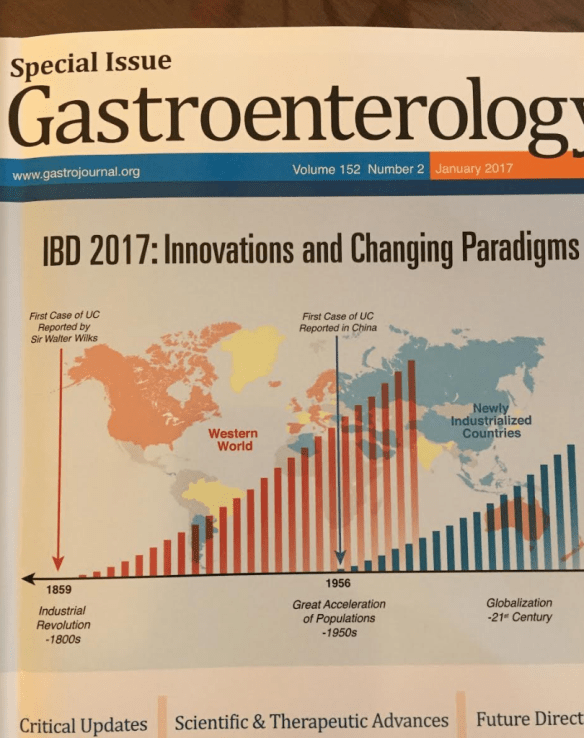
1st case of ulcerative colitis was reported in 1859.  !st cases of Crohn’s disease reported in 1932 (BB Crohn et al. JAMA 1932; 99: 1323-29).

Olmstead County, Minnesota –cases per 100,000:

  • 1965: 28
  • 1980: 90.5
  • 1991: 132.7
  • 2001: 213.9
  • 2011: 246.7

While rates of IBD have “shown signs of stabilization…pediatric-onset IBD continues to increase steadily in incidence.”

IBD Around the World –cases per 100,000:

  • 2005 Japan: 76
  • 2005 S Korea: 42
  • 2013 India: 9.3
  • 2013 China: 3.3.  The greatest incidence is noted in areas of increased urbanization and economic advancement.
  • 2005: Brazil: 9.7

Environmental factors/associations:

  • Cigarette smoking –increases risk of Crohn’s disease in Western countries, and has protective effect against Ulcerative colitis
  • Antibiotic use –increases risk of IBD in Western countries, but may be protective in developing countries.  “Antibiotic-induced dysbiosis may not develop as easily in developing countries, owing to ubiquitous exposure to a diverse range of microbiota that rapidly repopulate the intestinal tract.”
  • Breastfeeding –protects against developing IBD
  • Vitamin D –low levels increase risk of IBD in Caucasians.
  • Fiber –a “diet high in fiber protects against Crohn’s disease.”
screenshot-111

JD Lewis, MT Abreu.”Diet as a Trigger or Therapy for Inflammatory Bowel Disease”  Gastroenterology 2017; 152: 398-414.

“The most common question asked by patient is …’Doctor, what should I eat?'”

Key points:

  • Data from studies of immigrants to higher-IBD prevalence countries show an increasing incidence of IBD, leading to the hypothesis that environmental factors such as diet affect risk of IBD.
  • In early life, breast milk, in some but not all studies, has been associated with a lower risk of childhood-onset IBD.
  • Before development of IBD, studies have shown lower risk of IBD “among people who consume more fruits and vegetables, and a higher risk in people who consume less of these and more animal fats and sugar.”
  • “There is little information about which foods induce flares.” However, for UC, “a high intake of meat, especially red and processed meat, protein, alcoholic beverages, sulfur, and sulfate increased the likelihood of a flare” based on food questionnaires.  In patients with CD, diet with higher “total fat, saturated fat, monounsaturated fatty acids, and a higher ratio of omega-6:omega-3 PUFAs was associated with disease relapses.”
  • “Only approximately half of patients have ever received advice from a dietitian.”
  • Oral iron may trigger flares in a small percentage of patients with IBD.  The authors note that adherent E coli express genes for iron acquisition and require iron for growth.

Specific Diets/Additives:  Most of these diets have been discussed in previous posts, including:

Exclusive (and Partial) Enteral Nutrition:

  • “The most widely studied dietary intervention.” It has been shown to be effective for CD.  More elemental formulas have NOT been shown to be more effective.  “EEN and PEN therapy is less likely to normalize fecal levels of calprotectin in children.”
  • “Dietary therapy reduced inflammation and led to changes in the microbiome within 1 week. Unlike TNF antagonists, however, the changes to the microbiome induced by EEN did not lead to a microbiome resembling that of healthy individuals.”

Specific Carbohydrate Diet (SCD):

  • This diet has been studied in small populations.  Suskind et al reported SCD effectiveness “in 7 children with CD…showed that fecal calprotectin level decreased from a mean of 685 mcg/g to 213 mcg/g at 2-6 after starting the diet.”  “Cohen et al used video capsule endoscopy…in 10 children with CD…Four of 10 children achieved complete mucosal healing (Lewis score <135) and 6 of 10 children achieved clinical remission.”

Low FODMAP diet:

  • While the diet may induce symptom improvement, there is no “evidence that a low FODMAP diet reduces inflammation.”

Vitamin D supplementation:

  • “Vitamin D has multiple potential beneficial effects on intestinal inflammation.” The authors review studies that report lower risk of CD in patients with higher vitamin D levels and on the reduction in relapse in a study of CD patients who were in remission and  treated with Vitamin D (1200 IU daily)

Curcumin supplementation:

  • The authors review two small studies which suggested that curcumin for patients with ulcerative colitis increased clinical remission (when used with mesalamine)

The overall advice the authors give is that patients “should be advised to eat a well-balanced diet, such as the Mediterranean-style diet, avoiding processed foods or foods that they self-identify as worsening their symptoms.  Patients who are committed to attempting to manage their disease predominantly through dietary modification should be counseled about the importance of assessing for resolution of inflammation in addition to symptoms.”

Other Related blog posts:

Disclaimer: These blog posts are for educational purposes only. Specific dosing of medications/diets (along with potential adverse effects) should be confirmed by prescribing physician/nutritionist.  This content is not a substitute for medical advice, diagnosis or treatment provided by a qualified healthcare provider. Always seek the advice of your physician or other qualified health provider with any questions you may have regarding a condition.

Here we go again …Miralax Safety Questioned

The issue of miralax safety is something that is discussed on a daily basis in pediatric gastroenterology offices.  It is back in the news.  The headlines suggest that there could be a problem but when one examines these stories we find that these reports have NOT shown data indicating a safety concern.

Here’s a link to a NASPGHAN Neurogastroenterology statement on safety of Miralax:

Here’s a link to a recent article in AJC questioning the safety of Miralax:

In this article, “the FDA told WPVI that there isn’t enough data “to demonstrate a link between PEG 3350 and serious neuropsychiatric issues in children.”

Bayer, MiraLAX’s manufacturer, said in part: “As part of Bayer’s ongoing commitment to consumer well-being, we regularly track, analyze and report all adverse event data related to the use of the product. Results of this ongoing monitoring support the continued safe use of MiraLAX.”

In a 2015 article on Parents.com, Dr. Steve J. Hodges, an associate professor of pediatric urology at the Wake Forest School of Medicine, pointed out that “more than 100 studies have found PEG 3350 is safe to use in children.”

“I have found no published studies linking MiraLAX to severe or harmful side-effects,” said Hodges, who was responding to a New York Times article about the Philadelphia study.”

Here’s a few other posts on Miralax safety:

Related blog posts:

My take (borrowed from expert review): “Generally speaking, if your child has been prescribed PEG 3350 as part of his/her treatment plan, and you feel this medicine provides benefit, you should feel safe continuing PEG 3350. At this time, PEG 3350 appears to be safe based on current medical literature. We recommend discussing any concerns you have about the safety of PEG 3350 with your child’s health care provider. If you would prefer for your child to stop taking PEG 3350, discuss other treatments options with your child’s health care team before stopping PEG 3350 therapy. Although abruptly stopping PEG 3350 is not considered dangerous, it could lead to a relapse/worsening of constipation.”

From 'this week in church signs'

From ‘this week in church signs’

Nutrition Week (Day 6) Iron Deficiency Anemia in Breastfed Infants

In brief: A recent cross-sectional study (KM Clark et al. J Pediatr 2017; 181: 56-61) showed that breastfeeding at 9 months of age in Chinese infants was associated with iron deficiency anemia..  Iron deficiency can contribute to neurodevelopmental delays in addition to anemia.

  • In Zhejiang (n=142), 27.5% of breastfed infants had iron deficiency anemia (IDA) compared with 0% of formula-fed infants.
  • In Hebei (n=813) , 44% of breastfed infants had IDA compared with 2.8% of formula-fed infants.

My take: In later infancy (after 6 months of age), breastfeeding infants are at increased risk for iron deficiency anemia.

screenshot-97

Nutrition Week (Day 5) What a Gastrostomy Tube Means for Cognition

Looking at a retrospective cohort of 194 neonates, a recent study (SR Jadcherla et al. J Pediatr 2017; 181: 125-30) showed that infants discharged with a gastrostomy tube (Gtube) had associated lower cognitive outcomes.

The authors examined discharge milestones along with Bayley Scales of Infant Development (3rd edition) at 18-24 months of age.

Key findings:

  • 60% of infants (n=117) were discharged on oral feedings and 96% remained oral-fed at 1 year.
  • 40% (n=77) were discharged on gastrostomy feedings.31 (40%) remained fully Gtube dependent, 17 (22%) were orally-fed, and 29 (38%) were on oral/gtube combination.
  • Gtube feedings at discharge were a marker for lower cognition (P<0.01), communication (P=0.03) and motor (P<0.01) composite scores at 18-24 months of age.
  • Other factors associated with neurodevelopmental delay included intraventricular hemorrhage, younger gestational age, and bronchopulmonary dysplasia.

My take: This study provides evidence for an expected finding –infants who need gtubes have poorer neurodevelopmental outcomes than infants who do not need gtubes.

Related blog posts:

Thanks to an Olive Oyl fan for this picture

Thanks to an Olive Oyl fan for this picture


Nutrition Week (Day 4) Trophic Hormone for Pediatric Short Bowel Syndrome

A recent study (BA Carter et al. J Pediatr 2017; 181: 102-11) provides some preliminary data on the use of glucagon-like peptide-2 (GLP-2) (Teduglutide) for pediatric short bowel syndrome (SBS).

This was a 12-week, open-label study in patients aged 1-17 years with intestinal failure (IF) associated with SBS. Prior to the study, patients had shown little to minimal advance in enteral nutrition for at least 3 months. Three doses of GLP-2 (0.0125 mg/kg/d, 0.025 mg/kg/day, and 0.05 mg/kg/day).

Key findings:

  • All treated patients (37) experienced mild or moderate adverse effects, including vomiting, pyrexia, catheter-related complications, and upper respiratory tract infections. No serious adverse events were identified. In the 5 patients who received standard care, adverse effects were recorded as well, including upper respiratory tract infections in 2 (40%) which was similar to the other groups.
  • By week 12, parenteral nutrition (PN) volume and calories were reduced in the higher dosed groups.  In the 0.025 mg/kg/day group, PN volume dropped by 41% and calories by 45%.  In the 0.05 mg/kg/day group, PN volume dropped by 25% and calories by 52%. Virtually no change in these parameters occurred in the lowest dose (0.0125 mg/kg/day) with no change in volume and 6% drop in calories.
  • Enteral feeding volume occurred in all groups: 22%, 32%, and 40% in the groups and was directly related to the GLP-2 dosing.
  • Citrulline levels (a biomarker of enteral autonomy) were monitored “but the results were clouded by wide variability of baseline values.”  In adult studies, citrulline levels increased significantly.

My take: This open-label study has many limitations; further studies are planned (ClinicalTrials.gov, NCT02682381). Nevertheless, this study indicates that GLP-2 holds promise as a therapy for SBS/IF.

Another slide in a recent lecture on PNALD (slide derived from Conrad Cole lecture in Octobler 2015 -available at Pediatric Nutritionist Blog, slide 49):

screenshot-109

Related blog posts: