Closer Look at Ustekinumab Data

At a recent dinner, we had the opportunity to hear a review of some of the recent data on ustekinumab.  These notes may include some errors in transcription and errors of omission.  Most of this data is derived from a recent publication that has been summarized in this blog: Landmark Publication for Ustekinumab (Stelara) | gutsandgrowth

Some key points:

  • In numerous studies of biologic agents, longer duration of disease is associated with a much lower response to therapy.  For the UNITI-1/UNTI-2 studies, the patients enrolled had long duration of disease (~10 years in UNIT1-1, ~8 years in UNITI-2)
  • Recent data indicate that vedolizumab is effective for Crohn’s disease, but works slowly. It likely takes ~6 months to determine if it is working.
  • With ustekinumab, most patients respond within 3 weeks of the induction dose; however, among nonresponders, many responded after the first maintenance dose.  Thus, probably need to give at least the induction dose and the first maintenance dose for determining whether ustekinumab is effective.
  • Overall safety profile looks very good for ustekinumab.  More than 4000 patients in a psoriasis registry showed no serious safety signals (though psoriasis patients receive a lower dose).
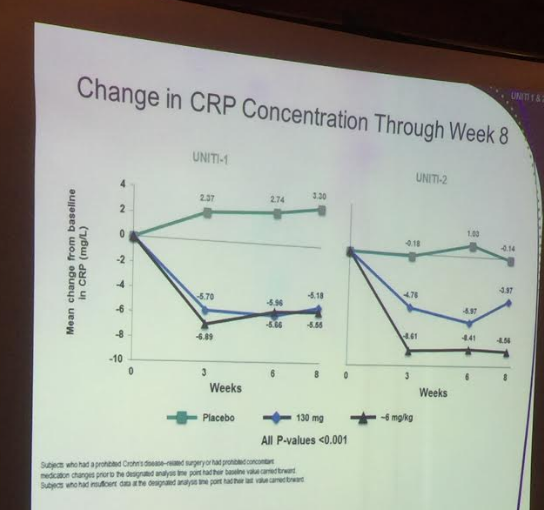
  • Overall, the 6 mg/kg induction dose outperformed the 130 mg dose with regard to objective measures.
  • High placebo rate in the IM-UNITI study likely is due to some residual response to the initial induction dose.
  • Every 8 week dosing for ustekinumab was more effective than every 12 week dosing in these studies, though, there are likely patients who need more frequent and some who could benefit from less frequent dosing.
  • 2.3% of patients in IBD studies had detectable antibody to ustekinumab but this did not preclude efficacy.
  • ~20% of IBD patients do not develop increased CRP
  • Pediatric studies of ustekinumab are ongoing testing different dosing regimens.
  • One other anecdote in regards to magical thinking about which premedications are most effective:  A man with a ridiculous hat was approached as he walked in an Atlanta.suburb.  A lady asked him why he wore such an unusual hat. He replied that “the hat keeps elephants far away.”  The lady said, “there are no elephants around here.” He said, “See it is working.”
screenshot-86 screenshot-87 screenshot-88 screenshot-89 screenshot-90 screenshot-91 screenshot-92 screenshot-93

Fasting Probably Not Needed Before Checking Lipids

A cross-sectional study (LN Anderson et al. J Pediatr 2017; 180: 47-52) of 2713 children extends prior observations that there is little evidence supporting the need for fasting prior to measurement of lipids.

Prior blog on this topic: Is Fasting Needed Before Checking Lipids

This study showed that fasting duration (0-5 hrs) was not significantly associated with total cholesterol, LDL, HDL, or triglycerides. This is most evident on the graphs on their Figure.

In the discussion, the authors note that the NHANES study 1999-2008 had similar results for the younger children.  Overall, there were 12,744 children aged 3-17 years;  80% fasted at least 8 hrs.  In this study, fasting did have a small effect on lipids, but among children 3-5 yrs, only LDL was statistically affected by fasting status.

My take: Based on this study and others, fasting seems to have only a small effect on lipid measurement and for routine screening, it is probably not needed.

Yosemite Natl Park

Yosemite Natl Park

Bariatric Surgery and Reversal of NASH

A small prospective study (M Manco et al. J Pediatr 2017; 180: 31-7) provides evidence that bariatric surgery/sleeve gastrectomy is effective at reversing nonalcoholic steatohepatitis (NASH) and hepatic fibrosis in adolescents (n=20).

All patients in this study had BMI >35 and weere 13-17 yrs of age.

Key findings at one year following intervention:

  • Among the 20 patients who underwent sleeve gastrectomy, there was a 21.5% loss in baseline weight, which compared with weight loss of 3.4% among 20 patients who received intragastric balloon device and weight increase of 1.7% among 53 patients who received lifestyle intervention counseling.
  • Sleeve gastrectomy group had resolution of NASH in all 20 and disappearance of hepatic fibrosis in 18 (90%).  In the intragastric balloon group, NASH reverted in 24% and fibrosis in 37% whereas there was no improvement in the lifestyle intervention group.

Full text link: Sleeve Gastrectomy for NASH

Limitations are discussed in the editorial by Inge and Xanthakos (pgs 6-7) and included small sample size, absence of patients with type 2 diabetes, and short followup period.  Nevertheless, this is “the largest and most informative series…in select adolescents with severe obesity.”

My take: Given the lack of effective pharmaceutical therapy and the typically impotent effects of lifestyle intervention, this data supports bariatric surgery to facilitate weight loss/NASH reversal in select adolescents.

Related article: JCF Leung et al. Hepatology 2017; 65: 54-64.  This study showed that the histologic severity and clinical outcomes are modestly better in nonobese patients (n=72) with NAFLD compared with obese patients (n=307). High triglycerides and higher creatinine were associated with more advanced liver disease in nonobese patients.

Briefly noted: D Houghton et al. Clin Gastroenterol Hepatol 2017; 15: 96-102.  This study with 24 subjects with nonalcoholic steatohepatitis showed that exercise reduced hepatic triglyceride content, visceral fat, and plasma triglycerides. However, circulating markers of inflammation and fibrosis was not reduced.  The implication is that exercise should be part of NASH treatment but that weight management/diet are needed as well.

Glacier Natl Park

Glacier Natl Park

. Related blog posts:

Guideline Links: Infant Cholestasis and Esophageal Atresia-Tracheoesophageal fistula

One way that I use this blog is to use the search function for previous posts with useful links.  For example, I know if I search “foreign” that I will come across a post that has a summary as well as a link to the NASPGHAN recommendations on Foreign Bodies (Foreign Bodies in Children -Expert Guidance).

This post has two links :

Related blog posts:

oneboatcostamaya


Picture Quiz: Intestinal Cause of Edema

screen-shot-2017-01-10-at-8-00-54-pm

Link to full text from AGA twitter feed:  A Rare Cause of Generalized Edema

Background: “A 19-year-old boy presented to our hospital because of a 6-month history of progressive dyspnea and generalized edema. He developed cough, abdominal fullness, diarrhea, and leg edema 5 years ago. Liver cirrhosis was suspected at that time…Chest radiography showed bilateral pleural effusions (Figure A). Abdominal computed tomography demonstrated large amount of ascites (Figure B). … Subsequently, antegrade double-balloon enteroscopy …demonstrated nodular mucosal lesions with a milk-like surface in the duodenum (Figure C). Moreover, snow flake appearance of mucosa was found in the jejunum and proximal ileum (Figure D). However, a normal appearance of mucosa was identified in the middle ileum (Figure E).”

The Answer: 

screen-shot-2017-01-10-at-8-04-30-pm

“Histologic examination shows chronic inflammation of the ileum characterized by increased lymphoplasma cell infiltration of lamina propria without malignancy. Moreover, marked dilatation of lymphatic ducts that involved the mucosa was identified (Figure F)… a diagnosis of primary intestinal lymphangiectasia (PIL) was made.

Eating Tips from Strong4Life Website

Our hospital has been working on childhood obesity and has developed a multifaceted program called “Strong4Life.”  Recently the associated website has added some useful content for families.

From recent Children’s Healthcare of Atlanta email:

New Feeding and Wellness Resources for Parents

Children’s has launched a new feeding and wellness resource section on its dedicated parenting website, Strong4Life.com. The site is full of articles, videos and tools that new parents will find essential. From birth through school-age, Strong4Life equips parents to deal with everything from bedtime battles and mealtime tantrums, to food parenting and picky eating, and everything in between. With filtering of content by age of child, parents can now access relevant, easy-to-try tips, facts and advice from Children’s doctors, registered dietitians and wellness experts, who are also parents.

A sampling of the many articles and videos can be found here:

Other recommendations from Strong4Life:

Added Sugars
In August, the American Heart Association released its recommendations on the consumption of added sugars for children ages two to 18 years old. Children in this age range should not consume more than six teaspoons or 25 grams of added sugar per day; and children under age two should avoid it altogether. To learn where sugar may be hiding in children’s diets and simple ways to avoid it, visit strong4life.com/sugar.

Screen Time
The American Academy of Pediatrics (AAP) fine-tuned their screen time guidelines, to align better with the digital world we live in:

  • Children 18 to 24 months—no screen time other than video chatting. If digital media is introduced, focus on high-quality programming/apps, and parents should co-view with their child
  • Children 2 years and older—limit digital media to one (1) hour or less per day, of high quality programming
  • All children—keep meals, bedrooms and playtimes screen-free

frogsinfront

Making Doctors Yelp?

Yelp definition: “a short sharp cry, especially of pain or alarm.”

Apparently the online review site, Yelp, is now reviewing health care provider performance.  A recent commentary (V Lee. NEJM 2017; 376: 197-9) provides some insight into this development.

  • Yelp has had “102 million customer reviews to date, 6% of them in the health care arena;” thus, Yelp “dwarfs longer-standing commercial physician review sites such as Healthgrades and Vitals.”
  • “Physicians do not always respond positively to the sudden exposure of sometimes negative reviews.”  These reviews could contribute to drops in physician morale.
  • However, these reviews are here to stay and help patients make more informed choices, provide performance feedback, and may improve quality in health care.
  • The biggest problems with these reviews include the fact that anyone (even a disgruntled neighbor, ex-girlfriend) can post a review and due to clarity of the reviews.  In addition, patient reviews should not be viewed without other metrics like quality and cost.

My take (borrowed from author): “the question is not whether there should be public disclosure of information on patient satisfaction, outcomes, and costs — it’s how and by whom it should be done.”

Related blog posts:

screenshot-69

Liver Briefs Feb 2017

JB Schwimmer et al. Gastroenterol 2016; 151: 1141-54.  Using a double-masked trial with 169 children with NAFLD, the use of cysteamine bitartrate for 1 year did not reduce histologic activity scores, but did reduce liver aminotransferase levels.

NA Terrault et al. Gastroenterol 2016; 151: 1131-40. The authors collected data from 2099 participants in the HCV-TARGET study who mainly received ledpasvir-sofosbuvir (311 received therapy in combination with ribavirin).  The study included 25% blacks, 66% with genotype 1A, 41% with cirrhosis, 50% with prior treatment, and 30% who were receiving proton pump therapy.  Key finding: SVR12 rates varied from 95% to 97% based on duration of therapy.  Factors that predicted SVR12 included higher albumin (>3.5 g/dL), lower total bilirubin (<1.2), absence of cirrhosis, absence of proton pump inhibitor therapy.

KR Olson et al. NEJM 2017; 376: 268-78.  This case report of an 18 yo woman with acute liver failure provides a helpful review.  For Wilson’s disease, the article reviews rapid diagnostic criteria: “a screen that shows a ratio of alkaline phosphatase (IU per liter) to total bilirubin (mg per deciliter) of lower than 4.0 and then subsequently shows a ratio of aspartate aminotransferase (IU per liter) to alanine aminotransferase (IU per liter) of higher than 2.2 has been described as 100% sensitive and specific for the diagnosis of Wilson’s disease.”  Making this diagnosis quickly is crucial and allows these patients to be UNOS status 1A, “the only cause of acute liver faliure that allows a patient with preexisting liver disease to be listed as status 1A”

Among children older than 10 years of age, Wilson's disease accounted for 90% of metabolic disease.

Among children older than 10 years of age, Wilson’s disease accounted for 90% of metabolic disease.