Quirky HIDA Study Shows That HIDA Scans Not Too Helpful

As noted in a previous post, Biliary Dyskinesia –“Only in America” | gutsandgrowth, gallbladder dykinesia is a quite dubious diagnosis.  A recent pediatric study (PM Jones et al. JPGN 2016; 63: 71-75) adds to the uncertainty.

This study utilized a large database for a retrospective review of HIDA scans in patients <22 years.  In a group of 2558 patients, 310 patients had a full-text gallbladder pathology report paired with HIDA scan. The majority of these HIDA scans (64.5%) were performed in teenage Caucasian girls.  Key finding:

  • Gallbladder ejection fraction (GBEF) did not correlate with the presence of gallbladder pathology.  The Odd Ratio (OR) for cholecystitis with EF of 16-34 was 0.98.
  • The majority had at least microscopic pathology: 71.6% had microscopic cholecystitis

The authors indicate that other studies have shown that the diagnosis of gallbladder dyskinesia is controversial “because some point to the strong placebo effect of a surgical intervention, as well as the finding that patients who were observed for a year or more had similar symptom improvement  compared with those who had an operation.” [J Pediatric Surg 2006; 41: 1894-8]

Ultimately, the utility of HIDA scans can only be addressed with randomized prospective studies. Perhaps, these studies will show that HIDA scans are not predictive of who needs a cholecystectomy.

My take: It is interesting that pathology did not correlate with HIDA results.  However, the bigger question is whether abnormal gallbladder function, as assessed by HIDA, triggers symptoms that merit cholecystectomy. This is not addressed by this study.

Beach Art

Beach Art

4 Points for C diff in Inflammatory Bowel Disease

A nice review: K Rao, PDR Higgins. Inflamm Bowel Dis 2016; 22: 1744-54.

Many aspects of Clostridium difficile with and without coexisting inflammatory bowel disease has been reviewed on this blog.  This review adds a few additional points:

  1. C difficile testing in patients with IBD, “start with enzyme immunoassay-based tests with a reflex to PCR test for discordant enzyme immunoassay results.”  Rationale: “PCR is quite sensitive for the presence of toxigenic C difficile, it may increase the detection of asymptomatic colonization and shedding.”
  2. Don’t test for C difficile in patients in clinical remission. “Clayton et al evaluated outpatients with IBD who were in clinical remission and had no recent exposure to antimicrobials, corticosteroids, immunomodulatory agents, or hospitalizations.  These patients had toxigenic C difficile carriage rates of 8.2%.”
  3. What to do when IBD patients test positive for C difficile infection (CDI) -treat which one or both? The authors recommend, that “if there is no response to the treatment for CDI after 48 hours, then concurrent immunologic therapy can be started/escalated.”
  4. Safety of FMT with IBD. “There may be additional risk incurred in the IBD population…[in a recent study] 14% of the subgroup of patients with IBD experienced adverse events including IBD flare, requiring hospitalization in some instances.” Overall, there is not enough data to “risk stratify patients in terms of these adverse outcomes.”

In addition to these pointers, advice on treatment based on severity and whether CDI is recurrent is listed on Table 1.

  • For primary CDI (nonsevere): metronidazole, vancomycin or fidaxomicin.
  • For primary CDI (severe): vancomycin or fidaxomicin.
  • For primary CDI (severe & complicated*): vancomycin at highest dose and IV metronidazole and (if ileus present) vancomycin rectally
  • Recurrent CDI: 1st recurrence — same as initial Rx, 2nd recurrence -same as initial Rx, then use either vancomycin pulsed and/or tapered regimen of 6 or more weeks

Related blog posts:

View from Grinnell Glacier Trail, Glacier Nat'l Park

View from Grinnell Glacier Trail, Glacier Nat’l Park

Disclaimer: These blog posts are for educational purposes only. Specific dosing of medications/diets (along with potential adverse effects) should be confirmed by prescribing physician/nutritionist.  This content is not a substitute for medical advice, diagnosis or treatment provided by a qualified healthcare provider. Always seek the advice of your physician or other qualified health provider with any questions you may have regarding a condition.

Reappraisal of the Risk of Autoimmune Disease with Celiac, Plus One

Using a matched cohort design with 1215 cases of celiac disease and 6075 controls, C Canova and colleagues (J Pediatric 2016; 174: 146-52) provide data from 1989-2011 regarding the development of hypothyroidism and diabetes.  This retrospective, longitudinal, population-based Italian study relied on data from the integrated National Health Service.

Key findings:

  • Over this >20 year period, the risk of developing hypothyroidism was HR 4.64 and the risk of developing type 1 diabetes mellitus was HR 2.50 (not statistically significant)
  • The risk of hypothyroidism was more prevalent in males with HR 20.00.

The authors note: “The most plausible mechanism explaining the association between CD and T1DM/ATD [autoimmune thyroid disease] is a shared genetic background.”

Also noted: NASPGHAN Clinical Report on the Diagnosis and Treatment of Gluten-related Disorders. ID Hill et al. JPGN 2016; 63L 156-63.  Recommended monitoring for celiac disease, from Table 5:

  • At diagnosis: CD serology, CBC, Iron profile, HFP, Thyroid tests (TSH, free T4), Calcium, Vit D.
  • At 3-6 mo after diagnosis: CD serology (TTG IgA or DGP-IgG)
  • Annually:  CD serology, CBC, Thyroid tests (TSH, free T4), Vit D.

Related blog posts:

Congaree National Park (SC) and the "knees" of the Bald Cypress trees

Congaree National Park (SC) and the “knees” of the Bald Cypress trees

Why Asthma Study is Important: Hygiene Theory

In my view, one of the most important pediatric studies this year was just published (reference below).  For a long time, it has been recognized that growing up on farms can reduce the likelihood of developing conditions like asthma, as well as inflammatory bowel disease (Related post: NYT: Educate Your Immune System | gutsandgrowth).  This study: Innate Immunity and Asthma Risk in Amish and Hutterite Farm Children provides an in depth assessment of 60 children and helps uncover the reason for these epidemiologic results.

Here’s the quick 2 minute summary: Innate Immunity and Asthma Risk in Amish and Hutterite Farm Children

Screen Shot 2016-08-05 at 9.13.14 AM


Fecal Calprotectin Monitoring Helpful at Identifying Relapse in IBD

Thanks to Ben Gold for this reference: Y. Zhulina et al. Aliment Pharm Ther 2016; 44: 495-504.

Methods: 

  • Patients aged 18 years or older, with a known diagnosis of IBD in clinical remission, were prospectively studied. Patients provided faecal samples every third month and were prospectively followed until the rst clinical relapse or the end of the 2-year follow-up period.  
  • Relapse was dened as increasing symptoms necessitating intensied medical therapy or surgery.

Key finding:

  • Among 104 patients, Crohns disease (n = 49) and ulcerative colitis (n = 55), 37 had a relapse. A doubling of faecal calprotectin level between two consecutively collected samples was associated with a 101% increased risk of relapse (HR: 2.01; 95% CI: 1.532.65; P < 0.001).

My take: Another study showing that stool calprotectin is quite useful. How long will it be until I will not need to write letters to insurance companies to get this test covered?

Also noted in the same issue: 
“The safety of autologous and metabolically fit bone marrow mesenchymal stromal cells in medically refractory Crohn’s disease – a phase 1 trial with three doses” (pages 471–481) T. Dhere, I. Copland, M. Garcia, K. Y. Chiang, R. Chinnadurai, M. Prasad, J. Galipeau and S. Kugathasan. Aliment Pharm Ther 2016; 44: 471-81. This study examined the use of mesenchymal stromal cells in 12 patients.

In conclusion, a single infusion of fresh autologous bone marrow-derived mesenchymal stromal cells propagated ex vivo using a non xenogeneic human platelet lysate growth supplement at doses ranging 2–10 million cell/kg BW was well tolerated in patients with medically refractory moderate to severe Crohn’s disease in this preliminary study. Our data neither addressed long-term safety nor sustained efficacy. However, this study informs that a future phase 2 study 

A previous study of mesenchymal stromal cells was briefly discussed in a previous blog: Sanjay Gupta is Wrong…about Stem Cell Therapy

Related blog posts:

Hidden Lake at Glacier National Park

Hidden Lake at Glacier National Park

Is Obamacare Causing Skyrocketing Premiums?

Not yet according to a recent commentary: BD Sommers. NEJM 2016; 375: 201-3. The graph below provides some perspective.  In addition, the author cautions those who have voiced early alarm bells regarding upcoming rates.  He notes the same alarms have been raised in the previous 2 years. Though, he notes, “there are reasons to suspect that marketplace premium growth for 2017 will exceed this year’s levels.  Two of the law’s provisions designed to reduce financial risk to insurers in the new markets expire after 2016 — the risk corridor and reinsurance provisions…the country’s continued emergence from the aftermath of the Great Recession may well spur increasing rates of health care inflation for the general population, as well as for the ACA exchanges”

“Premium growth — even when it does reach into the double-digit range that sparks such substantial media attention — is a policy challenge to be examined and addressed and is also part of the general historical pattern that precedes the ACA.”  Those who argue “the law as a whole should be scrapped ignore the devastating effect that repeal would have on the estimated 20 million Americans who have thus far gained insurance under the law.”

My take (from commentary): “Regardless of what ends up happening this year, it seems likely that next spring will bring renewed claims that the sky is falling — when experience should make clear that it isn’t.”

ACA premiums

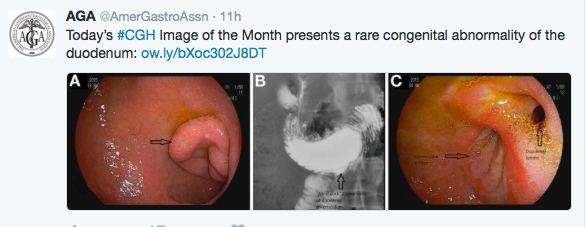
Image from CGH: Duodenal Diverticulum

Clin Gastroenterol Hepatol 2016; 14: e93

DOI: http://dx.doi.org/10.1016/j.cgh.2015.12.035

Intraluminal duodenal diverticulum is a rare duodenal congenital abnormality caused by an anomalous process of recanalization of the primitive foregut. It has a characteristic radiographic appearance on contrast studies, resembling a “windsock web” or “thumb of a glove”

Screen Shot 2016-07-29 at 10.30.28 PM

An upper gastrointestinal (GI) endoscopy was then performed that revealed a 3-cm pedunculated mass in the second part of the duodenum that was biopsied (Figure A), and the patient was referred for an endoscopic ultrasound. A repeat endoscopy before the endoscopic ultrasound revealed a large intraluminal diverticulum that had the appearance of a mass when inverted. Subsequently (Figure B), an upper GI series was performed that showed a large elongated tubular diverticulum arising from the second portion of the duodenum, 2.5 × 12 cm in size, with rapid filling and peristalsis with oral contrast, which extended to the left aspect of the spine when maximally distended

Bedtime in Preschool-Aged Children and Risk for Adolescent Obesity

An upcoming article (Journal of Pediatrics, (DOI: http://dx.doi.org/10.1016/j.jpeds.2016.06.005)shows an association between bedtime and the development of obesity:

Full-text link: Bedtime in Preschool-Aged Children and Risk for Adolescent Obesity

Abstract:

Objective

To determine whether preschool-aged children with earlier bedtimes have a lower risk for adolescent obesity and whether this risk reduction is modified by maternal sensitivity.

Study design

Data from 977 of 1364 participants in the Study of Early Child Care and Youth Development were analyzed. Healthy singleton-births at 10 US sites in 1991 were eligible for enrollment. In 1995-1996, mothers reported their preschool-aged (mean = 4.7 years) child’s typical weekday bedtime, and mother-child interaction was observed to assess maternal sensitivity. At a mean age of 15 years, height and weight were measured and adolescent obesity defined as a sex-specific body-mass-index-for-age ≥95th percentile of the US reference.

Results

One-quarter of preschool-aged children had early bedtimes (8:00 p.m. or earlier), one-half had bedtimes after 8:00 p.m. but by 9:00 p.m., and one-quarter had late bedtimes (after 9:00 p.m.). Children’s bedtimes were similar regardless of maternal sensitivity (P = .2). The prevalence of adolescent obesity was 10%, 16%, and 23%, respectively, across early to late bedtime groups. The multivariable-adjusted relative risk (95% CI) for adolescent obesity was 0.48 (0.29, 0.82) for preschoolers with early bedtimes compared with preschoolers with late bedtimes. This risk was not modified by maternal sensitivity (P = .99).

Conclusions

Preschool-aged children with early weekday bedtimes were one-half as likely as children with late bedtimes to be obese as adolescents. Bedtimes are a modifiable routine that may help to prevent obesity.

My take: Another potential reason to heed Samuel Jackson’s advice: Go the F- to Sleep (early)

Related blog posts:

Vickery Creek

Vickery Creek

How often are acid blockers used in neonates?

A recent study (JL Slaughter et al. J Pediatric 2016l 174: 63-70) shows a high rate of acid blockers in neonatal intensive care units.  This study retrospectively analyzed the Pediatric Health Information System database (PHIS) from 2006-2013.

  • Of 122,0002 infants: 23.8% received either a histamine-2-receptor antagonist (H2RA) or proton pump inhibitor (PPI).
  • 19.0% had received an H2RA
  • 10.5% had received a PPI

My take (borrowed from authors): “despite limited evidence and  increasing safety concerns, H2RAs/PPIs are frequently prescribed to extremely preterm neonates…Our findings support the need for innovative studies.”  Wouldn’t it be nice if there was proof of efficacy in this population?

Vickery Creek, Roswell

Vickery Creek, Roswell