Preventing Neonatal Hepatitis B Transmission with Tenofovir

A recent study (CQ Pan et al. NEJM 2016; 374: 2324-34) showed that tenofovir administered to mothers starting at 30-32 weeks of gestation lowered the rate of perinatal hepatitis B virus (HBV) acquisition.This was a multi center, open-label, randomized parallel-group design trial.  The maternal tenofovir dose was 300 mg.

Key points:

  • 200 mothers with HBeAg and HBV DNA >200,000 IU/mL in this study
  • 68% achieved an HBV DNA level <200,000 IU/mL (compared with 2% of controls).  Above this threshold has been shown to be associated with increased HBV transmission.
  • 5 of 97 (5%) in the treatment group acquired HBV compared to 18 of 100 in the control group.  However, in the per-protocol analysis which excluded infants born to women who withdrew consent, were lost to follow-up, or discontinued therapy there were 0 cases of transmission (0 of 88).
  • There were no specific safety signals identified in this study.  In the discussion, the authors note that the Antiretroviral Pregnancy Registry which includes data from 4013 women who received tenofovir, the rate of birth defects with TDF was 2.4% compared to the general population rate of 2.7%.

My take: This study provides more evidence that antivirals can prevent perinatal HBV infection.

Related blog posts:

Screen Shot 2016-06-19 at 10.56.30 PM

Intellectual Disability in Pediatric Liver Transplantation

A recent study (A Wightman et al. JPGN 2016; 62: 808-12) describes the prevalence of intellectual disability in a retrospective cohort from 2008-2013. The importance and the discomfort of the topic is referenced in the introduction:

  • “A 2005 survey of pediatric liver transplant programs (n=12) found that 33% of centers reported that cognitive disability was “always or usually” considered in their decision. No pediatric centers, however, considered mild or moderate cognitive disability alone (IQ 35-70) to be a relative or absolute contraindication to transplantation.”
  • The 2005 AASLD guideline states that “children with mental retardation pose significant logistical and ethical challenges” but does not comment on whether this is a contraindication.

This retrospective study of children who underwent an isolated liver transplant from 2008-2013 (n=254).

Key findings:

  • 15% of all first pediatric liver transplantation recipients have intellectual disability
  • Graft function and patient survival were similar among those with and without intellectual disabilities.  Metabolic disease, as the indication for liver transplantation, was the etiology more commonly among children with intellectual disability.

This study had numerous limitations.  Due to these limitations (eg. selection bias, lack of a standardized mechanism of measuring intellectual disability), it is likely that intellectual disability occurs more commonly than in 15% of pediatric liver transplant recipients. In fact, a previous study showed 42% of recipients required special education and 29% had IQ <85 (Cognitive Outcomes after Liver Transplantation | gutsandgrowth).

Related neurocognitive recommendations from the 2014 AASLD Pediatric Liver Transplantation Guidelines:

  • 28. “Neurocognitive testing should be performed in children awaiting LT to identify areas warranting early intervention to minimize later cognitive diffi- culties (2-B).”
  • 75, 76, and 92. LT is contraindicated with Alper’s disease, multiorgan mitochondrial disease, and Niemann-Pick type C.
  • In nearly 40 pages of recommendations, this guideline offers very little guidance on this topic.
AASLD 2014 Pediatric Transplantation Guidelines

AASLD 2014 Pediatric Transplantation Guidelines

“Explain It To Me Like I’m a Six Year Old”

Sometimes when I read an article, I wish it was presented in a much simpler manner.  In the movie “Philadelphia,” the lawyer played by Denzel Washington tells his clients to “explain it to me like I’m a six-year-old.”

A recent clinical report (MI Ardura et al. JPGN 2016; 63: 130-55) probably would have benefitted from this idea to some degree.  This report examines infectious disease issues with regard to patients receiving tumor necrosis factor-α (TNFα) inhibitors.  All in all, it is very thorough and reviews more than 20 infectious agents (bacteria, fungi, mycobacteria, and viral agents).

Table 2 is most helpful.  In this table, the authors recommend that before starting TNF inhibitors:

  • Risk factor screening for Brucella (eg exposure to animals, unpasteurized dairy products), Bartonella (eg exposure to kitten), Listeria (eg dietary history), Salmonella (eg exposure to reptiles), Aspergillus (eg exposure to construction), coccidioidomycosis (exposure to endemic area), Histoplasma (long list of exposures listed in Table 3 includes barns, caves, chicken coops, old buildings), and Hepatitis C virus
  • Direct testing is recommended for Mycobacterium tuberculosis, Hepatitis B virus, HIV (≥ 13 yrs if in hospital or ≥15 years), and Varicella zoster virus

Table 4 lists recommended vaccines.  For live virus vaccines, the authors recommend to avoid unless they can be administered at least 4 weeks prior to immunosuppressive therapy.

Other useful information:

  • “Granulomatous infections caused by bacteria, mycobacteria, and fungi are the most frequently  described infections in patients receiving anti-TNFα therapies.”
  • Infection rates of 239/100,000 reported with infliximab between 1998-2002.
  • More than 70% of these infections occurred within 3 to 6 months of starting infliximab therapy, “suggesting the possibility of reactivation of latent infection.”
  • M tuberculosis was most common (54/100,000)
  • “In general, anti-TNFα therapy should be discontinued during any severe infection.”

My take: This report offers a lot of information. Its impact on daily practice would be much greater if the authors created a simple one-sheet screening questionnaire form with recommended bloodwork and vaccines.

Related blog posts:

Shem Creek Pelican Art

Shem Creek Pelican Art

Pediatric Nutritionist/Scott Pentiuk: Update on two topics: Blenderized diets and Eosinophilic Esophagitis

From the Pediatric Nutritionist blog –two lectures from Dr. Scott Pentiuk:

Two Lectures: Blenderized diets and Eosinophilic esophagitis

These lectures feature a lot of useful references and practical advice.

Related blog posts:

Shem Creek, SC

Shem Creek, SC


One Day Polyethylene Glycol 3350 Prep

A recent study (B Sahn et al. JPGN 2016; 63: 19-24) with 155 patients prospectively showed that a 1-day polyethylene glycol (PEG) 3350 prep was safe and fairly effective.

The prep: 4 g/kg PEG in children with weights 10-50 kg and (with 238 gm for those >50 kg along with a single dose of a stimulant: either bisacodyl 5 mg-15 mg orally (10 mg for 21-30 kg) or senna (17.6 mg for 20 kg, 26.4 mg for 21-30 kg, and 52.8 mg for >31 kg).  The PEG was mixed typically with a sports drink to a max of 64 oz.

Key findings:

  • Hypokalemia was noted in 37 (24%) but none lower than 3.3 mmil/L.
  • Hypoglycemia was identified in 5 (3 were younger than 7). The one patient with severe hypoglycemia (31 mg/dL) was a one-year-old with corticosteroid dependency and had missed his morning steroid dose.
  • Colon cleansing was excellent or good in 77%.  The authors note that this suboptimal cleansing is due in part to the difficulty of using split-dosing in pediatrics.
  • 3/4ths of patients found the prep to be easy or average to tolerate.

My take: This study validates the common approach of using 1-day PEG 3350 preps in children.  Due to the low risk of hypoglycemia, particularly in young children, and the frequent mild hypokalemia, some children may benefit from starting intravenous fluids prior to induction of anesthesia.

Related blog posts:

Disclaimer: These blog posts are for educational purposes only. Specific dosing of medications/diets (along with potential adverse effects) should be confirmed by prescribing physician/nutritionist.  This content is not a substitute for medical advice, diagnosis or treatment provided by a qualified healthcare provider. Always seek the advice of your physician or other qualified health provider with any questions you may have regarding a condition.

Arthur Ravenel Jr Bridge

Arthur Ravenel Jr Bridge


Antibiotics Given Early in Life Linked to Childhood Obesity…Again

While yesterday’s post discussed quadruple therapy for H pylori/need for multiple antibiotics, today’s post will focus on one of the downsides of antibiotic usage. For several years, this blog has highlighted numerous studies which show a link between antibiotics and later obesity (see related blog posts below).  Another study (FI Scott et al. Gastroenterol 2016; 151: 120-29), using a large database, quantifies this risk further.

This retrospective study used prospectively collected data from The Health Improvement Network (THIN), using a cohort of 21,714 children from the UK.

Key findings:

  • In the cohort, 1306 (6.4%) were obese at age 4 years.
  • Antibiotic exposure was associated with an increased risk of obesity at 4 years, with odds ratio of 1.21. The OR went to 1.41 for 3-5 prescriptions.
  • Antifungal agents were not associated with an increased risk of obesity., OR 0.81

In the discussion the authors make a number of useful points:

  • In the U.S. between 2006-2008, there “were >10 million antibiotic prescriptions…annually for children without clear indication.” Thus, this is modifiable contributing factor to obesity.
  • The risk is modest with “approximately 1.2% absolute and 25% relative increase in the risk of early childhood obesity. This relationship is strongest when considering repeat exposures.”
  • Though this is a large study, the authors had many limitations, as expected in a retrospective study.  These included a lack of awareness of the indication for the antibiotic, potential selection bias, and difficulty adjusting for some confounders like breast feeding and physical activity.

The study is in agreement with data from agriculture.  Numerous studies have highlighted how antibiotics can improve weight gain in industry.  Here are some useful references:

  • Gaskins HR, et al. Antibiotics as growth promotants: mode of action. Animal Biotechnol 2002; 13: 29-42
  • Lassiter CA. Antibiotics as growth stimulants for dairy cattle: a review. J Dairy Sci 1955; 38: 1102-38.
  • Moore P, et al. Use of sulphasuccidine, streptothricin and streptomycin in nutrition studies with the chick. J Biol Chem 1946; 165: 437-41.
  • Cho I, et al. Antibiotics early in life alter the murine colonic microbiome and adiposity. Nature 2012; 488 (7413): 621-26.
  • Cox LM, et al. Altering the intestinal microbiota during a critical developmental window has lasting metabolic consequences. Cell 2014; 158: 705-21.

My take: Farmers have understood that antibiotics fatten up young animals for 70 years.  Yet, this basic information is NOT commonly understood by parents and many physicians. If this risk for obesity were widely known, it would help limit the use of antibiotics for well-recognized indications.

Related blog posts:

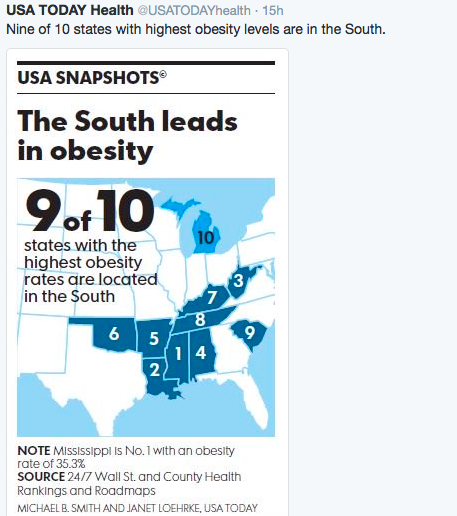
South Leads Obesity

Quadruple Therapy for Helicobacter Pylori Favored in Toronto Guidelines

Toronto consensus guidelines (C Fallone et al. Gastroenterol 2016l 151: 51-69) for H pylori treatment in adults emphasize use of 14 day therapy and use of quadruple regimens.  Specific recommendations included the following:

  • PAMC: PPI/amoxicillin/metronidazole/clarithromycin OR
  • PBMT: PPI/bismuth/metronidazole/tetracycline

Full text link: Toronto Consensus for the Treatment of H Pylori

Abstract:

Background & Aims

Helicobacter pylori infection is increasingly difficult to treat. The purpose of these consensus statements is to provide a review of the literature and specific, updated recommendations for eradication therapy in adults.

Methods

A systematic literature search identified studies on H pylori treatment. The quality of evidence and strength of recommendations were rated according to the Grading of Recommendation Assessment, Development and Evaluation (GRADE) approach. Statements were developed through an online platform, finalized, and voted on by an international working group of specialists chosen by the Canadian Association of Gastroenterology.

Results

Because of increasing failure of therapy, the consensus group strongly recommends that all H pylorieradication regimens now be given for 14 days. Recommended first-line strategies include concomitant nonbismuth quadruple therapy (proton pump inhibitor [PPI] + amoxicillin + metronidazole + clarithromycin [PAMC]) and traditional bismuth quadruple therapy (PPI + bismuth + metronidazole + tetracycline [PBMT]). PPI triple therapy (PPI + clarithromycin + either amoxicillin or metronidazole) is restricted to areas with known low clarithromycin resistance or high eradication success with these regimens. Recommended rescue therapies include PBMT and levofloxacin-containing therapy (PPI + amoxicillin + levofloxacin). Rifabutin regimens should be restricted to patients who have failed to respond to at least 3 prior options.

Conclusions

Optimal treatment of H pylori infection requires careful attention to local antibiotic resistance and eradication patterns. The quadruple therapies PAMC or PBMT should play a more prominent role in eradication of H pylori infection, and all treatments should be given for 14 days.

Related blog posts:

Sullivan's Island, Low Tide

Sullivan’s Island, Low Tide

One Proposal to Reduce Thiopurine Combination Therapy

A recent review (X Roblin et al. Inflamm Bowel Dis 2016; 22: 1496-1501) provided a useful review of thiopurine/biologic combination therapy.  The part of this review that I found intriguing was their Figure 3: “Proposed algorithm that may guide drug discontinuation or de-escalation in patients with IBD who achieved sustained deep remission while on combination therapy.”

  • In those (in sustained deep remission) with an infliximab trough level >5 mcg/mL, this algorithm recommends discontinuation of thiopurine.
  • In those with an infliximab trough level 3-5 mcg/mL and with 6-TGN >250, this algorithm recommends reduction of thiopurine to obtain 6-TGN level >125.
  • In those with an infliximab trough level <2 mcg/mL and with 6-TGN >250, this algorithm recommends discuss stopping infliximab.

The authors acknowledge that this algorithm has not been studied and “needs to be investigated in prospective trials specifically addressing this issue.”

My take: Until more studies emerge, the best way to balance control of IBD and minimize drug toxicity remains uncertain.

Unrelated references:

  • “Crohn’s disease of the ileoanal pouch” AL Lightner et al. Inflamm Bowel Dis 2016; 22: 1502-8.
  • SZ Koh et al. Inflamm Bowel Dis 2016; 22: 1397-1402. This reference describes clinical factors associated with development of Crohn’s disease in patients with IBDU who have undergone ileal pouch (e.g. younger age).

Related blog posts:

Arthur Ravenel Jr Bridge

Arthur Ravenel Jr Bridge

Disease extent and need for higher infliximab dosing

A recent study (JM Shapiro et al. JPGN 2016; 62: 867-72) reviewed 98 pediatric patients treated with infliximab (2012-2014) with inflammatory bowel disease (IBD).

The authors divided their patients into three groups, mainly based on extent of colonic involvement.  In those with limited colonic involvement, they were labelled “limited” disease (n=53).  In those with patchy inflammation involving the entire colon, they were considered to have “moderate” disease (n=27).  In contrast, those with continuous pancolitis were ascribed to have “extensive” disease (n=18).  Overall, Crohn’s disease accounted for 85 patients (87%),  ulcerative colitis for 11 patients (11%), IBDU for 2 patients (2%).  Interestingly, the majority (9 of 11) of those patients without Crohn’s disease were considered to have extensive disease.

Key findings:

  • “Patients with moderate and extensive disease, started taking 5 mg/kg per dose, showed statistically significant shorter times to escalation that those with limited disease.”
  • 70% of those with extensive disease required dose escalation, compared with 58.3% of those with moderate disease and 26.4% of those with limited disease.
  • The authors note that patients (n=8) with extensive disease who started with 10 mg/kg dosing  “exhibited longer treatment durability;” all 8 patients who started on 10 mg/kg dosing remained on this dose at the study’s conclusion.  Among the 10 patients that started on 5 mg/kg dosing, only 7 were on IFX therapy at the study conclusion–3 remained on 5 mg/kg, 4 were escalated to 10 mg/kg; there were 3 patients who stopped IFX therapy (1 infusion reaction, 2 with nonresponse).

My take: This is a small study. Yet, the implication is that early optimal dosing of IFX is likely  helpful, especially in the setting of extensive disease.

Related blog posts:

Chattahoochee River

Chattahoochee River