Mirtazapine for Functional Dyspepsia

In a randomized, placebo-controlled pilot study (J Tack et al. Clin Gastroenterol Hepatol 2016; 385-92) with 34 patients (29 women, median age 35.9 years), the authors showed improved dyspepsia symptom scores at weeks 4 and 8 compared with baseline.

Background: Mirtazapine is an antidepressant which is associated with weight gain and improvement in nausea.

Methods: The treatment group received 15 mg each day.

Results:

  • Compared with the control group, these was improvement in early satiety, quality of life, GI-specific anxiety, nutrient tolerance, and weight loss.
  • Two patients in the treatment group dropped out due drowsiness.  Interestingly, the trend of improvement was greater at week 4 then for week 8.
  • The authors note that epigastric pain and burning did not improve.

Limitations: small number of patients, and tertiary care patient population

My take: more studies are needed for this vexing problem

Related blog posts:

Disclaimer: These blog posts are for educational purposes only. Specific dosing of medications/diets (along with potential adverse effects) should be confirmed by prescribing physician/nutritionist.  This content is not a substitute for medical advice, diagnosis or treatment provided by a qualified healthcare provider. Always seek the advice of your physician or other qualified health provider with any questions you may have regarding a condition.

Fountain at Gibbs Gardens


Fountain at Gibbs Gardens


Chronic Granulomatous Disease and GI Involvement

Chronic granulomatous disease associated inflammatory bowel disease primarily involves the anus and rectum (SK Khangura et. al. Clin Gastroenterol Hepatol 2016; 14: 395-402).  In this study from the NIH, among 78 patients with CGD-IBD enteric fisula were found in 18% (73% were perianal), colonic stictures were noted in 24% (80% in anorectal area).

Other findings:

  • -EGD showed inflammation in 21%, 74%, and 37% of patients in esophageal, gastric and duodenal biopsies respectively
  • -Small bowel disease was unusual, though two of the four patients with ileostomies had ileal ulcers
  • -” ‘Target-like lesions,’ which have a clear elevated center with surrounding erythema, were characteristic of mild disease
  • -Approximately 40% of CGD patients have GI tract involvement
  • -GI tract malignancy was not observed in this cohort
  • -24 patients had pancolitis

My take: This reference provides comprehensive details of the clinical features of a large cohort with CGD.

Which animals kill the most humans

Which animals kill the most humans

Understanding the Risks of Propofol for Colonoscopy

A recent article & editorial (KJ Wernli et al. Gastroenterol 2016; 150: 888-94 & 801-2) shows that the use of propofol, delivered by an anesthetist, is associated with a small increase risk of adverse events.  This finding goes against assumptions that there would be reduced complications with an anesthesia expert in the room who could manage resuscitation and airway problems.

The study analyzed claims data from more than 3 million colonoscopies in the U.S between 2008-2011 in 40-64 year-olds.

Key findings:

  • Use of anesthesia was associated with a 13% increase in the risk of any complications within 30 days.
  • The increased risk included perforation (OR 1.07), hemorrhage (OR 1.28), and abdominal pain (OR 1.07).  Interestingly, the perforation risk was increased only in those undergoing polypectomy (OR 1.26) indicating that some confounders may have been difficult to eliminate.
  • Complications secondary to anesthesia were present as well (OR 1.15) and stroke (OR 1.04).

This is not the first study to associate anesthesia with increased risk of aspiration and mechanical complications (Cooper G et al. JAMA Intern Med 2013; 173: 551-6). It is certainly possible that the increased risk is due in part to patient selection, despite attempts to control for this.

It is also important to note that better sedation has not resulted in improved colonoscopy outcomes like increased polyp detection.

Will these results change anything? No.

The small increased safety risk (detectable only in studies of millions of patients), if accurate, is not going to stop the use of anesthesia services for two reasons.

  1. Patient satisfaction
  2. Financial incentives

Patient satisfaction.  Propofol results in excellent sedation, often with complete absence of pain combined with rapid recovery and an antiemetic effect.

Financial incentives.  Many endoscopists are able to employ an anesthetist and generate additional revenue by billing for sedation (in addition to the costs of the endoscopist), whereas this is not allowed with the combination of intravenous opioids/benzodiazepines used for ‘deep sedation.’  Even in the many who do not receive revenue for these services, the rapid recovery expedites patient care and room turnover.

My take: While propofol administered by anesthetists is a little less safe and more expensive, it is here to stay, at least until incentives are created to reconsider this approach.

Georgian Terrace

Georgian Terrace

More on Anti-TNF Drug Levels (part 2) and a Few Mentions

Another study (K Papamichael et al. Clin Gastroenterol Hepatol 2016; 14: 543-9) examined therapeutic drug levels with regard to infliximab induction and mucosal healing.

In this retrospective study with 101 patients with ulcerative colitis, 54 (53.4%) achieved mucosal healing between weeks 10-14, defined by a Mayo endoscopic score of 0 or 1.  97% of patients were treated with 5 mg/kg infusions.

Key finding:

  • Infliximab threshold concentrations of 28.3 mcg/mL at week 2, 15 mcg/mL at week 6, and 2.1 mcg/mL at week 14 were associated with mucosal healing.

My take: While this study provides information on what type of levels to expect at 2, 6, and 14 weeks, what is really important is figuring out which patients need higher doses of infusions from the start.

Unrelated, briefly noted:

R Yadlapati et al. Clin Gastroenterol Hepatol 2016; 14: 535-42. In this prospective blinded cohort study of 59 subjects, oropharyngeal pH testing (Restech Dx-pH) and salivary pepsin analysis was not able to distinguish between healthy volunteers and subjects with a combination of laryngeal and reflux symptoms.

M Moris et al. Clin Gastroenterol Hepatol 2016; 14: 585-93. This study reports increasing findings of small pancreatic cysts with more (and better) MRI imaging.

Y Kawamura et al. Clin Gastroenterol Hepatol 2016; 14: 597-605. This retrospective study shows, among almost 10,000 patients with fatty liver disease, that alcohol consumption of ≥40 g/day is an independent risk factor for hepatocellular carcinoma.

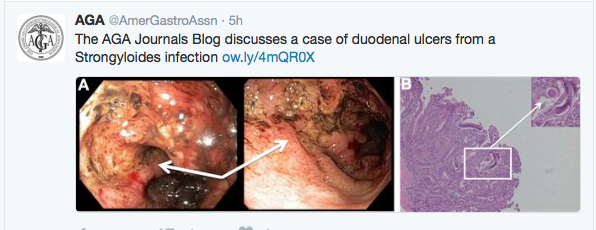
Strongloides

More on Anti-TNF Drug Levels

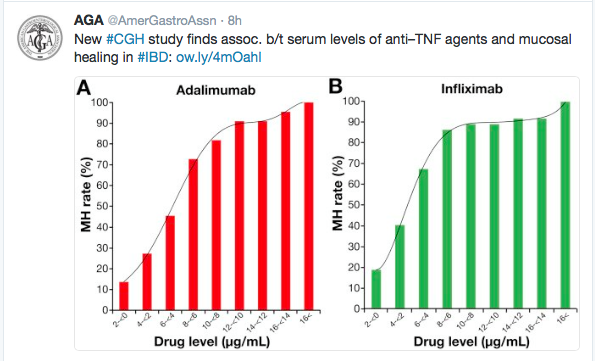
B Ungar et al (Clin Gastroenterol Hepatol 2016; 14: 550-7) report median serum levels of infliximab (n=78) or adalimumab (n=67) in correlation with mucosal healing.

In this retrospective cross-sectional study of adult patients with IBD (median age ~35 years), the authors found a correlation with higher drug troughs and mucosal healing.

“Levels of infliximab above 5 mcg/mL…and levels of adalimumab above 7.1 mcg/mL identified patients with mucosal healing with 85% specificity. Increasing levels of infliximab above 8 mcg/mL produced only minimal increases in the rate of mucosal healing, whereas the association between higher level of adalimumab and increased rate of mucosal healing reached a plateau at 12 mcg/mL”

The authors propose a “therapeutic window” of 6-10 for infliximab and 8-12 for adalimumab.

Clin Gastro Trough Levels

Remarks from DDW

Remarks from DDW

Oral Cancer and Inflammatory Bowel Disease

A recent study (KH Katsanos et al. Clin Gastroenterol Hepatol 2016; 14: 413-20) shows an increased risk of oral cancers in patients with inflammatory bowel disease (IBD). Because these cancers are infrequent, the absolute risk remains low.  However, this study provides some further insight into why other cancers may occur more often in IBD as well.

This retrospective study collated data on 7294 patients with IBD seen at a single New York center (2000-2011).  Key findings:

  • 11 patients (7 male) developed biopsy-proven oral cancer, most commonly of the tongue (n=6).  The overall oral cancer age-adjusted standardized incidence ration (SIR) was 9.77 and the SIR for tongue was 18.91.  These numbers could be influenced by a referral bias.
  • The average age for oral cancer in this study was 44 years.
  • Prior treatment for IBD had occurred in 7 patients, including 4 with a thiopurine, 1 with infliximab, and 3 with combination therapy.
  • One patient died.

Discussion:

  • Traditional risk factors for oral cancer: tobacco exposure (smoking, oral tobacco) and alcohol consumption.
  • The authors speculate that in their population that acquiring oncogenic HPV virus may have contributed to increased risk.  This is clearly a risk with cervical cancer which has been reported as increased in IBD populations as well.

Related blog postCancers Complicating Inflammatory Bowel Disease | gutsandgrowth

Gibbs Gardens

Gibbs Gardens

Metronidazole –Associated Encephalopathy

An interesting image (D Farmakiotis, B Zeluff. NEJM 2016; 374: 1465) shows an unusual side effect from metronidazole. This individual who had cirrhosis presented with confusion after a fall.

The MRIs below show “a symmetric, enhanced fluid-attenuated inversion recovery (FLAIR) signal in the dentate nuclei of the cerebellum (Panel A, arrow), a finding consistent with encephalopathy associated with metronidazole use.” Panel B shows resolution one month later following metronidazole discontinuation.

Risk factors for metronidazole encephalopathy:

  • Liver dysfunction
  • Prolonged treatment with metronidazole (typical cumulative dose >20 g)

Flagyl Encephalopathy

Know Hepatitis B Campaign

The CDC has launched a campaign to improve identification of Hepatitis B, particularly among Asian Americans.  Here’s the link: Know Hepatitis B Campaign

There are plenty of resources on this site.

Key fact:

“While Asian Americans make up about 5% of the total U.S. population, they account for half of the 2.2 million Americans living with chronic hepatitis B. In fact, one in 12 Asian Americans has hepatitis B.”

Related blog posts:

Screen Shot 2016-05-19 at 9.07.29 AM


Understanding Single-Payer Health Care: “Medicare for All”

A recent commentary (J Oberlander. NEJM 2016; 374: 1401-3) explains the “virtues and vices of single-payer health care.”

“In a country where nearly 30 million persons remain uninsured, even insured patients face staggering bills, and more money is spent on administration than on heart disease and cancer, it’s no surprise to hear calls for sweeping change.”

Virtues of Single-Payer System:

  • Based on Canadian experience, single-payer greatly reduces administrative costs and complexity.
  • Concentration of purchasing power
  • Guarantee that all residents receive care
  • The problems of a single-payer system “pale in comparison” to the current U.S. system

Vices of Single-Payer System:

  • Wait lists for some services
  • Public dissatisfaction
  • Would require increased taxes (though may improve overall finances for most)

It Does Not Matter if Single-Payer is Better:

It would face intense opposition from insurers, medical industry, and would not be adopted by Congress. “In short, single payer has no realistic path to enactment in the foreseeable future.”

My take (in agreement with author): “Preserving and strengthening the ACA [affordable care act] as well as Medicare, and addressing underinsurance and affordability of private coverage is a less utopian cause than single payer. I believe it’s also the best way forward now for U.S. medical care.”

Related blog posts:

Graphic showing association between obesity and asthma

Graphic showing association between obesity and asthma


Rome IV -Pediatric Changes

What are the changes in Rome IV for children and adolescents?  JS Hyams, C DiLorenzo et al (Gastroenterol 2016; 150: 1456-68) provide a helpful review.

Key point:

The ‘dictum’ that there was “no evidence for organic disease” as an criteria for functional disorders has been dropped in favor of “after appropriate medical evaluation the symptoms cannot be attributed to another medical condition.”  This subtle change discourages excessive investigations.

The functional disorders covered in this article include

  • H1 Functional nausea and vomiting disorders: H1a -cyclic vomiting syndrome, H1b -functional nausea and vomiting (NEW), H1c -rumination syndrome, H1d -aerophagia
  • H2 Functional abdominal pain disorders: H2a -functional dyspepsia, H2b -irritable bowel syndrome, H2c -abdominal migraine, H2d -functional abdominal pain -not otherwise specified
  • H3 Functional defecation disorders: H3a -functional constipation, H3b -nonretentive fecal incontinence

Other points:

  • “There are no published data on the treatment of isolated functional nausea and isolated functional vomiting”
  • “We have eliminated the requirement of pain to fulfill the criteria for FD” [functional dyspepsia]
  • Criteria for cyclic vomiting and abdominal migraines now require only 2 episodes in a 6 month period
  • Criteria for functional constipation requires only 1 month rather than 2 months (this is true for H3b as well).  The authors endorsed the NASPGHAN expert guidelines which included “no role for routine use of an abdominal x-ray to diagnose FC.”  The guideline discourages testing for cow’s milk allergy, hypothyroidism, celiac disease and hypercalcemia in the absence of alarm symptoms.

In a separate article, MA Benninga, S Nurko et al (Gastroenterol 2016; 150: 1443-55) describe the functional disorders affecting infants and toddlers.

In my view, the article in this special edition that incorporates the most changes regards functional disorders of the biliary tree (FGBD) (PB Cotton et al Gastroenterol 2016; 150: 1420-29). This is mainly due to data showing that sphincterotomy is no better than sham treatment for patients with post-cholecystectomy pain.  “The concept of sphincter of Oddi dysfunction type III is discarded.”  In addition, for biliary pain/’gallbladder dyskinesia,’ the authors also acknowledge that the role of obtaining a gallbladder ejection fraction is “controversial.”  “Symptoms suggestive of FGBD often resolve spontaneously so that early intervention is unwarranted.”  Ultimately, the authors state that “treatment recommendations are not firmly evidence-based.”

Related blog posts:

Owl in Our Neighborhood

Owl in Our Neighborhood