Adrenal Insufficiency due to Fluticasone in Eosinophilic Esophagitis

A recent study (MC Golekoh et al. J Pediatr 2016; 170: 240-5) shows that adrenal insufficiency developed in 10% of patients on chronic (>6 months) swallowed corticosteroid therapy for Eosinophilic Esophagitis (EoE).

Background: 58 patients with 67% receiving fluticasone and 33% receiving budesonide.  Median age: 13.7, median fluticasone dose 1320 mcg/day, median treatment duration: 4 yrs.  For budesonide, median dose was 1000 mcg/day and median age 10.7 yrs.

Key findings with low-dose ACTH stimulation:

  • Abnormal peak cortisol (≤ 20 mcg/dL) present in 15% and adrenal insufficiency (< 18 mcg/dL)  (n=6) noted in 10%
  • Only patients receiving >440 mcg/day of fluticasone had adrenal insufficiency
  • No patients taking budesonide had an abnormal cortisol level

Commentary:

  • Higher doses of fluticasone, particularly early in treatment, has been shown to have an improved inflammatory response.  However, as with asthma therapy, higher doses increase the risk of adrenal insufficiency.
  • Adrenal insufficiency can be asymptomatic but pose a risk for life-threatening adrenal crisis.
  • Strengths of study: Fairly large cohort, endoscopic/pathologic reports available, and ACTH stimulation testing which has better sensitivity than random cortisol.
  • Limitations: Lower number of patients receiving budesonide, particularly at a higher dose.  No indication of adherence.

My take: If higher doses of fluticasone are needed for prolonged period, consider screening (endocrinology consultation) for adrenal insufficiency.

Related blog posts:

Farjado, Puerto Rico

Farjado, Puerto Rico

CDC Guideline for Prescribing Opioids for Chronic Pain

Full Text: CDC Guideline for Prescribing Opioids for Chronic Pain—United States, 2016

D Dowell et al. JAMA. Published online March 15, 2016. doi:10.1001/jama.2016.1464 .

Excerpts:

  • No evidence shows a long-term benefit of opioids in pain and function vs no opioids for chronic pain with outcomes examined at least 1 year later (with most placebo-controlled randomized clinical trials ≤6 weeks in duration).

  • Extensive evidence shows the possible harms of opioids (including opioid use disorder, overdose, and motor vehicle injury).

  • Extensive evidence suggests some benefits of nonpharmacologic and nonopioid pharmacologic therapy, with less harm.

CDC: “We know of no other medication routinely used for a nonfatal condition that kills patients so frequently,”

1st Six Recommendations (12 total)

1. Nonpharmacologic therapy and nonopioid pharmacologic therapy are preferred for chronic pain. Clinicians should consider opioid therapy only if expected benefits for both pain and function are anticipated to outweigh risks to the patient. If opioids are used, they should be combined with nonpharmacologic therapy and nonopioid pharmacologic therapy, as appropriate. (Recommendation category: A; evidence type: 3)

2. Before starting opioid therapy for chronic pain, clinicians should establish treatment goals with all patients, including realistic goals for pain and function, and consider how opioid therapy will be discontinued if benefits do not outweigh risks. Clinicians should continue opioid therapy only if there is clinically meaningful improvement in pain and function that outweighs risks to patient safety. (Recommendation category: A; evidence type: 4)

3. Before starting and periodically during opioid therapy, clinicians should discuss with patients known risks and realistic benefits of opioid therapy and patient and clinician responsibilities for managing therapy. (Recommendation category: A; evidence type: 3)

4. When starting opioid therapy for chronic pain, clinicians should prescribe immediate-release opioids instead of extended-release/long-acting (ER/LA) opioids. (Recommendation category: A; evidence type: 4)

5. When opioids are started, clinicians should prescribe the lowest effective dosage.  (Recommendation category: A; evidence type: 3)

6. Long-term opioid use often begins with treatment of acute pain. When opioids are used for acute pain, clinicians should prescribe the lowest effective dose of immediate-release opioids and should prescribe no greater quantity than needed for the expected duration of pain severe enough to require opioids. Three days or less will often be sufficient; more than 7 days will rarely be needed. (Recommendation category: A; evidence type: 4)

Other points:

  • Avoid concurrent benzodiazepines
  • Review state prescription drug monitoring program to look for dangerous combination therapies and prior opiod dosing
  • Consider risk mitigation strategies (eg. naloxone)
  • Suggests urine screening at start to screen for illicit substance abuse which increases risk

USAToday’s review of these guidelines: CDC issues new guideline on opiods

Bottomline: This report is very important for those who prescribe opiods for chronic pain.

Law Library, Univ of Michigan

Law Library, Univ of Michigan

Why GMO labels are a bad idea

I was pleased to see the March 11 USAToday editorial: Our view: GMO Labels Feed Unwarranted Fears

Excerpt:

“Mandatory labeling …on balance it’s a bad idea. A key reason is that it validates the notion that genetically modified organisms (GMOs) are dangerous, which is simply not true.  Using science to make crops more resistance to drought or insects builds on the ancient practice of selectively breeding plants…Doing this in a lab at the genetic level makes it faster, more precise, and more effective.  But…harder for nonscientists to grasp…the European Union found that GMOs ‘are not per se more risky than…conventional plant breeding.’…75% to 80% of foods contain them.”

“The risk from mandatory labeling is the same as any action that ignores science and plays to unfounded fear.”

Related blog posts:

Walnut Street Bridge

Walnut Street Bridge

Drug Waste Costing Billions. Who benefits? Pharmaceutical Companies

From NY Times: Waste in Cancer Drugs Costs $3 Billion a Year

Here’s an excerpt:

The federal Medicare program and private health insurers waste nearly $3 billion every year buying cancer medicines that are thrown out because many drug makers distribute the drugs only in vials that hold too much for most patients, a group of cancer researchers has found…

If drug makers distributed vials containing smaller quantities, nurses could pick the right volume for a patient and minimize waste…according to researchers at Memorial Sloan Kettering Cancer Center, whopublished a study on Tuesday in BMJ…

“Drug companies are quietly making billions forcing little old ladies to buy enough medicine to treat football players, and regulators have completely missed it,” said Dr. Peter B. Bach, director of the Center for Health Policy and Outcomes at Memorial Sloan Kettering and a co-author of the study…

Some non-cancer drugs also generate considerable waste, includingRemicade, an arthritis drug sold by Johnson & Johnson for which an estimated $500 million of the drug’s $4.3 billion in annual sales comes from quantities that are thrown away, researchers found.

My take: this is another indictment of our pharmaceutical companies willful neglect of medication costs or cynical manipulation of our healthcare system.

Related blog posts:

Why Georgia Cannot Provide More Healthcare

RE: Georgia Senate Resolution 756.

From Jay Bookman: Ga. can’t afford health care for its people, but tax cuts? Sure!..

Here is an excerpt:

Medicaid cannot be expanded in Georgia, extending much-needed health insurance to some 400,000 of our fellow citizens, because the state budget is under too much strain.

Sure, expanding Medicaid would save lives and improve the quality of life for many others, many of them lower-income working people whose jobs don’t include health coverage. Sure, it would bring billions of new federal dollars into the state and help rescue a health-care delivery system that is now collapsing in much of rural Georgia. Sure, it would create thousands of jobs, and sure, federal tax money would no longer be flowing out of Georgia to subsidize Medicaid coverage for people in other states…

Yet on Monday, a supermajority of the state Senate voted to slash the state income tax by an amount roughly equivalent to that needed to fund Medicaid expansion.

Related blog posts:

My day on the beach is about to get worse

My day on the beach is about to get worse. Flamenco beach.

European Experience with Biosimilars

While there are numerous concerns regarding the use of biosimilar products, the preliminary experience with biosimilar infliximab has been favorable.

Full text link: European Experience of Infliximab Biosimilars for IBD (Gastroenterology & Hepatology)

Key points:

  • Biosimilars are leading to cost reductions of 30-40%.  In addition, to lowering the cost of infliximab, this is leading to reductions in costs for adalimumab and vedolizumab which are competing as 1st line therapies.
  • In the authors study of the first 210 patients, they did not find any difference in terms of immunogenicity or side effects.  In addition, efficacy was comparable to the ‘originator’ drug.

My take: Infliximab and adalimumab have been blockbuster medications for pharmaceutical companies, in part because they provide a great clinical benefit.  However, if biosimilars are truly biosimilar, the cost reductions will result in their widespread adoption.

Related blog post: Biosimilars -Position Statement  GutsandGrowth  This position statement: “Treatment of a child with sustained remission on a specific medication should not be switched to a biosimilar until clinical trials in IBD are available to support the safety and efficacy of such a change”

Castillo San Felipe del Morro

Castillo San Felipe del Morro

More on Hidradenitis Suppurativa and Inflammatory Bowel Disease

In a population-based inception cohort study (S Yada et al. Clin Gastroenterol Hepatol 2016; 14: 65-70) of 679 patients with inflammatory bowel disease (IBD) followed for a median of more than 19.8 years, it was determined that patients with IBD were ~9 times more likely to develop hidradenitis suppurativa (HS) compared with general population. 8 of 679 patients developed HS; only one had HS prior to IBD.

Other findings:

  • Most Crohn’s disease patients with HS had perianal disease.  Most ulcerative colitis patients developed HS after colectomy.
  • Female sex and obesity were risk factors for HS.

In a second retrospective study (N Kamal et al. Clin Gastroenterol Hepatol 2016; 14: 71-9), the authors identified 15 patients with CD and HS.  10 patients had perianal disease.  In this population, “both diseases were characterized by their severity, requirement of systemic medical therapies including anti-TNF and high operative rate.” this article contained some very helpful pictures.

Unrelated article: F Wang, JL Kaplan, BD Gold et al. Cell Reports; 2016: 14: 945-55.  This highly technical study used two independent cohorts of patients with Crohn’s disease and non-IBD controls.  One cohort, RISK, had over 700 patients and ~30,000 mean number of reads per sample; the other cohort, PIBD-CC, and 87 patients and ~3000 mean number of reads per sample.  Overall, the study showed associations between Crohn’s disease and bacteria in the lumen and the study helps provide an information-based method to depict dysbiosis.

Related blog post: Add it to the list

San Juan

San Juan

“Cat in the Hat” Effect with Transjugular Intrahepatic Portosystemic Shunt (TIPS)

IL Holster et al (Hepatology 2016; 63: 581-89) provide useful data on the use of transjugular portosystemic shunt (TIPS) compared with endoscopic therapy/Beta-blocker for prevention of variceal rebleeding.

In this multicenter randomized trial, TIPS was compared with either endoscopic variceal ligation or glue injection along with beta-blocker treatment in 72 patients with either a first or 2nd episode of variceal bleeding.  The median followup was 23 months.

Key findings:

  • 0 of 37 (0%) of TIPS patients had rebleeding compared with 10 of 35 (29%) in the endoscopic group.
  • TIPS mortality 32% compared with endoscopic group mortality of 26% (P=0.418)
  • Hepatic encephalopathy was 35% (TIPS) vs 14% (endoscopic group) (P=0.035)

This study shows that rebleeding is common in the endoscopic therapy group but that TIPS, while fixing bleeding, often resulted in other problems.  In “The Cat in the Hat” analogy, this would equate to moving the bathtub stain to the dress or curtains but not really improving the situation.

My take: It is helpful to see how these treatment strategies compare.  The data from this study does not clearly point to one strategy over another for dealing with this serious consequence of cirrhosis.

Related blog posts:

Statue at Ferry Dock, Culebra

Statue at Ferry Dock, Culebra

Sertraline and Liver Disease

A recent case report (MA Conrad, HC Lin. J Pediatr 2016; 169: 313-5) on sertraline-associated cholestasis provided a good reason to take a quick review on the NIH Liver Toxicity website:

Hepatotoxicity with sertraline (zoloft)

Liver test abnormalities have been reported to occur in up to 1% of patients on sertraline, but elevations are usually modest and infrequently require dose modification or discontinuation.  Rare instances of acute, clinically apparent episodes of liver injury with marked liver enzyme elevations with or without jaundice have been reported in patients on sertraline.  The onset of injury is usually within 2 to 24 weeks and the pattern of serum enzyme elevations has varied from hepatocellular to mixed and cholestatic.  Autoimmune (autoantibodies) and immunoallergic features (rash, fever, eosinophilia) are uncommon.  Actue liver failure due to sertraline has been described but is very rare.

The case report describes a 15 yo who developed jaundice (peak bilirubin 33.7 mg/dL with a direct fraction of 29.2 mg/dL) after 6 months of treatment with 75 mg per day.  After negative blood tests, he had a liver biopsy which was notable for rare bile ducts.  A jaundice chip was negative for underlying disorders like Alagille syndrome.  Urine bile acids were negative as well.  His laboratories normalized completely four months after cessation of sertraline.

It is interesting to note that sertraline has been used therapeutically for patients with pruritus due to cholestasis (Understanding Cholestatic Pruritus | gutsandgrowth)

My take: This case report describes bile duct paucity (vanishing bile ducts) as a result of sertraline therapy.  For practitioners, the bottom line is that SSRIs rarely cause liver toxicity; however, for patients with persistently-abnormal liver chemistries on SSRI therapy, discontinuation and identification of a safe alternative medication may be warranted.

Castillo San Felipe del Morro

Castillo San Felipe del Morro

Hepatitis B & C -Winter 2016

The large randomized pediatric entecavir study for Hepatitis B virus (HBV) is now in print: MM Jonas et al. Hepatology 2016; 63: 377-87.  Full link to this study on previous blog: Pediatric Entecavir Data  This study has led to FDA approval for use of entecavir in children as young as 2 years.  One interesting aspect of the study was the 2.6% drug resistance rate in the second year of the study.  This further validates current recommendations to treat children with “immune active” phases (e.g. abnormal transaminases and abnormal histology).

Briefly noted:

H Roberts et al. Hepatology 2016; 63: 388-97.  This study provides prevalence data for chronic HBV, 1988-2012.  During 2011-12, there were approximately 850,000 Americans with chronic HBV infections.  Migration of persons from HBV endemic countries has “largely contributed to prevalence rates remaining constant since 1999.”

JM Wilder et alHepatology 2016; 63: 437-44. This study showed that ledipasvir/sofosbuvir was similarly effective in black and non-black patients, with SVR12 rates of 95% and 97% respectively.  This is important because older interferon-based treatments were much less effective in black patients.

TB Dick et al. Hepatology 2016; 63: 634-43.  This review provides in-depth guidance regarding drug-drug interactions relevant to the new direct-acting antiviral agents used to treat Hepatitis C viral infection.

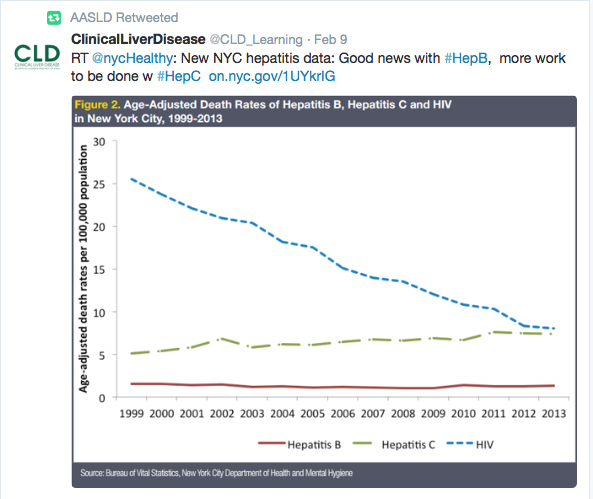
NY City Data for HIV, HBV, HCV

NY City Data for HIV, HBV, HCV