Dietary Diversity in Infants

A recent study (Woo JG et al. J Pediatr 2015; 167: 969-74) indicates that breastfed infants in a US cohort had lower dietary diversity at 6-12 months of age than a cohort from Shanghai and Mexico City.

The diversity of consumed foods helps ensure intake of all necessary macro- and micronutrients.  One indicator, the “minimum dietary diversity” (MDD) developed by the World Health Organization has been used.  Infants meeting MDD standards between 6-23 months are less likely to experience stunting.

Key findings:

  • “Only 28% of Cincinnati [US cohort] infants fed >50% human milk achieved MDD between 6 and 12 months.”
  • Across all cohorts, dietary diversity increased from 31% at 6 months of age to 92% at 12 months of age.
  • Shanghai infants had the highest diversification, “largely accounted for by significant consumption of eggs”

This study shows that some of previous recommendations, prior to 2008, to avoid foods like eggs and peanuts to lessen atopic disease/food allergies may have affected introduction of a more diverse diet.  Newer data has shown that earlier introduction of foods lessens the likelihood of food allergies.

The associated editorial (pg 952-53) notes that despite the ‘breast is best’ philosophy, that “if this principle is taken to extreme and introduction of nutrient dense complementary foods is delayed well past 6 months of age, the extensively breastfed older infant is at risk for suboptimal intakes of multiple micronutrients, anemia, growth faltering, and other poor health outcomes.”

From recent painting class (it's an improvement from stick figure drawing)
From recent painting class (it’s an improvement from stick figure drawing)

“I’ve Got the Best Doctor”

In numerous conversations, I have had heard from friends and family that “I’ve Got the Best Doctor.”  For everyone who thinks that, here’s a good read by Ezekiel Emanuel in NY Times:

Are Good Doctors Bad for Your Health?

Here’s an excerpt:

One of the more surprising — and genuinely scary — research papers published recently appeared in JAMA Internal Medicine. It examined 10 years of data involving tens of thousands of hospital admissions. It found that patients with acute, life-threatening cardiac conditions didbetter when the senior cardiologists were out of town. And this was at the best hospitals in the United States, our academic teaching hospitals. As the article concludes, high-risk patients with heart failure and cardiac arrest, hospitalized in teaching hospitals, had lower 30-day mortality when cardiologists were away from the hospital attending national cardiology meetings. And the differences were not trivial — mortality decreased by about a third for some patients when those top doctors were away…

One possible explanation is that while senior cardiologists are great researchers, the junior physicians — recently out of training — may actually be more adept clinically. Another potential explanation suggested by the data is that senior cardiologists try more interventions…

One thing patients can do is ask four simple questions when doctors are proposing an intervention, whether an X-ray, genetic test or surgery. First, what difference will it make? Will the test results change our approach to treatment? Second, how much improvement in terms of prolongation of life, reduction in risk of a heart attack or other problem is the treatment actually going to make? Third, how likely and severe are the side effects? And fourth, is the hospital a teaching hospital?

My take: Perhaps some of the differences in outcome are related to severity of illness that more experienced physicians may manage.  Nevertheless, it is clear that the reputation of the physician does not correlate well with clinical outcomes.

Related blog posts:


Improving Outlook in Neonatal Nutrition (Part 2)

Besides arguing for more aggressive and earlier use of intravenous protein, Dr. Adamkin noted that newer lipid emulsions (eg. SMOFlipid) are likely to be helpful due to the concentrations of docosahexaenoic acid (DHA) and arachidonic acid (ARA).  DHA and AA are the two main long chain polyunsaturated fatty acids (LCPUFAs) and are integral to the structural membranes of cells in the central nervous system and retina.

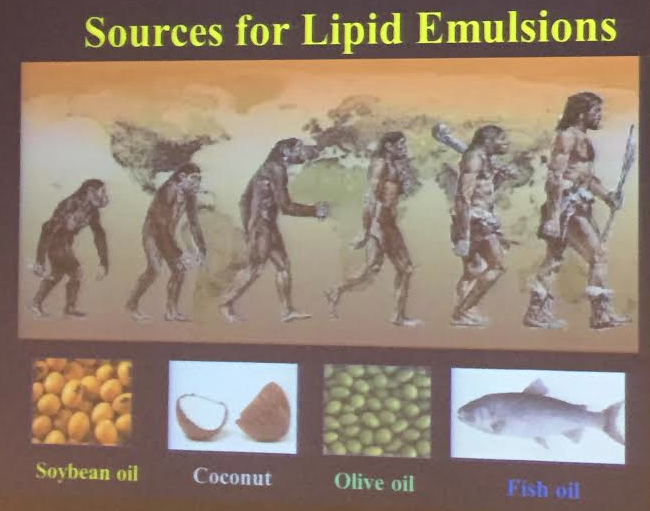
Slow Evolution of Lipid Emulsions

Slow Evolution of Lipid Emulsions

Decreasing Incidence of Growth Failure with More Aggressive Nutrtion

Decreasing Incidence of Growth Failure with More Aggressive Nutrition –average daily protein intake in most recent cohort during 1st 5 days is 3 g/kg/day (much higher than in previous years

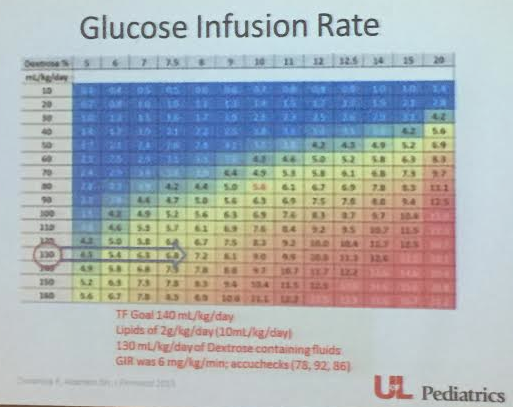
At U of L, they have developed a quick card to calculate glucose infusion rate based on dextrose and fluid volume (mL/kg/day)

At U of L, they have developed a quick card to calculate glucose infusion rate based on dextrose and fluid volume (mL/kg/day)

Other points:

  • SGA infants have low lioprotein lipase –>higher triglycerides
  • Slow lipid infusion associated with better tolerance
  • Insulin may be needed if not able to provide a glucose infusion rate of at least 4 mg/kg/min; otherwise, he recommends avoiding insulin.
  • Dr. Adamkin recommended adding carnitine after 4 weeks of TPN
  • During transition to enteral feeding, in order to continue with 3.5-4 g/kg/day of amino acids, many infants will need a stock solution of IVFs with supplemental amino acids to supplement enteral feeds

Related blog posts:

Improving Outlook in Neonatal Nutrition (Part 1)

I recently had the opportunity to hear a terrific lecture by David Adamkin (University of Louisville) on neonatal nutrition.  Unlike previous lectures that I’ve highlighted on this blog (Neonatal Nutrition Lecture -What We Know Right Now …) which focused on enteral nutrition and breastmilk.  This lecture focused on providing early parenteral nutrition to prevent postnatal growth failure.

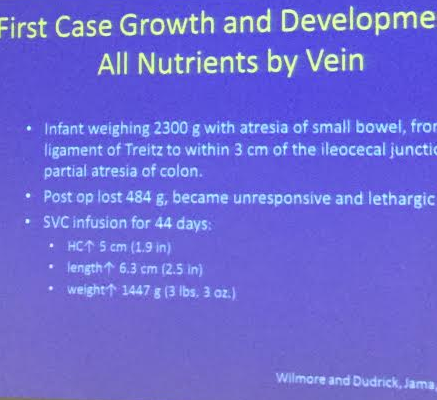
"Father" of TPN was Stanley Dudrick (1968)

“Father” of TPN was Stanley Dudrick (1968)

Introduction of TPN dramatically improved survival for many infants.  In disorders like gastroschisis, TPN increased survival from ~10% to 90%.

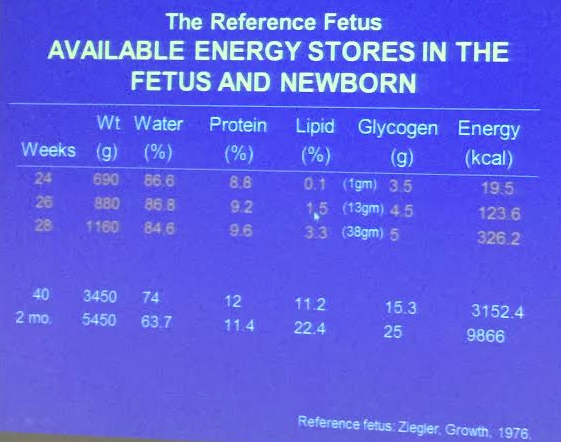
Extreme premature infants have minimal energy reserves

Extreme premature infants have minimal energy reserves

At 24-28 weeks gestational age, fetuses are ‘bathed in amino acids’ and extreme premature infants need early amino acids.  At University of Louisville, the neonatologists try to deliver ~3 gm/kg/day of amino acids in 1st 1-2 days in order to match intrauterine growth and prevent growth failure. Half of postnatal weight loss is water; other half is related to proteolysis.  To facilitate TPN at all hours, they use a stock solution (4% amino acids at 60 mL/kg/day delivers 2.4 mg/kg/day of protein; 80 mL/kg/day delivers 3.2 mg/kg/day of protein.

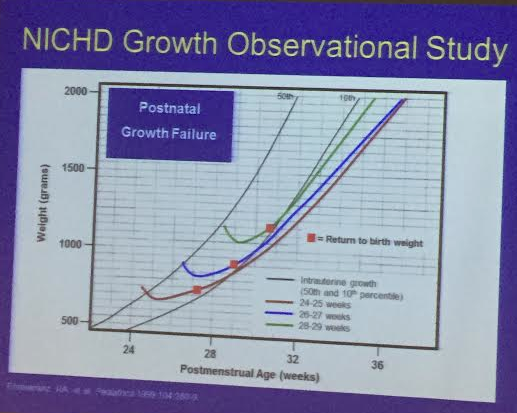
Return to Birth Weight Time is Correlated with Growth Failure

Return to Birth Weight Time is Correlated with Growth Failure.  Extreme prematurity has been correlated with slower return to birth weight

Screen Shot 2015-11-11 at 10.59.04 PM

Lack of correlation between BUN and Protein Intake

Lack of correlation between BUN and Protein Intake

BUN increases with any protein intake but not affected by protein intake -issue has to do renal fxn, comorbidity.  Smaller & sicker have higher BUN.

Key points:

  • The more premature, then the longer it takes to return birth weight and more growth failure
  • Poor growth related to neurodevelopment outcomes
  • With higher protein intake, there is better glucose tolerance; protein intake helps with glucose tolerance & lowers chance of hyperkalemia

More tomorrow…

Henoch-Schonlein Purpura and Neurologic Manifestations

Briefly noted:

Stefek B, et al. J Pediatr 2015; 167: 1152-4.  This study reports on an 8-year-old with Henoch-Schonlein purpura (HSP) who developed posterior reversible encephalopathy syndrome (PRES).  The authors state that neurologic manifestations develop in 2-8% of patients with HSP; of these patients, 20% suffer long-term effects.

Also, in commentary to my post on Thursday, one blog follower pointed out that the Fred Hollows Foundation is another charitable organization dedicated to restoring eyesight and has been doing this for a long time.

Atlanta Botanical Gardens

Atlanta Botanical Gardens

Clearing Out My Desk

These articles have been sitting on my desk or my email and worth a quick mention:

“Proton Pump Inhibitors Alter Specific Taxa in the Human Gastrointestinal Microbiome: A Crossover Trial” DE Freedberg et al. Gastroenterol 2015; 149: 883-85. In this study of 12 healthy volunteers over 12 weeks, the study’s major finding (according to associated commentary) “is the absence of any significant changes in microbial diversity with proton pump inhibitors.” However, there was “an increase in bacterial taxa associated with C difficile infection.”

“Quality of Life and Its Determinants in a Multicenter Cohort of Children with Alagille Syndrome” BM Kamath et al. J Pediatr 2015; 167: 390-6.  Quality of life is impaired in Alagille compared to healthy children and children with alpha-one antitrypsin; it is associated with growth failure which may be modifiable.

“Baseline Ultrasound and Clinical Correlates in Children with Cystic Fibrosis” DH Leung et al. J Pediatr 2015; 167: 862-68.  In this prospective study of children (n=719) from age 3-12 years, unsuspected cirrhosis was seen in 3.3% of patients and a heterogeneous liver echotexture was identified in 8.9%.

Case report of phlegmonous gastritis associated with ulcerative colitis (with good pictures): J Cordova, R Gokhale, B Kirschner. Gastroenterol 2015; 149: 867-69.

“High Prevalence of Idiopathic Bile Acid Diarrhea Among Patients with Diarrhea-Predominant Irritable Bowel Syndrome Based on Rome III Criteria” I Aziz et al. Clin Gastroenterol Hepatol 2015; 13: 1650-55.

Emergence of plasmid-mediated colistin resistance mechanism MCR-1 in animals and human beings in China: a microbiological and molecular biological study” The Lancet. DOI: http://dx.doi.org/10.1016/S1473-3099(15)00424-7 (Reference from Sana Syed)

Milder Celiac Disease Being Diagnosed Now

A study (Kivela L et al. J Pediatr 2015; 167: 1109-15) over a period of 48 years from Finland provides some hard data regarding the changing presentation of celiac disease.

Here are the key points;

  • Age at diagnosis has increased from a median of 4.3 years before 1980 to 7.6 years and 9.0 years in later periods.
  • Poor growth has decreased.  Among the 46 children diagnosed prior to 1980, poor growth occurred in 66% whereas 2010-2013: 23% had poor growth (had 14% were overweight or obese)
  • Severity of small-bowel mucosal damage was milder (Figure 1 D).  Among those with gastrointestinal presentation, total villous atrophy also declined from “61-62% to 18-22% (P=.001).”

Why is the presentation changing? There are increased “proportions of screen-detected and asymptomatic children…[this has] increased over 6-fold and simultaneously gastrointestinal symptoms …decreased.”  While there are improved diagnostic methods and increased knowledge, there has also been a “well-defined increase in the true prevalence of celiac disease.”

Related blog posts:

Gratitude and Eye Sight

For this day, I wanted to share a NY Times Story by Nicholas Kristof (In 5 Minutes, He Lets the Blind See) which highlights the successes of Dr. Sanduk Ruit (a Nepali ophthalmologist) along with Dr. Geoffrey Tabin (from University of Utah).  They can restore eyesight for $25!

An excerpt:

Some 39 million people worldwide are blind — about half because of cataracts — and another 246 million have impaired vision, according to the World Health Organization…He has restored eyesight to more than 100,000 people, perhaps more than any doctor in history, and still his patients come…

At first, skeptics denounced or mocked his innovations. But then the American Journal of Ophthalmology published a study of a randomized trial finding that Dr. Ruit’s technique had exactly the same outcome (98 percent success at a six-month follow-up) as the Western machines. One difference was that Dr. Ruit’s method was much faster and cheaper.

Related story on CNBC from 2013: Curing the blind

Bottomline: If you want to help save someone’s eyesight for $25: http://www.cureblindness.org/get-involved/support (Himalayan Cataract Project).

Sandy Springs

Sandy Springs

More Training Needed for Wireless Capsule Endoscopy

A recent study (NM Hijaz et al. JPGN 2015; 61: 421-23) shows that there is little formal training in wireless capsule endoscopy.  Though this study was merely a 5-item questionnaire sent to program directors (adult and pediatric), it showed that only 4% of pediatric program respondents had a formal training module and only 27% have a hands-on course.  These results were based on a 39% pediatric program response (25/64).

My take: Despite the low response rate to the questionnaire, given the increasing use of WCE as an evaluation tool, better training is needed.

Related blog posts:

sunf

Overlooking Obesity in Hospitalized Children

A recent study (MA King et al. J Pediatr 2015; 167: 816-20) shows that physicians and physician trainees rarely addressed overweight/obesity in hospitalized children at a Utah pediatric hospital.

Using a chart review and an administrative database, the authors note that overweight/obesity was identified in 8.3% (n=25) and addressed in 4% (n=12) of 300 hospitalized children with overweight/obesity.  They conclude that “this represents a missed opportunity for both patient care and physician trainee education.”

My take: In many cases, addressing overweight/obesity at a stressful time like a hospitalization may be unwelcome. In children who are not very sick, offering nutritional counseling would be worthwhile.  For others, I think encouraging outpatient followup would be reasonable.

Also noted: “High Prevalence of Nonalcoholic Fatty Liver Disease in Adolescents Undergoing Bariatric Surgery” SA Xanthakos et al. Gastroenterol 2015; 149: 623-34. In this cohort of 242 adolescents, 59% had NAFLD.  None had cirrhosis; stage 3 fibrosis was identified in 0.7%. Comment: I’m surprised that only 59% had NAFLD.

white flower