
NASPGHAN Awards 2014

I wanted to congratulate/recognize this year’s awardees at NASPGHAN and to summarize some of the associated presentations.

This blog entry has abbreviated/summarized the presentations. Though not intentional, some important material is likely to have been omitted; in addition, transcription errors are possible as well.

Major Awards:

  1. Harry Shwachman Award: Peter Whitington (Children’s Hospital of Chicago) This award is given for major life long scientific contribution to the field of pediatric gastroenterology.
  2. Distinguished Service Award: Melvin Heyman (UCSF Division Chief and JPGN editor). This award is given for excellence and service in the field of pediatric gastroenterology.
  3. AAP Murray Davidson Award: Jeffrey Hyams (Division Chief Connecticut Children’s)This award is given to an outstanding clinician, scientist and educator.

Fellow Research Award: “Bile Acid Signatures in Children Confer Protection From Clostridium Difficil Infection” ME Tessier et al (Baylor College of Medicine). Conclusions: Stool bile acids profiles are different in children with C difficile infection and could be a predisposing factor.  C diff toxins may alter bile acid profiles via inducing epithelial FGF-19 production.

Young Investigator Award “Analysis of Candidate Genes by Whole Exome Sequencing in Very Early-Onset IBD” J Kelsen (CHOP), et al. VEO-IBD cohort. Excellent presentation! (Related blog post: Just the Beginning: Mutations in Very Early Onset ..)

  • Children <5 years/extensive controls.
  • Mutation Findings: IL10RA/IL21R variants, RAG2/PIK3R1 variants
  • Presentation included phenotypic description (clinical and immunity/functional analysis)
  • Gut microbiome development being studied as well
  • Trying to combine microbiome data with genomic data.

William Balistreri Prize “A Prospective Newborn Screening Study for Biliary Atresia” Sanjiv Harpavat (Baylor College of Medicine) et al.   Excellent talk!

Background: 67 infants with biliary atresia (2007-2014) on retrospective review—ALL had elevated conjugated/direct bilirubin levels in first 24-48 hours of life. (Related blog post: Diagnosing biliary atresia earlier | gutsandgrowth)

Repeat testing at 2 weeks can identify those infants that need to be followed closely.  Workup needed for those who remained abnormal at 2 weeks of life.

This algorithm was studied at 4 different hospitals in Houston with 2-12% premature infants)

In newborn period:

  • N=11,636 –121 abnormal on newborn testing (based on hospital’s normative values -usually direct bilirubin >0.4)
  • When repeated at 2 weeks: 102 of these 121 were normal/only 12 continued to test high (2 with BA, 1 A1AT, 1 Rh disease, 8 resolved).  The two patients detected with biliary atresia is in line with the expected frequency of ~1 in 5000.
  • 7 missed retesting. 3 died (congenital heart disease), 2 missed followup, 2 had PCP refuse retesting.
  • Testing results: 100% sensitivity. Good specificity with repeat testing.

Baylor Workup approach to cholestasis:

  • 3-4 day evaluation
  • Day 1: liver panel, A1AT typing, U/S, CXR
  • Days 2-4: liver biopsy/percutaneous cholangiogram, +/- Kasai

Current AAP recommendation (per Ronald Sokol) is for all infants to have fractionated bilirubin.

Take-home message: How can we diagnose every infant on time? Possibly check every infant for direct/conjugated bilirubin in first 48 hours.

Young Clinical Investigator Award: “Poop-MD: A mobile health application accurately identifies acholic stools.” Douglas Mogul

Problem of delayed diagnosis has been improved in some studies with stool color cards. With emergence of smart phones (80% of 18-35 year olds have smart phones), opportunity to identify echoic stools with new technology.

  • PoopMD. Software determines whether stool is bloody, acholic, etc. Can email doctor and place reminder. FREE app.
  • Parents takes the picture of stool and then app analyzes.
  • Pilot study with 45 initial photographs reviewed by panel of 7 pediatricians
  • When at least 6 physicians agreed on stool color as being acholic (n=7), this was tested against app
  • App: 100% sensitivity for acholic stools. 89% specificity.
  • Working on Spanish version and improved interface.

Other awards:

NASPGHAN Foundation Awards

NASPGHAN Foundation Awards

Sponsored Awards
Sponsored Awards

Outcome of “Successful” Biliary Atresia Patients

A recent publication (J Pediatr 2014; 165: 539-546) from the Childhood Liver Disease Research and Education Network (CHiLDREN) provides a strong rationale for close followup of biliary atresia (BA) patients with their native livers.  The Biliary Atresia Study of Infants and Children (BASIC) is one of the ongoing longitudinal studies within CHiLDREN.

Among a cross-sectional study BASIC cohort of 219 children (median age 9.7 years) who survived with their native livers for at least 5 years, they had the following findings:

  • In preceding 12 months, cholangitis occurred in 17%, and 62% had experienced cholangitis at least once following hepatoportoenterostomy (HPE) (also called Kasai procedure.  The authors note wide discrepancy in usage of prophylactic antibiotics; some stop at 2 years following HPE and some never stop antibiotic prophylaxis.
  • In preceding 12 months, bone fractures occurred in 5.5%.  Overall, 15% had had at least one bone fracture at some point, which is higher than the general population. Only 14.6% of entire cohort were receiving vitamin D supplementation.
  • Portal hypertension: clinically detectable splenomegaly, thrombocytopenia, ascites, and variceal hemorrhage were seen in 56%, 43%, 17%, and 9% of patients in this cohort.
  • Health-related quality of life was reported as normal in 53%
  • Mean height and weight z-scores were normal in this cohort.
  • Over 98% had clinical or biochemical evidence of chronic liver disease.

Full-text Link

Bottomline: This BASIC study shows the need for careful followup of “successful” biliary atresia patients and provides more accurate data regarding risks of specific complications.

Briefly noted: J Pediatr 2014; 165: 547-55.  In this study with same first author (Vicky Ng), the investigators develop and validate a pediatric liver transplantation (LT) quality of live instrument for LT patients aged 8-18 years.

Related blog posts:

START Study: Steroids Not Effective For Biliary Atresia (After Kasai)

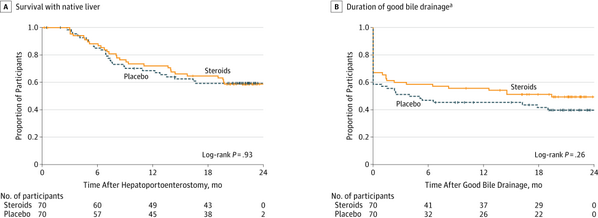
A recent multicenter study has shown that steroids are not helpful after hepatoportoenterostomy for Bilairy Atresia (BA) (Bezerra JA et al. Hepatoportoenterostomy for Bile Drainage in Infants With Biliary Atresia. JAMA. 2014 May 7;311(17):1750).  Thanks to Saul Karpen for the reference.  I want to congratulate all of the authors, but particularly Jorge Bezerra, Saul Karpen, and Rene Romero for collaborating on this important study.

The randomized, double-blind, placebo-controlled START trial from the NIH-supported ChiLDren study enrolled 140 patients (257 were screened) from 2005-2011.  High-dose steroids, starting with methylprednisolone 4 mg/kg/day for 2 weeks and then tapered was compared with placebo.  No statistically significant improvement was noted.  Ultimately, the steroid intervention did not affect transplant-free survival which was 58.7% in the steroid group and 59.4% in the placebo group at 24 months of age.  Figure 2 (see below -from @JAMA twitter feed) shows Kaplan-Meier analysis plots with regard to transplant-free survival and bile drainage; the latter was slightly better in steroid group, but not statistically significant. In addition, steroids were associated with an earlier onset of first serious adverse events, 37% in steroid group compared with 19% in the placebo group within 30 days of Kasai.

Embedded image permalink

With regard to safety, the authors note that both groups were “found to have a high incidence of adverse events, indicating that they were most likely the direct consequences of the severe liver disease typical of biliary atresia. However, steroid therapy was associated with…complications at the sites of surgical anastomoses and intestinal perforation.”

Take-home message: Avoid steroids after Kasai procedure.

Related blog posts:

Reclassifying Biliary Atresia -Three Subtypes

Using a large prospective multicenter cohort (ChiLREN study group), a recent study examined 289 infants and identified three subtypes of biliary atresia (BA) enrolled in PROBE (Hepatology 2013; 58: 1724-31).

Previously, BA has been considered to have two presentations:

  • Acquired/nonsyndromic ~90%
  • Embryonic/syndromic ~10%

However, this study suggests the following:

  • Group 1 -nonsyndromic, isolated BA. n=242 (84%)
  • Group 2 -BA with major malformation but without laterality defect. n=17 (6%)
  • Group 3 -syndromic, with laterality defect. n=30 (10%)

Group 3 BA defects included splenic abnormalities (eg. asplenia, polysplenia, right-sided spleen), cardiovascular anomalies (eg. dextrocardia, TAPVR, interrupted IVC) and gastrointestinal anomalies (eg. “abdominal heterotaxy,” malrotation, annular pancreas).

In contrast, Group 2 BA had frequent genitourinary problems (cystic kidney and hydronephrosis) along with different cardiovascular anomalies and gastrointestinal anomalies which included esophageal/duodenal/jejunal atresia and imperforate anus.

Other points:

  • The frequency of cardiac problems is particularly important to recognize as this could make differentiation from Alagille syndrome more difficult.
  • One other interesting finding was the high incidence of autoimmunity in first-degree relatives of all BA groups (~44%).

Bottomline: there are at least 3 subtypes of BA.

Related posts:

What is the role for preventing variceal bleeding in Biliary Atresia?

During medical school, I read a book called “The House of God”  (The House of God – Wikipedia, the free encyclopedia.  One of this cynical book’s premises is that doing more diagnostic tests and treatments to help patients actually harms them.

A recent study of children with biliary atresia reminded me of this premise (Gastroenterol 2013; 145: 801-7, eidtorial 719-22).   In this retrospective study, there were 66 children with endoscopic evidence of portal hypertension who underwent endoscopic therapy for either primary (n=36, mean age 22 months) or secondary (n=30, mean age 24 months) treatment of esophageal varices biliary atresia (2001-2011).  These children were at high risk for bleeding; they had a mean bilirubin of >10 mg/dL and 20% had ascites.

Results:

Primary prophylaxis group: mean of 4.2 sessions were needed to eradicate varices.  Varices reappeared in 37%; there was no breakthrough bleeding.  97% survived for 3 years.  All of these patients had varices grade 2 or higher and 94% had red wale markings.

Secondary prophylaxis group (after previous bleeding): mean of 4.6 sessions to eradicate varices.  Varices reappeared in 45% and 10% had breakthrough bleeding.  84% survived for 3 years.

Treatment:

  • For bleeding group, sclerotherapy was used in 73%, banding in 17%, and both in 10%.
  •  For prophylaxis group, sclerotherapy was used in 44%, banding in 41%, and both in 14%.
  • By the end of the study, sclerotherapy was mainly used in patients weighing less than 8 kg.
  • Each endoscopy session had the same endoscopist, used octreotide (2 mcg/kg/hr) an 1 hour before and then for 2-3 days afterwards.
  • With bleeding patients, these sessions occurred after the patient was stabilized, with a mean of 10 days afterwards.
  • Patients had an average of four 3-day hospitalizations.
  • Within an average of 14 months, more than half of the primary prophylaxis group had undergone transplantation

The authors interpret their data as follows:  “primary or secondary prophylaxis of bleeding is well tolerated and greatly reduces the risks of variceal bleeding in children with biliary atresia and high-risk gastroesophageal varices.  The results support the active detection of these signs by endoscopic procedures.”

In contrast, the editorial is much less supportive of primary prophylaxis.  “We need to weigh the risks and benefits of multiple procedures in a nonbleeding child who may not bleed for years, when varices have a high chance of recurring and transplant is sometimes imminent. Because mortality from gastrointestinal bleeding in children is quite low (zero in this small study), we may need to consider a ‘wait and see’ approach.”

Bottomline: A failed Kasai is an indication for transplantation which is a much more definitive treatment for portal hypertension.

Previous related blog posts:

Biliary Atresia More Common in Preterm Infants

During my fellowship, one of the faculty presented an abstract indicating that 4 out of 40 preterm infants with cholestasis had significant underlying liver disease in addition to parenteral nutrition associated cholestasis (PNAC).  One of these patients had biliary atresia.  The obvious point was not to assume that the cholestasis was due to the usual suspects found with premature infants.

A recent study indicates that biliary atresia (BA) in Taiwan is more common in preterm infants than in term infants (J Pediatr 2013; 163: 100-3).  The authors identified 197 cases (166 term infants) of BA between 2004-2010. This retrospective study used a nationwide screening for BA (the national stool card registry center database) along with reports from surgeons of the Taiwan Biliary Atresia Study Group.

Results:

  • Annual incidence of BA per 10,000 live births was 1.43 and 2.37 for term and preterm infants respectively.
  • Kasai operation before 60 days occurred in 68.7% of term and 44.4% of preterm infants.  Mean age of Kasai was 52.9 days for term infants and 71.8 for preterm infants.
  • Major congenital anomalies along with BA were more common among preterm (18.5%) than term (4.1%).
  • Mean onset of clay-colored stools among preterm infants was 33.6 days compared with 29.6 for term infants.
  • Stool cards had good sensitivity in detecting BA in both preterm and term infants: 96.3% and 92.8% respectively.
  • Jaundice-free at 3 months following Kasai was 62% of term infants and 37% of preterm infants.
  • 18-month survival with native liver was 72.7% in term infants and 50% in preterm infants.

While the authors point out several studies that have shown prematurity is an independent risk factor associated with BA, nevertheless this idea is counter to conventional wisdom that BA patients are typically well-appearing term infants at the time of diagnosis.  The authors also note that despite delayed diagnosis in preterm infants, this was not correlated with an impact on jaundice-free status 3 months following surgery.  This finding, in particular, should be cautiously interpreted as there were only 27 infants in the preterm group.

Related blog posts:

Learning a lot from ChiLDREN (part 2)

As noted in previous post (Learning a lot from ChiLDREN (part 1) | gutsandgrowth), several recent studies highlight the benefits of multisite collaboration to study infrequent pediatric liver problems.  In these studies, the Childhood Liver Disease Research and Education Network (ChiLDREN) has collected prospective longitudinal observational date from multiple centers; data from 10 centers provides useful information on the frequency of portal hypertension (PHT) in young adults with biliary atresia (BA) (JPGN 2012; 55: 57-73).

163 subjects were enrolled between May 2006 and December 2009.  Seven patients were excluded due to the presence of polysplenia which interferes with the assessment of PHT.

Demographics: subjects ranged in age from 1 to 25 years with a mean of 9.2 years.  56% were female, 75% were caucasian.

PHT was considered definite if there was either a history of a PHT complication (variceal bleeding, ascites) or if there were clinical findings c/w PHT (both splenomegaly and thrombocytopenia).  PHT was considered “possible” if either splenomegaly or thrombocytopenia was present and “absent” if no criteria were met.

  • PHT: definite in 80 (49%), possible in 27 (17%) and absent in 56 (34%)
  • 43 subjects had a history of PHT complications: 32 with esophageal variceal (EV) bleeding, 14 with ascites, and 8 with hepatopulmonary syndrome.
  • Of the patients with EV, only 3 had normal platelet count and normal spleen size.

Teaching points:

  1. One-third of subjects with EV bleeding survived with their native liver for at least 5 years.
  2. EV age of onset was highly variable; 7 had bleeding in the first two years of life.
  3. Growth parameters were fairly unremarkable in those with definite PHT.
  4. Long-term followup will be needed to identify factors which predict progression of PHT and the development of adverse outcomes.

Previous related blog posts:

Working on biomarkers for Biliary Atresia

Two studies have tried to identify biomarkers to facilitate the diagnosis of biliary atresia (BA).

  • JPGN 2012; 55: 366-69
  • JPGN 2012; 55: 370-75

The first study looks at the serum of 24 patients with BA & 24 cholestatic controls.  Several circulating microRNAs (miRNAs) were associated with BA.  The miR-200b/429 cluster could correctly classify up to 85% of patients.

The second study took serum samples from 42 infants with BA, 38 infants with non-BA cholestasis, and 36 healthy controls.  Using mass spectrometry and enzyme-linked immunosorbent assays, they identified a candidate biomarker, Apo C-II, which was down-regulated in BA samples compared to healthy controls, but relatively upregulated compared with cholestatic non-BA samples.  The sensitivity of this model was 94% and the specificity was 92%.

Given the consequence of a missed diagnosis of BA, further work to identify biomarkers with even better sensitivity/specificity will be necessary to change current diagnostic algorithms.

Previous related blog entries:

Fat soluble vitamin deficiency -sometimes the rule rather than the exception

While it is well-known that cholestasis predisposes individuals to develop fat-soluble vitamin (FSV) deficiencies, the exact frequency is not clear.

A recent prospective multi center study of infants with biliary atresia (BA) indicates that FSV deficiency is quite frequent –thanks to Kipp Ellsworth for forwarding this article (DOI: 10.1542/peds.2011-1423; http://pediatrics.aappublications.org/content/early/2012/08/08/peds.2011-1423).  “Infants with BA are at risk for malabsorption of dietary lipid and fat-soluble vitamins (FSVs) due to insufficient intraluminal bile acid concentrations.”

To determine the frequency of FSV deficiencies, this study examined 92 infants with BA who were enrolled in a randomized double-blinded, placebo-controlled trial of corticosteroid therapy after hepatoportoenterostomy (HPE).  This study was conducted by the Biliary Atresia Research Consortium (BARC) between 2005-2008.

All infants were treated with a standardized dose of a liquid multiple FSV/d-α tocopheryl polyethylene glycol-1000 succinate (TPGS; a micelle forming water-soluble form of vitamin E).  Infants received initially ADEKs; later in the study, ∼32 months after start, participants were changed to AquADEKs due to a manufacturer’s change.  In addition, all infants received supplemental vitamin K, initially 2.5 mg three times per week.  As noted in supplement to article, the two study multivitamins have particularly low amounts of vitamin D (800 units) and vitamin E (80-100 units) compared to frequent dosing in clinical practice for severe cholestasis (see below).

TABLE 1 from study: Target FSV Levels and Replacement Regimens

  • Vitamin A (retinol)

Target:  19–77 mg/dL retinol:RBP molar ratio >0.8

Supplement strategy:  Increments of 5000 IU (up to 25–50 000 IU/d) orally or monthly intramuscular administration of 50 000 IU

  • D (25-hydroxy vitamin D)

Target: 15–45 ng/mL

Supplement: Increments of 1200 to 8000 IU orally daily of cholecalciferol or ergocalciferol; alternatively calcitriol at 0.05 to 0.20 mg/kg per day

  • E (α tocopherol) 

Target: 3.8–20.3 mg/mL & vitamin E:total serum lipids ratio >0.6 mg/g

Supplement: Increments of 25 IU/kg of TPGS orally daily (to 100 IU/kg per d)

  • K (phytonadione)

Target: INR ≤1.2

Supplementation Strategy:

  • <1.2-1.5  INR:  2.5 mg vitamin K orally daily
  • 1.5-1.8  INR: 1.8  2.0–5.0 mg vitamin K intramuscular and 2.5 mg vitamin K orally daily
  • >1.8 INR:  2.0–5.0 mg vitamin K intramuscular and 5.0 mg vitamin K orally daily

Results: FSV was common in infants with total bilirubin (TB) ≥2 mg/dL. At three months post HPE, only 3 infants with this degree of cholestasis were sufficient for all four vitamins.; at 6 months post HPE, all 24 infants with TB ≥2 mg/dL had at least one FSV deficiency: “100%, 79%, 50%, and 46%, respectively, for vitamins A, D, E, and K .”   Also, the incidence of vitamin D deficiency would be higher if the authors had chosen a higher target.

Take-home points:

  • FSV deficiencies are common particularly in patients with TB > 2mg/dL; thus careful monitoring is worthwhile
  • There is no current multivitamin that is adequate.  A better strategy is to individualize the dosing for each vitamin and consider injection (except for vitamin E) if needed

Initial individualized dosing of FSV supplementation in clinical practice for severe cholestasis (prior to deficiencies):

Vitamin A: start with ~5000 units daily.

Vitamin D: See previous posts for more information on dosing.  Two options include: Drisdol® (8000 IU/ml) 0.125ml/kg/day (=1000 IU/kg/day) and Bio-D-Mulsion Forte® http://www.bioticsresearch.com/node/1570 -each drop = 2,000 IU (also inexpensive)

Vitamin E (Liqui-E®/Nutr-E sol®26.6 IU/ml) 1ml/kg/day
with tocopherol polyethylene glycol succinate.  Alternative is AquaE®(Yasoo -www.yasooproducts.com/aqua-e/).

Vitamin K (phytonadione) 2.5mg QOD

Related posts:

Diagnosing biliary atresia earlier

Common to be “D-ficient”

Outcomes of Biliary Atresia

MicroRNAs and biliary atresia

Bleeding due to vitamin K deficiency

Bleeding due to vitamin K deficiency

With cholestasis in infancy, Bill Balistreri taught me that there were four potential emergencies:

  • Bleeding due to vitamin K deficiency or coagulopathy
  • Hypoglycemia
  • Sepsis
  • Metabolic poisoning with formula (in patients with galactosemia)

Once these issues have been considered, then it is appropriate to start investigating the etiology of the cholestasis.

One of the more dramatic complications is intracranial hemorrhage (ICH). While ICH is a well-recognized complication of cholestasis in infancy, the long-term outcomes are not well-characterized. A report from Japan adds some insight (JPGN 2012; 54: 552-57).

Among a retrospective review of 83 infants with biliary atresia (BA) between 1979 to 2009, ICH occurred in 8% despite oral vitamin K prophylaxis (2 mg).  The onset of ICH was between 47-76 days after birth and was prior to surgery.  Coagulopathy was noted in all cases, which improved with vitamin K intravenously.  Two infants required craniotomy.  In 5 of 7 cases, neurologic sequelae were noted including developmental delay in three, epilepsy in one, and mild hemiparesis in two.

Additional references:

  • Blood Rev 2009; 23: 49-59.  Review of vitamin K deficiency.
  • Pediatrics 2008; 121:e857.  Vitamin K deficiency common in cholestatic breastfed babies.  Can be prevented with 1mg po each week or single IM dose of 2mg.
  • Eur J Pediatr Surg 2005; 15: 295-9.  Bleeding disorder as 1st symptom of BA.
  • Pediatr Neurosurg 2006; 42: 362-7.  ICH due to vitamin K deficiency.
  • Pediatrics 2006; 118: e1657.  dose of 0.2mg effective for median of 25days (w/o toxicity/accumulation of K1O) in infants <32weeks gestation.