IBD Update January 2015 (Part 1)

1. From the recent Advances in IBD Conference, Healio Gastroenterology reports on Dr. Baldassano’s update on PLEASE study which examined enteral nutrition in comparison to anti-TNF therapy.  Here’s the link: Enteral Nutrition Outcomes (Thanks to Kipp Ellsworth for this reference)

Here’s an excerpt:

Citing the findings from the Pediatric Longitudinal Study of Semi-Elemental Diet and Stool Microbiome (PLEASE), Baldassano demonstrated that greater mucosal healing was achieved in CD patients on exclusive enteral nutrition compared with partial enteral nutrition therapy. In this prospective cohort study, 38 children received enteral therapy with defined formula diet and 52 controls received anti-TNF-alpha therapy. The enteral nutrition group was further stratified to evaluate mucosal healing on a more restrictive diet; one subgroup received 80% to 90% of total caloric needs from enteral therapy, of which 14% achieved induction of remission at 8 weeks, the other subgroup received 90% to 100% of total caloric needs from enteral therapy, of which 45% achieved remission, and 62% of controls achieved remission.

2. NEJM 2014; 371: 2418-27. This is a case report of a 9-year-old with Crohn’s Disease and pulmonary nodules.  This report serves as a useful review.

3. Standardized use of fecal calprotectin (here’s the link -from KT Park’s Twitter feed):

Fecal calprotectin -use for identifying IBD and for identifying relapse risk

4. Inflamm Bowel Dis 2014; 20: 2247-59. Study examined factors associated with infliximab clearance.  Higher clearance noted with low albumin, high body weight, and the presence of antibodies to infliximab (ATI).  The authors note that higher concentrations with dose escalation are more likely when the dose interval was shortened than by increasing the administered dose.

5. Inflamm Bowel Dis 2014; 20: 2260-65. “Natural History of Perianal Crohn’s Disease After Fecal Diversion.”  Despite greater use of biologics, only 15 of 49 patients reestablished intestinal continuity between 2000-2011.  In this group of 15, only 5 remained reconnected and 3 of these 5 patients had procedures to control sepsis.  The likelihood of sustained intestinal continuity remains low in patients who have required a diverting procedure.

Related blog posts:

Sandy Springs, Georgia

Sandy Springs, Georgia

New Normal for Ulcerative Colitis

A recent study (Clin Gastroenterol Hepatol 2014; 12: 1887-93) shows that patients with ulcerative colitis (UC) with subclinical activity, based on fecal calprotectin levels, improve with mesalamine escalation.  DEAR, the acronym for this study,  stands for Dose Escalation And Remission.

Methods: The researchers screened 119 patients with UC who were considered to be in remission based on the Simple Clinical Colitis Activity Index score. 52 patients who had calprotectin > 50 mcg/g and were receiving no more that  3 g/day of mesalamine were identified and switched to a mesalamine  MMX 2.4 g/day dose for 6 weeks.  Then the group was divided into an escalation group (4.8 g/day) or control group (continued with 2.4 g/day) for an additional 6 weeks.

Key findings:

  • 26.9% of the escalation group and 3.8% of the control group achieved a calprotectin <50 mcg/g.
  • 52.6% of the escalation group and 15.8% of the control group achieved a calprotectin <100 mcg/g.
  • 76.9% of the escalation group and 16.7% of the control group achieved a calprotectin <200 mcg/g.

This study shows that higher doses of mesalamine were more effective in improving the calprotectin biomarker; however, the exact target value for calprotectin is not entirely clear.  This study is in agreement with several others which have suggested a dose-response relationship with mesalamine therapy. This study suggests that a “quiescent” ulcerative colitis by scoring indices may overestimate the extent of colitis control.  However, the associated editorial (pg 1894) cautions that “the current data are not sufficient to warrant the use of mesalamine dose escalation in patients with UC in clinical remission who have an increased FC (fecal calprotectin) concentration greater than 50 mcg/kg.”

Also noted: Clin Gastroenterol Hepatol 2014; 12: 1865-70.  Prospective study of 59 patients with UC with clinical and endoscopic remission.  18 (30.5%) had histologic inflammation which correlated with elevated fecal calprotectin: median 278 mcg/g compared with 68 mcg/g for those without histologic inflammation.

Take-away message: If histologic inflammation is important, then fecal calprotectin can help identify this in patients otherwise considered to be in remission.

Related blog posts:

NASPGHAN Notes –Last Word for this Year

This blog entry has abbreviated/summarized several presentations. Though not intentional, some important material is likely to have been omitted; in addition, transcription errors are possible as well.

IBD Treatment: Targets for the Modern Age –Eric Benchimol (Children’s Hospital of Eastern Ontario)

Goal: Review mucosal healing and best targets to measure to predict prognosis

Treat-to-target:

  • Regular assessment of disease activity using objective outcome measures.
  • Adjust treatment if not accomplishing goal.
  • Proven helpful in rheumatoid arthritis, hypertension, diabetes, and hypercholesterolemia.

Old targets:

  • “Clinical remission”
  • “Feeling better”
  • Indices: PCDAI, CDAI, Harvey-Bradshaw
  • Problem: Active disease is not well-predicted by symptoms or laboratory markers
  • 2nd Problem: Active symptoms not always due to active IBD (could be due to functional complaints)
  • PUCAI score in ulcerative colitis does reflect ulcerative colitis severity fairly well

New Targets

  • High correlation with outcomes
  • Cost-effective
  • Available

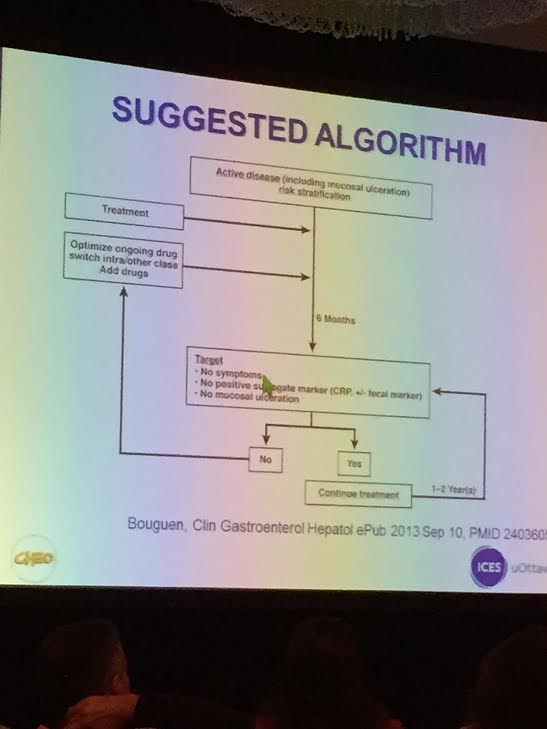
Is mucosal healing achievable?   If you were scoped and adjustments made in therapy, then much higher rate (HR >4) of remission. Bougen, Clin Gastroenterol Hepatol 12: 978.  Endoscopy may be best way to assess mucosal healing.  Since it is invasive, efforts have been made to identify surrogate markers.

Treat-to-Target Algorithm

Treat-to-Target Algorithm

Surrogate Markers

  • Ultrasound –can be useful but operator-dependent
  • MRE had 83% accuracy for endoscopic remission: Gastroenterol 2014; 146: 374.
  • Calprotectin not as accurate in children? Am J Gastroenterol 2014; 109: 637. Sensitivity high 97%, specificity for remission 68%
  • CRP –if elevated, higher risk of complications or surgery. However, sensitivity is much lower for disease activity than calprotectin/imaging studies for active disease
  • Drug levels. Therapeutic IFX trough levels (and adalimumab) are highly predictive of mucosal healing.

Bottomline (my interpretation): Resolution of clinical symptoms and improvement in bloodwork is not good enough.  When/timing to assess with sensitive surrogate markers is still uncertain.  In many patients, endoscopy is needed to assure adequate improvement; however, in others, a followup imaging study (eg. MRE) or sensitive stool assays may be the best approach.

A related story (from AGA’s Today in Medicine email feed & pointed out to me by Ben Gold) indicates that estimation of clinical symptoms is not accurate:

Survey Suggests Severity Of IBD Is Underestimated By Gastroenterologists.

MedPage Today (10/31, Walsh, 186K) reports that survey results presented at a medical conference indicate that “the severity of inflammatory bowel disease is significantly underestimated by gastroenterologists.” Researchers found that “a total of 55% and 67% of physicians who participated in a web-based survey rated cases of Crohn’s disease and ulcerative colitis as being mild when they were actually moderate.” Meanwhile, “for case studies that represented severe disease, 76% and 81% of the physicians gave ratings of either moderate or mild for Crohn’s disease and ulcerative colitis, respectively.”


Related blog posts:

Risk Stratification in Pediatric IBD: Are we there yet? Jeffrey Hyams (Connecticut Children’s

Initially, Dr. Hyams described the exploding head syndrome; many attendees might have thought they had this due to information/”big data” overload, but this syndrome is a sleep disorder/parasomnia event.  Here’s a link to the image from his talk.  Then, Dr. Hyams reviewed data on risk stratification:

  • Mutations: Some genetic mutations are associated with disease severity
  • Still needed: specific pediatric data
  • Microbiome: Some profiles associated as prognostic factors in pediatric RISK study
  • Early anti-TNF associated with improved outcomes (using propensity analysis) Gastroenterol 2014; 146: 383.

Bottomline: Not there yet with risk stratification. Many factors environmental, genetic susceptibility, immune response, and treatment need to be sorted out with “big data.”

Key Clinical Questions for your practice at this time:

  • Does this patient have known risk factors for doing poorly?
  • Am I using current therapies properly?
  • What is the risk of undertreated disease? This needs to be considered with discussion of safety of IBD meds.

Cross Examination of Cross-Sectional Imaging in IBD –Sudha Anupindi (Radiology/CHOP)

  • For the most part, barium studies discouraged (eg. UGI/SBFT) by speaker; radiation ~1 mSv.
  • CT (conventional) widely available and easy –if needed urgently/middle of night.

Initial presentation: imaging of choice

  • MR enterography –no radiation, better contrast resolution, best for perianal disease, able to evaluated peristalsis. Two limitations: cost, interpretation
  • CT enterography –fewer motion artifacts (0.6 seconds), lower cost, increased availability, better spatial resolution radiation reduced with current technology at most Children’s hospitals: 1-2 mSv

Abdominal ultrasound holds promise as alternative imaging with lower cost.


Pattern of Skin Reactions to Anti-TNF Agents

A recent study indicated a high rate of skin reactions to anti-TNFα in their pediatric inflammatory bowel disease (IBD) population (Inflamm Bowel Dis 2014; 20: 1309-15).

In a two-year prospective study, 84 children with IBD (64 with Crohn’s) who were receiving infliximab infusions were screened for skin changes and had labwork (blood tests and stool calprotectiin).

Key findings:

  • 40 (47.6%) had chronic skin reactions and half of these were considered severe. However, when looking at the “severe” lesions shown in Figure 2, one might question the characterization.
  • Ear lobes and scalp were affected most frequently with psoriasis-like manifestations, followed by eyelids, perioral and pubic areas, trunk, and extremities.
  • Skin reactions were more common in those with a low degree of intestinal inflammation based on calprotectin levels: 133 mg/g in those with skin changes compared with 589 in those without.
  • Seven patients (8.3% of entire cohort) discontinued therapy due to skin reaction.
  • Most patients responded well to topical potent corticosteroids.

Take-home message: In this prospectively-followed cohort, there was a surprisingly high rate of skin reactions.  In patients receiving anti-TNFα therapy, it is a good idea to look closely at their ears and scalp.

Related blog post:

TNF Antagonists and Psoriasis | gutsandgrowth

New Biomarker for Crohn’s Disease (Plus Two)

A recent study identifies a new biomarker for Crohn’s disease (CD) (Inflamm Bowel Dis 2014; 20: 1037-48).

The authors examined a cohort of 208 newly diagnosed pediatric CD and 43 non-IBD controls for ileal/rectal expression of FcγRIA mRNA.  In addition, in a smaller cohort of 26 newly diagnosed CD patients, 83 established CD patients and 30 non-IBD controls the authors measured peripheral blood polymorphonuclear neutrophil (PMN) CD64 index.

Key findings:

  • Ileal FcγRIA mRNA expression was significantly elevated in CD compared with non-IBD controls
  • PMN CD64 was significantly elevated in CD compared with non-IBD controls and correlated with mucosal injury as measured by the simple endoscopic score for CD.
  • Patients in clinical remission with a PMN CD64 <1 had a high rate of sustained remission (95%) whereas only 56% had sustained remission if PMN CD64 was >1.

Take-home point: This study shows in pediatrics, as in adults IBD patients, that PMN CD64 index is associated with mucosal inflammation; high levels are associated with clinical relapse.  Serum biomarkers are likely to complement stool biomarkers like fecal calprotectin.

One other point the authors make: “studies have found that 57% to 59% of CD have concurrent IBS.”  Thus, there is a need for biomarkers to distinguish whether patients with clinical symptoms are experiencing an inflammatory relapse.

Related blog post: Calprotectin: Part of diagnostic algorithm for IBD 

Two other studies in same issue:

“Alterations in the Intestinal Microbiome (Dysbiosis) as a Predictor of Relapse After Infliximab Withdrawal in Crohn’s disease” pages 978-86.  N=33 CD patients. Key finding: “CD-associated dysbiosis, characterized by a decrease in Firmicutes, correlates with the time-to-relapse after infliximab withdrawal.”

“Tissue Studies in Screened First-degree Relatives Reveal a Distinct Crohn’s Disease Phenotype” pages 1049-56. N=38 asymptomatic relatives. Key finding: based on histologic scoring 61% were normal, 26% had minor lesions, and 13% had evidence of active disease. This study indicates that screening relatives may identify a subset with early biologic disease.

Marriage, Divorce and Separation with Anti-TNF Therapy

This review article (Inflamm Bowel Dis 2014; 20: 757-66) examines the question of whether and when anti-tumor necrosis factor (anti-TNF) agents can be stopped in Crohn’s disease (CD) patients in remission.  This topic is particularly helpful since this comes up frequently in clinical practice.

As recently as a few years ago, one expert advised me that starting an anti-TNF agent (like infliximab or adalimumab) was like getting married.  Once you committed, you stayed in that relationship indefinitely.  Of course, it is well-known that individuals get divorced.  In medical terms, I guess that would be the equivalent of developing antibodies to the anti-TNF agent or other adverse reactions.  Switching from one anti-TNF to another would be equivalent to marital infidelity.

So what does this review article say about all of this?  The article examines nine studies with a little more than 500 patients.  “Current evidence suggests that a group of CD patients, possibly 30% to 40% in clinical remission while on IM (immunomodulators) and infliximab can stop the latter and maintain clinical remission for a relatively long interval.  It seems that, if followed long enough, virtually all patients (including those on IM) will eventually develop clinical recurrence.”

If tempted to separate but not divorce anti-TNF therapy, the authors recommend, in addition to clinical remission, “normal colonoscopy (and/or normal surrogate markers of disease activity) should be adopted as a criterion when stopping therapy and during follow-up….As of today, many authors do not recommend to routinely stop anti-TNF agents in patients responding to this therapy and in the absence of other issues.  Others propose to stop them after a minimum of 2 years of clinical and endoscopic remission or longer if only clinical remission can be documented…

If costs or other issues are present, we suggest to cautiously stop anti-TNF agents only in patients on combination therapy with profound (clinical, biochemical, and endoscopic) and long lasting (>1 year) remission and continuing the IM.  Such patients should be closely followed by serial determinations of fecal calprotectin and inflammatory indices, and the medication immediately restarted in the presence of a flare. When in doubt, colonoscopy should be performed.

Take-home message: Most patients are better off staying married to their anti-TNF therapy.

Also noted: Inflamm Bowel Dis 2014; 20: 742-56.  Clinical Utility of Fecal Biomarkers for the Diagnosis and Management of Inflammatory Bowel Disease.  This is a useful review with 103 references.

Calprotectin: Part of diagnostic algorithm for IBD?

Full text available at this link from Jeremy Adler: cghjournal.org/article/S1542-3565(13)01044-6/abstract#.Ut5vnV5z8Cw.twitter …

This article describes the use of fecal calprotectin (FC) levels as a screen for inflammatory bowel disease.  The false-negative rate for this assay is related to pre-test probability of having IBD.  Thus, in patients with a low probability of IBD, a normal calprotectin may allow avoidance of endoscopic evaluation and may be “particularly cost-effective when baseline clinical suspicion for IBD is low to moderate…the low FC cutoff value of 50 μg/g would substantially reduce the likelihood of false-negative FC, minimizing delayed diagnosis of true IBD.” In those with persistent symptoms, the article’s algorithm recommends proceeding with endoscopic evaluation.

Excerpt from abstract:

Conclusions

Screening adults and children to measure fecal levels of calprotectin is effective and cost-effective in identifying those with IBD on a per-case basis when the pre-test probability is ≤75% for adults and ≤65% for children. The utility of the test is greater for adults than children. Increasing the FC cutoff level to ≥50 μg/g increases diagnostic accuracy without substantially increasing total cost.

Related blog posts:

Remission in Crohn’s Disease

A recent article highlights the issue of remission in Crohn’s disease (CD) (Inflamm Bowel Dis 2013; 19: 1645-53).

As noted in previous blog entries (see links below), improvements in remission with ImproveCareNow and with previous drug trials have several limitations due to the current definition of remission.  Currently, even during periods of clinical remission (defined currently mainly by symptoms), laboratory or endoscopic evidence of persistent inflammation can be seen.  Persistent inflammation is likely to lead to progressive bowel damage. With the advent of more effective treatments as well as better biomarkers, a more objective measure of remission is needed.

“Remission is an evolving concept in CD. At its most fundamental level, remission should be a state with little or no risk of disease progression, likely implying the absence of biological evidence of inflammation.”

The authors proposed definitions of remission based on whether the patient has “early” disease or “late” disease.  Early disease “may be defined as disease duration ≤18 months without previous exposure to immunosuppressants or biologics.”

Early disease:

  • Biologic remission (inflammation control): a) mucosal healing on colonoscopy (no ulcers with the exception of a few aphthous ulcers <5 mm in diameter) and/or b) improvements in serum and fecal biomarkers: CRP < 5 mg/L, fecal calprotectin <250 mcg/g
  • Clinical remission in practice (symptom control): complete absence of symptoms; 1-2 formed stools per day without abdominal pain.  In a clinical trial, CDAI <150 points.
  • Outcomes: no disease progression or complications, normal quality of life

Late disease:

  • Biologic remission (inflammation control): a) mucosal healing on colonoscopy (no ulcers with the exception of a few aphthous ulcers <5 mm in diameter) and/or b) improvements in serum and fecal biomarkers: CRP < 5 mg/L, fecal calprotectin <250 mcg/g
  • Clinical remission (symptom control): a: inflammatory symptom improvement (may have residual symptoms due to previous damage or surgery). In clinical trial, CDAI 150-220 points.
  • Outcome: stabilization of noninflammatory symptoms and no progression of structural damage, improved quality of life

The authors goal is to rework remission to include symptom control and histologic/mucosal healing.  This concept is not novel.  Investigators in the adalimumab EXTEND study coined the term “deep remission.” This term referred to patients with both CDAI remission and complete mucosal healing.  Patients who achieved deep remission had improved outcomes, including fewer hospitalizations and fewer surgical resections (Gut 2010; 59: A80).

Bottomline: Improvements in both objective measures of biologic inflammation along with resolution of clinical symptoms are needed to change the long-term outcome for patients with Crohn’s disease.  The definition of remission should reflect this reality.

“When you can measure what you are speaking about and express it in numbers, you know something about it; but when you cannot express it in numbers, your knowledge is of a meagre and unsatisfactory kind” –Lord Kelvin 1883

Related blog entries:

Quality improvement and better outcomes in Pediatric Inflammatory Bowel Disease

More information on outcomes and quality improvement (QI) efforts are available from Cincinnati Children’s Hospital (JPGN 2012; 55: 679-88).  The QI efforts at Cincinnati are part of a broader effort in QI in pediatric IBD that has been discussed on a previous post (see below).

Our group has rejoined Improve Care Now (ICN) and I look forward to gaining more first hand experience.  Some of the ICN target goals:

  • 80% remission rate among each center and sustained remission rate of 45%
  • 76% steroid-free remission
  • 90% checking TPMT if using thiopurine
  • 95% checking PPD/chest xray if using biologic therapy
  • 95% using accepted methotrexate dosing

As I look at these goals, I wonder whether the remission rate is feasible and about the variation in different centers. For example, among the groups with >75% enrollment of their patients, one center reports a 89% remission rate and another center 64% remission rate.  Given the limited number of therapeutic agents, how could there be such a difference?  Some explanations could include variation in the use of more potent biologic agents as well as capturing/assuring followup of more patients who are doing well.

Given this backdrop, I looked at this most recent publication to learn how their QI practices could translate into better care for my patients.

In this retrospective chart review study of 505 patients, who were followed from 2007-2010 at the IBD center, the remission rate increased from 59% to 76%.  The data were captured prospectively.  This corresponded to improved patient global assessment (>7) from 69% to 80%.  Repeated steroid use dropped from 17% to 10%.  Vitamin D (25-OH D) improved and this also correlated with quiescent disease.

Remission rates were defined by a pediatric Crohn clinical disease index, the sPCDAI, or PUCAI for Ulcerative colitis.

Key observations:

  • There was a trend towards increased use of anti-TNFα therapy (along with decreased use of 6-mercaptopurine) during the study period, but this did not reach statistical significance. No statistical difference was identified in the use of any major IBD medication class.
  • Despite target goals, the only drug class with a statistically significant change in dosing was 5-ASA (from 42 mg/kg to 50 mg/kg).
  • Fecal calprotectin monitoring increased.  The QI team recommended that IBD patients with ‘inactive’ disease have a fecal calprotectin measured every 6 months.  Those with elevated values had therapeutic drug monitoring implemented.  “Fecal calprotectin >400 μg/g is associated with a higher chance of relapse in a pediatric cohort.”
  • Starting in 2009, increased vitamin D monitoring was implemented (every 6 months).  In patients with a serum 25-OHD level < 30 ng/mL, treatment with 50,000 units weekly (for 6-8 weeks) was recommended (8000 units if weight <20 kg).  Once serum 25-OHD was >30 ng/mL, patients were maintained on monthly dosing.
  • Preclinic planning also increased and corresponded to improved remission rates which were 67% in 2009 and 76% in 2010.
  • The authors conclude: “Our results show that significant improvement in patient outcomes were achieved following QI efforts that did not rely on new medications or therapies, rather through initiating novel care processes and standardization of care.”

I think this conclusion is misleading.  First of all, as the authors point out, they did change their therapeutic approach.  They started vitamin D in more patients, used anti-TNFα therapy in more patients, and increased dosing of 5-ASA agents.  Other gains in remission rate could have been related to improved followup of patients who were doing well.

Despite my skepticism about the conclusion, I think the overall achievements are laudable.  Decreasing variation of care and assuring that all patients receive the best care possible with our diagnostic tests and current therapies is certainly worthwhile.  When patient care is studied carefully, this makes sure that “standard” practice like checking TPMT status before thiopurine use, checking PPDs before anti-TNFα therapy, and using optimal drug dosing occur in virtually all patients.

Developing a checklist for each patient can help assure that best practices occur.  For those with electronic medical records, this may mean putting in more “hard stops.”  A hard stop means the physician cannot sign out of a chart without paying attention to a specific detail.  For example, if a physician orders methotrexate, a “hard stop” could come up if the dosing was not in the typical target range.

Useful link:

Link for disease classification (quiescent, mild, moderate, severe):

http://links.lww.com/MPG/A129

Related blog entries:

Predicting Necrotizing Enterocolitis with Fecal Biomarker

A recent study has shown some promise in detecting necrotizing enterocolitis (NEC) with a fecal biomarker, S100A12 (J Pediatr 2012; 161: 1059-64).

In this prospective study of 145 preterm infants with a birth weight <1500 g, stool samples were collected on alternated days for 4 weeks.  Fecal S100A12 and calprotectin were measured.  Calprotectin in previous studies has been shown to be a poor marker for NEC.

Fecal S100A12, also called calgranulin C, belongs to a novel group of proinflammatory molecules. It is released by activated or damaged cells under conditions of cell stress and indicates phagocyte-specific damage.

18 (12.4%) developed NEC.  Fecal S100A12 levels were elevated in severe NEC and also at 4-10 days beforehand.  The sensitivity, specificity, positive predictive values, and negative predictive values were 70%, 68%. 37%, and 89% respectively.  Thus, there is limited utility of this stool test due to the limited sensitivity/specificity.  There is substantial overlap between control patients and patients who developed NEC.  Furthermore, fecal S100A12 levels are age-dependent.  Generally, they are higher early in life, likely due to increased mucosal permeability.

Calprotectin levels were elevated at the onset of NEC (median 349 mg/kg) and 48 hours before onset (median 83 mg/kg).  The difference at 48 hours prior to onset did not reach statistical significance.