Large Study Shows FMT Efficacy/Safety in Children

Clinical Gastroenterol Hepatol 2019. In press: Efficacy of Fecal Microbiota Transplantation for Clostridium difficile Infection in Children Thanks to Ben Gold for this reference.

Abstract

Background & Aims

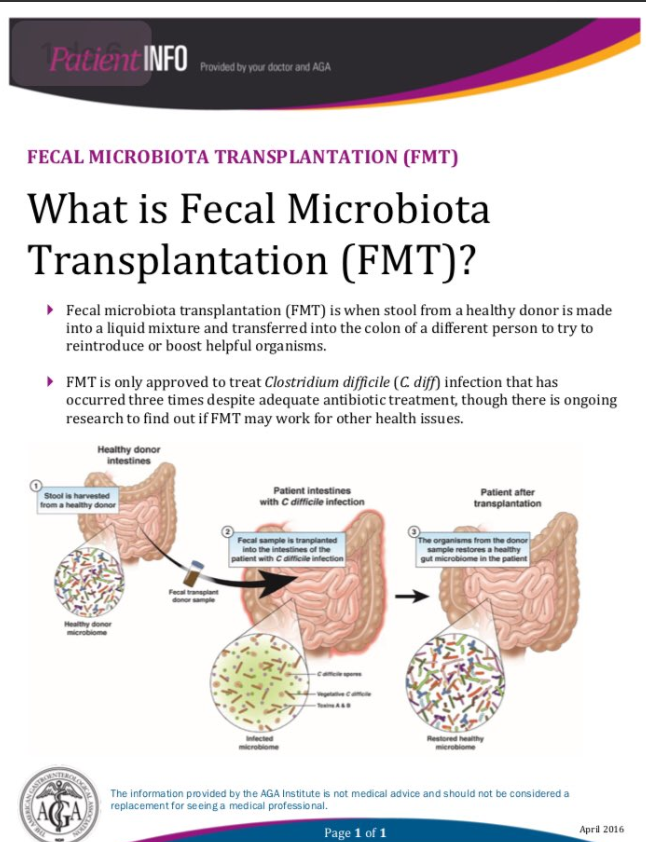
Fecal microbiota transplantation (FMT) is commonly used to treat Clostridium difficile infection (CDI). CDI is an increasing cause of diarrheal illness in pediatric patients, but the effects of FMT have not been well studied in children. We performed a multi-center retrospective cohort study of pediatric and young adult patients to evaluate the efficacy, safety, and factors associated with a successful FMT for the treatment of CDI.

Methods

We performed a retrospective study of 372 patients, 11 months to 23 years old, who underwent FMTs at 18 pediatric centers, from February 1, 2004 to February 28, 2017; 2-month outcome data were available from 335 patients. Successful FMT was defined as no recurrence of CDI in the 2 months following FMT. We performed stepwise logistic regression to identify factors associated with successful FMT.

Results

Of 335 patients who underwent FMT and were followed for 2 months or more, 271 (81%) had a successful outcome following a single FMT and 86.6% had a successful outcome following a first or repeated FMT. Patients who received FMT with fresh donor stool (odds ratio [OR], 2.66; 95% CI, 1.39–5.08), underwent FMT via colonoscopy (OR, 2.41; 95% CI, 1.26–4.61), did not have a feeding tube (OR, 2.08; 95% CI, 1.05–4.11), or had 1 less episode of CDI before FMT (OR, 1.20; 95% CI, 1.04–1.39) had increased odds for successful FMT. Seventeen patients (4.7%) had a severe adverse event during the 3-month follow-up period, including 10 hospitalizations.

Conclusion

Based on the findings from a large multi-center retrospective cohort, FMT is effective and safe for the treatment of CDI in children and young adults. Further studies are required to optimize the timing and method of FMT for pediatric patients—factors associated with success differ from those of adult patients.

Related blog posts:

Park Guell, Barcelona

Clostridium difficile and Cannabis

Briefly noted:

W El-Matary et al. J Pediatr 2019; 206: 20-5.  This study from Manitoba using electronic database found that the incidence rate of C difficile was stable from 2005-2015, with an overall rate of 7.8 per 100,000 person-years.  Children with Hirschsprung’s and inflammatory bowel disease had increased prevalence rates.

JL O’Loughlin et al. J Pediatr 2019; 206: 142-7. Using data from two longitudinal studies in Montreal (Cannabis is legal for adults in Canada since 2018), the authors examined the rate of cannabis initiation starting in 6th grade through 11th grade. Key finding was that cannabis use was 1.8 time more likely among children whose parents used cannabis.  Overall, cannabis use increased from 3.1% in grade 6 to 25.7% in grade 11.

What is erythromelagia?  This term was noted in the title of a recent report (J Pediatr 2019; 206: 217-24) and refers to bilateral episodic pain and redness that occurs in feet, hands and occasionally the ears.  In some case, symptoms progress proximally to involve the legs, arms, and rarely the face.


NY Times: The Battle Over Fecal Transplantation

NY Times: Drug Companies and Doctors Battle Over the Future of Fecal Transplants

This article highlights a concern that pharmaceutical companies may persuade the FDA to regulate fecal transplants similar to medications.  This will exponentially increase the cost and limit the access to beneficial human excrement. Thanks to one of my sons for pointing out this commentary to me.

An excerpt:

As pharmaceutical companies seek to profit from the curative wonders of human feces, doctors worry about new regulations, higher prices and patients attempting DIY cures…

The clash is over the future of fecal microbiota transplants, or F.M.T., a revolutionary treatment that has proved remarkably effective in treating Clostridioides difficile, a debilitating bacterial infection that strikes 500,000 Americans a year and kills 30,000…

At the heart of the controversy is a question of classification: Are the fecal microbiota that cure C. diff a drug, or are they more akin to organs, tissues and blood products that are transferred from the healthy to treat the sick? The answer will determine how the Food and Drug Administration regulates the procedure, how much it costs and who gets to profit…

Human feces, it turns out, are a potential gold mine, for both medical researchers and drug makers…

Inspired by the success of fecal transplants for C. diff, scientists are racing to develop similar treatments for an array of ailments and disorders, among them obesityautismulcerative colitis, and Alzheimer’s and Parkinson’s diseases…

For now, most of the material used in fecal transplants comes from OpenBiome, the public stool bank in Cambridge …The material comes from donors who earn $40 a pop and must pass intensive screenings and regular medical checkups. “It’s harder to become a stool donor than it is to get into M.I.T.,” said Carolyn Edelstein, who runs the organization…The F.D.A. has ramped up oversight of OpenBiome’s production, leading to more rigorous testing and higher prices, which will double to $1,600 this month.

Related blog posts:

From NY Times Twitter Feed

Fecal Microbioata Transplantation for Recurrent Clostridium difficile — Position Paper

A recent position paper (ZH Davidovics et al. JPGN 2019; 68: 130-43) from NASPGHAN/ESPGHAN on Fecal Microbioata Transplantation (FMT) for Recurrent Clostridium difficile infection (CDI) provides a pretty good review. Though, I think a summary table of recommendations would have made this publication much more helpful.

Here is a full-text link: Fecal Microbiota Transplantation for Recurrent Clostridium difficile Infection and Other Conditions in Children: A Joint Position Paper

A couple key points/excerpts:

In general, we concur with current adult guidelines  when considering FMT for the treatment of rCDI in children and propose FMT be considered in children with one of the following:
1. rCDI (recurrence of symptoms within 8 weeks of treatment for CDI) (either a or b)
a. At least 3 episodes of mild to moderate CDI and failure of a 6- to 8-week taper with vancomycin with or without an alternative antibiotic (eg, rifaximin, nitazoxanide).
b. At least 2 episodes of severe CDI resulting in hospitalization and associated with significant morbidity.

2. Moderate CDI not responding to standard therapy (including vancomycin) for at least 1 week. We recommend caution, however, in such cases, with repeated testing for etiologies other than CDI such as IBD.

3. Severe CDI or fulminant C difficile colitis with no response to standard therapy after 48 hours.

My take:  I think the IDSA 2017 guidelines are more useful: Clostridium difficile Guidelines (2017 IDSA/SHEA)

More related blog posts:

Fecal Microbiota Transplantation: How important is the BMI of the stool donor?

Currently fecal microbiota transplantation (FMT) “best practices” exclude obese stool donors based on a report of germ-free mice gaining weight after FMT from mice with obesity and based on a case report of an individual with 34 pound weight gain after FMT.

A recent report (M Fischer et al. Clin Gastroenterol Hepatol 2018; 16: 1351-3) suggests that the the BMI of the stool donor does not affect recipient weight after a single FMT procedure for C difficile infection.

This analysis included 173 patients with a mean age of 57 years.  One group of 103 were from a randomized control trial; in this group, 66 (64%) received FMT from a normal weight (BMI 18-24.9) donor and 37 (36%) received FMT from an overweight (BMI 25-29.9) donor. Among an additional 70 individuals from an observational cohort, 25 received FMT from normal weight donor, 30 received FMT from overweight donor, and 15 received FMT from an obese donor.

Key finding:

  • There was no significant difference in BMI among the FMT recipients up to 48 weeks after a single FMT.  Based on data from Figure 1, patients who received FMT from normal weight donor had slightly higher mean weight gain at 48 weeks afterwards (not statistically-significant)

The authors caution that a prospective study is required to confirm these findings and in the interim, they recommend exclusion of obese/overweight FMT donors.

My take: There are plenty of willing stool donors –so who knows if this will ever be examined adequately.  This study challenges the idea that FMT from an obese donor will result in recipient obesity, presumably via changes in the microbiome.

Related blog posts:

Clostridium difficile and Inflammatory Bowel Disease

My view is that Clostridium difficile infection (CDI) in children with inflammatory bowel disease is often overdiagnosed due to detection of a carrier state in many when tested by PCR assays and the overlapping clinical features.  This is particularly important when considering fecal microbiota transplantation (FMT) due to the potential risks of this treatment.

Recently, I had a letter to the editor (J Pediatr 2018; 199: 283) on this topic that was accepted:

The author’s reply suggested that their approach followed IDSA guidelines by checking CDI with PCR in those who were clinically-symptomatic.  Yet, the IDSA guidelines (link here: IDSA C diff guidelines) do not focus on the issue of IBD flare-ups which cause identical symptoms.  Expert IBD specialists have recommended the following for identifying CDI in patients with IBD:

“Start with enzyme immunoassay-based tests with a reflex to PCR test for discordant enzyme immunoassay results.”  Rationale: “PCR is quite sensitive for the presence of toxigenic C difficile, it may increase the detection of asymptomatic colonization and shedding.” (K Rao, PDR Higgins. Inflamm Bowel Dis 2016; 22: 1744-54.)

Related blog posts:


Use of Fecal Microbiota Transplantation for Primary Clostridium difficile Infection

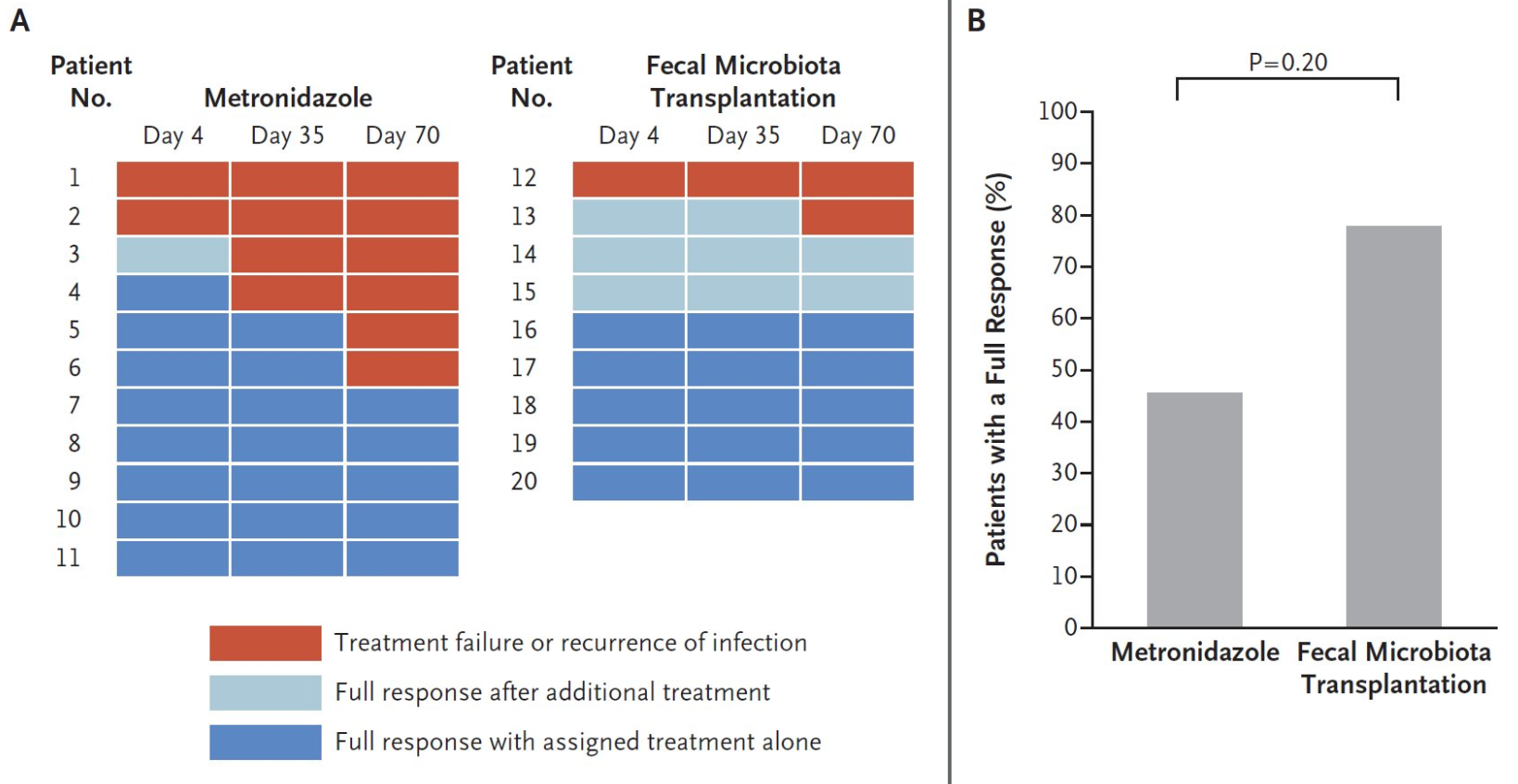
A recent letter (FE Juul et al. NEJM 2018; 378: 2535-6) describes the results of a small study in which fecal microbiota transplantation (FMT) (n=9) was compared with metronidazole (n=11) for primary treatment of Clostridium dificille infection. The primary end point was clinical cure (firm stool consistency ≤3 BMs/day) and no evidence of recurrent C diff infeciton.

Key findings:

  • In C diff group, 5 had full primary response and an additional 3 had full response after additional antibiotics which were added in in three of the four without primary response by day 4. By day 70, 7 of 9 (78%) had full response.
  • In metronidazole group, five had full primary response.  By day 70, only five of eleven (45%) had full response.

My take: It would probably be better to compare FMT to either vancomycin of fidaxomin  (rather than metronidazole) for primary treatment.  Until more data are available, this study does not change clinical practice of using antimicrobials for C diff as primary treatment.

Clostridium difficile Guidelines

Clinical Practice Guidelines for Clostridium difficile Infection in Adults and Children: 2017 Update by the Infectious Diseases Society of America (IDSA) and Society for Healthcare Epidemiology of America (SHEA)

Clinical Infectious Diseases, Volume 66, Issue 7, 19 March 2018, Pages e1–e48,https://doi.org/10.1093/cid/cix1085

Summary from Infectious Disease Advisor: Updated C difficile Infection Clinical Guidance From IDSA/SHEA

The comprehensive clinical practice guideline …was endorsed by the Infectious Diseases Society of America (IDSA) and the Society for Healthcare Epidemiology of America (SHEA)…

Recommendations for treatment of CDI in adults… now favors a 10-day course of vancomycin or fidaxomicin rather than metronidazole for first-line therapy of mild/moderate CDI in adults… Fidaxomicin, also a newly recommended first-line therapy for mild/moderate CDI in adults, may reduce the risk for recurrent CDI because of its narrow spectrum compared with vancomycin.

Recommended treatment strategies for recurrent CDI, a complication that occurs in approximately 25% of patients, have also been revised…Following initial CDI treated with a 10-day course of vancomycin, either a several-week tapered and pulsed course of vancomycin or a 10-day course of fidaxomicin is recommended. For most patients, probiotics can be considered because of favorable cost and safety, although definitive efficacy data for probiotics to prevent recurrent CDI are still lacking. For multiply recurrent CDI (ie, at least 3 CDIs), correction of the patient’s underlying intestinal microbiota perturbation with fecal microbiota transplantation (FMT) should be strongly considered..

The diagnosis of CDI… Molecular tests (eg, nucleic acid amplification tests [NAATs], such as polymerase chain reaction), which do not differentiate colonization and infection, are now the most commonly used test for CDI among US hospitals. NAATs have the potential to misdiagnose patients with colonization as having CDI, particularly when used in patients with low likelihood of CDI. Thus, this guideline strongly reinforces the importance of practicing good diagnostic stewardship and limiting C difficile testing to patients with new-onset, unexplained, and clinically significant (ie, at least 3 unformed stools in a 24-hour period) diarrhea…formed stools should not be tested for C difficile, nor should patients be retested within 7 days of a previous negative C difficile test. In pediatric populations, because of the unclear role of C difficile as a cause of diarrhea in infants, children less than 12 months of age should not be tested…

If diagnostic stewardship is not an achievable goal, use of NAAT alone is likely to lead to frequent misdiagnosis of CDI among patients with C difficile colonization. In these cases, NAAT alone should be avoided and a multistep algorithm that incorporates toxin testing is recommended.

Related blog posts:

Cumberland Island 2018

How to Cultivate Clostridium difficile Infections

The emergence of more frequent and virulent Clostridium difficile infections (CDIs) has generally been attributed to antibiotic usage.  A recent study (J Collins et al Nature 2018; 553, 291–4.  doi:10.1038/nature25178) suggests that changes in our diet are a contributing factor as well.

From Abstract:

Here we show that two epidemic ribotypes (RT027 and RT078) have acquired unique mechanisms to metabolize low concentrations of the disaccharide trehalose. RT027 strains contain a single point mutation in the trehalose repressor that increases the sensitivity of this ribotype to trehalose by more than 500-fold. Furthermore, dietary trehalose increases the virulence of a RT027 strain in a mouse model of infection. RT078 strains acquired a cluster of four genes involved in trehalose metabolism, including a PTS permease that is both necessary and sufficient for growth on low concentrations of trehalose. We propose that the implementation of trehalose as a food additive into the human diet, shortly before the emergence of these two epidemic lineages, helped select for their emergence and contributed to hypervirulence.

From GI & Hepatology News: Food additive makes C difficile more virulent: “Prior to 2000, trehalose was limited by a relatively high cost of production.”  However, with innovations in production, trehalose concentrations in food increased, particularly in ice cream, pasta, and ground beef; “concentration in food skyrocketed form around 2% to 11.25%.”  In addition, the FDA in 2000 noted that trehalose as “generally recognized as safe.”

My take“On the basis of these observations, we propose that the widespread adoption and use of the disaccharide trehalose in the human diet has played a significant role in the emergence of these epidemic and hypervirulent strains,” Dr. Collins and his colleagues wrote in Nature.

Flower Display in Las Vegas Hotel

Cost Effective Fecal Transplantation

A recent retrospective study (DE Brumbaugh et al. J Pediatr 2018; 194: 123-7) examined the effectiveness of intragastric fecal microbiota transplantation (FMT) for recurrent Clostridium difficile infection (CDI) in 42 children (47 FMTs).

Key findings:

  • 94% (16/17) success in otherwise healthy children
  • 75%  (9/12) success in medically complex children
  • 54% (7/13) success in inflammatory bowel disease.
  • Figure 2 describes cost: nasogastric FMT cost for hospital/professional charges was $1139 compared to $4998 for nasoduodenal FMT and $7767 for colonoscopy FMT

To understand the results better, one needs to look at their methods.  The authors defined CDI based on a positive fecal polymerase chain reaction (PCR) test.  All patients undergoing FMT had to have had >2 episodes of CDI.

The authors discuss the issue that asymptomatic Clostridium difficile carriage is common in IBD (“6 times that in healthy controls”) and the fact that true CDI can be difficult to ascertain as the relative contribution of IBD activity can be difficult to separate from CDI.  Interestingly, the authors did not comment on their use of PCR testing to establish infection.

As noted in a previous blog post (Overdiagnosis of Clostridium difficile with PCR assays), immunoassay testing for toxin is likely helpful in equivocal cases.  In an influential JAMA Intern Med study (JAMA Intern Med. 2015;175(11):1792-1801.  doi:10.1001/jamainternmed.2015.4114), virtually all CDI-related complications and deaths occurred in patients with positive toxin immunoassay test results. Patients with a positive molecular test result and a negative toxin immunoassay test result had outcomes that were comparable to patients without C difficile by either method.

Other useful points in this study:

  • The authors note that craniofacial anatomy may preclude NG placement in some patients (in some orogastric insertion could be an alternative)
  • Patients at high risk for GERD/aspiration along with general anesthesia patients are “not good candidates for FMT”
  • “If there is concern for undiagnosed IBD or other GI pathology, FMT via colonoscopy may be preferable” as FMT could be diagnostic and therapeutic.

My take: This study confirms the utility of intragastric FMT for recurrent CDI as a cost-effective option.  More careful examination of CDI in patients with IBD could result in determining which patients are most likely to benefit from FMT

Hoover Dam


Related blog posts: