Expert Advice on Clostridium difficile and Inflammatory Bowel Disease

Link: Management of Clostridium difficile Infection in Inflammatory Bowel Disease: Expert Review from the Clinical Practice Updates Committee of the AGA Institute

Abstract: The purpose of this expert review is to synthesize the existing evidence on the management of Clostridium difficile infection in patients with underlying inflammatory bowel disease. The evidence reviewed in this article is a summation of relevant scientific publications, expert opinion statements, and current practice guidelines. This review is a summary of expert opinion in the field without a formal systematic review of evidence.

Best Practice Advice 1: Clinicians should test patients who present with a flare of underlying inflammatory bowel disease for Clostridium difficile infection.

Best Practice Advice 2: Clinicians should screen for recurrent C difficile infection if diarrhea or other symptoms of colitis persist or return after antibiotic treatment for C difficile infection.

Best Practice Advice 3: Clinicians should consider treating C difficile infection in inflammatory bowel disease patients with vancomycin instead of metronidazole.

Best Practice Advice 4: Clinicians strongly should consider hospitalization for close monitoring and aggressive management for inflammatory bowel disease patients with C difficile infection who have profuse diarrhea, severe abdominal pain, a markedly increased peripheral blood leukocyte count, or other evidence of sepsis.

Best Practice Advice 5: Clinicians may postpone escalation of steroids and other immunosuppression agents during acute C difficile infection until therapy for C difficile infection has been initiated. However, the decision to withhold or continue immunosuppression in inflammatory bowel disease patients with C difficile infection should be individualized because there is insufficient existing robust literature on which to develop firm recommendations.

Best Practice Advice 6: Clinicians should offer a referral for fecal microbiota transplantation to inflammatory bowel disease patients with recurrent C difficile infection.


Related blog posts:

screenshot-94

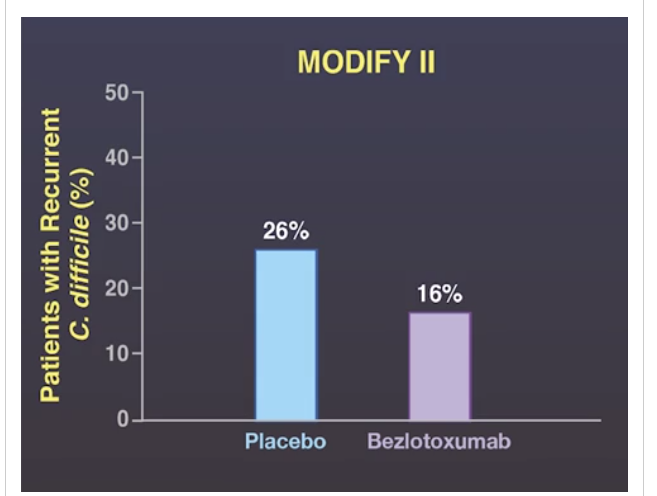
Quick Take: Preventing Recurrent Clostridium difficile Infection with Bezlotoxumab

A recent study on a new monoclonal antibody to prevent Clostridium difficile infection is available from the NEJM.  Here’s the link: Preventing Clostridium difficile Infection Recurrence

screenshot-79

screenshot-81

screenshot-83

My take: In Modify I and Modify II, Bezlotoxumab reduced the rate of Clostridium difficile recurrence in elderly patients (median age 66 years). In a high risk patients, the likely hefty cost of this medication may be warranted.

These studies were likely pivotal in receiving FDA approval: FDA Approves Merck’s ZINPLAVA™ (bezlotoxumab) to Reduce Recurrence of Clostridium difficile Infection

Store Your Stool at OpenBiome

Due to concerns regarding disruption of a person’s microbiome and C diff infection, there is now an option to store your own stool –should it be needed to restore your ‘health’ microbiome.

Here’s a link to the Gastroenterology & Endoscopy News Report: OpenBiome Now Stores Your Stool

An excerpt:

Banking one’s own stool is a particularly good idea for individuals who have an elective surgery scheduled and for those who are predisposed to developing C. difficile infections, such as patients with inflammatory bowel disease, Dr. Kassam said…

“Just like banking one’s blood prior to surgery, one should be able to bank their stool in anticipation of antimicrobial exposure after admission to a hospital,” Dr. Brandt said. “This is of even greater importance in the immunocompromised patient who requires multiple courses of antimicrobials.”

Related blog posts:

Acadia Natl Park

Acadia Natl Park

Molecular Panels for Identifying Etiology with Acute GI Symptoms

A recent study (MR Nicholson et al. J Pediatr 2016; 176; 50-6) examined the use of multiplex molecular testing to determine the etiology of acute gastroenteritis in children.  It is interesting that little has been published about this increasingly common practice of sending a 12 to 15 panel PCR assay when faced with acute GI symptoms, mainly diarrhea.

This study was a prospective population-based study of children <6 years with acute gastroenteritis (2008-2011).

Findings:

  • 70.4 % (152/216) samples tested positive for a pathogen, with norovirus the most frequent (n=78, 36.1%). Clostridium difficile was next at 16.2% (n=35).
  • 22.7% (n=49) tested positive for more than 1 pathogen including 25 with a C difficile detection
  • In this study, the authors noted C difficile colonization in 8% of healthy children aged 0-51 months and in 14% of children <12 months

Implications of this study and this technology:

  • Prior to this technology, traditional approaches typically identified less than 15% of the cases of acute gastroenteritis.  Thus, this new technology increases the likelihood of a definitive diagnosis.
  • Multiple pathogens, particularly with C difficile, illustrate how this new technology will present some difficulties with interpretation.  C difficile has very high rates of colonization in infants (anywhere from 25-80%) without AGE symptoms and lower rates of colonization in toddlers.  High colonization/detection has been noted in inflammatory bowel disease patients (17%) and pediatric oncology patients (30-55%).
  • For C difficile, molecular testing is much less likely to correlate with clinical disease than toxin-based assays. “A recent study in adults found that virtually all CDI-related complications occurred in patients with a positive toxin immunoassay.” (JAMA Intern Med 2015; 175: 1792-801)

My take: These panels are helpful in identifying infectious etiologies of AGE and may help prevent unnecessary endoscopic procedures.  Due to their limitations, careful selection of which patients to test and cautious interpretation of the results are needed.

Related blog posts:

Sunset from Bar Harbor, ME

Sunset from Bar Harbor, ME

FMT in the “Real World”

At DDW 2016, OpenBiome presented data (abstract Su1737) from 2,050 patients who received fecal microbiata transplants (FMT) in “the real world.”

Key findings:

  • Overall, 84% clinical cure rate with a single treatment
  • 85% of patients were treated with FMT via colonoscopy (250 mL) and 15% via nasal tube (50 mL). Nasal tube administration had a lower clinical cure rate of 77.9%, compared with 85.1% who had FMT via colonoscopy.

More information on this study: “Closet Thing to Miracle Cure”: Study Confirms Benefit of FMT in C difficile  Gastroenterology & Endoscopy News July 2016  This link also presents data on use of FMT in ulcerative colitis and the use of capsule FMT.

Related blog posts:

Lymphonodular Hyperplasia2

4 Points for C diff in Inflammatory Bowel Disease

A nice review: K Rao, PDR Higgins. Inflamm Bowel Dis 2016; 22: 1744-54.

Many aspects of Clostridium difficile with and without coexisting inflammatory bowel disease has been reviewed on this blog.  This review adds a few additional points:

  1. C difficile testing in patients with IBD, “start with enzyme immunoassay-based tests with a reflex to PCR test for discordant enzyme immunoassay results.”  Rationale: “PCR is quite sensitive for the presence of toxigenic C difficile, it may increase the detection of asymptomatic colonization and shedding.”
  2. Don’t test for C difficile in patients in clinical remission. “Clayton et al evaluated outpatients with IBD who were in clinical remission and had no recent exposure to antimicrobials, corticosteroids, immunomodulatory agents, or hospitalizations.  These patients had toxigenic C difficile carriage rates of 8.2%.”
  3. What to do when IBD patients test positive for C difficile infection (CDI) -treat which one or both? The authors recommend, that “if there is no response to the treatment for CDI after 48 hours, then concurrent immunologic therapy can be started/escalated.”
  4. Safety of FMT with IBD. “There may be additional risk incurred in the IBD population…[in a recent study] 14% of the subgroup of patients with IBD experienced adverse events including IBD flare, requiring hospitalization in some instances.” Overall, there is not enough data to “risk stratify patients in terms of these adverse outcomes.”

In addition to these pointers, advice on treatment based on severity and whether CDI is recurrent is listed on Table 1.

  • For primary CDI (nonsevere): metronidazole, vancomycin or fidaxomicin.
  • For primary CDI (severe): vancomycin or fidaxomicin.
  • For primary CDI (severe & complicated*): vancomycin at highest dose and IV metronidazole and (if ileus present) vancomycin rectally
  • Recurrent CDI: 1st recurrence — same as initial Rx, 2nd recurrence -same as initial Rx, then use either vancomycin pulsed and/or tapered regimen of 6 or more weeks

Related blog posts:

View from Grinnell Glacier Trail, Glacier Nat'l Park

View from Grinnell Glacier Trail, Glacier Nat’l Park

Disclaimer: These blog posts are for educational purposes only. Specific dosing of medications/diets (along with potential adverse effects) should be confirmed by prescribing physician/nutritionist.  This content is not a substitute for medical advice, diagnosis or treatment provided by a qualified healthcare provider. Always seek the advice of your physician or other qualified health provider with any questions you may have regarding a condition.

Recognizing Reactive Arthritis due to Clostridium difficile

A recent study shows that reactive arthritis can occur in children with Clostridium difficile infection and that recognition of this problem will improve management.

From JAMA Online First, DB Horton et al JAMA Pediatr. Published online May 16, 2016. doi:10.1001/jamapediatrics.2016.0217 (thanks to Ben Gold for this reference):

Abstract:

Importance  The incidence of Clostridium difficile infection has increased among children. The epidemiology of pediatric C difficile infection–associated reactive arthritis is poorly understood.

Objective  To characterize the incidence, recognition, and distinguishing clinical features of pediatric C difficile infection–associated reactive arthritis among children with C difficile infection.

Design, Setting, and Participants  In this cohort and nested case-control study using electronic health records from January 1, 2004, to December 31, 2013, across 3 geographically diverse pediatric health care networks, we screened for reactive arthritis among 148 children between ages 2 and 21 years with diagnostic or procedural codes suggesting musculoskeletal disease associated with C difficile diagnosis or positive testing. We identified 26 cases with acute arthritis or tenosynovitis within 4 weeks before to 12 weeks after confirmed C difficile infection with (1) no alternative explanation for arthritis and (2) negative synovial cultures (if obtained). Network-matched C difficile–infected controls without arthritis were randomly selected at the time of cohort member C difficile infections.

Main Outcomes and Measures  Incidence of C difficile infection–associated reactive arthritis was calculated based on (1) pediatric source population and (2) children with C difficile infection. Characteristics of cases and controls were compared using conditional logistic regression.

Results  Based on the cases identified within the source population of the 3 hospital networks, we estimated that C difficile infection–associated reactive arthritis incidence was 5.0 cases per million person-years (95% CI, 3.0-7.8). Reactive arthritis affected 1.4% of children with C difficile infection yearly (95% CI 0.8%-2.3%). Joint symptoms began a median of 10.5 days after initial gastrointestinal symptoms, often accompanied by fever (n = 15 [58%]) or rash (n = 14 [54%]). Only 35% of cases of C difficile infection–associated reactive arthritis were correctly diagnosed by treating health care professionals (range across centers, 0%-64%). Five affected children (19%) were treated for presumed culture-negative septic hip arthritis despite having prior postantibiotic diarrhea and/or other involved joints. Compared with controls, cases of C difficile infection–associated reactive arthritis were less likely to have underlying chronic conditions (odds ratio [OR], 0.3; 95% CI, 0.1-0.8). Although all cases had community-onset C difficileinfection and fewer comorbidities, they were more likely to be treated in emergency departments and/or hospitalized (OR, 7.1; 95% CI, 1.6-31.7).

Conclusions and Relevance  C difficile infection–associated reactive arthritis is an underdiagnosed, potentially morbid reactive arthritis associated with C difficile infection occasionally misdiagnosed as septic arthritis. Given the rising incidence of pediatric C difficile infections, better recognition of its associated reactive arthritis is needed.

Screenshot from JAMA website

Screenshot from JAMA website

Fecal Transplantation: “Frozen is as Good as Fresh”

Besides pointing out that someone could make $13,000 per year selling their stool, a recent Washington Post story summarized a JAMA study (JAMA. 2016;315(2):142-149. doi:10.1001/jama.2015.18098) which indicated that frozen stool works as well as fresh stool in treating Clostridium difficile infection.

In this study:

Design: Randomized, double-blind, noninferiority trial enrolling 232 adults with recurrent or refractory CDI, conducted between July 2012 and September 2014 at 6 academic medical centers in Canada.

Key finding: In the per-protocol population, the proportion of patients with clinical resolution was 83.5% for the frozen FMT group and 85.1% for the fresh FMT group

Washington Post Summary In fecal matter transplants, frozen is as good as fresh

Here’s an excerpt:

The new study, led by McMaster University’s Christine H. Lee and published Tuesday in JAMA, found that patients given donations that had been frozen for up to 30 days fared just as well as those given fresh samples…

Lee and her colleagues administered one or two FMT enemas to 178 patients, splitting them into two groups to compare freshly-harvested samples and ones that had been frozen and defrosted. Thirteen weeks later, 85 percent of the fresh patients were diarrhea-free. In the frozen group, the success rate reached 83.5 percent – a margin that allows Lee and her team to dub the treatment “noninferior.”

Related blog posts:

Bryce Canyon

Bryce Canyon.  This is where I was told to beware of ‘poison rock’ —  one drop can kill you

NY Times: “Should We Bank Our Own Stool?”

A provocative article poses the question: Should we bank our own stool?

Here’s an excerpt:

The scientific term for this is “autologous fecal transplant.” In theory, it could work like a system reboot disk works for your computer. You’d freeze your feces, which are roughly half microbes, and when your microbiome became corrupted or was depleted with antimicrobials, you could “reinstall” it from a backup copy.

That damage from antibiotics may not be trivial. Studies have linked antibiotic use early in life with a modestly increased risk of asthma,inflammatory bowel diseaseobesity and rheumatoid arthritis. These are associations, of course; they don’t prove that antibiotics cause disease…

Almost 60 years later, the “fecal transplant” is a cutting-edge treatment for the pathogen Clostridium difficile, a bug that kills 29,000 yearly and infects nearly half a million…

Memorial Sloan Kettering Cancer Center in New York has also started a proactive stool-banking study. Most of the subjects are patients with leukemia. Before stem cell transplants, patients receive antibiotics andchemotherapy, often wiping out their microbiota…

OpenBiome…started a pilot self-banking program called “PersonalBiome.” One complication: If he stores your stool, you can generally withdraw it only to treat C. difficile, not for preventive “reconstitution.” That’s because stool is regulated as a drug and not, as with embryos or blood, a tissue, which makes its use more complex.

Related blog posts:

Atlanta Botanical Garden, Bruce Munro Exhibit

Atlanta Botanical Garden, Bruce Munro Exhibit

Acid Suppression/C difficile and Adrenal Suppression/Topical Steroids

Briefly noted:

J Jimenez et al. (JPGN 2015; 61: 208-11) provide more data that gastric acid suppression is associated with an increase risk of Clostridium difficile infection (CDI). This was a retrospective case-control study with 138 children with CDI and 276 controls. After adjustment, acid-suppression therapy had a 1.8 Odds Ratio association with CDI.

S Harel et al. (JPGN 2015; 61: 190-3) in this retrospective ‘pilot’ study of  patients receiving topical budesonide for eosinophilic esophagitis, 6 of 14 (43%) had mild biochemical evidence of adrenal suppression, as measured by ACTH testing. Bottomline: a prospective study is likely needed to confirm or refute these findings. In the meanwhile, stress steroid coverage could be considered in patients on prolonged budesonide.