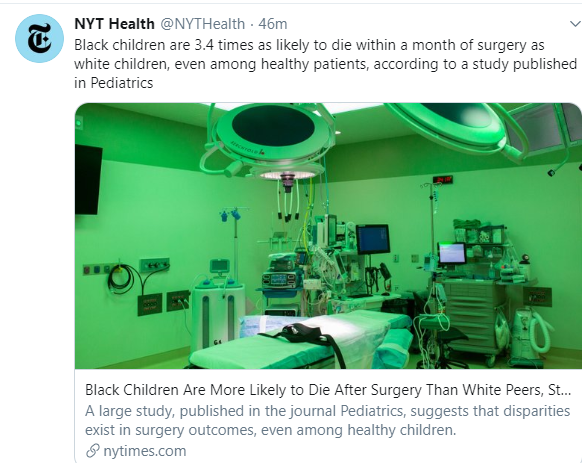
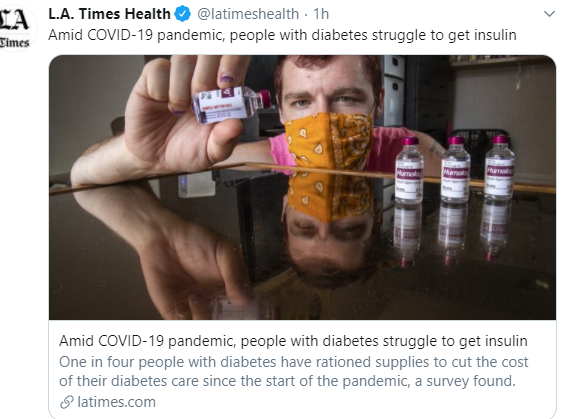
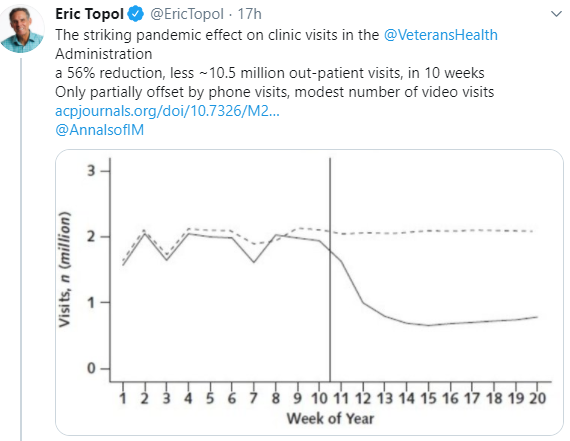
Missing Care Due to COVID-19

When analyzing health care expenditures, it has been well-recognized that many patients/families cut back on both necessary and unnecessary care when faced with increased costs; that is, individuals are not very good at selecting care that is truly essential.  This is one reason why many health care policy advisors are opposed to  high copays and deductibles as a way of reducing health care costs.

I have seen the same type of problem amidst the pandemic.  Due to fears of contracting SARS-CoV-2 (rather than mainly cost), individuals/families are deferring routine medical care.  This is leading to delays in diagnosis of many serious illnesses and missing opportunities to prevent illnesses (eg. vaccines).  A recent study has shown some of the impact with regard to cancer that happened early in the pandemic (and may be ongoing).

HW Kaufman et al. JAMA Netw Open. 2020;3(8):e2017267. doi:10.1001/jamanetworkopen.2020.17267. Full text: Changes in the Number of US Patients With Newly Identified Cancer Before and During the Coronavirus Disease 2019 (COVID-19) Pandemic

Introduction/Background:  In this study, we analyzed weekly changes in the number of patients with newly identified cancer before and during the COVID-19 pandemic.

Methods: This cross-sectional study included patients across the United States who received testing for any cause by Quest Diagnostic; data was compared between baseline period (January 6, 2019, to February 29, 2020) and the COVID-19 period (March 1 to April 18, 2020). n=278 778 patients. Study evaluated  breast cancer,  colorectal cancer, lung cancer,  pancreatic cancer, gastric cancer, and esophageal cancer.

Key findings:

  • During the pandemic period, the weekly number fell 46.4% (from 4310 to 2310) for the 6 cancers combined, with significant declines in all cancer types, ranging from 24.7% for pancreatic cancer (from 271 to 204; P = .01) to 51.8% for breast cancer (from 2208 to 1064; P < .001)

The authors noted a similar problem has been reported with cardiovascular disease.  A study from 9 high-volume US cardiac catheterization laboratories found a 38% decrease in patients treated for ST-elevation myocardial infarction, considered a life-threatening condition.

My take: It is difficult to calculate the actual toll of this pandemic which includes a great deal of secondary problems: delays in diagnosis of life-threatening conditions, mental health/suicides, death from poverty, setbacks in the opioid crisis & overdose deaths, and enormous setbacks in global health projects.

Related blog posts:

Published IBD-COVID-19 Data from SECURE-IBD & Others

When I received an email in EARLY MARCH of this year regarding SECURE-IBD, I thought the researchers were insightful and proactive.  Recently, the authors published their early findings: EJ Brenner, RC Ungaro et al. Gastroenterol 2020; 159: 481-491. Full Text PDF: Corticosteroids, But Not TNF Antagonists, Are Associated With Adverse COVID-19 Outcomes in Patients With Inflammatory Bowel Diseases: Results From an International Registry

“Surveillance Epidemiology of Coronavirus Under Research Exclusion for Inflammatory Bowel Disease (SECURE-IBD) is a large, international registry created to monitor outcomes of patients with IBD with confirmed COVID-19.”

Key findings:

  • 525 cases from 33 countries were reported (median age 43 years, 53% men)
  • Risk factors for severe COVID-19 among patients with IBD included increasing age (adjusted odds ratio [aOR], 1.04; 95% CI, 1.01–1.02), ≥2 comorbidities (aOR, 2.9; 95% CI, 1.1–7.8), systemic corticosteroids (aOR, 6.9; 95% CI, 2.3–20.5), and sulfasalazine or 5-aminosalicylate use (aOR, 3.1; 95% CI, 1.3–7.7).
  • Tumor necrosis factor antagonist treatment was not associated with severe COVID-19 (aOR, 0.9; 95% CI, 0.4–2.2)

Other COVID-19 articles from same journal:

My take: There is a tremendous amount of information regarding SARS-CoV-2 & COVID-19 with regard to the GI tract and liver disease.  For the most part, the data indicate that individuals need to continue to treat their underlying disease and that most therapies do not increase the risk of worsening infection; the biggest risk factors remain increasing age and common comorbidities (eg. obesity, hypertension, and diabetes).  The published studies also provide insight and recommendations for preventing SARS-CoV-2 for health care providers.

Related blog posts:

This May Be a Good Time to Be Wearing Glasses

W Zeng et al. JAMA Ophthalmol. Published online September 16, 2020. doi:10.1001/jamaophthalmol.2020.3906. full text  Association of Daily Wear of Eyeglasses With Susceptibility to Coronavirus Disease 2019 Infection

Findings  In this cohort of 276 patients hospitalized with COVID-19 in Suizhou, China, the proportion of daily wearers of eyeglasses was lower than that of the local population (5.8% vs 31.5%).

Meaning  These findings suggest that daily wearers of eyeglasses may be less likely to be infected with COVID-19.


COVID-19 Toll on U.S. Children

From AAP News: AAP Report: 513,415 children diagnosed with COVID-19

  • The latest report shows a rate of 680 COVID-19 cases per 100,000 children.
  • Children make up 9.8% of the total cases and about 1.7% of all COVID-19 hospitalizations, up from 0.8% of hospitalizations in late May.
  • Roughly 1.9% of children diagnosed with COVID-19 have been hospitalized, according to data from the 23 states and New York City that are publicly reporting hospitalization data.
  • There also have been at least 103 pediatric deaths in 42 states and New York City, making up about 0.07% of all COVID-19 deaths. Roughly 0.02% of children who have contracted known cases of COVID-19 have died.
  • There have been 792 confirmed cases of multisystem inflammatory syndrome in children in 42 states, New York City and Washington, D.C., and 16 death

Briefly noted: COVID-19 Cardiac Toxicity, U.S. Pandemic Research, Air-Bus Transmission

VO Puntmann et al. JAMA Cardiol. Published online July 27, 2020. doi:10.1001/jamacardio.2020.3557. Full text: Outcomes of Cardiovascular Magnetic Resonance Imaging in Patients Recently Recovered From Coronavirus Disease 2019 (COVID-19)

Conclusion:  In this study of a cohort of German patients recently recovered from COVID-19 infection, CMR revealed cardiac involvement in 78 patients (78%) and ongoing myocardial inflammation in 60 patients (60%), independent of preexisting conditions, severity and overall course of the acute illness, and time from the original diagnosis. These findings indicate the need for ongoing investigation of the long-term cardiovascular consequences of COVID-19.

NY Times: E Emanuel et al.  Where Is America’s Groundbreaking Covid-19 Research? The U.S. could learn a lot from Britain.

Excerpt: “ Yet with over six million coronavirus cases and 183,000 deaths, the United States has produced little pathbreaking clinical research on treatments to reduce cases, hospitalizations and deaths. Even one of the most important U.S. studies to date, which showed that the antiviral drug remdesivir could reduce the time Covid-19 patients spent in the hospital to 11 days from about 15, had too few subjects to demonstrate a statistically significant reduction in mortality…[British] researchers found no benefits from the use of hydroxychloroquine in hospitalized Covid-19 patients, nor from the lopinavir-ritonavir drug combination. On the other hand, dexamethasone, an inexpensive steroid, was found to reduce mortality by up to one-third in hospitalized patients with severe respiratory complications.” 

“Unfortunately, unlike Britain, the United States has lacked a clear, unified message from government health care leaders, major insurance companies and hospital systems to put in place large, simple randomized trials that are considered the standard of care for Covid-19 treatment. We need to change that muddled approach now and reassert the nation’s clinical research excellence.

NY Times: Roni Rabin. How a Bus Ride Turned Into a Coronavirus Superspreader Event

An excerpt: “A passenger on one of the buses had recently dined with friends from Hubei. She apparently did not know she carried the coronavirus. Within days, 23 fellow passengers on her bus were also found to be infected.

It did not matter how far a passenger sat from the infected individual on the bus, according to a study published in JAMA Internal Medicine on Tuesday. Even passengers in the very last row of the bus, seven rows behind the infected woman, caught the virus…

The new study “adds strong epidemiological evidence that the virus is transmitted through the air, because if it were not, we would only see cases close to the index patient — but we see it spread throughout the bus,” said Linsey Marr…

[THIS]  took place on Jan. 19, when there were still no confirmed Covid-19 cases reported in Ningbo…The potential for airborne transmission in close confined spaces raises concern about the winter months, when people will be spending more time indoors, Dr. Marr said. Her advice: “Avoid crowded indoor spaces where people are not wearing masks and the ventilation is poor.”

COVID-19 -New Infection Fatality Data & How to Fix the Testing Mess

From Annals of Internal Medicine 2020 https://doi.org/10.7326/M20-5352: J Blackburn et al. Full Text: Infection Fatality Ratios for COVID-19 Among Noninstitutionalized Persons 12 and Older: Results of a Random-Sample Prevalence Study

Background: Mortality rates have been calculated from confirmed cases, which overestimates the infection fatality ratio (IFR). To calculate a true IFR, population prevalence data are needed from large geographic areas where reliable death data also exist.

Results: The Table below suggests IFR of 0.01% for those <40, 0.12% for those 40-59, and 1.71% for those ≥60 in noninstitutionalized persons.  The Table indicates nearly a 3-fold increase risk in Non-White persons. Whites had an IFR of 0.18%; non-Whites had an IFR of 0.59%. Also, I think the Table incorrectly suggests that Females have a higher IFR than Males (but the numbers suggest that they are equivalent).

From The New Yorker, Atul Gawande: We Can Solve the Coronavirus-Test Mess Now—If We Want To

This is a lengthy article which describes some of the mistakes that we’ve made with testing, some of the technical details with various tests, pooled testing, at-home testing, wastewater testing, and how to fix testing (including assurance testing) to gain control of this pandemic.

An excerpt:

We could have the testing capacity we need within weeks. The reason we don’t is not simply that our national leadership is unfit but also that our health-care system is dysfunctional….

In the United States, getting a test is anything but easy…[And] through early August, results routinely took four days or more, making the tests essentially useless. 

Assurance testing” has been required by countries such as IcelandFrance, and Germany for travellers from abroad in order to avoid a mandatory two-week quarantine

For SARS-CoV-2–Is 2 Meters Enough?

NR Jones et al. BMJ 2020;370:m3223. Full Text: Two metres or one: what is the evidence for physical distancing in covid-19?

Key messages from article:

  • Current rules on safe physical distancing are based on outdated science
  • Distribution of viral particles is affected by numerous factors, including air flow
  • Evidence suggests SARS-CoV-2 may travel more than 2 m through activities such as coughing and shouting
  • Rules on distancing should reflect the multiple factors that affect risk, including ventilation, occupancy, and exposure time

Highlighted article from Eric Topol’s Twitter Feed

A more nuanced approach is recommended by authors -color-coded Figure 3 above –caption: “Risk of SARS-CoV-2 transmission from asymptomatic people in different settings and for different occupation times, venting, and crowding levels (ignoring variation in susceptibility and viral shedding rates). Face covering refers to those for the general population and not high grade respirators. The grades are indicative of qualitative relative risk and do not represent a quantitative measure. Other factors not presented in these tables may also need to be taken into account when considering transmission risk, including viral load of an infected person and people’s susceptibility to infection. Coughing or sneezing, even if these are due to irritation or allergies while asymptomatic, would exacerbate risk of exposure across an indoor space, regardless of ventilation.”

COVID-19: At-Risk Populations, Moral Distress, and Related News

Before today’s post –more on voting this year:

Democracy Docket Four Ways to Safely Cast Your Ballot without USPS

  • This article also has very helpful links to all of the states’ resources, regulations, and contacts

Several recent commentaries have shown scenarios impacted by this pandemic.  Thanks to Ben Gold for sharing these references.

CA Wong et al. Pediatrics, Mitigating the Impacts of the COVID-19 Pandemic Response on At-Risk Children

Here, we (1) highlight the health risks of the pandemic response measures to vulnerable pediatric subpopulations and (2) propose risk mitigation strategies that can be enacted by policy makers, health care providers and systems, and communities.

  • Children With Behavioral Health Needs
  • Children in Foster Care or at Risk for Maltreatment
  • Children With Medical Complexity

R Cholera et al. Pediatrics. Full link: Sheltering in Place in a Xenophobic Climate: COVID-19 and Children in Immigrant Families

One in 4 children (>18 million) in the United States lives in an immigrant family, in which the child or ≥1 parent was born outside the United States.1 Among children in immigrant families (CIF), >7 million live in “mixed-status” families, meaning ≥1 parent is not a US citizen.2 The COVID-19 pandemic amplifies existing inequities and introduces new ones as immigrant families navigate school closures, lack of health insurance and paid leave, and decisions to seek medical care or public services amid ongoing immigration enforcement. Additionally, immigrant families are more likely to live in multigenerational households,4 heightening the risk of COVID-19 for multiple family members…For CIF in US communities coping with persistent fears of immigration enforcement and family separation, economic devastation during a pandemic may threaten the stability of place. In this article, we apply a health equity framework5 to evaluate the impact of COVID-19 on CIF and highlight opportunities for advocacy and action for pediatricians, hospitals and health care systems, and policymakers to mitigate the unique risks faced by CIF

AM Evans et al. Pediatrics:  Pediatric Palliative Care in a Pandemic: Role Obligations, Moral Distress, and the Care You Can Give

Moral distress refers to the experience of being unable to take the action that one believes to be morally right or required.1 the inability to provide care because of resource constraints, involvement in care that one deems to be against a patient’s interests, and disputes about care planning with families and within teams…

We cannot have an obligation to save a life that cannot be saved: we can only be obliged to do what we can… It is only your role to act well within your scope of responsibility and to be the best clinician that you can be under the circumstances. Recognizing the limits of one’s powers can relieve a burden of guilt that is unconnected with one’s own choices and actions.


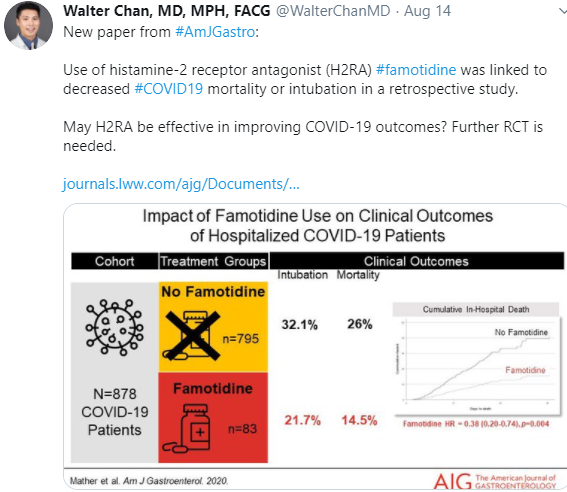
Famotidine may be helpful based on a retrospective study:


This long piece from Slate details the myriad public health mistakes in the U.S. approach to COVID-19: The Trump Pandemic

Screenshots and Tweets; MCAT Exposures, Uninsured in Texas, Health Inequalities, a Joke, Other News

Good Reads:

  1. Wired: Bill Gates on Covid: Most US Tests Are ‘Completely Garbage’
  2. MMWR: Hospitalization Rates and Characteristics of Children Aged <18 Years Hospitalized with Laboratory-Confirmed COVID-19 — COVID-NET, 14 States, March 1–July 25, 2020 “Analysis of pediatric COVID-19 hospitalization data from 14 states found that although the cumulative rate of COVID-19–associated hospitalization among children (8.0 per 100,000 population) is low compared with that in adults (164.5), one in three hospitalized children was admitted to an intensive care unit…Among 222 (38.5%) of 576 children with information on underlying medical conditions, 94 (42.3%) had one or more underlying conditions . The most prevalent conditions included obesity (37.8%), chronic lung disease (18.0%), and prematurity (gestational age <37 weeks at birth, collected only for children aged <2 years) (15.4%)end highlight.”  Key finding: Using a multisite, geographically diverse network, this report found that children with SARS-CoV-2 infection can have severe illness requiring hospitalization and intensive care.

COVID-19 Physician’s Personal Experience

Link: MY COVID-19 Excerpts: