Pediatric NAFLD: You Don’t Have to be Obese/Overweight to Have Fatty Liver Disease (but it helps)

A recent study (P Kumar et al. JPGN 2018; 67: 75-9) examined suspected NAFLD in 12 to 18 year olds using data from NHANES. In the analysed cohort, there were 124 suspected NAFLD and 1385 without suspicion of NAFLD.  This subset was weight to represent a U.S. population of over 18 million.

Key definitions:

  • Suspected NAFLD was defined by abnormal ALT (>25.8 U/L for boys and >22.1 U/L for girls) who did not have another explanation (eg. viral hepatitis, medication)
  • Lean BMI was defined by BMI less than 85th% for age
  • Hypertriglyceridemia ≥ 150
  • Low HDL ≤ 40 mg/dL
  • HOMA-IR =fasting glucose x insulin (microU/mL) divided by 405. Insulin resistance was defined as HOMA-IR ≥ 3

Key findings:

  • Suspected NAFLD affects ~8% of lean adolescents in the U.S.
  • Hypertriglyceridemia was noted in 10 of 124 suspected NAFLD and was a risk factor (P=0.028) as was Low HDL which occurred in 15 (P=0.016) and IR which occurred in 43 (P=0.053)

My take: Elevated ALT, a marker for fatty liver disease, is common even in adolescents without obesity. Elevated triglycerides, low HDL, and insulin resistance are all risk factors for suspected NAFLD in non-overweight/non-obese teens.

Related blog posts:

Cumberland Island 2018

Pilot Study: Treating Obstructive Sleep Apnea with Beneficial Effects on Fatty Liver Disease in Children

Briefly noted: A small pilot study (n=9) (SS Sundaram et al. J Pediatr 2018; 198: 67-75) showed that treatment (with home CPAP) of obstructive sleep apnea (OSA) was associated with improved alanine aminotransferase levels, reduced metabolic syndrome markers and lower F(2)-isoprostanes (a marker of oxidative stress) in pediatric patients with nonalcoholic fatty liver disease (NAFLD). All nine of the participants were Hispanic males with a median age of 11.5 years; they had a median BMI of 29.5 and had biopsy-proven NAFLD. The improvement in NAFLD parameters occurred despite an increase in BMI. The authors note that studies in adults have shown contradictory findings with regard to whether treatment of OSA helps NAFLD.

My take: This study suggests potential beneficial liver effects of treating OSA.  Regardless, treatment of OSA could be considered a quality metric in the care of children with NAFLD as better sleep at night has additional clear benefits.

Related blog posts:

Outside Mercedes-Benz Stadium (Atlanta)

Possible Quality Metric for Fatty Liver Disease: Dyslipidemia

With nonalcoholic fatty liver disease (NAFLD), it is well-documented that adverse cardiovascular events influence mortality more than any other factor.  Dyslipidemia plays an important role in these outcomes.

A recent study (KE Harlow et al. J Pediatr 2018; article in press. DOI: https://doi.org/10.1016/j.jpeds.2018.02.038) indicates that “clinically actionable dyslipidemia” is present in more than half of pediatric patients with NAFLD.

This multicenter, longitudinal cohort study included children (n=585) with NAFLD enrolled in the National Institute of Diabetes and Digestive and Kidney Diseases Nonalcoholic Steatohepatitis Clinical Research Network.

Key findings:

  • The prevalence of children warranting intervention for low-density lipoprotein cholesterol at baseline was 14%. After 1 year of recommended dietary changes, 51% achieved goal low-density lipoprotein cholesterol, 27% qualified for enhanced dietary and lifestyle modifications, and 22% met criteria for pharmacologic intervention
  • Elevated triglycerides were more prevalent, with 51% meeting criteria for intervention at baseline. At 1 year, 25% achieved goal triglycerides with diet and lifestyle changes, 38% met criteria for advanced dietary modifications, and 37% qualified for antihyperlipidemic medications.

My take: Assessing/managing dyslipidemia is an important component of NAFLD care.

Link to abstract: Clinically Actionable Hypercholesterolemia and Hypertriglyceridemia in Children with Nonalcoholic Fatty Liver Disease

Related blog posts:


Liver Articles -Spring 2018

C Sikavi et al. Hepatology 2018; 67: 847-57.  This systematic review highlights that the combination of hepatitis C virus (HCV) infection and HIV infection is no longer a difficult-to-treat population with the implementation of direct-acting antivirals (DAAs). There are similar sustained virologic responses (SVRs) among those with and those without HIV.  In clinical trials, patients with combined HCV-HIV had SVRs of 93.5-98% with DAA treatment; “real-world cohorts” had SVRs of 90.9%-98%.

MS Middleton et al. Hepatology 2018; 67: 858-72.  Using data from the prospective CyNCh trial (cysteamine for NAFLD), the authors examined MRIs for diagnostic accuracy among 169 enrolled children.  In this group, 110 (65%) and 83 (49%) had MRI and liver biopsy at baseline. MRI-PDFF (proton density fat fraction) was able to classify grade 1 steatosis from grade 2-3 steatosis with area under receiving operator characteristic curve of 0.87.  Thus, this study shows MRI-estimated PDFF has high diagnostic accuracy.

G Mieli-Vergani et al. JPGN 2018; 66: 345-60.  Position paper for Pediatric Autoimmune Liver Disease (AIH, ASC, de novo AIH after liver transplantation). This is a very useful review.  A couple of pointers from the authors:

  • “Present experience with budesonide as the first-line treatment is limited and does not appear to offer clear clinical advantage over the standard treatment”[prednisone]
  • Fecal calprotectin should be obtained to evaluate for IBD in patients with autoimmune liver disease, “even in asymptomatic children.”

JM Cotter et al. JPGN 2018; 66: 227-33. This retrospective study with 39 patients with primary sclerosing cholangitis (PSC) showed a lack of correlation between liver tests and fibrosis at presentation.  Average age of PSC diagnosis was 11.2 years, 74% had inflammatory bowel disease and 51% had autoimmune hepatitis. Related blog post: Big Pediatric PSC Study (with 781 children)

Mechanisms in Fatty Liver Disease Improved After Bariatric Surgery

A recent prospective study (V Nobili et al. J Pediatr 2018; 194: 100-8) consecutively enrolled 20 severely obese adolescents with biopsy-proven nonalcoholic fatty liver disease (NAFLD). The authors used liver histology, immunohistochemistry and cytokine analysis to assess the changes (after 12 months) induced by bariatric surgery with laparoscopic sleeve gastrectomy (LSG).

Key findings:

  • NAFLD Activity Score and fibrosis improved after LSG. Steatosis, hepatocyte ballooning, and NAS score showed a significant improvement (Z=-2.7; P=.007) at 12 months following surgery. Fibrosis improvement (Z=-2.449) was noted as well.
  • The histologic improvement “is associated with activation of local cellular compartments (hepatic progenitor cells, hepatic stellate cells, and macrophages), thus, strengthening the role of cellular interactions and hepatic adipocytokine production in the pathogenesis of NAFLD.”

This study has a large number of figures illustrating the changes in liver architecture and immunohistochemistry changes.

My take: This study shows specific improvements following LSG and shows correlation with cytokines and immunohistochemistry providing a mechanistic explanation for these improvements.

Related blog posts:

How Successful is Liver Transplantation for Fatty Liver Disease?

A recent guideline update (ZM Younossi. Liver Transplantation 2018; 24: 166-70) provides some useful information about nonalcoholic fatty liver disease (NAFLD), nonalcoholic steatohepatitis (NASH), and liver transplantation (LT).

Key points:

  • “Despite metabolic comorbidities, posttransplant outcomes of NASH patients are generally good.  In fact, 1-, 3-, and 5-year patient and graft survival rates are …similar to other liver diseases.”
  • NASH/NAFLD can recur following LT…”NASH with significant fibrosis (stage ≥2) occurs in approximately 5% of recipients by 5 years after transplantation.”
  • Additional issues to manage after LT, include weight management, and metabolic conditions including diabetes, hypertension, dyslipidemia, and hypertension.  All of these conditions can be affected by specific immunosuppressants.  For example, calcineurin inhibitors and corticosteroids can exacerbate type 2 diabetes mellitus.

My take: This article indicates better LT outcomes than I expected in patients with NASH/NAFLD.

Related blog posts:

Bright Angel Trail

NAFLD Guidance from American Association for the Study of Liver Diseases

Link: AASLD Guidance for the Diagnosis and Management of Nonalcoholic Fatty Liver Disease

This guidance provides a 2018 review of NAFLD and current diagnostic/management recommendations in both adults and children.  Some points from this practice guidance:

  • “Liver-related mortality is the second or third cause of death among patients with NAFLD.” Cardiovascular disease remains the number one and cancer-related mortality is in the top three.
  • “Routine screening for NAFLD in high-risk groups attending primary care, diabetes, or obesity clinics is not advised at this time because of uncertainties surrounding diagnostic tests and treatment options.” Likewise, screening of family members is not recommended.
  • In children: “Because of a paucity of evidence, a formal recommendation cannot be made with regard to screening for NAFLD in children with overweight and obesity.”
  • In patients undergoing evaluation with suspected NAFLD, the authors specifically recommend checking ferritin, iron saturation, and autoantibodies that could indicate autoimmune liver disease.
  • In patients with suspected NAFLD, the authors recommend evaluation for comorbities including dyslipidemia, diabetes, hypothyroidism, polycystic ovary syndrome, and sleep apnea.
  • “Liver biopsy should be considered in patients with NAFLD who are at increased risk of having…advanced fibrosis” and in “whom competing etiologies…cannot be excluded without a liver biopsy.”
  • Pharmacologic therapies are not recommended in those without biospy-proven NASH and fibrosis.  Specifically, the authors suggest consideration of pioglitazone and vitamin E and recommend against metformin, GLP-1 agonists, omega-3 fatty acids, and ursodeoxycholic acid.
  • “Weight loss (7%-10%) is needed to improve the majority of histopathological features of NASH.”
  • In patients with cirrhosis due to NASH, screening for varices is recommended and consideration of screening for HCC.

My take: This practice guidance is quite reasonable.  At this time, more focus on systemic measures to counter overweight and obesity is crucial.  Pharmacologic therapies for NAFLD will need to be effective for the cardiovascular, metabolic, and liver-related problems.

Related blog posts:

Bright Angel Trail, Grand Canyon

Silymarin for Nonalcoholic Steatohepatitis

A recent study (CW Kheong et al. Clin Gastroenterol Hepatol 2017; 15: 1940-9) examined the use of silymarin (milk thistle) in a randomized, placebo-controlled, double-blind trial for nonalcoholic steatohepatitis (NASH). Patients (n=49) who were assigned to silymarin received 700 mg three times a day for 48 weeks; there were 50 patients assigned to placebo..

Key findings: 

  • Silymarin did not significantly improve the primary outcome of achieving a lower NAS score by 30% or more; this occurred in 32.7% of the silymarin group vs. 26.0% in the placebo group.
  • Reduction in fibrosis was noted in the silymarin group (histology drop by 1 point or more): 22.4% compared to 6.0% in the placebo group.

Silymarin has many potential beneficial properties: anti-oxidant, anti-inflammatory, anti-fibrotic, anti-viral, and metabolic functions.

My take: Given the safety of silymarin, if these findings can be confirmed in a larger trial, it would be an exciting advance in the field of fatty liver disease which has no proven pharmacologic therapies.

Related blog post:


Grand Canyon Basin

Fatty Liver Disease with Craniopharyngioma and with Down Syndrome

A recent retrospective study (SY Yung et al. Ann Pediatr Endocrinol Met 2017; 22 https://doi.org/10.6065/apem.2017.22.3.189 –thanks to Jeff Schwimmer for this reference) describes the problem of nonalcoholic fatty liver disease (NAFLD) in long-term survivors of childhood-onset (CO) craniopharyngioma.

This study reviewed 75 children with CO-craniopharyngioma who had surgery prior to 15 years of age. The mean followup was 4.3 years.

Key findings:

  • 51 had either elevated AST or ALT above 40 IU/L. ALT ≥60 IU/mL was observed in 15 patients.
  • Estimated prevalence of NAFLD based on mainly imaging was 47%. 27 underwent ultrasonography and 5 underwent CT scan.
  • Among those with available growth data, 41% were obese and 18% were overweight.
  • NAFLD developed within a year after surgery in many patients.

This study had many limitations, including reliance of ultrasonography for diagnosis and incomplete evaluations.  Despite this, it is clear that hypothalamic obesity places patients at a high risk for developing NAFLD.  In addition, NAFLD in this population may be more aggressive.

My take: This study documents the well-recognized phenomenon of NAFLD in CO-craniopharyngioma with obesity.  Current treatment relies on trying to preserve hypothalamic function and optimizing lifestyle/nutrition.

Briefly noted: D Valentini et al. J Pediatr 2017; 189: 92-7.  Using ultrasound in 280 Italian children with Down syndrome, the authors identified NAFLD in 45% of those considered nonobese and 82% of those overweight/obese. In a related commentary (pg 11-13 Full text: Down syndrome and Pediatric NAFLD …), the authors (AD Matteo, P Vajro) note that Down syndrome patients may have increased NAFLD due to less activity, more obesity including possible excess adiposity in those with normal BMI, obstructive sleep apnea, or perhaps other mechanisms.

Related blog posts:


Fructose Restriction Improved Fatty Liver Disease in Children

A recent study (J-M Schwarz et al. Gastroenterol 2017; 153: 743-52, editorial MB Vos, IR Goran Gastroenterol 2017; 153: 642-5 ) showed that restriction of fructose quickly improved fatty liver disease.

Several points from the editorial:

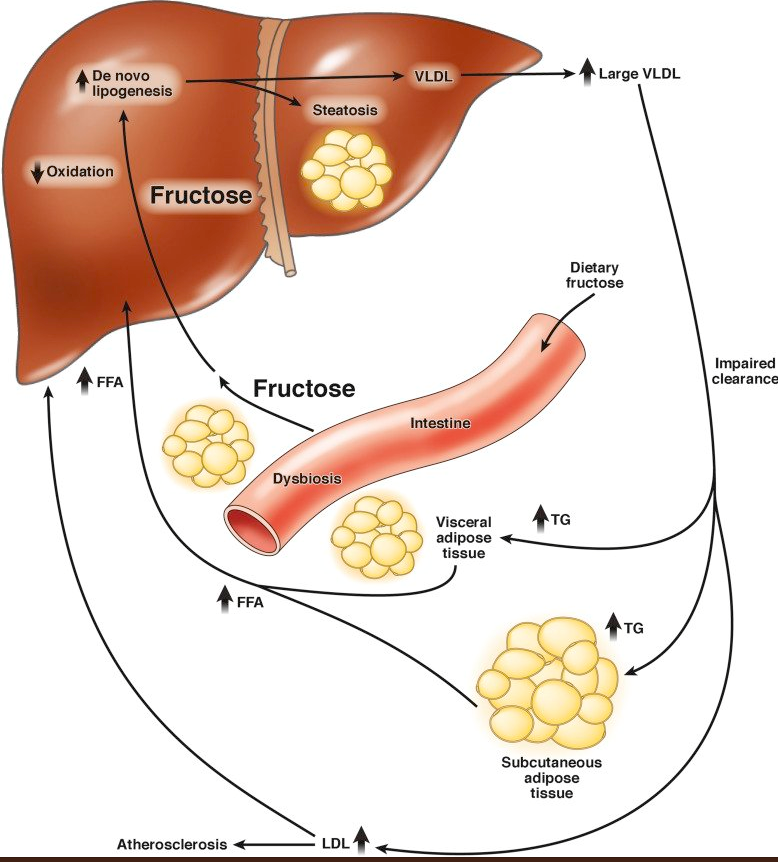
  • “The metabolic driver of buildup of fat storage in the liver is de novo lipogenesis (DNL) and fructose is a major substrate of DNL”
  • “In the healthy state, DNL is not expected to be a major contributor to lipid accumulation in the liver….[but] in a fatty liver, it has been estimated that 26% of the fat originates from DNL.”
  • Fructose is “limited in a natural diet…However, it is added to many processed foods and drinks in the form of cane sugar..and other types of sugars, going by ≥57 different names.”
  • Fructose is “commonly used in animal models to induce hepatic steatosis.”

The study is summarized in a recent AGA Journals Blog: Can Restricting Fructose Intake Reduce Fatty Liver Disease in Children?

An excerpt:

Jean-Marc Schwarz et al performed a clinical trial to investigate the effects of reducing fructose intake for 9 days in obese Latino and African American children with habitual high sugar consumption (fructose intake >50 g/day). They measured the effects of isocaloric fructose restriction on de novo lipogenesis, liver fat, visceral fat, subcutaneous fat, and insulin kinetics.

In their study, 41 children, 9−18 years old, had all meals provided for 9 days. The meals had the same energy and macronutrient composition as their standard diet, but with starch substituted for sugar, yielding a final fructose content of 4% of total kilocalories. The authors measured metabolic factors before and after fructose restriction. They measured liver fat, visceral fat, and subcutaneous fat by magnetic resonance spectroscopy and imaging.

Schwarz et al found that on day 10 of the diet, liver fat decreased from a median 7.2% at baseline to 3.8%, and visceral fat decreased from 123 cm3  at baseline to 110 cm3. Liver fat decreased in all but 1 of the 38 participants for whom paired data were available…

De novo lipogenesis decreased significantly after 9 days of fructose restriction; the de novo lipogenesis area under the curve value on day 10 decreased from 68% at baseline to 26% after the diet, in childen with low or high baseline levels of liver fat.

Insulin secretion during fasting and in response to an oral glucose tolerance test decreased significantly in children with low and high baseline levels of liver fat…

In an editorial that accompanies the article, Miriam B. Vos and Michael I. Goran say that it will be important to determine whether the effects of fructose reduction are sustained past 9 days…Vos and Goran state that it is important for physicians, nutritionists, schools, and parents to find ways to reduce fructose in the diets of children and patients with NAFLD.

Related posts: