Why Does Primary Sclerosing Cholangitis Increase the Risk of Colorectal Cancer in Ulcerative Colitis?

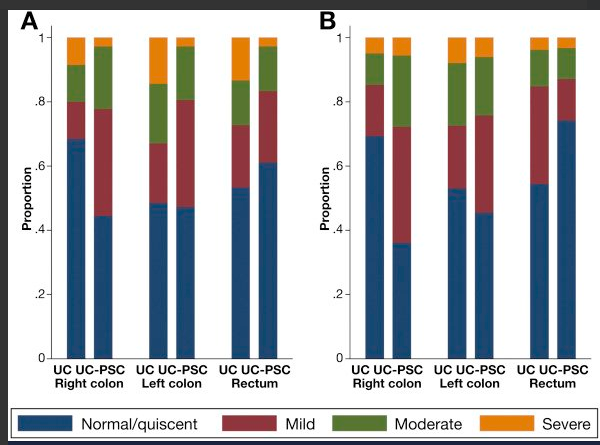
A recent retrospective study (Clin Gastroenterol Hepatol 2018; 16: 68-74) compared adult patients who had ulcerative colitis (UC) with (n=23) and without primary sclerosing cholangitis (n=120) (PSC). All patients had pancolitis and were in clinical remission.

Key finding:

  • Patients with UC-PSC had more subclinical endoscopic activity (odds ratio (OR) 4.21) and histologic activity (OR 5.13) in the right colon compared with patients without PSC

It is known that the presence of PSC is a risk factor for colorectal cancer (CRC).  A previous meta-analysis (RM Soetiknno et al. Gastrointest Endosc 2002; 56: 48-54) described a OR of CRC of 4.09.

My take: This study shows that UC patients with PSC who are in clinical remission have a greater degree of endoscopic and histologic inflammation in the proximal colon compared to patients without PSC.  This increased inflammation is a likely factor in the increased risk for CRC.

Related blog posts:

Crohn’s Disease Diagnosis Identified After Colectomy in Presumed Ulcerative Colitis

A recent retrospective single-center study (I Jones et al. JPGN 2018; 66: 69-72) identified a high rate of inflammatory bowel disease (IBD) reclassification.  From 2003-2014, 570 children were diagnosed with IBD, including 190 with ulcerative colitis.  29 of these patients underwent colectomy.  Among this select group, 24% (7/29) were subsequently reclassified as having Crohn’s disease, sometimes several years later.  Only two of the seven reclassified patients were younger than 10 years of age at the time of colectomy.

My take: This rate of Crohn’s disease following colectomy is higher than in previous reports (generally 5-10%).  The larger point is that the diagnosis of ulcerative colitis is more uncertain in the pediatric population, particularly in those in the first decade of life.

Related blog posts:

Near Bright Angel Trail, Grand Canyon

Fatty Acid Intake and Risk of Ulcerative Colitis Flare

A recent study (Barnes EL et al. Clin Gastroenterol Hepatol 2017; 15: 1390-6) found an association between the intake of certain fatty acids and the risk of an ulcerative colitis flare.  This is nicely summarized in the AGA Journals Blog.

Here’s the link: Does Consumption of Certain Fatty Acids Increase Risk of Ulcerative Colitis Flares?

Here’s an excerpt:

Diets with high levels of fatty acids such as myristic acid (found in palm oil, coconut oil, and dairy fats) increased risk of flare in patients with ulcerative colitis (UC), researchers report in the September issue of Clinical Gastroenterology and Hepatology. Their findings, from a prospective study of more than 400 patients in remission during treatment with aminosalicylates, could guide future studies of supplements or compounds that reduce risk of flares in patients with UC in remission…

Edward L. Barnes et al performed a prospective study of dietary patterns among 412 patients, from 25 sites, with UC in remission during monotherapy with an aminosalicylate (mesalamine, sulfasalazine, or balsalazide for at least 3 months before enrollment). Patients completed a validated food frequency questionnaire (on consumption of dairy, fruits, vegetables, eggs, meat, fish, cereals, breads, and starches, beverages, sweets, and baked goods) at enrollment and were followed for 12 months…

Forty-five patients (11%) had a relapse of UC within 1 year of study enrollment… In multivariable analysis, higher intake of myristic acid (odds ratio, 3.01) and alpha linolenic acid (odds ratio, 5.50) were associated with increased risk of relapse, although a dose–response relationship was retained only for myristic acid intake.

Other foods previously implicated in flares of UC, such as processed meat, alcohol, and foods high in sulfur, were not associated with an increased risk of flare.

Related blog posts:

From Andy Warhol Exhibit at the High Museum

Breastfeeding: Protection from Inflammatory Bowel Disease

Xu L, et al. Systematic review with meta-analysis: breastfeeding and the risk of Crohn’s disease and ulcerative colitisAliment Pharmacol Ther2017;46:780-789.

https://doi.org/10.1111/apt.14291Thanks to Mike Hart for this reference.

From abstract:

Results

A total of 35 studies were included in the final analysis, comprising 7536 individuals with CD, 7353 with UC and 330 222 controls. Ever being breastfed was associated with a lower risk of CD (OR 0.71, 95% CI 0.59-0.85) and UC (OR 0.78, 95% CI 0.67-0.91). While this inverse association was observed in all ethnicity groups, the magnitude of protection was significantly greater among Asians (OR 0.31, 95% CI 0.20-0.48) compared to Caucasians (OR 0.78, 95% CI 0.66-0.93; P = .0001) in CD. Breastfeeding duration showed a dose-dependent association, with strongest decrease in risk when breastfed for at least 12 months for CD (OR 0.20, 95% CI 0.08-0.50) and UC (OR 0.21, 95% CI 0.10-0.43) as compared to 3 or 6 months.

From associated editorial by David Rakel:

This meta-analysis of 35 studies shows that there is a dose–response protective effect of the duration of breastfeeding on inflammatory bowel disease. The association shows as much as an 80% reduction in risk for both Crohn’s disease and ulcerative colitis for breastfeeding more than 12 months.

Breast Feeding Graph

Inflammatory bowel disease arises from a complex set of interactions related to genetic susceptibility, environmental exposures, and a dysregulated immune response to dysbiotic intestinal microbiota, according to the study authors. These data will give us one more reason to encourage breastfeeding, ideally for a year or more.

Related blog post: Nutrition Week (Day 7) Connecting Diet and Epidemiology in IBD


Top Anti-TNF for Ulcerative Colitis

A recent retrospective cohort study (S Singh et al. Clin Gastroenterol Hepatol 2017; 15: 1218-25) compared infliximab and adalimumab in a nationwide Danish cohort of adults with ulcerative colitis (UC) from 2005-2014. The authors used propensity score and selected 171 patients who received infliximab (IFX) from a total of 1580 and 104 patients who received adalimumab (ADA) among a total of 139.

Key findings:

  • Patients who received ADA had higher hospitalization rates (HR 1.84) and a trend toward higher UC-related hospitalization (HR 1.71, CI 0.95-3.07) compared to IFX
  • Risk of abdominal surgery was not significantly higher in ADA patients (HR 1.35) compared to IFX
  • Serious infections were higher in ADA group, HR of 5.11 of needing hospitalization due to infections

There have been no randomized clinical trials  to determine if a specific anti-TNF agent is superior to another. In an associated editorial (MT Osterman, GR Lichtenstein, 1197-99), the authors note that while we don’t know which agent is superior, by comparing similar trials (ACT 1 & 2 for IFX and ULTRA 1 & 2 for ADA), “raw week 8 induction rates of clinical remission, clinical response, and mucosal healing are approximately 16%, 18%, and 19%, respectively, higher for infliximab”..”less dramatic differences favoring infliximab (approximately 9%, 13%, and 15%, respectively) are seen during maintenance at 1 year.”

My take: Due to the lack of randomized head-to-head studies, we do not know with certainty which anti-TNF is best for UC.  However, the data we have from retrospective cohort studies and from using raw data from prospective studies suggests that infliximab is effective in more patients.

Related blog posts:

University of Virginia Rotunda Pctures


Disclaimer: These blog posts are for educational purposes only. Specific dosing of medications (along with potential adverse effects) should be confirmed by prescribing physician.  This content is not a substitute for medical advice, diagnosis or treatment provided by a qualified healthcare provider. Always seek the advice of your physician or other qualified health provider with any questions you may have regarding a condition.

Low Rate of Ocular Disease in Pediatric Crohn’s Disease

A recent study (S Naviglio et al. Inflamm Bowel Dis 2017; 23: 986-90) confirms that there is a low rate of ocular disease in pediatric inflammatory bowel disease (IBD); in this cohort, half had Crohn’s disease (CD) and half had ulcerative colitis.

In this single center study, 94 children with a median age of 13.4 yrs were offered ophthalmologic examination (2014-2016).  None of these patients reported ocular symptoms.  The authors assert that 70% had intestinal remission, though 64% had elevated fecal calprotectin levels (>100 mg/kg). Key finding: One patient (1.06%) had ocular finding of uveitis (previously diagnosed prior to study)

The authors indicate that hepatobiliary manifestations, present in 9, were the most common extraintestinal IBD manifestation (EIM). Arthropathy occurred in 8, cutaneous manifestations occurred in 6 and ‘metastatic’ CD occurred in 4.

My take:  Ocular disease is an infrequent EIM in pediatric patients with IBD.

Related articleK Hata et al. Inflamm Bowel Dis 2017; 23: 1019-24. This article found that patients with EIMs were more likely to have chronic pouchitis after colectomy for ulcerative colitis. Overall, chronic pouchitis developed in 3.3%, 7.6% and 16.6% at 2, 5, and 10 years respectively. Key finding: preoperative EIM yielded a HR of 4.52.

Tofacitinib Induction and Maintenance for Ulcerative Colitis

W Sandborn et al. N Engl J Med 2017; 376:1723-1736 May 4, 2017DOI: 10.1056/NEJMoa1606910

Abstract from NEJM:

BACKGROUND

Tofacitinib, an oral, small-molecule Janus kinase inhibitor, was shown to have potential efficacy as induction therapy for ulcerative colitis in a phase 2 trial. We further evaluated the efficacy of tofacitinib as induction and maintenance therapy.


METHODS

We conducted three phase 3, randomized, double-blind, placebo-controlled trials of tofacitinib therapy in adults with ulcerative colitis. In the OCTAVE Induction 1 and 2 trials, 598 and 541 patients, respectively, who had moderately to severely active ulcerative colitis despite previous conventional therapy or therapy with a tumor necrosis factor antagonist were randomly assigned to receive induction therapy with tofacitinib (10 mg twice daily) or placebo for 8 weeks. The primary end point was remission at 8 weeks. In the OCTAVE Sustain trial, 593 patients who had a clinical response to induction therapy were randomly assigned to receive maintenance therapy with tofacitinib (either 5 mg or 10 mg twice daily) or placebo for 52 weeks. The primary end point was remission at 52 weeks.


RESULTS

In the OCTAVE Induction 1 trial, remission at 8 weeks occurred in 18.5% of the patients in the tofacitinib group versus 8.2% in the placebo group (P=0.007); in the OCTAVE Induction 2 trial, remission occurred in 16.6% versus 3.6% (P<0.001). In the OCTAVE Sustain trial, remission at 52 weeks occurred in 34.3% of the patients in the 5-mg tofacitinib group and 40.6% in the 10-mg tofacitinib group versus 11.1% in the placebo group (P<0.001 for both comparisons with placebo). In the OCTAVE Induction 1 and 2 trials, the rates of overall infection and serious infection were higher with tofacitinib than with placebo. In the OCTAVE Sustain trial, the rate of serious infection was similar across the three treatment groups, and the rates of overall infection and herpes zoster infection were higher with tofacitinib than with placebo. Across all three trials, adjudicated nonmelanoma skin cancer occurred in five patients who received tofacitinib and in one who received placebo, and adjudicated cardiovascular events occurred in five who received tofacitinib and in none who received placebo; as compared with placebo, tofacitinib was associated with increased lipid levels.


CONCLUSIONS

In patients with moderately to severely active ulcerative colitis, tofacitinib was more effective as induction and maintenance therapy than placebo.

Vitamin D and Ulcerative Colitis Remission

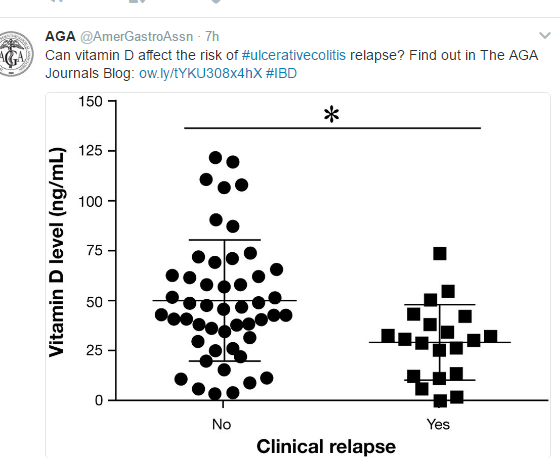
A recent study (J Gubatan et al. Clin Gastroenterol Hepatol 2017; 15: 240-6) examined a prospective study of 70 patients with ulcerative colitis (UC).  These patients (average age 48.6 yrs) were initially in clinical remission.  Key findings:

  • Mean baseline vitamin D (25-OH) level was lower among patients with subsequent relapse (29.5 ng/mL) than those without relapse (50.3 ng/mL)
  • Over 12 months, a 25-OH D value <35, was associated with a small increased risk of relapse (odds ratio1.25). 20% of patients with a value <35 had clinical relapse compared with 9% (P= .003) who had values >35.

Because vitamin D levels are inversely related to UC disease activity, this study is particularly intriguing.  By enrolling patients prospectively while in remission, this study suggests that good vitamin D levels may directly have immunoprotective and anti-inflammatory properties.

The AGA Journals blog provides an excellent summary of this study: Can Vitamin D Affect Risk of Ulcerative Colitis Relapse?

“In an editorial that accompanies the article, Stephen Hanauer reminds readers that the mean vitamin D level in the entire cohort was 44 ng/mL, and 60% of the subjects were taking vitamin D supplements. A normal vitamin D level is considered to be 20–40 ng/mL in healthy individuals, and the 35 ng/mL cut-off level used in the study was within this range.

Hanauer also mentions that in assessing the confidence intervals for risk of relapse at lower or higher vitamin D levels, there does not appear to be a dose–response effect in the odds ratios according to levels. Based on these findings, Hanauer says it would be premature to target a level of 35 ng/mL. He states that the best predictors of clinical relapse are still endoscopic and histologic markers of inflammation.”

My take: At this time, trying to maintain a normal vitamin D level is likely to be worthwhile; though, values obtained during acute flares remain unreliable.

Related blog posts:

Disclaimer: These blog posts are for educational purposes only. Specific dosing of medications/diets (along with potential adverse effects) should be confirmed by prescribing physician/nutritionist.  This content is not a substitute for medical advice, diagnosis or treatment provided by a qualified healthcare provider. Always seek the advice of your physician or other qualified health provider with any questions you may have regarding a condition.

screenshot-99

Vedolizumab: summary of latest data

BG Feagan et al. Clin Gastroenterol Hepatol 2017; 15: 229-39.

From Clin Gastroenterol Hepatol, Feb 2017 Issue Highlights Link from AGA twitter feed:Vedolizumab in Anti-Tumor Necrosis Factor Naïve or Previously Exposed Ulcerative Colitis Patients

“Feagan et al present data comparing patients based on past exposure to anti-TNF agents. This post-hoc analysis compared 464 patients who received vedolizumab or placebo who were naïve to TNF antagonists to 367 patients who had been exposed but had an inadequate response, loss of response, or intolerance to TNF antagonists…

The investigators describe greater differences in efficacy for vedolizumab (versus placebo) in patients who were naïve to TNF inhibitors than for patients with prior exposure to anti-TNF agents.

Week 6 reponse rates to vedolizumab or placebo were 53% vs 26% amongst patients naïve to TNF antagonists (absolute difference 26%) compared to 39% vs 21% in patients with prior anti-TNF exposure (absolute difference 18%).

Week 52 remission rates with vedolizumab and placebo were 47% and 19%, respectively, for patients naïve to TNF antagonists (absolute difference 28%) compared with 36% and 5%, respectively, in patients with prior exposure to TNF biologics (absolute difference 29.5%).

Thus, while vedolizumab demonstrated significantly greater efficacy as induction and maintenance therapy for UC patients whether or not they had previously received therapy with anti-TNF agents, there were numerically greater treatment benefit at week 6 among patients who had never received prior biologic therapy.

My take: Given the higher response in anti-TNF naive patients along with the favorable safety profile, vedolizumab could be considered as a first-line therapy.

Related Blog Posts:

Induction endpoints in TNF-failure patients by type of failure. Forest plots show difference from placebo and 95% CIs for percentages of patients with (A) clinical response, (B) clinical remission, and (C) mucosal healing at Week 6. Patients with more than one type of TNF antagonist failure were evaluated by each type of failure; thus the number of patients in the subgroups may total more than the number of enrolled patients.

Induction endpoints in TNF-failure patients by type of failure. Forest plots show difference from placebo and 95% CIs for percentages of patients with (A) clinical response, (B) clinical remission, and (C) mucosal healing at Week 6. Patients with more than one type of TNF antagonist failure were evaluated by each type of failure; thus the number of patients in the subgroups may total more than the number of enrolled patients.

What Happens When Infliximab Is Stopped in Patients with Ulcerative Colitis Remission

‘If it ain’t broke, don’t fix it’

Perhaps, the above sentiment is needed for patients with ulcerative colitis who are doing well with infliximab therapy according to a recent study (G Fiorino et al. Clin Gastroenterol Hepatol 2016; 14: 1426-32).

In this multicenter retrospective cohort study, 111 patients with ulcerative colitis who had been in remission (>12 months) were followed after stopping infliximab (IFX) and compared with 82 controls who remained on therapy.  Here’s what happened (see Figure 1 in study):

  • Among those who discontinued IFX, 53 patients (47.7%) relapsed in the followup period.  This corresponded to an incidence of 23.3 per 100 person-years and with a median time to relapse of 3.6 years.
  • In comparison, for those who remained on IFX, 14 relapses (17.1%) occurred which corresponded to an incidence of 7.2 per 100 person-years at risk and with a median time to relapse of 7.6 years.
  • Thiopurine use after stopping IFX seemed to diminish the risk of relapse: 15.0 per 100 person-years compared with 31.2 per 100 person-years for those taking an aminosalicylate alone.
  • For those who restarted IFX, 77.1% had a response and 51.4% returned to remission; however, 17.1% had infusion reactions.

My take: In a real-life experience, stopping IFX in patients with ulcerative colitis who had been in sustained clinical remission resulted in a higher relapse rate.  This finding is consistent with other studies.

Related blog posts:

The Lawn at University of Virginia

The Lawn at University of Virginia