Challenges for Aspiring Physicians: Application Overload, Shadowing Issues, and Wonka Bars

Two recent commentaries discuss some of the problems for aspiring physicians:

  • RP Walensky, LD Walensky. NEJM 2025; 392: 1251-1254. Application Overload — A Call to Reduce the Burden of Applying to Medical School
  • DB Holt, EA Elster. NEJM 2025; 392: 1249-1251. Rethinking Shadowing for Aspiring Physicians

In the first article, the authors detail the burden associated with the common-place high-volume applications to medical schools.

The cost is approximately $150 per school for application fees, plus $345 for taking the MCAT and having the score distributed through AMCAS. These fees are waived for qualifying low-income applicants (as primarily defined by household income below 400% of the national poverty level) who apply to the AAMC Fee Assistance Program and provide the required financial documentation.2 After submitting the primary application, applicants face a flood of secondary applications, some requiring up to eight additional essays. Even when the essay prompts are similar to those from other schools, the instructions often specify different lengths. One premedical student posted on social media the findings of his review of 54 medical schools’ secondary applications: he identified 222 different prompts, which he provided to help applicants get a jumpstart on their frenzied essay writing.3..

Between 2013 and 2023, … the total number of applications and the average number of applications per student increased dramatically — by 40% (from 690,281 to 966,947) and 28% (from 14.4 to 18.4), respectively. Despite the disproportionate escalation in applications submitted, the success rate (matriculants divided by applicants) remained flat (range, 36 to 44%).”

The authors recommend limiting applications to 10 to 12 medical school applications per applicant. This would benefit students as well as faculty burdens.

The secondary-application process also needs to be reined in. Medical schools could adopt standardized secondary essays… Under this model, a student applying to 10 schools would complete a maximum of 13 secondary essays — 3 standardized and 1 customized essay per school — rather than the current norm of 60 to 80 essays (e.g., 20 secondary applications with 3 to 4 distinct essays each).”

My take: In Charlie and the Chocolate Factory, there are only five golden tickets. If everyone buys twice as many Wonka bars, it is a lot more expensive and perhaps more time-consuming. For medical school applicants, applying to 20 or more programs does not help if almost everyone is doing this. It does disadvantage the minority who do not have the financial means or available time to complete this arduous task.

In the second commentary, the article details the problems with shadowing experiences.

Medical school admission in the United States remains intensely competitive. In 2024, according to the Association of American Medical Colleges (AAMC), prospective students submitted an average of 18 applications apiece…Many medical school admissions committees consider shadowing a physician to be an essential clinical experience for professional identity formation, so nearly all applicants now do some shadowing: 95% of respondents to the 2024 AAMC Matriculating Student Questionnaire (MSQ) said they’d spent time observing a physician at work.1 

Premedical students are spending more time shadowing — sometimes hundreds to thousands of hours, which often necessitate taking a “gap year” between college and medical school at a financial cost…Three quarters of medical school applicants report taking time off before medical school, 50% taking 1 to 2 years and 25% taking 3 or more years...

These additional years delay entry into the workforce and result in higher levels of debt than moving more quickly toward potential earnings as a physician; one lost year of a physician’s salary (an average of $265,000) would result in an estimated net loss of $2 million by retirement if the money were invested at a 7% return…

Although medical schools consider clinical experiences other than shadowing, a review of our own data suggests that applicants who have shadowed physicians for more than 50 hours are more likely than their peers to be admitted — and more likely to come from higher-income families.

The authors point out that unstructured observation is of unclear benefit. A course from Stanford, that far fewer hours (11-20 hrs) was sufficient for more than 90% of students “to decide whether medicine was the right career for them….The current emphasis on shadowing not only contributes to a longer and more expensive medical education pathway but also discourages nontraditional applicants and pursuit of genuine interests in other areas that make for well-rounded physicians.”

My take: The pathway to medical school has become more time-consuming and expensive. At the same time, it is doubtful that lengthy shadowing experiences or extensive numbers of applications are benefiting aspiring students.

Related blog post:

Angel Oak Tree, Historical Landmark in Charleston, SC. The tree is approximately 400 years old

Longevity Gap Present Even in Wealthy Americans

S Machado et al. NEJM 2025;392:1310-1319. Association between Wealth and Mortality in the United States and Europe

Methods: This was a longitudinal, retrospective cohort study with 73,838 adults (mean [±SD] age, 65±9.8 years), a total of 13,802 (18.7%) died during a median follow-up of 10 years.

Key findings:

  • The gap in survival between the top and bottom wealth quartiles was wider in the United States than in Europe
  • The poorest Americans appeared to have the lowest survival among all wealth groups in the study sample
  • Survival among the participants in the top wealth quartiles in northern and western Europe and southern Europe appeared to be higher than that among the wealthiest Americans
  • Survival in the wealthiest U.S. quartile appeared to be similar to that in the poorest quartile in northern and western Europe

The countries in the Survey of Health, Ageing, and Retirement in Europe (SHARE) were split into the following three groups: northern and western Europe (Austria, Belgium, Denmark, France, Germany, the Netherlands, Sweden, and Switzerland), southern Europe (Italy, Portugal, and Spain), and eastern Europe (Czech Republic, Estonia, Hungary, Poland, and Slovenia). The shaded area in Panel A indicates the difference between quartile 4 (the wealthiest) and quartile 1 (the poorest) in the Health and Retirement Study (HRS); the same shaded area was added in Panels B, C, and D for the purposes of comparison. The median duration of follow-up was 10 years in both surveys, and the mean (±SD) age at baseline was 65±9.8 years.

In their discussion, the authors note that health care access should not be a factor for wealthy Americans. However, “systematic factors may influence longevity across social strata, such as diet; environment; behavioral, cultural, and social attitudes; and opportunities for social mobility.2,28,32,33 The poorest are most vulnerable to these systemic factors, but these factors are broad and probably affect the entirety of society.”

My take: This study indicates that mortality in the United States is higher than in Europe, even at higher wealth levels.

Commentary on this article from NBC News (4/2/25): Not even wealth is saving Americans from dying at rates seen among some of the poorest Europeans

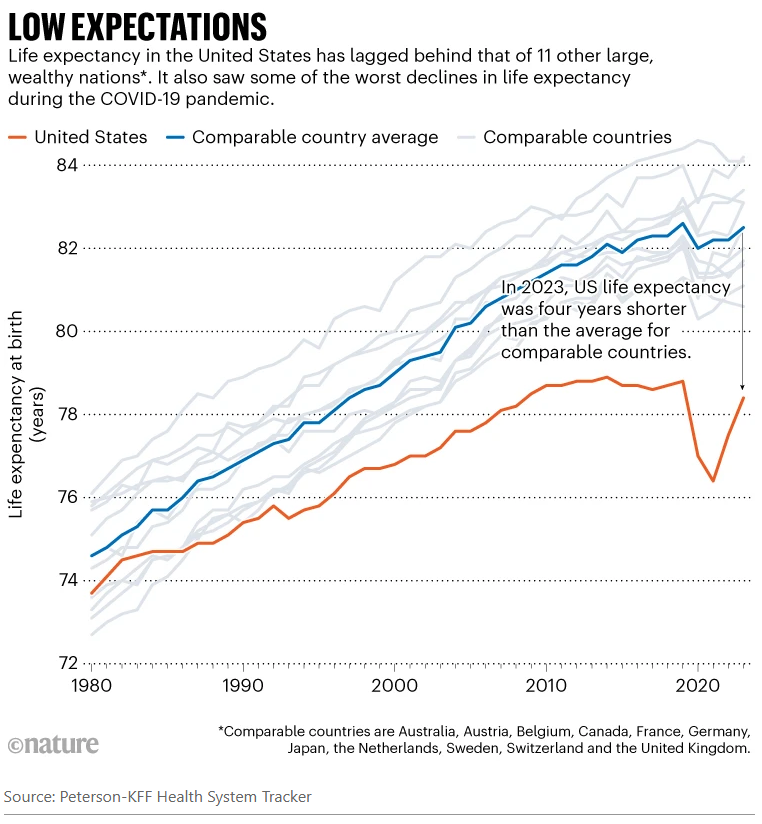
“Fifty years ago, life expectancy in the U.S. and wealthy European countries was relatively similar. That began to change around 1980. As European life expectancy steadily increased, the U.S. struggled to keep pace — and its life expectancy even began declining in 2014…The wealthiest group in northern and western Europe had mortality rates about 35% lower than the wealthiest group in the U.S.”

Related blog posts:

U.S. Measles Outbreak Is Not Slowing

These charts show measles data through April 7th. Some additional data through Apirl 11th is listed below.

For those interested in a deeper dive into the measles numbers, you can follow Caitlin Rivers substack. From her notes on April 11:

  • Since my last update on Tuesday, Arkansas and Hawaii reported cases for the first time this year. At least five states have reported ten or more cases, which is very unusual. Texas continues to register the most cases, with 541 to date.”
  • According to the CDC, 712 cases have been reported so far this year. 1 in 3 (32%) are under the age of 5, and 1 in 10 (11%) have been hospitalized.”

Related blog posts:

Are Muscle-Building Supplements Risky for Teens?

K Camero, NBC News, Feb 21, 2025. Overuse of muscle-building products associated with body image condition

An excerpt:

A Canadian study, published Wednesday in the journal PLOS Mental Health, finds that young people who consume multiple muscle-building products are more likely to show symptoms of a condition called muscle dysphoria…

About 2,730 Canadian teens and adults ages 16–30, mostly white males and females, were recruited via Instagram and Snapchat advertisements…

26% of the boys and men scored above the level for muscle dysmorphia — that is, being extremely preoccupied with a perceived lack of muscle mass or tone. Use of the workout supplements and products was associated with more symptoms of muscle dysmorphia…

About 55% adolescents and young men in the U.S. use bodybuilding supplements, according to some estimates…

Experts said the findings spotlight how unrealistic body ideals — often fueled by fitness influencers who promote or sell workout supplements online — may be driving more children and young adults to overuse powders or pills.

My take: The patients in this study may not be representative of the entire population; thus, the percentages of those affected should be interpreted carefully. Nevertheless, it is likely that a very significant proportion of young men have “muscle dysphoria” (also termed “‘bigorexia”). Supplements are poorly regulated and can result in adverse effects at any dosage (see posts below).

Related blog posts:

Wat Paknam Bhasicharoen (Big Buddha) Temple in Bangkok

Vaccination Confidence: Americans Support Shots

2/16/25 NYT Caitlin Rivers: Sorry, Mr. Kennedy, Most Americans Want to Get Their Shots

An excerpt:

There is very little that Americans can agree on these days…

But one thing nearly everyone agrees on? Vaccines are good.

This simple fact has been overshadowed by fears about what will happen to vaccine policy under Robert F. Kennedy Jr., the new secretary of health and human services. He has a long history of vaccine skepticism, and critics fear his leadership could lead to interference with vaccine programs or even withdrawal of vaccines from the market. Such moves are already roiling some state health programs. In Louisiana, the Health Department will “no longer promote mass vaccination,” instead leaving vaccine education to medical providers…

Recent reports in the news media and medical journals highlight a decline in the proportion of kindergartners who have received the measles, mumps and rubella shot. In the past five years, national coverage has fallen to 93 percent, from 95 percent, and in some states like Idaho, it is as low as 80 percent. But while these numbers fall short of the national goal of 95 percent required to maintain herd immunity for measles, they remain a resounding show of confidence…

Some 92 percent of American children received the polio vaccine by age 2, and more than 90 percent were vaccinated against hepatitis B. And it’s not just because of school requirements. Nearly nine in 10 Americans — including 86 percent of Republicans — say the benefits of childhood vaccines outweigh the risks...

Emphasizing the popularity of vaccines is not merely a matter of correcting the record. Studies have shown that presenting vaccines as a subject of debate or controversy can unintentionally reinforce vaccine hesitancy by making the issue appear less settled. For instance in one study, researchers found that college students who were asked to read a news report on vaccine safety that presented both sides in a falsely balanced fashion came away with the mistaken impression that the science on vaccine safety was in flux…

Routine vaccinations are just that: routine. Nearly all children receive them, and millions have benefited by being spared painful diseases and death. Leaders who undermine this basic tool may find themselves on the wrong side of both science and voters.

My take: Caitlin Rivers provides a lot of useful advice regarding infectious diseases. She has frequent (~weekly) substack articles with up-to-date information regarding infection prevalence (eg. Flu, COVID, norovirus, etc). Link to substack: Force of Infection

Related blog posts:

Brooklyn Bridge, NYC

The Future of Medicine: AI’s Role vs Human Judgment

Pranav Rajpurkar and Eric J. Topol. NY Times Feb 2, 2025: The Robot Doctor Will See You Now

An excerpt:

“The medical community largely anticipated that combining the abilities of doctors and A.I. would be the best of both worlds, leading to more accurate diagnoses and more efficient care…That assumption might prove to be incorrect. A growing body of research suggests that A.I. is outperforming doctors, even when they use it as a tool…

Simply giving physicians A.I. tools and expecting automatic improvements doesn’t work. Physicians aren’t completely comfortable with A.I. and still doubt its utility, even if it could demonstrably improve patient care…

Medical training will need to adapt to help doctors understand not just how to use A.I., but when to rely on it and when to trust their own judgment…But the promise for patients is obvious: fewer bottlenecks, shorter waits and potentially better outcomes. For doctors, there’s potential for A.I. to alleviate the routine burdens so that health care might become more accurate, efficient and — paradoxically — more human.”

In a related Substack article (open access: Opinion | When A.I. Alone Outperforms the Human-A.I. Partnership), Dr. Topol and Dr. Rajpurkar list several studies showing that AI alone may be better than physicians with AI under some circumstances:

My take (borrowed from the authors): “The future of medicine won’t be shaped by a simple choice between human or artificial intelligence, but by our ability to understand their respective strengths and limitations, and to orchestrate their collaboration in ways that truly benefit patient care.”

Related blog posts:

The Alarming Impact of Microplastics on Human Health

Yesterday’s post described the problems than pollution and chemicals are associated with in children.

Today’s post reviews data that microplastics accumulate in the brain and are associated with dementia in adults. A thorough review of this topic from Eric Topol 2/3/25: The Microplastic Concerns Elevate—To the Brain

Some excerpts:

Background: Last March a landmark prospective study of microplastics found nearly 60% of patients undergoing an artery operation (carotid endarterectomy) 58% had microplastics and nanoplastics (MNPs) in their plaque. Their presence was linked to a subsequent 4.5 -fold increase of the composite of all-cause mortality, heart attack and stroke…A multi-center study from China showed microplastics were present in the semen and urine of all 113 men assessed and were associated with reduced sperm count and semen quality The CDC data indicate they are likely present in the bodies of all Americans. As you know by now, MNPs are pervasive in our air and water, there’s currently an annual output of 400 million tons of plastics, and the burden of MNPs is expected to double by 2040 if nothing is done to change course.

The main sources of MNPs

The New Study

As reported in today’s Nature Medicine, Alexander Nihart and colleagues assessed concentrations of MNPs in the brain, liver and kidney…To emphasize, the MNP concentration in the brain was 7-30 times greater than the concentration in the liver or kidneys...the increased concentration of MNPs was considerably greater in the people with dementia. Even at the most recent, higher MNP concentration, the brains without dementia averaged ~5,000 μg g−1 whereas the brains from individuals with dementia has MNP concentrations that were 2 to 10-times higher…

Another study published on 22 January in Science Advances demonstrates, in the mouse model, that MNPs in the bloodstream cross the blood-brain-barrier, activate the immune system (schematic below) and result in stagnation of blood flow, culminating in blood clots, also resulting in neurological abnormalities…

Some practical tips were, however, provided: “Reducing exposure to microplastics is feasible, by avoiding food and drinks packaged in plastics, using less synthetic fabric and cleaning up household dust. Heating plastic containers leaches lots of microplastics, so avoiding microwaved ready-meals and plastic kettles should help too.”

The essential point of this post is that the striking brain accumulation of MNPs is paralleled by the overwhelming accumulation of evidence for their toxicity to human health. 

Related blog posts:

Urgent Need for New Chemical Regulations For Kids

The Consortium for Children’s Environmental Health. NEJM 2025; 392: 299-305. Manufactured Chemicals and Children’s Health — The Need for New Law

This review article explains the worsening toll that chemicals in our environment are exacting on the health of children.

Here are some of the key excerpts:

  • “An estimated 350,000 manufactured chemicals, chemical mixtures, and plastics are currently listed in global inventories.3 Most are produced from fossil fuels — gas, oil, and coal. Production has expanded 50-fold since 1950, is currently increasing by about 3% per year, and is projected to triple by 2050.4 Environmental pollution5,6 and human exposure7 are widespread.”
  • In the past half-century, “the incidence of childhood cancers has increased by 35%.10 Male reproductive birth defects have doubled in frequency.11 Neurodevelopmental disorders now affect 1 in 6 children, and autism spectrum disorder is diagnosed in 1 in 36.12 Pediatric asthma has tripled in prevalence.13 Pediatric obesity has nearly quadrupled in prevalence and has driven a sharp increase in type 2 diabetes among children and adolescents.14 In adults, by contrast, illness, disability, and death due to cardiovascular disease, stroke, and many cancers have decreased.15,16
  • “Research in environmental pediatrics has flourished over the past 25 years. Two key catalysts of this growth were the 1993 publication of the National Research Council report, Pesticides in the Diets of Infants and Children21 which elucidated the biologic bases of children’s heightened susceptibility to toxic chemicals, and the passage in 1996 of the Food Quality Protection Act (FQPA), the U.S. law on pesticides. The FQPA made protecting children’s environmental health a national priority and required generation of data on chemical hazards to children, stimulating substantial expansion of federally funded research in environmental pediatrics…Prenatal exposures are particularly hazardous…diseases associated with early-life exposures can manifest any time during the life span.23
  • “Prospective, birth-cohort epidemiologic studies that measure chemical exposures in pregnant persons and fetuses and follow children longitudinally over many years are particularly powerful platforms for discovering associations between synthetic chemicals and disease because they link exposures to outcomes in individual children and eliminate recall bias.”
  • “Widespread childhood exposure to a toxic chemical can damage the health, economic viability, and security of an entire society. For example, each year from the 1950s through the 1970s, about 100,000 tons of tetraethyl lead were added to gasoline in the United States to enhance automotive performance, causing massive environmental lead contamination and extensive human exposure… The average IQ among U.S. children was reduced by an estimated 2 to 5 points,32 the number of children with an IQ above 130 decreased by more than 50%, and the number with an IQ below 70 (the criterion used in the International Classification of Diseases to define intellectual disability) increased by more than 50%…reducing toxic chemical exposures can produce major economic benefits…because each additional IQ point is associated with an increase of 1.8 to 2.4% in lifelong earning potential.
  • “Chemicals should no longer be presumed harmless until proven otherwise…National chemical policies should take into consideration findings from animal and mechanistic toxicology studies, which are highly predictive of human health risks, including risks to children.49

My take: Pollution from chemicals and plastics is worsening and resulting in worsening health/intellectual outcomes for children. I doubt any legislation will be forthcoming to improve the situation. It is unfortunate that protecting profits is prioritized over protecting our health.

Related blog posts:

A ‘good demon’ at The Grand Palace in Bangkok

The Pediatrician’s Role in Vaccination and Trust

Two recent commentaries on “hot button” issues:

  • ER Menzin: The Pediatrician’s Lament. NEJM 2025; 392: 320-321
  • PMG Santos et al. Texas Executive Order GA-46 and the Erosion of Trust in Health Care. NEJM 2025; 392: 108-109

An excerpt from the first commentary:

“Throughout my career, I have seen new vaccines approved: pneumococcus, rotavirus, meningococcus, and human papillomavirus. In each case, I have studied the data, reviewed published recommendations, and adjusted my language to encourage vaccination. I consider the high immunization rate in my patient panel to be one of my greatest professional accomplishments — a quantitative metric of the benefit I provide…

Every so often, parents will look at me over a smiling infant and tell me they want their child to have only one or two recommended vaccines. Can I choose the most important? I tell them the question is akin to asking me to pick my favorite child — an impossible task…

Some will ask, “Can you recommend a good pediatrician who does not believe in vaccines?” No, I say, no more than I can recommend a good physicist who does not believe in gravity…

Even if patients are skeptical of the alphabet soup of institutions designed to protect and safeguard their health, they still have confidence in the long-standing relationships with their clinicians. To deserve that trust, we are obligated to raise our collective voice in defense of science, health, and vaccines.”

From the 2nd Commentary:

“On Halloween morning, 2024, Texas physicians received disturbing news about hospital policies set in compliance with Governor Greg Abbott’s Executive Order GA-46 — a rule that mandates the collection and reporting of information on patient citizenship status during intake…

Throughout medical training, physicians learn that trust is a cornerstone of patient care: we ask patients to share deeply personal information about themselves and their loved ones, with the assurance that legal and ethical safeguards protect against the misuse of such information. Chief among these safeguards is the Health Insurance Portability and Accountability Act (HIPAA), which restricts physicians from disclosing protected health information (PHI) without a person’s consent. Citizenship status, though not traditionally considered PHI, may be treated as such when it is paired with medical information obtained during patient encounters…

GA-46 … will deter immigrants, both documented and undocumented, from seeking help for serious medical concerns… Under the Emergency Medical Treatment and Labor Act (EMTALA), hospitals are required to provide emergency care to all patients, regardless of citizenship status. GA-46 indirectly conflicts with EMTALA’s intent to guarantee access to emergency services for all people by discouraging undocumented people from seeking care…

From an economic standpoint, Texas officials have stated that the goal of GA-46 is to protect the financial solvency of public hospitals; however, federal financial support covers most uncompensated care costs. Moreover, contributions from immigrants help sustain the viability of public health insurance programs. In 2017, immigrants helped offset a $67 billion deficit in health care costs for U.S.-born citizens by paying $58 billion more in taxes and premiums than was spent on their health care; 89% of this surplus was attributed to contributions made by undocumented immigrants…

Physicians in Texas and Florida must continue to inform patients of their right to refuse disclosure of their citizenship status.”

Related blog posts: