Hepatitis B Vaccine Protects for Up to 30 Years

From summary at GI & Hepatology News: Hepatitis B vaccine protection lasts 30 years

An excerpt:

  • Ninety percent of patients in a 1981 hepatitis B vaccine trial still had evidence of immune protection 30 years later, according to a study in the Journal of Infectious Diseases…
  • 243 members of the original cohort who responded to the original primary vaccine series but received no subsequent doses during the 30-year period…
  • Of the patients tested, 125 (51%) had anti-HBs levels greater than or equal to 10 mIU/mL. Among participants with anti-HBs levels below 10 mIU/mL who were available for follow-up, 75 of 85 (88%) responded to a booster dose with an anti-HBs level greater than or equal to 10 mIU/mL at 30 days.
  • Read the full study in the Journal of Infectious Diseases (J Infect Dis. 2016 Jan 21. doi: 10.1093/infdis/jiv748).

Related blog posts:

Bell Tower, Univ Mich

Bell Tower, Univ Mich


Bad News Bili

A study (BL Schneider et al. J Pediatr 2016; 170: 211-7) from ChiLDReN (Childhood Liver Disease Research Network) shows that infants with biliary atresia whose total bilirubin (TB) does not drop below 2 mg/dL (34.2 microM) at anytime during the first 3 months after hepatoportoenterostomy (HPE) (Kasai) are at high risk for disease progression.

Key findings:

  • 68/137 (50%) had TB <2.0 at some point following HPE.
  • In the cohort with TB ≥ 2.0, the odds ratio for liver transplantation or death was 16.8.  Higher TB was associated with diminished weight gain, coagulopathy, and hypoalbuminemia
  • In the cohort with TB ≥ 2.0, transplant-free survival at 2 year occurred in only 20% compared with 86% in the TB <2.0 group
  • Interestingly, only 6.6% had variceal bleeding among the entire cohort by age 2 years.

The TB was associated with multiple other parameters of worsening liver function, indicating that TB is not the only measure to affect the decision of liver transplantation.

My take: About half of all patients following a Kasai were at high risk for early progressive liver disease.  TB ≥ 2.0 is a useful indicator of high risk.

Related blog posts:

Walnut Street Bridge, Chattanooga

Walnut Street Bridge, Chattanooga

Sertraline and Liver Disease

A recent case report (MA Conrad, HC Lin. J Pediatr 2016; 169: 313-5) on sertraline-associated cholestasis provided a good reason to take a quick review on the NIH Liver Toxicity website:

Hepatotoxicity with sertraline (zoloft)

Liver test abnormalities have been reported to occur in up to 1% of patients on sertraline, but elevations are usually modest and infrequently require dose modification or discontinuation.  Rare instances of acute, clinically apparent episodes of liver injury with marked liver enzyme elevations with or without jaundice have been reported in patients on sertraline.  The onset of injury is usually within 2 to 24 weeks and the pattern of serum enzyme elevations has varied from hepatocellular to mixed and cholestatic.  Autoimmune (autoantibodies) and immunoallergic features (rash, fever, eosinophilia) are uncommon.  Actue liver failure due to sertraline has been described but is very rare.

The case report describes a 15 yo who developed jaundice (peak bilirubin 33.7 mg/dL with a direct fraction of 29.2 mg/dL) after 6 months of treatment with 75 mg per day.  After negative blood tests, he had a liver biopsy which was notable for rare bile ducts.  A jaundice chip was negative for underlying disorders like Alagille syndrome.  Urine bile acids were negative as well.  His laboratories normalized completely four months after cessation of sertraline.

It is interesting to note that sertraline has been used therapeutically for patients with pruritus due to cholestasis (Understanding Cholestatic Pruritus | gutsandgrowth)

My take: This case report describes bile duct paucity (vanishing bile ducts) as a result of sertraline therapy.  For practitioners, the bottom line is that SSRIs rarely cause liver toxicity; however, for patients with persistently-abnormal liver chemistries on SSRI therapy, discontinuation and identification of a safe alternative medication may be warranted.

Castillo San Felipe del Morro

Castillo San Felipe del Morro

Hepatitis B & C -Winter 2016

The large randomized pediatric entecavir study for Hepatitis B virus (HBV) is now in print: MM Jonas et al. Hepatology 2016; 63: 377-87.  Full link to this study on previous blog: Pediatric Entecavir Data  This study has led to FDA approval for use of entecavir in children as young as 2 years.  One interesting aspect of the study was the 2.6% drug resistance rate in the second year of the study.  This further validates current recommendations to treat children with “immune active” phases (e.g. abnormal transaminases and abnormal histology).

Briefly noted:

H Roberts et al. Hepatology 2016; 63: 388-97.  This study provides prevalence data for chronic HBV, 1988-2012.  During 2011-12, there were approximately 850,000 Americans with chronic HBV infections.  Migration of persons from HBV endemic countries has “largely contributed to prevalence rates remaining constant since 1999.”

JM Wilder et alHepatology 2016; 63: 437-44. This study showed that ledipasvir/sofosbuvir was similarly effective in black and non-black patients, with SVR12 rates of 95% and 97% respectively.  This is important because older interferon-based treatments were much less effective in black patients.

TB Dick et al. Hepatology 2016; 63: 634-43.  This review provides in-depth guidance regarding drug-drug interactions relevant to the new direct-acting antiviral agents used to treat Hepatitis C viral infection.

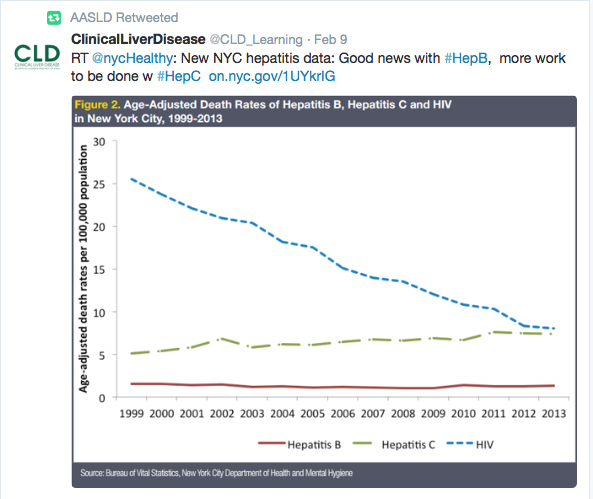
NY City Data for HIV, HBV, HCV

NY City Data for HIV, HBV, HCV

More on Hepatitis B Treatment in Children

A recent post (New Hepatitis B Treatment Guidelines -AASLD) described the updated treatment recommendations.  When these guidelines were published, a separate review devoted specifically to pediatrics was published (Hepatology 2016; 63: 307-18).

Some of the key points:

  • This pediatric review included 14 studies with 1425 children.  The authors note that 7 of these trials had a high risk of bias.  Also, the studies are limited by relying on surrogate markers of long-term outcomes as clinical outcomes like cirrhosis, HCC, and death are rare in childhood.
  • Among oral agents, entecavir and lamivudine are approved for use in children ≥ 2 years, whereas adefovir and tenofovir are approved for use in children ≥ 12 years.  Both lamivudine and adefovir are associated with frequent development of viral resistance
  • For children with elevated ALT (>1.5 times upper limit of normal [ULN]), treatment is recommended:

9A. The AASLD suggests antiviral therapy in HBeAg-positive children (ages 2 to <18 years) with both elevated ALT and measurable HBV DNA levels, with the goal of achieving sustained HBeAg seroconversion.

Why not treat everyone?

  • Children with immune-tolerant HBV infection (normal or near-normal ALT [< 1.5-2 times ULN] along with high HBV DNA [>10 million IU/mL]), “are not typically candidates for treatment because treatment with any of the currently available drugs has not been demonstrated to improve HBeAg seroconversion compared with no treatment.”
  • Children with ALT >10 time ULN may be in the process of spontaneous seroconversion “and should be observed for several months before treatment” is initiated.
  • “Prolonged treatment with nucleoside or nucleotide analogs in children who are in immune-tolerant phase has not been associated with substantial benefit and carries a risk of developing antiviral drug resistance…An exception may be those…undergoing immunosuppressive therapy.”
Mina Falls, El Yunque Rainforest

Mina Falls, El Yunque Rainforest

In brief: Pediatric HCV trial, Exercise for NAFLD, and Urso for Unconjugated Hyperbilirubinemia

Schwarz et al. JPGN 2016; 62: 93-96.  This study showed that all 21 children who had achieved a sustained virological response with PEG-interferon/ribavirin maintained an SVR during followup of 4.4-7.0 years.  Hopefully, new direct-acting highly effective oral agents will be approved in pediatrics and make this study less relevant.

U.S. Food and Drug Administration approved Zepatier (elbasvir and grazoprevir) Jan 28, 2016

Anderson et al. JPGN 2016; 62: 110-17.  Participants (n=2612) from a large longitudinal study with prospectively collected data were followed. “The adolescents who are more active in late childhood have lower risk of ultrasound scan fatty liver and lower ϒ-gluamyl transferase levels.”  In addition, they showed that more activity was correlated with lower fat mass in adolescence.

Saki et al. JPGN 2016; 62: 97-100. In a double-blind randomized clinical trial of 80 neonates with unconjugated hyperbilirubinemia, treatment with added ursodeoxycholic acid (5 mg/kg/dose BID) resulted in improved clearance of bilirubin compared to phototherapy alone. At 12, 24 and 48 hours, total bilirubin in the treatment group was 12, 10 and 9.8 respectively compared with 14.4, 12.5, and 10.1 for the control group.  Furthermore, the mean time for phototherapy to decrease bilirubin to <10 was 15.5 hours in the treatment group compared with 44.6 hours in the control group.  This study, if confirmed, could result in shorter hospital stays.

Old Town, San Juan

Old Town, San Juan

Predicting a Bad End in Drug-Induced Liver Injury

A recent study (VL Re et al. Clin Gastroenterol Hepatol 2015; 13: 2360-68) examined a retrospective cohort of 15,353 patients with presumed drug-induced liver injury (DILI) to formulate a more sensitive model for predicting liver failure.

The authors note that Hy’s Law has good specificity but poor sensitivity.  In their population, Hy’s Law had a specificity of 0.92, negative predictive value of 0.99, sensitivity of 0.68, and a positive predictive value of 0.02.

  • Hy’s law (named for Hyman Zimmerman): AST or ALT > 3 ULN and total bilirubin ≥2 ULN indicate serious hepatotoxicity with >10% mortality rate.

By incorporating data from platelet count and total bilirubin, the authors devised a Drug-Induced Liver Toxicity ALF Score which had a high sensitivity of 0.91 but a lower specificity of 0.76.

  • DrILTox ALF Score = -0.00691292*platelet count + 0.19091500*total bilirubin (per mg/dL)
  • Example: platelet count of 145 & total bilirubin of 3.0 yields a valued of -0.4296 which is above cut off of -1.081 indicating an increased risk of ALF.

Thus, low platelet counts and high bilirubins are strong predictors of acute liver failure (ALF) in the setting of DILI.

My take: Overall, the incidence of ALF due to drugs remains fairly low and determining that a specific drug induced liver injury remains problematic.  This study shows that ALF can occur in those who do not meet Hy’s Law criteria and that more sensitive predictors are needed.

Related blog posts:

How Effective is Zinc Therapy for Wilson’s Disease?

A study from France (R Santiago et al. JPGN 2015; 61: 613-18) examined the use of zinc therapy for Wilson’s disease. Though the national survey had 90 children from 6 centers, there were only 26 who were treated with zinc and only 9 who had received zinc as a first-line single therapy.

Despite the small numbers, data on treating children with Wilson’s disease are fairly sparse; as such, this article provides some helpful information.

The study reviews zinc’s mechanism of action:

“Oral zinc induces enterocyte synthesis of metallothionein, a cystic-rich protein acting as an endogenous chelator for metals, which preferentially binds copper in the enterocyte and inhibits its entry into the portal circulation. Thereby, it reduces copper intestinal absorption and leads to copper elimination in fecal contents within senescent enterocytes.”

Key results:

  • “Median transaminase level normalized within 6 months from treatment initiation” in the entire cohort of 26 children.  However, 10 of 26 children had abnormal ALT at 6 months into therapy.
  • Zinc dose was gradually increased such that 38% eventually had doses “exceeding recommended doses” which were >75 mg/day in 6-15 years and >150 mg/day in those ≥16 years.
  • Overall, the authors thought that zinc appeared to be less effective.  Failure with zinc occurred in 5 of 9 (3 due to ineffectiveness, 2 due to poor adherence).  The authors note that decompensation has been reported in children and adults on zinc monotherapy.

The authors indicate that zinc therapy is likely most appropriate after an induction phase with chelators in most children.  Criteria for changing to zinc include the following: “patients should be clinically well…with normal transaminase levels and hepatic synthetic function, non-ceruloplasmin-bound copper concentration within the normal range, and 24-hour urinary copper excretion in the range of 200-500 mcg/24 h.”

Additional precautions with zinc acetate (which is often better tolerated than chelators), 4 of 26 children in this study had gastric irritation, including one child with a perforation.  Therefore, a low threshold for endoscopy should be set in a child with epigastric pain. Adherence can be problematic due to the timing & frequency (TID) of zinc administration.  Monitoring urinary zinc excretion can be useful to monitor compliance.

Related blog posts:

Seattle Seafair

Seattle Seafair

Chronic Hepatitis B in North American Children

As part of the Hepatitis B Research Network (HBRN), 343 children were enrolled in 7 U.S. and Canadian centers.  A recent study (KB Schwarz et al. J Pediatr 2015; 167: 1287-94) provides data on HBV epidemiology and a related commentary by Brian McMahon (1186-7) provides some useful advice on what is needed to further reduce HBV infection.

88 children were not enrolled.  More than half of these patients refused to participate, the other reasons included language barriers or inability to comply with follow-up.

Key findings:

  • 78% of the subjects in this study were Asian
  • 55% were adopted.  This high adoption rate likely skews some of the data because (according to the associated editorial) “children with HBV in the US..most are likely to be children of parents who immigrated to the US from endemic countries and not adoptees.”
  • 97% had international origins with either the child or a parent born abroad
  • HBV genotype B was most common (43%) followed by genotype C (32%), D (16%), A (5%), E (4%) or multiple (<1%).

In the editorial, Dr. McMahon notes that ascertaining the rate of a birth dose of HBV vaccine would be of interest.  In many countries, vaccination is started at ≥2 months and this is unlikely to prevent HBV transmission.  Two important public health issues for North America:

  • “First, all pregnant women, especially those foreign-born, need to be screened for HBsAg and if positive, their infants should receive HBV vaccine and hepatitis B immune globulin immediately after birth.”
  • “Second, all foreign-born children and adults who immigrate to the US or Canada should be tested for HBsAg.”

My take: This study provides an up-to-date snapshot of tertiary care for children with HBV in North America.  There are many opportunities to curtail (or hopefully eliminate) the impact of HBV in our communities and around the world.

AASLD Guideline (Nov 2015): Treatment of Chronic HBV 

Related blog posts:

San Diego Zoo

San Diego Zoo

My Favorite Posts 2015

I want to thank all of those who have provided input to this blog this year.  Best wishes to all for a happy and healthy 2016.

Here’s my list of favorite posts in the past year:

On being a doctor:

Nutrition posts:

Gastroenterology posts:

IBD posts:

Liver posts:

Screen Shot 2015-12-09 at 8.21.20 PM