IBD Shorts June 2018

AL Granstrom et al. JPGN 2018; 66: 398-401. Using a nationwide Swedish registry, the authors determined that patients with a Hirschsprung disease had an increased risk of receiving a diagnosis of IBD (OR 4.99).  In total 20 of 739 HD patients, developed IBD.

T Card et al. Inflamm Bowel Dis 2018; 24: 953-9.  This article questions the ‘what is the risk of progressive multifocal leukoencephalopathy ..with vedolizumab?  The authors are not certain.  But they state that after reviewing 54,619 patient-years “there have been no cases of PML reported in association with vedolizumab use.”

LCT Buer et al. Inflamm Bowel Dis 2018; 24: 997-1004. This case report of 10 patients describes combination therapy with anti-TNF therapy with vedolizumab. “At the end of follow-up, all patients were in clinical remission, and 8 patients could discontinue anti-TNF treatment.”

OJ Adedokun et al. Gastroenterol 2018; 154: 1660-71. This study examined pharmocokinetics and response of ustekinumab in patients with Crohn’s disease from 701 patients in phase 3 studies..  “Trough concentrations was approximately threefold higher in patients given ustekinumab at 8-week intervals compared with 12-week intervals…Trough concentrations of 0.8 (or even up to 1.4 mcg/mL) or greater were associated with maintenance of clinical remission.”  Also, “concentrations of ustekinumab did not seem to be affected by cotreatment with immunomodulators.”

View from Pine Mountain
Low-Value Care: IBD Serologies for Diagnosis of IBD

A recent high-value care series (MD Long, BE Sands. Clin Gastroenterol Hepatol 2018; 16: 618-20) explains why “clinicians should not use IBD serologies as a test to diagnose inflammatory bowel disease.”

Here are the key points:

  • “Benoir et demonstrated that a 7-marker serology panel had a lower predictive value than routine laboratory tests in diagnosis of IBD among symptomatic pediatric patients.”
  • “Studies on the accuracy of these serologies for diagnosis included populations with a high prevalence of IBD (42%-62%), rather than the low-prevalence populations in primary care settings” (or even in for routine GI office visits)…”When the disease is rare, a greater proportion of the positive tests represent false positives and the PPV [positive predictive value] is low.”
  • The authors also recommend against using serologies to predict a more aggressive course because “no data exist that modifications based on these serologies improve outcomes.”

My take: When I highlight this article, there is an element of confirmational bias as I have held a dim view of their value for a long time. While there is some academic interest in IBD serology results, to me, it is a disturbing trend to see patients with nonspecific abdominal pain referred who have already had these serological markers.

ADMIRE Study: Use of Stem Cell Therapy for Complex Perianal Fistulas in Crohn’s Disease

A recent phase 3 randomized, double-blind, placebo-controlled study (J Panes et al. Gastroenterol 2018; 154: 1334-42) examined the use of stem cell therapy for the treatment of complex perianal fistulas in Crohn’s disease (CD).

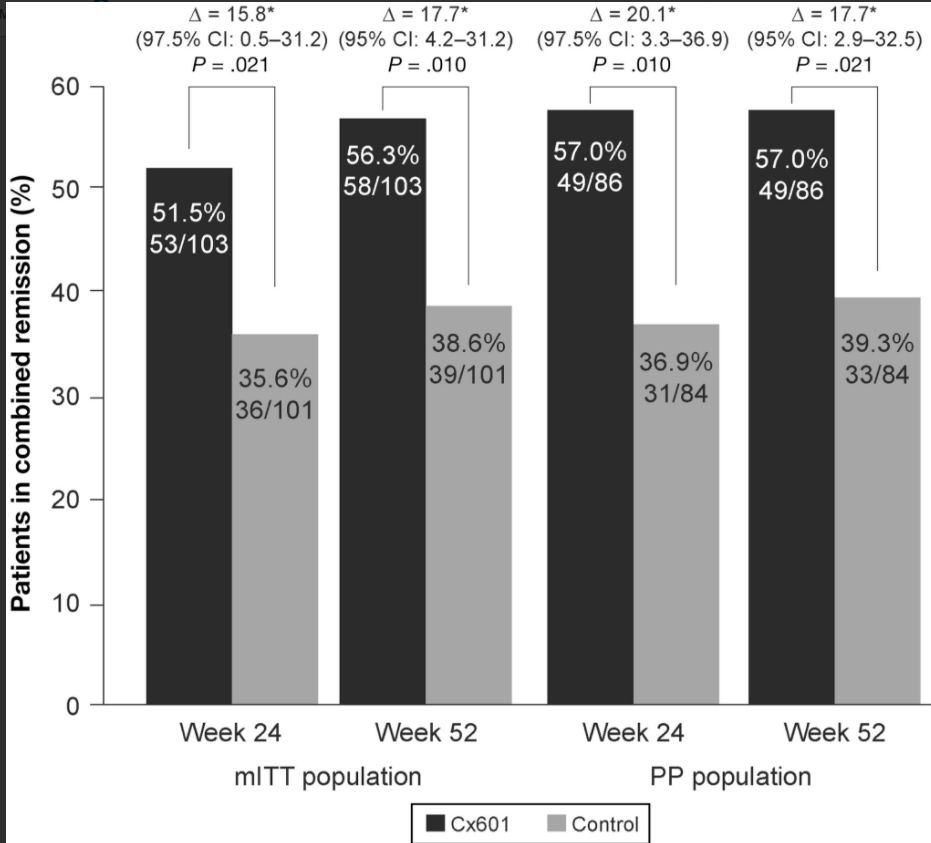
They used a single local injection of 120 million Cx601, a suspension of allogeneic expanded adipose-derived stem cells, and compared to a placebo injection.  This study comprised 212 patients from 49 centers. The primary endpoint, labelled “combined remission,” was based on absence of draining fistulas and MRI findings.

Key Findings:

  • As noted in Figure 1 (below), combined remission occurred in 51.5% of Cx601-Rx patients compared with 35.6% for placebo at week 24; at week 52, combined remission occurred in 56.3% of Cx601-Rx patients compared with 38.6%

My take: This local therapy improved outcomes for 1 year after a single injection and appears promising for refractory perianal fistulas.  It may help avoid surgery or systemic immunosuppression.


Closer Look at Data Then Image Below

“A Guide to Gutsy Living”

A recent article ( David JG, Jofriet A, Seid M, et al. “A Guide to Gutsy Living”: Patient-Driven Development of a Pediatric Ostomy Toolkit. Pediatrics. 2018;141(5): e20172789) describes “A Guide to Gutsy Living”: Patient-Driven Development of a Pediatric Ostomy Toolkit (Full Text)

From ImproveCareNow: Download a free copy of the Ostomy Toolkit

Background:

The education we received about our ostomy surgery was brief and focused only on basic skills regarding caring for an ostomy, including changing and emptying the bag, but did not address concerns we had about living with ostomies as part of our everyday lives. This educational void placed the burden on us as patients to find resources on our own, decide if the information was appropriate, and determine if it was reliable and accurate.

In this article, we describe how we, as patients, harnessed the capacity of a collaborative chronic care network1 and were supported to develop a resource that patients needed.

Methods:

We started a national task force of interested patients and parents who had experiences with ostomies to develop a pediatric ostomy toolkit. The task force was composed entirely of patients and parents and consisted of 7 patients and parents

After a literature review, we asked task force members to identify questions and topics related to living with an ostomy, including questions members had preoperatively, immediately postoperatively, and in the extended time since their surgeries. From this prompt, our group generated a list of topics all patients and parents agreed on based on the shared concerns, insights, or questions our task force members had around ostomy surgery… After the creation of the toolkit, we reached out to clinicians to provide clinical review.

Results:

Our final 19-page, colorful toolkit included topics relating to friends, school, travel, ostomy supplies, clothing, playing sports, using humor to cope, emergency kits, educational issues (eg, 504 plans), “Gastronauts” (Gastronauts are freely available puppets with ostomies), and ostomy medical language…The pediatric ostomy toolkit was posted on the ICN Exchange platform

My take (borrowed from authors): In our patient- and parent-led toolkit project, we demonstrate how patients and families can self-organize and ask clinicians to consult to create needed resources within a network

Resources:

  • The Oley Foundation website is a good link for patients with enteral tubes, ostomies, and central lines. http://oley.org/
  • From ImproveCareNow: Download a free copy of the Ostomy Toolkit

View from Pine Mountain

 

Sub-Analysis of DIAMOND Study

K Watanabe et al. Clin Gastroenterol Hepatol 2018; 16: 542-9.

The DIAMOND study evaluated monotherapy with adalimumab (n=85) compared with combination therapy of adalimumab with azathioprine (n=91).

Key findings:

  • In this subanalysis of patients with moderate and severe Crohn’s disease (CD), endoscopic response (defined by SES-CD drop of at least 8 points or SES-CD <4) was significantly higher at week 26: 71.6% vs 54.4%. The OR for endoscopic response was 2.12 at week 26 with combination therapy.
  • At week 52 the endoscopic response difference was not statistically significant: 60% vs. 50%.
  • Similarly, mucosal healing was more common (but not statistically significant) in the combination group compared with monotherapy: 20.9% vs 103% at week 26, and 21.5% vs 12.2% at week 52.
  •  While not statistically significant, the combination group had ADA trough that was higher (7.6 compared with 6.5).

My take: The results described above for endoscopic responses and mucosal healing rates are depicted in figure 2 (I do not have a digital copy of figure or permission to use).  After one looks at this figure, depicting the data noted above, there certainly appears to be an advantage for the use of combination therapy in patients with moderate-to-severe CD.

Related blog posts:


I have not independently verified the claims on this tweet

From ImproveCareNow: Resources for Mind Body Interventions

From ImproveCareNow: Resources for Mind Body Interventions

The above linked-website has links to many others for patients and providers: meditation, mindfulness, yoga and guided imagery.  The links on this page borrowed from Chelly Dykes and KT Park who credits Dr. Sindu Vellanki and Dr Ann Ming Yeh from Stanford.


Literature on these topics (also from ImproveCareNow): Mind Body Interventions and IBD

Mind Body Interventions and IBD – Journal Articles

Overview:

  • Yeh, A. M., Wren, A., & Golianu, B. (2017). Mind–Body Interventions for Pediatric Inflammatory Bowel Disease. Children, 4(4), 22. doi:10.3390/children4040022
  • Mindfulness/ Meditation/ Mindfulness based Stress Reduction (MBSR):
  • Kabat-Zinn, J., Lipworth, L., Burney, R., & Sellers, W. (1987). Four-Year Follow-Up of a Meditation-Based Program for the Self-Regulation of Chronic Pain: Treatment Outcomes and Compliance. The Clinical Journal of Pain, 3(1), 60.

**Note: This is an overview of MBSR, not IBD specific

Mindfulness:

  • Neilson, K., Ftanou, M., Monshat, K., Salzberg, M., Bell, S., Kamm, M. A., . . . Castle, D. (2016). A Controlled Study of a Group Mindfulness Intervention for Individuals Living With Inflammatory Bowel Disease. Inflammatory Bowel Diseases, 22(3), 694-701.
  • Jedel, S., Hoffman, A., Merriman, P., Swanson, B., Voigt, R., Rajan, K., . . . Keshavarzian, A. (2014). A Randomized Controlled Trial of Mindfulness-Based Stress Reduction to Prevent Flare-Up in Patients with Inactive Ulcerative Colitis. Digestion, 89(2), 142-155.
  • Hood, M. M., & Jedel, S. (2017). Mindfulness-Based Interventions in Inflammatory Bowel Disease. Gastroenterology Clinics of North America, 46(4), 859-874.
  • Berrill, J. W., Sadlier, M., Hood, K., & Green, J. T. (2014). Mindfulness-based therapy for inflammatory bowel disease patients with functional abdominal symptoms or high perceived stress levels. Journal of Crohns and Colitis,8(9), 945-955. doi:10.1016/j.crohns.2014.01.018
  • Gerbarg, P. L., Jacob, V. E., Stevens, L., Bosworth, B. P., Chabouni, F., Defilippis, E. M., . . . Scherl, E. J. (2015). The Effect of Breathing, Movement, and Meditation on Psychological and Physical Symptoms and Inflammatory Biomarkers in Inflammatory Bowel Disease.Inflammatory Bowel Diseases,21(12), 2886-2896.

Clinical Hypnosis:

  • Keefer, L., Taft, T. H., Kiebles, J. L., Martinovich, Z., Barrett, T. A., & Palsson, O. S. (2013). Gut-directed hypnotherapy significantly augments clinical remission in quiescent ulcerative colitis. Alimentary Pharmacology & Therapeutics,38(7), 761-771.
  • Mawdsley, J. E., Jenkins, D. G., Macey, M. G., Langmead, L., & Rampton, D. S. (2008). The Effect of Hypnosis on Systemic and Rectal Mucosal Measures of Inflammation in Ulcerative Colitis. The American Journal of Gastroenterology,103(6), 1460-1469.
  • Shaoul, R., Sukhotnik, I., & Mogilner, J. (2009). Hypnosis as an Adjuvant Treatment for Children With Inflammatory Bowel Disease. Journal of Developmental & Behavioral Pediatrics,30(3), 268.
  • Vlieger, A., Govers, A., Frankenhuis, C., & Benninga, M. (2010). Hypnotherapy for children with functional abdominal pain or irritable bowel syndrome: Long term follow-up. European Journal of Integrative Medicine,2(4), 191.

Yoga: 

IBS + Yoga:

  • Schumann, D., Anheyer, D., Lauche, R., Dobos, G. Langhorst, J., Cramer, H. Effect of Yoga in the Therapy of Irritable Bowel Syndrome: A Systematic Review. Clin. Gastroenterol. Hepatol.  2016, 14, 1720-1731.
  • Selvan, S. R., Kavuri, V., Selvan, P., Malamud, A., & Raghuram, N. (2015). Randomized clinical trial study of Yoga therapy for Irritable Bowel Syndrome (IBS). European Journal of Integrative Medicine,7, 23.
  • Kuttner, L., Chambers, C., Hardial, J., Israel, D., Jacobson, K., Evans, K. A Randomized Trial of Yoga for Adolescents with Irritable Bowel Syndrome. Pain Research & Management 2006, 11, 217-223.
  • Evans, S., Lung, K., Seidman, L., Sternlieb, B., Zeltzer, L., & Tsao, J. (2014). (567) Iyengar yoga for adolescents and young adults with irritable bowel syndrome (IBS). J. Pediatri. Gastroenterol. Nutri. 2014, 59, 244-253.

IBD + Yoga:


Concurrent Infections in Inflammatory Bowel Disease Flares

Briefly noted: Y Hanada et al. Clin Gastroenterol Hepatol 2018; 16: 528-33.

In this retrospective review with 9247 patients with IBD, the incidence of bacterial pathogens (non-C diff) identified was <3% of those who were tested; in this group (n=25), Aeromonas was detected in 8,Salmonella in 7, Plesiomonas in 4, Campylobacter in 2, and Yersinia in 2.  From authors: “These infections did not have a significant negative impact on patient outcomes.  Given these findings, routine testing for infections other than CDI is not recommended.”

Chattahoochee River

Opiates, Inflammatory Bowel Disease and Mortality

A recent retrospective study (NE Burr et al. Clin Gastroenterol Hepatol 2018; 16: 534-41) with 3517 patient’s with Crohn’s disease (CD) and 5349 with ulcerative colitis (UC) examined the frequency of opioid prescriptions and the relationship to fatal outcomes.

Key findings:

  • Compared to 1990-93, the period of 2010-13 saw a sharp rise in the use of opiods in England: 10% compared to 30%.
  • Prescription of strong opioids (>3 prescriptions per calendar year) was associated with premature mortality: Hazard ratio 2.18 for CD and 3.3 for UC.

This study is in agreement with other data showing increasing use of opiate prescriptions worldwide for chronic noncancer pain (although there has been a drop in the past year).  As with other studies of patients with inflammatory bowel disease, this study shows an association between opioid use and mortality.

My take: Needing an opioid may be a marker for more severe disease. Whether the opioid use directly contributes to mortality remains unclear.