IBD Shorts August 2018

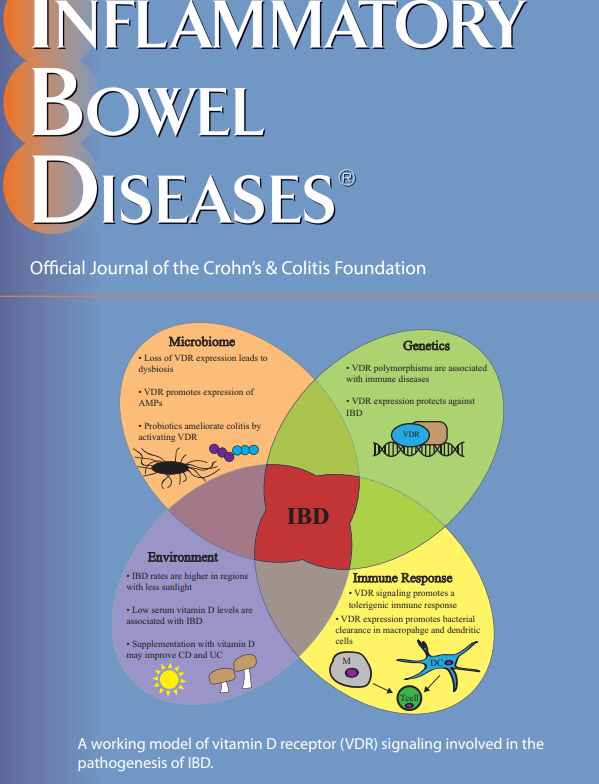
Vitamin D Receptor Signaling in IBD. Inflamm Bowel Dis 2018; 24: 1149-54.  This article reviews the ways vitamin D/vitamin D receptor may contribute to the genetic, environmental, immune, and microbial aspects of IBD.

LY Chi et al. Inflamm Bowel Dis 2018; 24: 1344-51. This study with 223 pediatric patients & young adults found that current or prior combination therapy with infliximab, compared to monotherapy resulted in higher infliximab levels and lower antibody formation. Combination agent was mainly methotrexate (n=71) rather than thiopurine (n=13). In those with infliximab dose <10 mg/kg, those currently receiving combination therapy had median level of 11.1 compared with 7.0 for prior combination and 5.86 for monotherapy (never combination).

CM Johnson et al. Clin Gastroenterol Hepatol 2018; 16: 900-7.  In this retrospective study with 1466 patients with Crohn’s disease, the subset of patients with granulomas (n=187, 12.8%) were associated with a more aggressive phenotype and a younger age at diagnosis (23.6 years compared with 27.9 years; P= .0005). These patients had higher rates of steroid use, narcotic use, more stricturing and penetrating disease along with increase rates of surgery.


MRE Does Not Fare Well at Detecting Lesions Evident on Upper Endoscopy

A recent study (PC Church et al. JPGN 2018; 67: 53-8) examined how well EGD findings were detected by MRE in 188 children (mean age 14 years).

Key findings:

  • EGD was macroscopically abnormal in 93 (49%) with ulcerations being the most common abnormality in 66 (35%).
  • In contrast, the local radiologist identified UGI inflammation in 7 (4%) and the central radiologists identied UGI inflammation in 20 (22%).  “There was no agreement between local and central radiologists when examining the UGI as a whole (κ=-0.02, P-0.59)”
  • The local radiologists “correctly identified only 5 of 93 (8%) patients with UGI findings on EGD.”  The central radiologists “correctly identified 9 of 45 (30%) patients with UGI findings on EGD.”

The authors state that “the Porto criteria mandate the performance of EGD for all pediatric patients suspected of having IBD. Our study has demonstrated that MRE cannot be relied upon as the sole method of evaluating the UGI.”

My take: For those who take care of children with IBD, this study will not come as a surprise as many of the UGI findings (found at endoscopy) are subtle.  This study does quantify the much higher sensitivity of endoscopic evaluation and is similar to studies that have compared capsule endoscopy to MRE.

Related blog posts:


Cumberland Island 2018

Serology Titers Associated with Clinical Expression of Ulcerative Colitis in Children

Briefly noted: A recent study (EA Spencer et al.Inflamm Bowel Dis 2018; 24: 1335-42) examined phenotype and serology in 399 children with newly diagnosed ulcerative colitis (PROTECT study).

Key findings:

  • 65% had positive serology for pANCA; 62% in those <12 and 66% in those ≥12 years
  • 19% had positive serology for anti-CBir1; 32% in those <12 and 14% in those ≥12 years
  • High titer (≥ 100)) pANCA positivity was associated with more extensive disease but not with PUCAI values or Mayo endoscopic subscores.

My take: The serology titers for IBD, in my view, have academic interest but do not routinely enhance patient care.

Related blog post:

Amelia Island


IBD Shorts July 2018

DJ Gracie et al. Gastroenterol 2018; 154: 1635-46. This study of 405 adults indicated that IBD triggers anxiety and that anxiety triggers IBD. Specifically: “Baseline CD or UC disease activity were associated with an almost 6-fold increase in risk for a later abnormal anxiety score (hazard ratio [HR], 5.77; 95% CI, 1.89-17.7).  In patients with quiescent IBD at baseline, baseline abnormal anxiety scores were associated with later need for glucocorticosteroid prescription or flare of IBD activity (HR 2.08; 95% CI, 1.31-3.30).”

RL Dalal, B Shen, DA Schwartz. Inflamm Bowel Dis 2018; 24: 989-96.  This review provides updated information on epidemiology, diagnosis, and treatment recommendations for pouchitis.

A Alper et al. JPGN 2018; 66: 934-6. Key finding: Celiac disease is “not increased in children with IBD compared with non-IBD children with gastrointestinal symptoms.”  False-positive tTG serology can occur.

AK Shaikhkhalil et al. JPGN 2018; 66: 909-14. The authors showed that using a quality-improvement effort, there was increase utilization of enteral exclusive therapy (EEN).  Baseline 5.was <5% and by completion of intervention, utilization increased to approximately 50%. The interventions to achieve this are specified in this article, including talking points.  EEN is described as “nutrition therapy.” Patients are offered oral EEN and if not adequate by 3-4 days, nasogastric feedings are initiated (~15%).  Interestingly, of those to complete EEN therapy, 97% did not need NG placement.

Pictures from Ameilia Island:

Amelia Island

ICN Travel Toolkit -Tips for Patients with Inflammatory Bowel Disease

ImproveCareNow’s Patient Advisory Committee: ICN Travel Toolkit – a collection of personal stories, plus tips and techniques for traveling with IBD – written by members of the ICN Patient Advisory Council (PAC).

In addition to the tips offered by the PAC (see below), I would recommend that those travelling keep a succinct medical summary with the following (minimum):

  • Diagnosis and extent of disease
  • Other medical problems
  • Physician (contact info)
  • Allergies –food/medicines
  • Current list of medications including dosage and frequency
  • List of prior treatments
  • Previous surgeries

Also, below are other travel -related links, including to the CDC travel website which makes recommendations based on travel destination along with underlying problems.

A summary of the ICN travel tips from the PAC PowerPoint Presentation:


Why Does this Patient Have Colitis?

Just in time for this year’s Peachtree Road Race…

A brief report (RS Robinson et al. Gastroenterol 2018; 154: 1582-83) presents a case of a 28 year old, who had been in training for a marathon, with mild iron deficiency anemia, lower abdominal pain, and bloody bowel movements. The CT scan and colonoscopy showed diffuse colonic/ileal inflammation; the histology showed mucosal necrosis, crypt atrophy and acute inflammation (see below).

Answer to title question: Runner’s Colitis.  The authors note that in some long-distance runners an ischemic colitis can develop in part due to rerouting of blood with prolonged exercise.  Dehydration may exacerbate poor perfusion.  The splenic flexure and the rectosigmoid junction are particularly susceptible due to the ‘watershed’ nature of their blood supply.

The majority of individuals recover fully from this insult, though the literature describes one individual who required a subtotal colectomy after perforation.

VICTORY Consortium Showing Good Results for Vedolizumab

A presentation at the 13th Congress of the European Crohn’s and Colitis Organization (ECCO, Feb 2018) indicated that Vedolizumab had similar effectiveness as anti-TNF agents for both ulcerative colitis and Crohn’s disease. This data has been presented at a recent meeting in our office, some of the GI news magazines, and also ImproveCareNow listserv.

From Takeda website: Entyvio® (vedolizumab) Shows Higher Rates of Mucosal Healing Versus TNFα-Antagonist Therapy in Ulcerative Colitis and Crohn’s Disease Patients in Comparative Effectiveness Real-World Data Analysis

These analyses observed that patients with UC treated with Entyvio compared to TNFα-antagonist therapy had statistically significant higher 12-month cumulative rates of mucosal healing (50% vs 42%, hazard ratio [HR] 1.73, 95% confidence interval [CI] 1.10‑2.73) and clinical remission (54% vs 37%; HR 1.54, 95% CI 1.08‑2.18), and numerically higher steroid-free clinical remission rates (49% vs 38%; HR 1.43, 95% CI 0.79‑2.60). In CD, results reported statistically significant higher 12-month cumulative rates of mucosal healing (50% vs 41%; HR 1.67, 95% CI 1.13‑2.47), and numerically higher rates of clinical remission (38% vs 34%; HR 1.27, 95% CI 0.91‑1.78) and steroid-free clinical remission (26% vs 18%; HR 1.75, 95% CI 0.90‑3.43) compared to TNFα-antagonist therapy. These analyses were conducted by the VICTORY (Vedolizumab Health OuTComes in InflammatORY Bowel Diseases) Consortium.

My take: While the data compare anti-TNFs to vedolizumab in a “real-world setting,” the reported outcomes for anti-TNFs are lower than in other studies.  Vedolizumab had the best results in those with colonic disease.  Patients with Crohn’s disease with isolated small bowel disease had lower response rates.

Related study: AK Waljee et al Inflamm Bowel Dis 2018; 24: 1185-95. Using phase 3 clinical trial data with 594 subjects, the authors note that the majority of patients who will respond to vedolizumab can be identified by week 6 using a laboratory algorithm based on hemoglobin, albumin, vedolizumab level and CRP. Fformula: Hgb*Albumin*VDZ level/CRP*Weight. A cutoff of 185.96 predicted success with an AuROC of 0.75.   Higher hemoglobin, higher albumin, and higher vedolizumab level, and lower CRP are associate with higher response rates.

Related blog posts:

Red Top Mountain, Homestead Trail


IBD Shorts June 2018

AL Granstrom et al. JPGN 2018; 66: 398-401. Using a nationwide Swedish registry, the authors determined that patients with a Hirschsprung disease had an increased risk of receiving a diagnosis of IBD (OR 4.99).  In total 20 of 739 HD patients, developed IBD.

T Card et al. Inflamm Bowel Dis 2018; 24: 953-9.  This article questions the ‘what is the risk of progressive multifocal leukoencephalopathy ..with vedolizumab?  The authors are not certain.  But they state that after reviewing 54,619 patient-years “there have been no cases of PML reported in association with vedolizumab use.”

LCT Buer et al. Inflamm Bowel Dis 2018; 24: 997-1004. This case report of 10 patients describes combination therapy with anti-TNF therapy with vedolizumab. “At the end of follow-up, all patients were in clinical remission, and 8 patients could discontinue anti-TNF treatment.”

OJ Adedokun et al. Gastroenterol 2018; 154: 1660-71. This study examined pharmocokinetics and response of ustekinumab in patients with Crohn’s disease from 701 patients in phase 3 studies..  “Trough concentrations was approximately threefold higher in patients given ustekinumab at 8-week intervals compared with 12-week intervals…Trough concentrations of 0.8 (or even up to 1.4 mcg/mL) or greater were associated with maintenance of clinical remission.”  Also, “concentrations of ustekinumab did not seem to be affected by cotreatment with immunomodulators.”

View from Pine Mountain