Vaccination and Inflammatory Bowel Disease -Resources Targeted for Adult Patients

From a recent Gastroenterology & Hepatology –Full Link:

Gastroenterology & Hepatology  July 2017 – Volume 13, Issue 7; Vaccination of Patients With Inflammatory Bowel Disease.  Francis A. Farraye, MD, MSc

Thanks to John Pohl’s twitter feed for this link that provides recommendations for Adults with IBD.

An excerpt:

G&H  What specific resources for vaccinations are available to help gastroenterologists?

FF  It is helpful for providers to keep a copy of the Crohn’s and Colitis Foundation’s health maintenance recommendations posted in their office. This 1-page checklist (available at http://www.crohnscolitisfoundation.org/science-and-professionals/programs-materials/ccfa-health-maintenance.pdf) includes all recommended vaccines and also comments on other important health maintenance items, such as screening for cervical and skin cancer, depression, and osteoporosis. In addition, Cornerstones Health has a vaccination checklist (available at http://www.cornerstoneshealth.org/wp-content/uploads/2017/06/Monitoring-and-Prevention-3.10.2017.pdf) that can be downloaded, printed, and placed in each examination room to reinforce the importance of vaccination. Primary care providers as well as gastroenterologists can use these checklists as reminders in their busy practices.

Related blog post:

Disclaimer: These blog posts are for educational purposes only. Specific dosing of medications (along with potential adverse effects) should be confirmed by prescribing physician.  This content is not a substitute for medical advice, diagnosis or treatment provided by a qualified healthcare provider. Always seek the advice of your physician or other qualified health provider with any questions you may have regarding a condition.

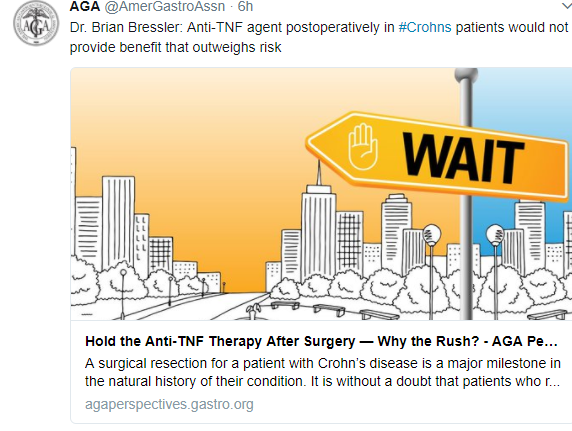
Two Viewpoints: Anti-TNF Therapy Shortly After Crohn’s Disease Surgery

A recent AGA perspectives issue provides two viewpoints on when to start/resume anti-TNF therapy after Crohn’s disease surgery:

Dr. Bressler states that he considers anti-TNF therapy for patients with ongoing immune dysfunction after surgery who are at high risk for recurrence.  Attributes of high risk disease include the following:

  • younger age (<30 years)
  • smoker
  • two or more surgeries for penetrating disease.

His commentary indicates that a “‘wait and see’ approach is appropriate for most patients. He frequently will measure a calprotectin three months postoperatively and every three months and perform a colonoscopy typically 6-9 months postoperatively. Those with endoscopic recurrence will be placed on anti-TNF therapy.

Dr. Requiero states:

  • The most effective way to prevent recurrence is to initiate an anti-TNF within four weeks of surgery. It has been my practice that patients at high risk for postoperative Crohn’s disease recurrence initiate anti-TNF shortly after they are discharged from the hospital.
  • If a patient had been on an anti-TNF prior to the surgery, I will usually resume the same anti-TNF after the surgery. In these patients, I do not give a re-induction course unless they had not received the anti-TNF for more than three months prior to surgery.
  • Concomitant therapy: “In the majority of patients, I treat with an anti-TNF, I will use a concomitant immunomodulator…One year after surgery, if there is no disease recurrence, I will decrease and often stop the immunomodulator. With the advent of therapeutic drug monitoring, I have a number of postoperative anti-TNF patients on monotherapy without an immunomodulator.
  • [In] patients at moderate risk for postoperative recurrence… I perform an ileocolonoscopy six months postoperatively and, if there is evidence of endoscopic recurrence, I add an anti-TNF agent. After finding a high rate of recurrence in these patients, I am beginning to shift my practice to initiating anti-TNFs in this moderate-risk group as well.

My take: I tend to favor Dr. Reguieiro’s approach in my patient population.

Related blog posts:

Pediatric Views on Biosimilars and Interchangeability

A recent commmentary (D Patel, KT Park. JPGN 2017; 134-6) explains the topic of interchangeability and its relationship to biosimlars. While biosimilars are expected to reduce the cost of biologic therapy, there are concerns regarding immunogenicity and whether switching to these products could reduce therapeutic sustainability.

The authors explain that some products are truly interchangeable and produce the same clinical result.  An interchangeable medicine (eg. typical generic) does not increase safety risk and switching from originator drug can be done by pharmacists or government payers without intervention of the prescribing health provider.

CT-P13 (Inflectra) has been approved as a biosimilar but has not been deemed an interchangeable product.  This is important.  Biosimilars “could have clinical consequences and repeated switches may increase immunogenicity.” Also, biosimilar products are much more complicated products than typical generic drugs.

Other key points:

  • The assumption that CT-P13 is interchangeable in pediatric IBD is “highly debatable.” Biosimilars undergo fewer studies than originator products.  CT-P13 has data from PLANETRA and PLANETAS trials “which may not be applicable for IBD, particularly pediatric IBD, given the inherent differences in disease pathophysiology.”
  • “No long-term, multiple-switch (eg. originator to biosimilar to originator) studies in pediatric or adult patients have been performed.”
  • “It is premature and possibly risky to assume that interchangeability will not cause differences in immunogenicity without long-term evidence in the pediatric population.” Pediatric patients likely have a “higher probability of developing autoantiantibodies” and need effective therapy for a longer duration.

My take: We still have a lot to learn.  Until more studies are available, switching stable patients could increase risk of losing response.

Related blog posts:

Dry Falls, Highlands NC

AGA Recommendations on Biosimilars

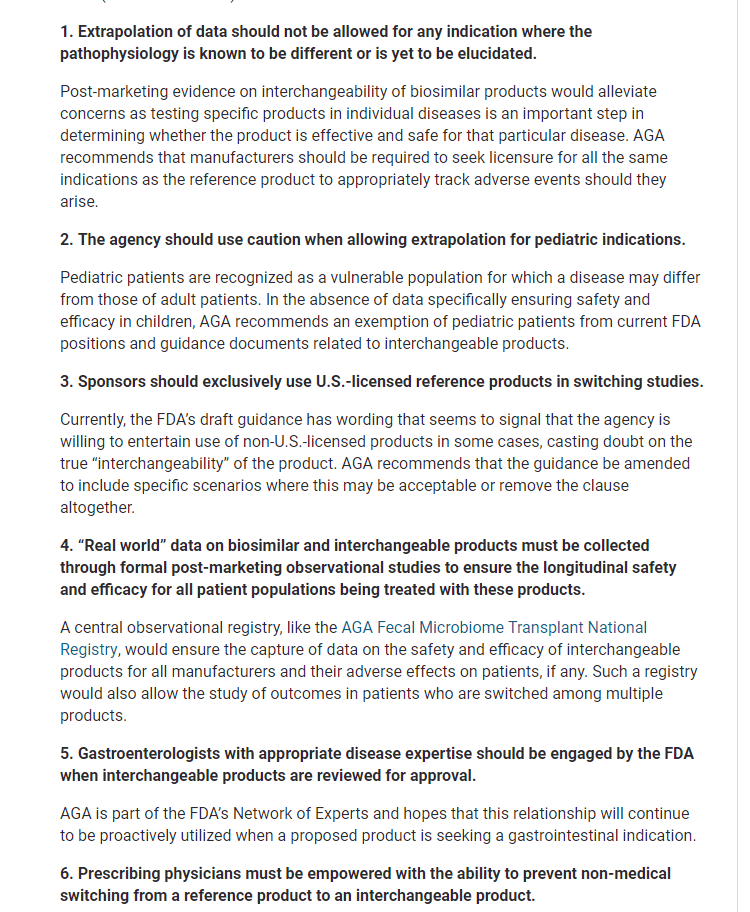
The AGA has made several recommendations regarding biosimilars –#2 and #6 are particularly of interest to pediatric gastroenterologists. More on this topic will follow tomorrow.

Link: AGA Makes Six Recommendations to FDA on Interchangeable Biosimilars

Related blog posts:

Pediatric IBD: Treating to Target

In 2014, an influential study by Sandborn et al (Clin Gastroenterol Hepatol 2014; 12: 978-85) described the importance of mucosal healing in a strategy termed “treating to target.”  The main findings (reviewed in a previous post Treating to Target) were the following:

  • Only half of the patients achieved MH.  “After a median follow-up of 62 weeks, 50.7% had MH and 61.1% had endoscopic improvement.”  79% of those who underwent adjustments achieved MH.
  • Clinical symptoms do not correlate with MH. “40.9% of patients experienced clinical symptoms despite MH and 18.8% of patients without clinical symptoms had significant endoscopic lesions.”
  • Biomarkers may be effective at predicting MH. “None of the patients with MH had an increased concentration of CRP.”
  • Adjusting treatment is needed if abnormal endoscopy; this is inherent in the philosophy of treating-to-target.

Now, my colleagues at Emory have published a single-center experience on mucosal healing (MH) (SL Santha, PR Shankar, A Pan, B Schoen, S Kugasthasan, CG Sauer. Inflamm Bowel Dis 2017; 23: 1447-53).  While this study has the typical limitations of a retrospective study, it makes several useful points.  It takes a little extra effort to interpret their findings as they describe their results based only on the 104 patients with clinical remission rather than based on the total of 182 patients who had at least two colonoscopies.  78 were excluded due to ‘acute GI symptoms.’

Of the 104 patients considered to be in clinical remission, 76 had Crohn’s disease and 28 patients had ulcerative colitis.

Key findings:

  • For patients with ulcerative colitis (UC) who were in clinical remission, 20 (71%) had MH per physician assessment, though only 10 patients (36%) had MH based on Mayo score of zero.  10 patients (36%) demonstrated histologic healing.
  • For patients with Crohn’s disease (CD) who were in clinical remission, 51 (67%) had MH per physician assessment, 34 (45%) had MH base on simple endoscopic score for CD, and 35 (46%) had histologic healing.
  • 21 of 25 CD patients and 8 of 8 patients with UC underwent escalation of therapy based on endoscopic evaluation. 9 patients underwent dose optimization of their biologic as the modification in their therapy; this step is now routinely done in pediatrics without followup endoscopy.

The discrepancy in MH rates based on physician assessment, endoscopic scores, and histologic healing is explained.  Generally, MH based on physician assessment would include normal and those with very mild mucosal disease.  “For CD, this included small and rare aphthous ulcers, and for UC, this included mild Mayo 1 erythema in only one segment of bowel.”

Questions about the approach to ‘treating to target:’

  • This study does not describe other alternative modalities to assess for mucosal healing. Is it feasible to use a biomarker like an abnormal calprotectin to target those in need of further evaluation? In those with abnormal biomarkers, dose escalation would not require a repeat scope.
  • The Emory group has used MRE extensively, but does not report MRE findings in this population.  Would MRE (which does not require sedation) be more useful in some patients?

As in adult patients, this study does show the need for objective markers in pediatric inflammatory bowel disease; 30% of patients who were considered to be in clinical remission had active disease with further investigation.  This finding has implications for ImproveCareNow which uses physician global assessment in tracking remission rates for pediatric IBD.

In their discussion, the authors state that “changes in medical therapy can increase the MH rate to nearly 80%, which could be even higher with additional changes in those who did not demonstrate MH on a second endoscopy.”  This sentence needs to be carefully interpreted.  The authors were able to show MH based on physician assessment in 82 of 104 patients (79%) who were in clinical remission.  This rate would be MUCH lower if the entire cohort of 182 were included, possibly no greater than 50%.

The authors conclude with “endoscopy should be considered in pediatric patients with IBD in clinical remission to identify those without MH who may require medication escalation despite the absence of clinical symptoms.”

My take: I agree with the authors that objective markers of clinical remission need to be obtained to assess the effectiveness of therapy.  However, I am not convinced that endoscopy is needed in every patient who is doing well on therapy; other biomarkers and imaging may be more beneficial.

Related blog posts:

Sign at Pisgah Fish Camp Restaurant: “On this site in 1897 nothing happened.”



Adalimumab Can Reverse Growth Failure in Pediatric Crohn’s Disease

In an industry-sponsored study (TD Walters et al. Inflamm Bowel Dis 2017; 23: 967-75), adalimumab (ADA) was shown to be effective agent in reversing growth failure associated with pediatric Crohn’s disease (CD).

Background:  About one-third of children and adolescents with CD suffer from growth failure and delayed puberty.  Several prior studies have shown that anti-TNF therapy can improve height velocity and that early treatment with anti-TNF therapy (≤3 months after diagnosis) leads to greater improvement in height obtained, if initiated before puberty or early into puberty. This study examines the effectiveness of ADA in children from the IMAgINE 1 trial.

The authors identified 73 participants with growth delays (& adequate data) along with 27 participants with no growth delays.

Key findings:

  • ADA therapy significantly improved and normalized growth rates at 26 and 52 weeks in patients with baseline linear growth impairment.
  • At week 26, height velocity z-score was 1.33 among 23 children in remission compared with -0.78 (n=29) among “nonremitters”
  • At week 52, height velocity z-score was 2.17 among 27 children in remission compared with -1.57 (n=17) among “nonremitters”

My take: In moderate to severe CD, anti-TNF agents have been demonstrated to reverse growth failure; though, this is expected to occur only in patients with clinical response. To my knowledge, no other CD medical therapies have been proven to reverse growth failure (surgical treatment can improve growth as well).

Related blog posts:

Quiet Spot on U Chicago Campus

Low Rate of Ocular Disease in Pediatric Crohn’s Disease

A recent study (S Naviglio et al. Inflamm Bowel Dis 2017; 23: 986-90) confirms that there is a low rate of ocular disease in pediatric inflammatory bowel disease (IBD); in this cohort, half had Crohn’s disease (CD) and half had ulcerative colitis.

In this single center study, 94 children with a median age of 13.4 yrs were offered ophthalmologic examination (2014-2016).  None of these patients reported ocular symptoms.  The authors assert that 70% had intestinal remission, though 64% had elevated fecal calprotectin levels (>100 mg/kg). Key finding: One patient (1.06%) had ocular finding of uveitis (previously diagnosed prior to study)

The authors indicate that hepatobiliary manifestations, present in 9, were the most common extraintestinal IBD manifestation (EIM). Arthropathy occurred in 8, cutaneous manifestations occurred in 6 and ‘metastatic’ CD occurred in 4.

My take:  Ocular disease is an infrequent EIM in pediatric patients with IBD.

Related articleK Hata et al. Inflamm Bowel Dis 2017; 23: 1019-24. This article found that patients with EIMs were more likely to have chronic pouchitis after colectomy for ulcerative colitis. Overall, chronic pouchitis developed in 3.3%, 7.6% and 16.6% at 2, 5, and 10 years respectively. Key finding: preoperative EIM yielded a HR of 4.52.

More Data for Ustekinumab in Crohn’s Disease

Briefly noted: C Ma et al. Inflamm Bowel Dis 2017; 23: 833-9.  This retrospective study examined the response to ustekinumab in 104 patients with Crohn’s disease.  All patients had achieved a steroid-free ustekinumab induction.  92.3% had failed anti-TNFα therapy.

Key findings:

  • 71.8% maintained a response at 52 weeks
  • 64.4% maintained an endoscopic or radiographic response

IBD Shorts and Postop Crohn’s Management

C Ma et al. Inflamm Bowel Dis 2017; 23: 833-9.  This retrospective study examined the ongoing response to ustekinumab in 104 patients with Crohn’s disease.  All patients had achieved a steroid-free ustekinumab induction.  92.3% had failed anti-TNFα therapy.Key findings:

  • 71.8% maintained a response at 52 weeks
  • 64.4% maintained an endoscopic or radiographic response

Related blog post: Closer Look at Ustekinumab Data

O Truffinet et al JPGN 2017; 64: 721-25. This small study with 8 children with Crohn’s disease examined the use of tacrolimus.  Six of eight showed a response to tacrolimus (target 8-15) with a clinical response at 2 months and 4 of 8 in clinical remission.  Adverse effects were common, occurring in 6 of 8.  These included renal dysfunction, diabetes, paresthesia and tremor.

J Adler et al.  JPGN 2017; 64: e117-e124. Using ImproveCareNow registry, the authors identified perianal disease (PD) in 1399 of 6679 cases (21%).  PD was more common in blacks than whites: 26% vs. 20%.  Overall, this study showed a higher rate of PD than previously recognized.

J Amil-Dias et al JPGN 2017; 64: 818-35.  This is an ESPGHAN IBD Porto Group guideline for surgical Crohn’s disease management in children.  There are 25 graded statements.  Here are a few:

  • #7 & #8. If needing surgery for CD pancolitis, the authors recommend subtotal colectomy and ileostomy.  Possible reanastomosis at later date if no significant rectal and/or perianal disease.  Ileal pouch-anal anastomosis is NOT recommended.
  • #13. Monitor Vitamin B12 if >20 cm resection of terminal ileum
  • #16. Postoperative management “should be based on ileocolonoscopy.” Figure 1 details recommendations, including need for assessment postoperatively.
  • In patients with high-risk factors, anti-TNF therapy is recommended postoperatively.  In those without high-risk factors, the authors indicate that thiopurines are reasonable with and advancing to anti-TNF if Rutgeerts i2 or greater at followup assessment.  High-risk factors include growth failure, short duration from diagnosis to surgery, extensive resection (>40 cm), and penetrating disease.

Related blog post:

Musee d’Orsay