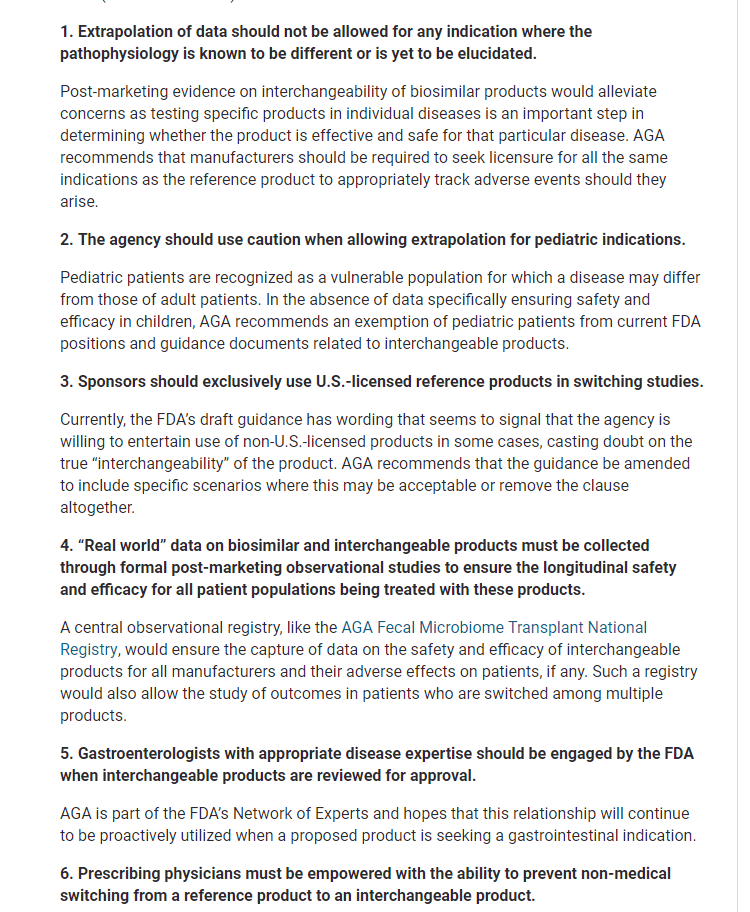
AGA Recommendations on Biosimilars

The AGA has made several recommendations regarding biosimilars –#2 and #6 are particularly of interest to pediatric gastroenterologists. More on this topic will follow tomorrow.

Link: AGA Makes Six Recommendations to FDA on Interchangeable Biosimilars

Related blog posts:

Pediatric IBD: Treating to Target

In 2014, an influential study by Sandborn et al (Clin Gastroenterol Hepatol 2014; 12: 978-85) described the importance of mucosal healing in a strategy termed “treating to target.”  The main findings (reviewed in a previous post Treating to Target) were the following:

  • Only half of the patients achieved MH.  “After a median follow-up of 62 weeks, 50.7% had MH and 61.1% had endoscopic improvement.”  79% of those who underwent adjustments achieved MH.
  • Clinical symptoms do not correlate with MH. “40.9% of patients experienced clinical symptoms despite MH and 18.8% of patients without clinical symptoms had significant endoscopic lesions.”
  • Biomarkers may be effective at predicting MH. “None of the patients with MH had an increased concentration of CRP.”
  • Adjusting treatment is needed if abnormal endoscopy; this is inherent in the philosophy of treating-to-target.

Now, my colleagues at Emory have published a single-center experience on mucosal healing (MH) (SL Santha, PR Shankar, A Pan, B Schoen, S Kugasthasan, CG Sauer. Inflamm Bowel Dis 2017; 23: 1447-53).  While this study has the typical limitations of a retrospective study, it makes several useful points.  It takes a little extra effort to interpret their findings as they describe their results based only on the 104 patients with clinical remission rather than based on the total of 182 patients who had at least two colonoscopies.  78 were excluded due to ‘acute GI symptoms.’

Of the 104 patients considered to be in clinical remission, 76 had Crohn’s disease and 28 patients had ulcerative colitis.

Key findings:

  • For patients with ulcerative colitis (UC) who were in clinical remission, 20 (71%) had MH per physician assessment, though only 10 patients (36%) had MH based on Mayo score of zero.  10 patients (36%) demonstrated histologic healing.
  • For patients with Crohn’s disease (CD) who were in clinical remission, 51 (67%) had MH per physician assessment, 34 (45%) had MH base on simple endoscopic score for CD, and 35 (46%) had histologic healing.
  • 21 of 25 CD patients and 8 of 8 patients with UC underwent escalation of therapy based on endoscopic evaluation. 9 patients underwent dose optimization of their biologic as the modification in their therapy; this step is now routinely done in pediatrics without followup endoscopy.

The discrepancy in MH rates based on physician assessment, endoscopic scores, and histologic healing is explained.  Generally, MH based on physician assessment would include normal and those with very mild mucosal disease.  “For CD, this included small and rare aphthous ulcers, and for UC, this included mild Mayo 1 erythema in only one segment of bowel.”

Questions about the approach to ‘treating to target:’

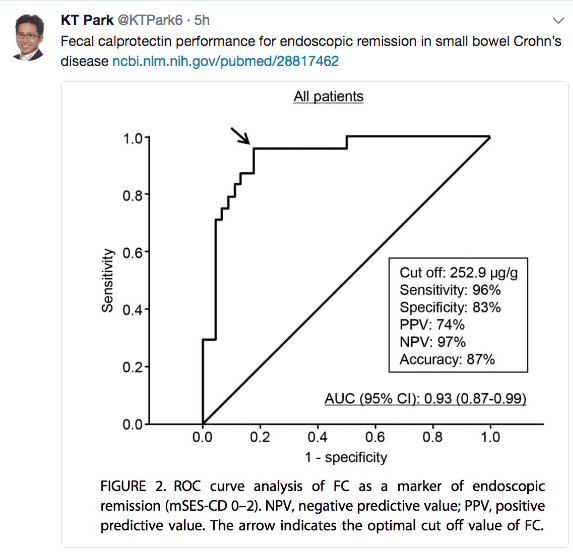
  • This study does not describe other alternative modalities to assess for mucosal healing. Is it feasible to use a biomarker like an abnormal calprotectin to target those in need of further evaluation? In those with abnormal biomarkers, dose escalation would not require a repeat scope.
  • The Emory group has used MRE extensively, but does not report MRE findings in this population.  Would MRE (which does not require sedation) be more useful in some patients?

As in adult patients, this study does show the need for objective markers in pediatric inflammatory bowel disease; 30% of patients who were considered to be in clinical remission had active disease with further investigation.  This finding has implications for ImproveCareNow which uses physician global assessment in tracking remission rates for pediatric IBD.

In their discussion, the authors state that “changes in medical therapy can increase the MH rate to nearly 80%, which could be even higher with additional changes in those who did not demonstrate MH on a second endoscopy.”  This sentence needs to be carefully interpreted.  The authors were able to show MH based on physician assessment in 82 of 104 patients (79%) who were in clinical remission.  This rate would be MUCH lower if the entire cohort of 182 were included, possibly no greater than 50%.

The authors conclude with “endoscopy should be considered in pediatric patients with IBD in clinical remission to identify those without MH who may require medication escalation despite the absence of clinical symptoms.”

My take: I agree with the authors that objective markers of clinical remission need to be obtained to assess the effectiveness of therapy.  However, I am not convinced that endoscopy is needed in every patient who is doing well on therapy; other biomarkers and imaging may be more beneficial.

Related blog posts:

Sign at Pisgah Fish Camp Restaurant: “On this site in 1897 nothing happened.”


Adalimumab Can Reverse Growth Failure in Pediatric Crohn’s Disease

In an industry-sponsored study (TD Walters et al. Inflamm Bowel Dis 2017; 23: 967-75), adalimumab (ADA) was shown to be effective agent in reversing growth failure associated with pediatric Crohn’s disease (CD).

Background:  About one-third of children and adolescents with CD suffer from growth failure and delayed puberty.  Several prior studies have shown that anti-TNF therapy can improve height velocity and that early treatment with anti-TNF therapy (≤3 months after diagnosis) leads to greater improvement in height obtained, if initiated before puberty or early into puberty. This study examines the effectiveness of ADA in children from the IMAgINE 1 trial.

The authors identified 73 participants with growth delays (& adequate data) along with 27 participants with no growth delays.

Key findings:

  • ADA therapy significantly improved and normalized growth rates at 26 and 52 weeks in patients with baseline linear growth impairment.
  • At week 26, height velocity z-score was 1.33 among 23 children in remission compared with -0.78 (n=29) among “nonremitters”
  • At week 52, height velocity z-score was 2.17 among 27 children in remission compared with -1.57 (n=17) among “nonremitters”

My take: In moderate to severe CD, anti-TNF agents have been demonstrated to reverse growth failure; though, this is expected to occur only in patients with clinical response. To my knowledge, no other CD medical therapies have been proven to reverse growth failure (surgical treatment can improve growth as well).

Related blog posts:

Quiet Spot on U Chicago Campus

Low Rate of Ocular Disease in Pediatric Crohn’s Disease

A recent study (S Naviglio et al. Inflamm Bowel Dis 2017; 23: 986-90) confirms that there is a low rate of ocular disease in pediatric inflammatory bowel disease (IBD); in this cohort, half had Crohn’s disease (CD) and half had ulcerative colitis.

In this single center study, 94 children with a median age of 13.4 yrs were offered ophthalmologic examination (2014-2016).  None of these patients reported ocular symptoms.  The authors assert that 70% had intestinal remission, though 64% had elevated fecal calprotectin levels (>100 mg/kg). Key finding: One patient (1.06%) had ocular finding of uveitis (previously diagnosed prior to study)

The authors indicate that hepatobiliary manifestations, present in 9, were the most common extraintestinal IBD manifestation (EIM). Arthropathy occurred in 8, cutaneous manifestations occurred in 6 and ‘metastatic’ CD occurred in 4.

My take:  Ocular disease is an infrequent EIM in pediatric patients with IBD.

Related articleK Hata et al. Inflamm Bowel Dis 2017; 23: 1019-24. This article found that patients with EIMs were more likely to have chronic pouchitis after colectomy for ulcerative colitis. Overall, chronic pouchitis developed in 3.3%, 7.6% and 16.6% at 2, 5, and 10 years respectively. Key finding: preoperative EIM yielded a HR of 4.52.

More Data for Ustekinumab in Crohn’s Disease

Briefly noted: C Ma et al. Inflamm Bowel Dis 2017; 23: 833-9.  This retrospective study examined the response to ustekinumab in 104 patients with Crohn’s disease.  All patients had achieved a steroid-free ustekinumab induction.  92.3% had failed anti-TNFα therapy.

Key findings:

  • 71.8% maintained a response at 52 weeks
  • 64.4% maintained an endoscopic or radiographic response

IBD Shorts and Postop Crohn’s Management

C Ma et al. Inflamm Bowel Dis 2017; 23: 833-9.  This retrospective study examined the ongoing response to ustekinumab in 104 patients with Crohn’s disease.  All patients had achieved a steroid-free ustekinumab induction.  92.3% had failed anti-TNFα therapy.Key findings:

  • 71.8% maintained a response at 52 weeks
  • 64.4% maintained an endoscopic or radiographic response

Related blog post: Closer Look at Ustekinumab Data

O Truffinet et al JPGN 2017; 64: 721-25. This small study with 8 children with Crohn’s disease examined the use of tacrolimus.  Six of eight showed a response to tacrolimus (target 8-15) with a clinical response at 2 months and 4 of 8 in clinical remission.  Adverse effects were common, occurring in 6 of 8.  These included renal dysfunction, diabetes, paresthesia and tremor.

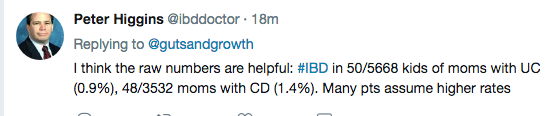
J Adler et al.  JPGN 2017; 64: e117-e124. Using ImproveCareNow registry, the authors identified perianal disease (PD) in 1399 of 6679 cases (21%).  PD was more common in blacks than whites: 26% vs. 20%.  Overall, this study showed a higher rate of PD than previously recognized.

J Amil-Dias et al JPGN 2017; 64: 818-35.  This is an ESPGHAN IBD Porto Group guideline for surgical Crohn’s disease management in children.  There are 25 graded statements.  Here are a few:

  • #7 & #8. If needing surgery for CD pancolitis, the authors recommend subtotal colectomy and ileostomy.  Possible reanastomosis at later date if no significant rectal and/or perianal disease.  Ileal pouch-anal anastomosis is NOT recommended.
  • #13. Monitor Vitamin B12 if >20 cm resection of terminal ileum
  • #16. Postoperative management “should be based on ileocolonoscopy.” Figure 1 details recommendations, including need for assessment postoperatively.
  • In patients with high-risk factors, anti-TNF therapy is recommended postoperatively.  In those without high-risk factors, the authors indicate that thiopurines are reasonable with and advancing to anti-TNF if Rutgeerts i2 or greater at followup assessment.  High-risk factors include growth failure, short duration from diagnosis to surgery, extensive resection (>40 cm), and penetrating disease.

Related blog post:

Musee d’Orsay


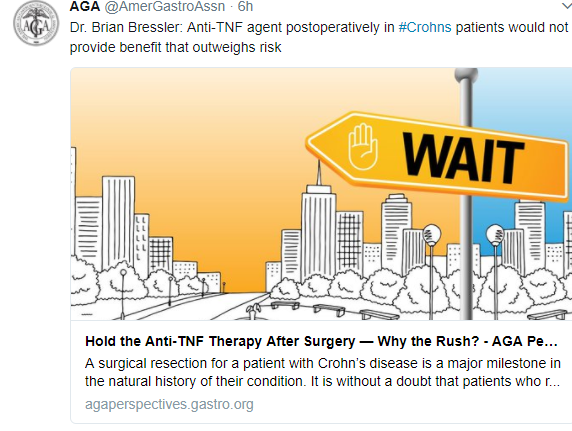
Surgical Reset for Anti-TNF Therapy with Crohn’s Disease

A recent study (A Assa et al. Inflamm Bowel Dis 2017; 23: 791-97) indicates that after surgery, anti-TNFα treatment is worth another try.

In this retrospective study with 53 children, 18 had “pharmacodynamic failure” with anti-TNFα medications (PK group) and 35 were controls. “Phamacocynamic failure is characterized by either a lack of improvement of CD symptoms or  loss of response after initial improvement in the setting of adequate serum drug levels without ADAs” [antidrug antibodies].

Key findings:

  • Mean age at time of intestinal resection was 14.8 years
  • Median time from resection to anti-TNF initiation was 8 months
  • Compared to the control group, the PK group had similar response to anti-TNF therapy.   “Similar proportions of patients from both groups were in clinical remission on anti-TNF treatment after 12 months and at the end of follow-up (1.8 years)”
  • At 12 months, remission rates were 89% (PK) versus 88.5% (control)

The authors propose an explanation: “A plausible explanation for this finding is that in severely inflamed tissue with high inflammatory burden, local high levels of TNFα serves as a sink for anti-TNFα antibodies and that tissue injury and local hypoxia might further limit drug penetrance to its target.”

My take: This information is useful.  Many patients who have surgery may respond to anti-TNFα therapy subsequently.  The unanswered question: Could more frequent dosing of anti-TNFα therapy have averted surgery in some patients by overcoming areas of intense disease?


IBD Resources for Clinicians/IBD Tweets

Another website with a few useful resources:

  • Steroid taper calendar -helps develop a calendar (can use to print out or take a picture)
  • Imaging risk calculator -this is not that great.  In essence if you have a patient present to ER with a CRP of 1 mg/dL and ESR of 20, it states that risk of a complication like a perforation is “NOT LOW” and to consider imaging
  • IBD School Video collection -links to UM website

Note -therapeutic drug monitoring may be more useful in children due to their changing size.

Disclaimer: These blog posts are for educational purposes only. Specific dosing of medications (along with potential adverse effects) should be confirmed by prescribing physician.  This content is not a substitute for medical advice, diagnosis or treatment provided by a qualified healthcare provider. Always seek the advice of your physician or other qualified health provider with any questions you may have regarding a condition.

More IBD Cases Than Ever in Young Canadian Children

Summary of recent article (Link to full study: Benchimol EI, et al. Am J Gastroenterol. 2017;doi:10.1038/ajg.2017.97) by Healio Gastroenterology: IBD incidence rapidly increasing in young Canadian children

An excerpt:

To evaluate the recent incidence, prevalence and trends in childhood-onset IBD in Canada, Benchimol and colleagues used health administrative data from five provinces to identify children aged younger than 16 years who were diagnosed with IBD between 1999 and 2010. During this period, 3,462 children were diagnosed with Crohn’s disease, 1,382 with ulcerative colitis and 279 with unclassifiable IBD, for an overall IBD incidence of 9.68 (95% CI, 9.11-10.25) per 100,000 children.

Throughout the study period, the annual percentage change in overall IBD incidence remained statistically stable, increasing by just 2.06% per year, but the incidence increased significantly among children aged younger than 5 years, rising by 7.19% per year.

Further, the annual percentage change in the prevalence of IBD increased significantly throughout the study period (4.56%), and at the end of the study period IBD prevalence was 38.25 (95% CI, 35.78-40.73) per 100,000 children.

The investigators noted their findings confirmed the predominant form of pediatric-onset IBD was Crohn’s disease, and that more boys were affected than girls.

My take: While Canada has high prevalence of IBD, I expect that there will be similar trends in epidemiology in multiple regions in young children.  When one looks at the increases in IBD prevalence over the last 100 years (see previous post) and the emergence of IBD in non-Western countries, it is quite alarming.

Also, last week a blog post discussed hepatic problems associated with IBD (Liver problems with IBD): here is full article text link: Hepatic Issues and Complications Associated with IBD

Related blog posts:

Liver Problems with Inflammatory Bowel Disease

A recent review (Full text: LJ Saubermann et al. JPGN 2017; 64: 639-52)  discusses the hepatic issues and complications associated with inflammatory bowel disease.

Key topics:

  • Primary Sclerosing Cholangitis (PSC)
  • Autoimmune Hepatitis (AIH)
  • Autoimmune Sclerosing Cholangitis (ASC)
  • Portal Venous Thrombosis/hypercoagulability
  • Cholelithiasis (more common in Crohn’s disease if diseased terminal ileum)
  • Viral hepatitis
  • Drug-Induced Liver Disease
  • Fatty Liver disease

Many of these topics have been discussed previously on this blog.  A couple of pointers in this review:

PSC:

  • Greater risk of colorectal carcinoma
  • IBD-PSC patients are at higher risk for pouchitis
  • GGT of >252 U/L “was highly sensitive (99%) and had good specificity (71%) for PSC” [or ASC]
  • The authors recommend “screening all newly diagnosed patients with IBD with ALT and GGT
  • Immunosuppressive therapy is NOT effective
  • Vancomycin therapy is currently being tested (clinical trials: NCT02137668 & NCT01802073)

AIH:

  • Less frequent in IBD patients than PSC
  • Most common treatment is prednisone/azathioprine
  • 40-80% of children have cirrhosis at AIH diagnosis, but “progression to end-stage liver disease is rare and …with appropriate treatment, 80% of patients achieve remission.”

ASC:

  • ASC is an overlap syndrome between AIH and PSC
  • “It is important that children with IBD and apparent AIH are routinely investigated for evidence of biliary disease with MRCP”
  • “ASC responds to the same immunosuppressive combination therapy used for AIH”

HAV/HBV Immunization:

  • HAV vaccination is effective in patients with IBD…although the rate [seroconversion] was significantly lower” in patients receiving anti-TNF therapy (92.4% vs 99.1% in one study).
  • In those needing HBV immunization: “One strategy evaluated to improve HBV immunity in adults with IBD is an accelerated course with double vaccine doses at 0, 1, and 2 months.”

Methotrexate (MTX):

  • “The extent of histological features of hepatotoxicity secondary to long-term MTX use in IBD has been infrequently described; however, the inicdence of significant abnormal histological findings appears to be rather low.”

My take: This article is a good starting point for liver-related issues in IBD.  For concerns regarding medications, the NIH livertox website is more useful and much more comprehensive.

Related blog entries:

DILI:

PSC:

AIH: