Primary Sclerosing Cholangitis (PSC) –Natural History Study

Last week, I posted an blog referencing new guidelines for peanut introduction.  A more detailed explanation of these guidelines: New Guidelines: Early Introduction of Peanut to Prevent Peanut Allergy from David Stukus (Thanks to Kipp Ellsworth for sharing this information)

_________________

A recent study (PL Valentino et al. JPGN 2016; 63: 603-09) follows “the largest reported pediatric PSC cohort” to determine the natural history.

Study characteristics:

This retrospective study followed 120 children (1-21 yrs) with a median age of 14 years.  27% had autoimmune sclerosing cholangitis (ASC), 63% had PSC; 24% (n=29) of entire cohort had exclusive small duct PSC. Median followup was 3.7 years.

Key findings:

  • 81% of PSC patients had inflammatory bowel disease; most (72/97) had ulcerative/indeterminant coliits. 40/72 had pancolitis.
  • PSC-IBD was more common than ASC-IBD (85% vs 68%).
  • 10-year transplant-free survival in this cohort was 89%; there were 6 liver transplants.
  • The rate of cirrhosis was lower in the group who had IBD preceding PSC (15% vs 31%,P=0.05).
  • PSC is clinically silent in the majority of patients; 64% presented with abnormal chemistries and no other symptoms.
  • ERCP therapeutic intervention was low, 3% for stenting and 7% for balloon dilatation.

The authors speculate that one reason for milder PSC-IBD disease could relate to the fact that IBD patients undergo frequent chemistries.  In those without IBD, subacute PSC could be present for a much longer period before detection.  The authors note that PSC in children presents as a milder disease with only 10% having cirrhossi compared with 30% in studies with adult patients.

My take: We have a lot to learn about PSC including which patients are likely to develop clinically significant liver disease and whether most patients benefit from treatment.

Related blog post: Should we care about subclinical PSC? (This post has links to others related to PSC)

Thunder Hole, Acadia Nat'l Park

Thunder Hole, Acadia Nat’l Park

Landmark Publication for Ustekinumab (Stelara)

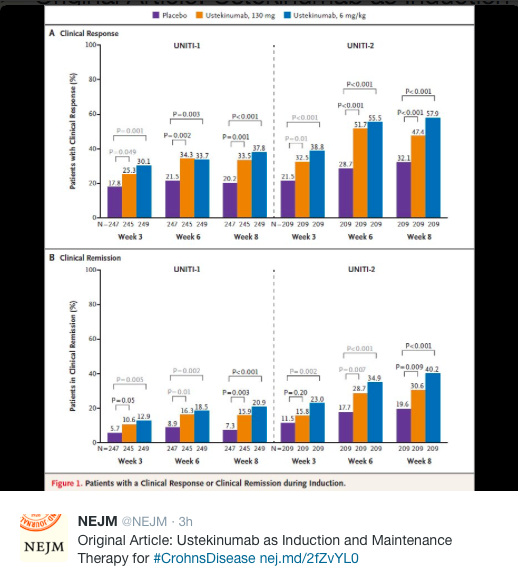
A recent study (BG Feagan, WJ Sandborn et al NEJM 2016; 375: 1946-60) provides extensive data regarding the effectiveness of ustekinumab for Crohn’s disease.

This publication combines three trials (industry-sponsored): UNITI-1, UNITI-2, and IM UNITI.  The first two trials with 741 and 628 patients respectively examined intravenous ustekinumab for induction.  Patients (18 years or older with Crohn’s disease) received either 130 mg, 6 mg/kg or placebo.  UNITI-1 were patients with primary or secondary nonresponse to TNF antagonists.  UNITI-2 were patients in whom conventional therapy failed or in which unacceptable side effects developed. The majority of UNITI-2 patients had not received a TNF antagonist.

IM UNITI with 397 patients followed patients who completed the first two trials for maintenance (90 mg SC every 8 weeks or every 12 weeks).  For this study, the primary end point was remission at week 44 (CDAI score <150).

The IM UNITI study involved 260 sites in 27 countries.

Key findings:

  • With the induction trials, ustekinumab outperformed placebo at 6 weeks.  For UNITI-1, 130 mg dosing resulted in 34.3% response, 6 mg/kg resulted in 33.7% response and placebo 21.5%.
  • For UNITI-2, 130 mg dosing resulted in 51.7% response, 6 mg/kg resulted in 55.5% response and placebo 28.7%.
  • For IM UNITI, every 8 weeks dosing resulted in 53.1% remission at week 44, compared with 48.8% dosed every 12 weeks, and 35.9% who received placebo.
  • For IM UNITI, among those who started in remission at week 0, 66.7% (q 8 weeks), 56.4% (q12 weeks) and 45.6% (placebo) remained in remission at 44 weeks.

When looking at more objective results, both UNITI-1 and UNITI-2 showed significant drops in calprotectin and CRP values; both of these objective markers favored 6 mg/kg over 130 mg fixed induction dose.

  • UNITI-1 at 6 weeks, calprotectin dropped 38.6 in 130 mg dosing group, 41.3 in 6 mg/kg group and 0 in placebo.
  • UNITI-2 at 6 weeks, calprotectin dropped 55.0 in 130 mg dosing group, 106.3 in 6 mg/kg group and 0 in placebo.
  • For the IM UNITI objective markers, it was noted that the median CRP values generally were unchanged in both treatment groups (q8 weeks, and q12 weeks) but increased in the placebo group by ~4 mg/L.  Also, calprotectin remained <250 mg in both ustekinumab treatment groups at a much higher percentage than those who received placebo.

Safety:

Extensive safety data are reported and more than 60% of all patients, including placebo-treated patients reported potential adverse effects.  Adverse effects and serious adverse effects were similar in treatment and control groups. During 1 year of therapy, there were no deaths or instances of the reversible posterior leukoencephalopathy syndrome.

Other points:

  • Response to ustekinumab was observed as early as week 3
  • UNITI-2 patients, most of whom had not failed a TNF antagonist, had higher response than UNITI-1 likely due to disease which was less refractory and of shorter duration

My take: These data support the use of ustekinumab for Crohn’s disease, particularly in patients who have not responded to other therapies.

stelarastudy


Notable Briefs for IBD -December 2016

MI Abdalla et al. Inflamm Bowel Dis 2016; 22: 2658-64.  This article reviewed the impact of an ostomy on QOL (quality of life) for Crohn’s disease patients. n=402 with ostomy compared with 4331 CD patients without.

Key findings:

  • Patients with ostomy were more likely to be in remission: 48.5% versus 31.35%.
  • Having an ostomy did not impact overall health-related quality of life but did reduce social role satisfaction.
  • Conclusion: “ostomy is well tolerated…particularly when clinical remission is achieved.”

WKM Liew et al. J Pediatr 2016; 178: 227-32. In this study with 16 patients (aged 6-24 years) who received thalidomide, more information on neuropathy is provided.  “All subjects with cumulative doses greater than 60 g developed polyneuropathy.”  4 of 5 subjects receiving the drug for >20 months developed neuropathy. Two important points:

V Collij et al. Inflamm Bowel Dis; 2016; 22: 2562-70. “We identified drugs that target the proteins encoded by IBD candidate genes.” Key finding: There were 113 drugs that could potentially be used in IBD treatment, including 14 known IBD drugs, 48 drugs that are/have been tested for IBD, 19 being tested for other inflammatory diseases, and 32 new investigational medications.

from one of the best days all year

from one of the best days all year on board “Bufflehead”

Latest on Vedolizumab

A Amiot et al. Clin Gastroenterol Hepatol November 2016 Volume 14, Issue 11, Pages 1593–1601.

Abstract:

Background & Aims

Phase 3 trials have shown the efficacy of vedolizumab, which binds to integrin α4β7, in patients with Crohn’s disease (CD) or ulcerative colitis (UC). We investigated the effectiveness and safety of vedolizumab in patients who failed anti-tumor necrosis factor therapy.

Methods

From June through December 2014, there were 173 patients with CD and 121 patients with UC who were included in a multicenter nominative compassionate early access program granted by French regulatory agencies. This program provided patients with access to vedolizumab before it was authorized for marketing. Vedolizumab (300 mg) was administered intravenously at weeks 0, 2, and 6, and then every 8 weeks. Disease activity was assessed using the Harvey–Bradshaw Index for CD and the partial Mayo Clinic score for UC. We report results obtained after the 14-week induction phase.

Results

Among the 294 patients treated with vedolizumab (mean age, 39.5 ± 14.0 y; mean disease duration, 10.8 ± 7.6 y; concomitant steroids, 44% of cases), 276 completed the induction period, however, 18 discontinued vedolizumab because of a lack of response (n = 14), infusion-related reaction (n = 2), or infections (n = 2). At week 14, 31% of patients with CD were in steroid-free clinical remission and 51% had a response; among patients with UC, 36% were in steroid-free clinical remission and 50% had a response. No deaths were reported. Severe adverse events occurred in 24 patients (8.2%), including 15 (5.1%) that led to vedolizumab discontinuation (1 case of pulmonary tuberculosis and 1 rectal adenocarcinoma).

Conclusions

In a cohort of patients with CD or UC who failed previous anti–tumor necrosis factor therapy, approximately one third of patients achieved steroid-free clinical remission after 14 weeks of induction therapy with vedolizumab. This agent had an acceptable safety profile in these patients.

Related Blog Posts:

screen-shot-2016-11-08-at-8-18-44-pm

FDA approves Amjevita (Humira biosimilar)

On 9/23/16: FDA approved Amjevita (Humira biosimilar)

Excerpt:

The U.S. Food and Drug Administration today approved Amjevita (adalimumab-atto) as a biosimilar to Humira (adalimumab) for multiple inflammatory diseases.

Amjevita is approved for the following indications in adult patients:

  • moderately to severely active rheumatoid arthritis;
  • active psoriatic arthritis;
  • active ankylosing spondylitis (an arthritis that affects the spine);
  • moderately to severely active Crohn’s disease;
  • moderately to severely active ulcerative colitis; and
  • moderate to severe plaque psoriasis.

…Amjevita is biosimilar to Humira. It has been approved as a biosimilar, not as an interchangeable product.

Fort Knox, Maine

Fort Knox, Maine

Vedolizumab Study in IBD

From CGH Associated Editor Charles Kari:

Effectiveness and Safety of Vedolizumab Induction Therapy for Patients With Inflammatory Bowel Disease

Vedolizumab is a biologic agent which targets the integrin receptor and is approved for the treatment of patients with moderate-severe ulcerative colitis (UC) and Crohn’s disease (CD). Vedolizumab inhibits the interaction between α4β7 integrin and mucosal addressin cell adhesion molecule-1 (MAdCAM–1).

In this [November] issue of Clinical Gastroenterology and Hepatology, Amiot and colleagues report the effectiveness and safety of vedolizumab induction therapy in patients with moderate-to-severe active UC and CD who previously failed anti-TNF therapy. Active IBD was defined according to the Harvey-Bradshaw index (HBI) >4 for CD patients and the Mayo Clinic score ≥6 for UC patients. Patients received intravenous vedolizumab at a dose of 300 mg at weeks 0, 2 and 6 and then every 8 weeks through week 52. Concomitant use of corticosteroids, immunomodulators, or methotrexate was permitted. The primary outcome measure was steroid-free clinical remission at week 14, which was defined as a HBI ≤4 for CD patients and a partial Mayo Clinic score ❤ with a combined stool frequency and rectal bleeding subscore of ≤1 for UC patients. A total of 294 patients were enrolled (CD, 173; UC, 121), of whom 276 completed the induction period. At week 14, 63 (36%) and 47 (39%) patients were in clinical remission in the CD and UC groups, respectively, of whom 53 (31%) and 43 (36%), respectively, were in steroid-free clinical remission. The clinical response rates at 14 weeks were 64% for CD patients and 57% for UC patients. Adverse events occurred in 93 patients (31.6%) out of 294 patients with serious adverse events in 24 (8.2%) and adverse events leading to vedolizumab discontinuation in 15 (5.1%) including one case of pulmonary tuberculosis.

In conclusion, in a cohort of IBD patients who failed anti-TNF therapy and received vedolizumab, about one third experienced steroid-free clinical remission at 14 weeks, with good safety profile (Figure 3).

screen-shot-2016-10-24-at-10-42-42-am

screen-shot-2016-10-24-at-10-42-50-am

Safer Than You Think: Biologic Therapies for IBD and Risk of Infection and Malignancy

While there have been a number of studies which have highlighted the potential risks of biologic agents, many studies have NOT identified any risk of infection or malignancy.

Another recent systematic review/meta-analysis (S Bonovas et al. Clin Gastroenterol Hepatol 2016; 14: 1385-97) provides reassuring data regarding the following biologics: infliximab, adalimumab, certolizumab, golimumab, natalizumab, and vedolizumab.

The authors identified 49 randomized placebo-controlled studies with 14,590 participants.

Key findings:

  • There was a moderate infection risk with odds ratio of 1.19 (19% increase in odds of developing an infection) and significant increase in opportunistic infections (eg. tuberculosis) OR 1.90
  • Risk of serious infections was NOT increased in patients treated with biologics with OR 0.89.  In studies with low risk of bias, the risk of serious infections had OR of 0.56.
  • No increase in malignancy risk was identified with OR 0.90 but the authors note that data was insufficient in terms of exposure and follow-up to be conclusive.

The authors note that the studies including in this review challenge some of the findings of observational studies. “However, observational studies lack the experimental random allocation of participants…the discrepancies between observational studies and randomized trial evidence might be explained by the inability of observational designs to fully address the complex and important differences between the IBD patients receiving and those not receiving biologics.”

Study limitations include “sponsorship bias -because the trials were supported by pharmaceutical companies and limited followup of 24 months. In addition, most of the trials in the meta-analysis were judged to be at high or unclear risk of bias because of their methodological characteristics.

My take: This study indicates that biologic therapies do not appear to increase the risk of serious infections and may not increase the overall risk of malignancy.

Related blog posts:

Portland Fish Market

Portland Fish Market


What Happens When Infliximab Is Stopped in Patients with Ulcerative Colitis Remission

‘If it ain’t broke, don’t fix it’

Perhaps, the above sentiment is needed for patients with ulcerative colitis who are doing well with infliximab therapy according to a recent study (G Fiorino et al. Clin Gastroenterol Hepatol 2016; 14: 1426-32).

In this multicenter retrospective cohort study, 111 patients with ulcerative colitis who had been in remission (>12 months) were followed after stopping infliximab (IFX) and compared with 82 controls who remained on therapy.  Here’s what happened (see Figure 1 in study):

  • Among those who discontinued IFX, 53 patients (47.7%) relapsed in the followup period.  This corresponded to an incidence of 23.3 per 100 person-years and with a median time to relapse of 3.6 years.
  • In comparison, for those who remained on IFX, 14 relapses (17.1%) occurred which corresponded to an incidence of 7.2 per 100 person-years at risk and with a median time to relapse of 7.6 years.
  • Thiopurine use after stopping IFX seemed to diminish the risk of relapse: 15.0 per 100 person-years compared with 31.2 per 100 person-years for those taking an aminosalicylate alone.
  • For those who restarted IFX, 77.1% had a response and 51.4% returned to remission; however, 17.1% had infusion reactions.

My take: In a real-life experience, stopping IFX in patients with ulcerative colitis who had been in sustained clinical remission resulted in a higher relapse rate.  This finding is consistent with other studies.

Related blog posts:

The Lawn at University of Virginia

The Lawn at University of Virginia

Changes in the Use of IBD Biologic Therapy

A recent study (W-J Lee et al. Inflamm Bowel Dis 2016; 22: 2410-17) offers a great deal of insight into changes in the use anti-Tumor Necrosis Factor Alpha (ant-TNF) therapy from 2009-2013 in patients ≤24 years.  The authors utilized databases with about 180 million people and identified 11,962 patients with inflammatory bowel disease (IBD).

Key findings:

  • 3300 of the 11,962 (27.6%) patients were treated with anti-TNF therapy.
  • Top-down treatment: 1298 of 3300 (39.3%) were treated with top-down therapy which was defined as usage of anti-TNF therapy within 30 days of first IBD medication prescription.  Interestingly, over the course of the study, there was a trend towards more top-down (versus step-up) therapy and shorter time to initiation of anti-TNF therapy. In 2009, 31.4% used a top-down approach compared with 49.8% in 2013.
  • Top-down therapy is associated with lower rates of corticosteroid use.
  • Infliximab dominant anti-TNF: infliximab was the anti-TNF in 89.2% of patients less than 12, 82.3% of patients 12-17, and 55.1% of patients 18-24.  Adalimumab accounted for the vast majority of the other TNF users. Though, the authors note a trend towards increasing use of adalimumab in both adult and pediatric patients in a separate study (Park KT et al. Inflamm Bowel Dis 2014; 20: 1242-49)
  • Cotherapy: thiopurines and methotrexate were used as cotherapy in 13.5% and 7.2% of top-down group compared with 54.8% and 14.6% respectively in step-up strategy.
  • Drug therapy among non-TNF users: 25.4% (2199) received a thiopurine, 79.3% (6871) received a 5-aminosalicylate, and 2.3% (201) received methotrexate.
  • Anti-TNF therapy discontinuation: Using top-down strategy 69.2% persisted on infliximab at 12 months and 56.8% persisted at 24 months.  In comparison, using step-up approach with infliximab, it was 72.7% at 12 months and 64.0% at 24 months.  The numbers were quite similar with all the anti-TNF agents indicating that step-up approach had significantly lower rate of anti-TNF discontinuation. The authors speculate that one factor could be use of cotherapy or possibly other adverse reactions.

The authors explain some of the limitations of their study in its reliance on databases, particularly with regard to misclassification.  However, in my opinion, these limitations do not affect any of the trends that the authors are able to document.

My take: For most of my patients, I have preferred to continue to utilize cotherapy  and/or step-up therapy because I think there is likely to be a more durable anti-TNF response.  The fairly small differences in anti-TNF durability have huge implications for those  who lose anti-TNF responsiveness given the limited treatment options.

Related blog posts:

Hidden Lake and Bear Mountain, Glacier National Park

Hidden Lake and Bear Mountain, Glacier National Park