What Happens When Infliximab Is Stopped in Patients with Ulcerative Colitis Remission

‘If it ain’t broke, don’t fix it’

Perhaps, the above sentiment is needed for patients with ulcerative colitis who are doing well with infliximab therapy according to a recent study (G Fiorino et al. Clin Gastroenterol Hepatol 2016; 14: 1426-32).

In this multicenter retrospective cohort study, 111 patients with ulcerative colitis who had been in remission (>12 months) were followed after stopping infliximab (IFX) and compared with 82 controls who remained on therapy.  Here’s what happened (see Figure 1 in study):

  • Among those who discontinued IFX, 53 patients (47.7%) relapsed in the followup period.  This corresponded to an incidence of 23.3 per 100 person-years and with a median time to relapse of 3.6 years.
  • In comparison, for those who remained on IFX, 14 relapses (17.1%) occurred which corresponded to an incidence of 7.2 per 100 person-years at risk and with a median time to relapse of 7.6 years.
  • Thiopurine use after stopping IFX seemed to diminish the risk of relapse: 15.0 per 100 person-years compared with 31.2 per 100 person-years for those taking an aminosalicylate alone.
  • For those who restarted IFX, 77.1% had a response and 51.4% returned to remission; however, 17.1% had infusion reactions.

My take: In a real-life experience, stopping IFX in patients with ulcerative colitis who had been in sustained clinical remission resulted in a higher relapse rate.  This finding is consistent with other studies.

Related blog posts:

The Lawn at University of Virginia

The Lawn at University of Virginia

Changes in the Use of IBD Biologic Therapy

A recent study (W-J Lee et al. Inflamm Bowel Dis 2016; 22: 2410-17) offers a great deal of insight into changes in the use anti-Tumor Necrosis Factor Alpha (ant-TNF) therapy from 2009-2013 in patients ≤24 years.  The authors utilized databases with about 180 million people and identified 11,962 patients with inflammatory bowel disease (IBD).

Key findings:

  • 3300 of the 11,962 (27.6%) patients were treated with anti-TNF therapy.
  • Top-down treatment: 1298 of 3300 (39.3%) were treated with top-down therapy which was defined as usage of anti-TNF therapy within 30 days of first IBD medication prescription.  Interestingly, over the course of the study, there was a trend towards more top-down (versus step-up) therapy and shorter time to initiation of anti-TNF therapy. In 2009, 31.4% used a top-down approach compared with 49.8% in 2013.
  • Top-down therapy is associated with lower rates of corticosteroid use.
  • Infliximab dominant anti-TNF: infliximab was the anti-TNF in 89.2% of patients less than 12, 82.3% of patients 12-17, and 55.1% of patients 18-24.  Adalimumab accounted for the vast majority of the other TNF users. Though, the authors note a trend towards increasing use of adalimumab in both adult and pediatric patients in a separate study (Park KT et al. Inflamm Bowel Dis 2014; 20: 1242-49)
  • Cotherapy: thiopurines and methotrexate were used as cotherapy in 13.5% and 7.2% of top-down group compared with 54.8% and 14.6% respectively in step-up strategy.
  • Drug therapy among non-TNF users: 25.4% (2199) received a thiopurine, 79.3% (6871) received a 5-aminosalicylate, and 2.3% (201) received methotrexate.
  • Anti-TNF therapy discontinuation: Using top-down strategy 69.2% persisted on infliximab at 12 months and 56.8% persisted at 24 months.  In comparison, using step-up approach with infliximab, it was 72.7% at 12 months and 64.0% at 24 months.  The numbers were quite similar with all the anti-TNF agents indicating that step-up approach had significantly lower rate of anti-TNF discontinuation. The authors speculate that one factor could be use of cotherapy or possibly other adverse reactions.

The authors explain some of the limitations of their study in its reliance on databases, particularly with regard to misclassification.  However, in my opinion, these limitations do not affect any of the trends that the authors are able to document.

My take: For most of my patients, I have preferred to continue to utilize cotherapy  and/or step-up therapy because I think there is likely to be a more durable anti-TNF response.  The fairly small differences in anti-TNF durability have huge implications for those  who lose anti-TNF responsiveness given the limited treatment options.

Related blog posts:

Hidden Lake and Bear Mountain, Glacier National Park

Hidden Lake and Bear Mountain, Glacier National Park


October 2016: IBD Studies

Briefly noted:

E Zittan et al. Inflamm Bowel Dis 2016; 22: 2442-47.  In this study with 773 patients with history of ulcerative colitis/ileal pouch-anal anastomosis, there was no significant difference in complications/leak among the 196 with preoperative anti-TNF exposure (n=26, 13.2%) compared with the control group (n=66, 11.7%). Preoperative anti-TNF exposure does not appear to worsen outcomes after surgery.

C Hartman et al. JPGN 2016; 63: 437-444. This cross-sectional survey of 68 children with IBD (57 Crohn’s disease) found frequent nutrient deficiencies based on 3 day diet records.  Interestingly, children on exclusive enteral nutrition were much less likely to have inadequate intakes of energy, minerals, or micronutrients. This article provides plenty of reasons for children with IBD, particularly Crohn’s disease, to work with a nutritionist.

M Fischer et al. Inflamm Bowel Dis; 2016; 22: 2402-09. In a cohort study of 67 patients (35 with Crohn’s, 31 with ulcerative colitis, and 1 indeterminate colitis), fecal microbiota transplantation (FMT) for refractory Clostridium difficile infection was successful in 53 (79%) with a single infusion.  Four of the 14 failures, subsequently responded to anti-CDI antibiotics. Of the 8 who had a 2nd FMT, 6 were successful; and 1 of 2 responded to 3rd FMT.  Thus, 60 of 67 responded overall to FMT.  After FMT, IBD disease activity was reported as improved in 25 (37%), no change in 20 (30%) and worse in 9 (13%).  In this cohort, 1 needed colectomy and 1 needed diversion.  This article indicates that FMT for CDI in IBD was associated with high cure rates and low risk of IBD flare.

A Khoruts et al. Clin Gastroenterol Hepatol 2016; 14: 1433-38. This was a study of 272 consecutive patients that underwent FMT for recurrent CDI. 15% had established IBD and 2.6% were determined to have IBD at time of FMT.  74.4% of IBD patients responded to a single FMT compared with 92.1% of patients without IBD.  More than one quarter of IBD patients experienced a clinical flare after FMT.

MA Conrad et al. Inflamm Bowel Dis; 2016: 22: 2425-31.  This review of early pediatric experience with vedolizumab in 21 subjects (16 with Crohn’s disease) identified a clinical response in 6/19 (31.6%) evaluable subjects at week 6 and 11/19 (57.9%) by week 22. Steroid-free remission was noted in 3/20 at 14 weeks (15%) and 4/20 (20.0%) at 22 weeks.  Overall, this shows a fairly low response rate to vedolizumab in this highly selected cohort.  Prospective pediatric studies of vedolizumab are needed to identify which patients are most likely to benefit.

University of Virginia Rotunda

University of Virginia Rotunda


Should We Care About Subclinical Primary Sclerosing Cholangitis with Inflammatory Bowel Disease?

A recent study (AK Lunder et al. Gastroenterol 2016; 151: 660-69, editorial 590-3) provides more information about the prevalence of subclinical primary sclerosing cholangitis (PSC) in the setting of long-term inflammatory bowel disease. From a cohort of 756 Norwegian patients in the “IBSEN” cohort of patients with inflammatory bowel disease, the authors analyzed 327 patients with magnetic resonance cholangiography (MRC).

Key findings:

  • 24 (7.5%) of 327 patients who had been followed for 20 years were found to have PSC lesions.  Only 7 (2.2%) were known to have PSC based on biochemical or clinical features. Subsequently, a missed case of small-duct PSC was recognized increasing the rate to 8.1%.
  • Subclinical PSC, interestingly, was detected more often in Crohn’s patients (9.0%) compared with ulcerative colitis (6.8%)
  • Extensive colitis, high prevalence of colectomy, and refractory IBD symptoms were more common in patients with suspected PSC compared with those without PSC features (P= .029, P= .002, and P= .012 respectively)

The natural history of these subclinical cases of PSC is unclear.  Studies have shown that patients with PSC with normal alkaline phosphatase values have an excellent outlook.  Yet, there should be some concern.  PSC has been associated with 400-fold higher chance of cholangiocarcinoma and 5-fold increased risk of developing colorectal cancer.  This could indicate the need for more intensive surveillance in these patients –though the exact risks in those with subclinical disease is unknown.

My take: Until we know more, I doubt looking for subclinical PSC makes sense outside research protocols.

Related blog posts:

insurancecoverage

Primary Sclerosing Cholangitis 2016

Though this blog has reviewed primary sclerosing cholangitis (PSC), it has been a while since I’ve posted much.  As such, I thought I would place a post of a recent review (KN Lazaridis, NF LaRusso. NEJM 2016; 375; 1161-70).

Key points:

Epidemiology:

  • Strongly associated with inflammatory bowel disease with 70-80% of PSC patients having IBD
  • Median age at diagnosis 41 years with ~6-% male

Clinical manifestations:

  • Insidious disease in most.  “About half the patients with this condition do not have symptoms but receive a diagnosis after liver-function tests are found to be abnormal.”
  • Diagnostic criteria include increased alkaline phosphatase for more than 6 months
  • In adults, a liver biopsy is not need for diagnosis
  • Tends to be slowly progressive
  • Bacterial cholangitis is reported as initial presentation in ~6% and can be recurrent and intractable
  • Colon cancer is more frequent in patients with PSC.  “Colonoscopy is warranted in all patients who have received a new diagnosis”

Subtypes:

  • Classic subtype (90%) involves the entire biliary tree
  • ~5% have only small intrahepatic bile duct involvement
  • ~5% of adults have overlap syndrome with autoimmune hepatitis.  In children, overlap syndrome is present in ~35%.
  • There are numerous “secondary” PSC causes including AIDS-related cholangiopathy, amyloidoiss, eosinophilic cholangiopathy, histiocytosis X, IgG4-associated cholangitis, and sarcoidosis (most extensive list -see Table 1)

Pathogenesis:

  • The exact reasons remain unclear.  There are associations with environmental triggers but these have not been proven to be causally related.  For example, patients with PSC are more likely to consume steak or hamburger compared with controls and less likely to consume similar amounts of fish.
  • Due to its association with IBD, there are “microbiota hypothesis” to account for the aberrant cholangiocytic response.

psc-nejm

Treatment:

  • “As of this writing, no effective medical therapy exists.”
  • The authors detail eight potential treatments that are being studied: obeticholic acid, simtuzumab, 24-nor-ursodeoxycholic acid, an apical sodium-dependent bile acid transporter inhibitor (LUM001), a human monoclonal antibody that targets vascular adhesion protein 1 (BTT1023), oral vancomycin (NCT01802073 -pediatric trial), and fecal microbiota transplantation.
  • Management: includes managing varices in those with cirrhosis, following for benign and malignant biliary strictures, following for gallbladder disease (eg. polyps or masses), colon cancer surveillance (typically yearly screening), and managing metabolic bone disease.

Briefly noted: M Bramuzzo et al. JPGN 2016; 63: 259-64.  Using an Italian Pediatric IBD registry, the authors noted 6.8% of 677 patients had autoimmune liver disease: 61% with PSC and 33% with overlap syndrome.

Related blog posts:


Briefly Noted: Inflammatory Bowel Disease Updates

Gut Microbial Diversity is Reduced in Smokers with Crohn’s Disease. JL Opstelten et al. Inflamm Bowel Dis 2016; 22: 2070-77.  This study compared stools from 21 nonsmoking patients with Crohn’s disease (CD) with 21 smokers with CD.  Smoking was accompanied by a reduced relative abundance of multiple genera.  My take: It is unclear whether smoking’s effect on the microbiome directly contributes to worsened outcomes or whether the changes in the microbiome are only an epiphenomenon.  Regardless, smoking increases the likelihood of worse outcomes in CD.

A Systematic Review on Infliximab and Adalimumab Drug Monitoring Levels, Clinical Outcomes and Assay. F Silva-Ferreira et al. Inflamm Bowel Dis 2016; 22: 2289-2301. This review selected 20 studies from an initial query of 1654 articles. Key points:

  • Different studies are difficult to compare due to distinct assays with different limitations. Thus, specific cutoffs are based on the specific assay used.
  • The authors state that proactive monitoring may be helpful at week 6, 14, 30 and 54 for infliximab.  They recommend checking infliximab level and antidrug antibodies in those with loss of response, mucosal ulceration or elevated biomarkers (eg. CRP, Fecal calprotectin).

FDA Gives Ustekinumab (Stelara) Approval for Crohn’s

Here’s a link summarizing FDA approval: Medscape: FDA Clears Ustekinumab (Stelara) for Crohn’s Disease

An excerpt:

The US Food and Drug Administration (FDA) has approved ustekinumab (Stelara, Janssen Biotech, Inc) for the treatment of moderately to severely active Crohn’s disease in patients aged 18 years or older.

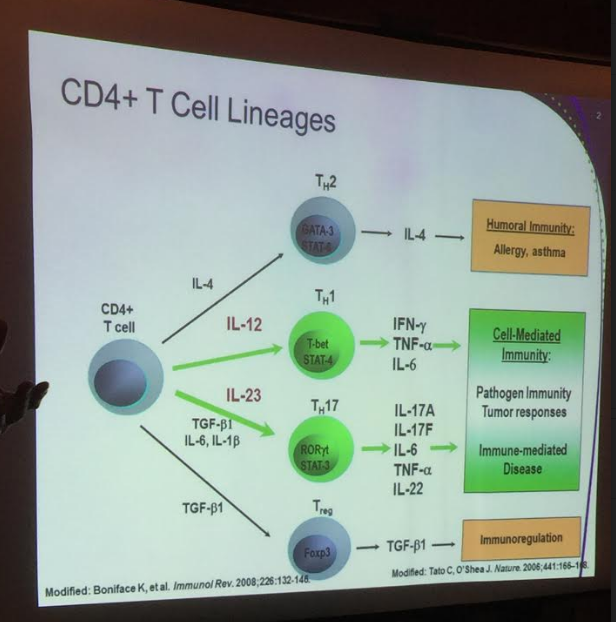
Specifically, the interleukin-12/23 inhibitor is indicated for Crohn’s patients who have failed or were intolerant to immunomodulator or corticosteroid therapy but who never failed treatment with a tumor necrosis factor (TNF) blocker or who failed or were intolerant to treatment with one or more TNF blockers, according to a company news release.

Ustekinumab is already approved in the United States for treatment of patients with plaque psoriasis and psoriatic arthritis…The clinical development program for ustekinumab for Crohn’s disease included more than 1300 patients across three pivotal phase 3 studies, which served as the primary basis for FDA approval.

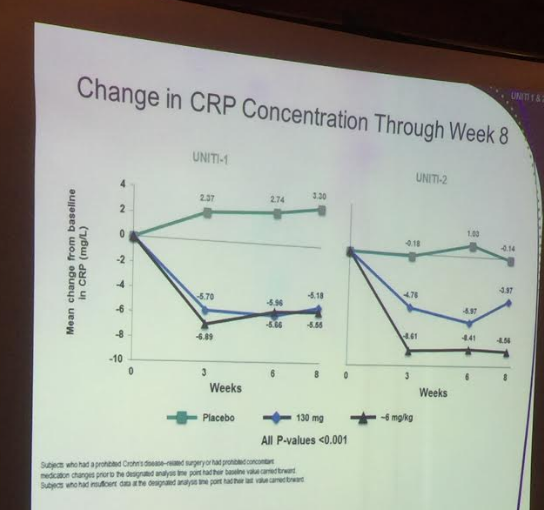
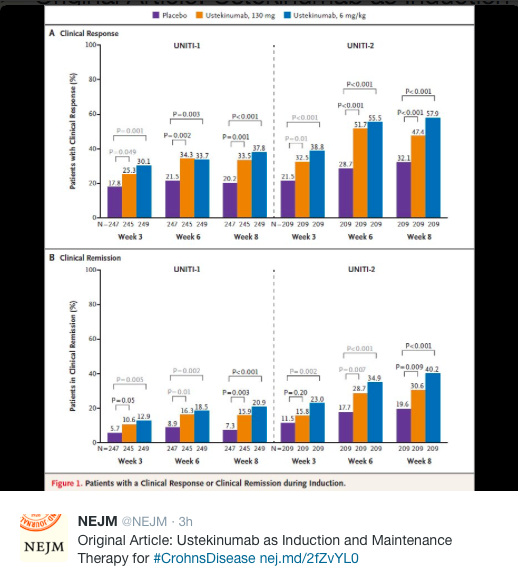
In clinical studies of patients who were either new to, experienced with, or failed anti-TNF therapy, between 34% and 56% of patients experienced symptom relief in the 6 weeks after receiving a one-time intravenous induction dose of ustekinumab. “Noticeable improvement was observed as early as 3 weeks,” the company said.

Most patients who responded to induction dosing and who continued ustekinumab treatment with subcutaneous maintenance doses every 8 weeks were in remission at the end of 44 weeks (52 weeks from initiation of the induction dose), the company said.

Full prescribing information and a medication guide are available online.

screen-shot-2016-09-28-at-4-18-01-pm


Small Pediatric IBD Studies …Briefly Noted

G Wahbeh et al. JPGN 2016; 63: 348-51.  This retrospective case series with 4 children  (aged 12-17 years) indicated that 2 had a ‘clinical response’ to ustekinumab therapy, though one of these had ongoing elevation of CRP.  The dosing may have been too low: 90 mg at week 0 and 4, then every 8 weeks.  My take: This study shows that ustekinumab’s use in pediatric IBD seems to be a ‘shot in the dark’ given the lack of coherent data.

Related posts:

L Zimmerman et al. JPGN 2016; 63: 352-56. Among a cohort of 123 children who had underwent a bowel resection, from 1977-2011, the overall postoperative complication rate was 13%.  This included 3 of 24 who had prior infliximab and 9 of 99 who had not received infliximab. It is noteworthy that the infliximab group had more corticosteroid exposure. The authors concluded that preoperative infliximab was not associated with increased complications but noted that their sample size was small. My take: Studies of adults with Crohn’s disease have yielded conflicting results on whether preoperative infliximab increases the risk of complications.  This study shows that children likely have a lower rate of postsurgical complications and more pediatric specific data are needed.

Related post:

From KT Park’s Twitter Feed:

calprotectin

4-week-ada-trough-ktparj

Latest on Tofacitinib for Refractory Ulcerative Colitis

From Gastroenterology & Endoscopy News July 2016: Tofacitinib Effective in Refractory and Severe UC

An excerpt:

Tofacitinib (Pfizer), an oral agent already approved for certain patients with rheumatoid arthritis, can induce clinical remission in up to 25% of individuals with moderate to severe, refractory ulcerative colitis (UC) and clinical response in as many as 60% of these patients.

The results, based on two placebo-controlled trials involving more than 1,100 patients, showed the drug also increased the risk for serum lipid elevations but was otherwise safe. Researchers presented the data at the 2016 annual meeting of the European Crohn’s and Colitis Organization (ECCO; oral presentation 019)…

The new data are from the OCTAVE Induction 1 and Induction 2 trials, identically designed, randomized, double-blind and placebo-controlled Phase III studies…In the OCTAVE 1 trial, 476 patients received 10 mg of tofacitinib orally twice daily for eight weeks and 122 received an oral placebo. In OCTAVE 2, 429 and 112 patients were randomized to receive the two regimens, respectively.

Screenshot from gastroendonews.com

Screenshot from gastroendonews.com

Also from Gastroenterology & Endoscopy News August 2016: Update on Diagnosis and Treatment for Ulcerative Colitis  This article provides a succinct summary regarding diagnosis and treatments of ulcerative colitis; treatments discussed include emerging therapies like tofacitinib.