How Does Splenda Affect the Gut Microbiota?

“You should never assume. You know what happens when you assume. You make an ass out of you and me because that’s how it’s spelled.”

–Attributed to multiple individuals (but I heard this first when I watched Bad News Bears as a kid)

The increasing frequency of many conditions like inflammatory bowel disease cannot be explained by our genetics.  The search for environmental triggers are ongoing.  Broadly, the main suspects are dietary, antimicrobials, and pollutants. (Related blog post: Nutrition Week (Day 7) Connecting Epidemiology and Diet in Inflammatory Bowel Disease)

The latest concern is now Splenda:

“The Artificial Sweetener Splenda Promotes Gut Proteobacteria, Dysbiosis, and Myeloperoxidasse Reactivity in Crohn’s Disease-Like Ileitis” A Rodriguez-Palacios et al. Inflamm Bowel Dis 2018; 24: 1005-20.  Editorial 1055-6 by B Chassaing and AT Gewirtz.

This highly technical study involved research in ileitis-prone SAMP mice and includes a huge amount of data and cool figures.

The authors note in their discussion: “The term ‘Western diets’ implies a proven shift of the microbiota that enhances the susceptibility to adherent-invasive E coli infections and intestinal inflammation in mice.  In this study, we report similar findings due solely to the administration of a minor component of the diet.”

Some of the key points in the editorial:

  • IBD has multigenic influences and “results from a general breakdown in the normally mutually-beneficial relationship between the intestine and the complex microbial community it harbors.”
  • “New findings …that Splenda promotes microbiota dysbiosis in mice and exacerbates a hallmark of inflammation in ileitis-prone SAMP mice suggest that consumption of this synthetic sweetener may be a specific factor that contributes to development of IBD in persons genetically prone to this disorder.”
  • Splenda has two main components: sucralose (sweetener) and maltodextrin (filler)
  • Splenda did not “impact inflammatory markers in control mice, but rather increased such parameters in SAMP mice.”
  • Splenda changed the microbiota in both control mice and SAMP mice, “particularly enrichment of gamma Proteobacteria, which are broadly associated with gut inflammatory diseases.”
  • “Splenda may be relatively safe for the majority of the population but still represents a serious risk factor for those prone to developing IBD or other chronic inflammatory diseases.”
  • Substances like sucralose which are primarily excreted in the feces (nonabsorbed) have generally been viewed as harmless.  “Appreciation of the pivotal role of the microbiota in health questions the latter assumption.”

My take: I think the influences on the microbiota are difficult to tease out.  Thus, this study (in mice) indicates —don’t assume that nonabsorbed agents are harmless

Why Did the Young Woman’s Heartburn Keep Getting Worse?

Mystery NY Times Case: Why Did the Young Woman’s Heartburn Keep Getting Worse?

An excerpt:

The radiologist who read the scan made an interesting observation. In each of the three visits to the E.R., the patient’s blood had been tested. All three tests showed an elevated white-blood-cell count. That could suggest an infection — but in her tests a quarter of those white blood cells were a cell type known as eosinophils, which normally make up only a tiny fraction of the white blood cells in the circulation. ..

When the radiologist saw the elevated level of eosinophils, however, he recalled an unusual and relatively new disorder known as eosinophilic gastroenteritis (EGE). He added this rarity to the list of possible causes of the patient’s abnormal CT findings on his report…

EGE is thought to be an unusual type of allergic reaction to foods. Food exposure triggers the recruitment of eosinophils to the gut, but once they have a toehold, repeated exposure isn’t necessary to keep them there. The disorder was first described in a series of patients in the United States in 1993 but since then has been found to occur throughout the developed world. Because it’s a relatively new disease, and because our understanding of allergy is still emerging, it’s not well understood. As recognition of the disorder expands, so, too, do the number of cases. Patients are usually started on an elimination diet and given steroids to further suppress the immune system. An elimination diet — one in which the foods most frequently linked to allergic reactions, like milk, eggs and wheat, are not consumed — has been shown to be helpful up to 90 percent of the time.

Related blog posts:

.

Low-Value Care: IBD Serologies for Diagnosis of IBD

A recent high-value care series (MD Long, BE Sands. Clin Gastroenterol Hepatol 2018; 16: 618-20) explains why “clinicians should not use IBD serologies as a test to diagnose inflammatory bowel disease.”

Here are the key points:

  • “Benoir et demonstrated that a 7-marker serology panel had a lower predictive value than routine laboratory tests in diagnosis of IBD among symptomatic pediatric patients.”
  • “Studies on the accuracy of these serologies for diagnosis included populations with a high prevalence of IBD (42%-62%), rather than the low-prevalence populations in primary care settings” (or even in for routine GI office visits)…”When the disease is rare, a greater proportion of the positive tests represent false positives and the PPV [positive predictive value] is low.”
  • The authors also recommend against using serologies to predict a more aggressive course because “no data exist that modifications based on these serologies improve outcomes.”

My take: When I highlight this article, there is an element of confirmational bias as I have held a dim view of their value for a long time. While there is some academic interest in IBD serology results, to me, it is a disturbing trend to see patients with nonspecific abdominal pain referred who have already had these serological markers.

Low Fiber Diet During Bowel Prep

A recent prospective, randomized trial (A Mytyk et al. JPGN 2018; 66: 720-24) compared a low fiber diet with a clear liquid diet during a polyethyylene glycol prep prior to colonoscopy. N=184, Median age 15 yrs (range 6-18 yrs).

Low fiber diet included milk, dairy products, some soups, bread and rolls, sandwiches, meat, fish, eggs, pasta, and honey.

Children in both groups were asked to fast for a minimum of 6 hours prior to colonoscopy and their bowel prep was assessed with the Boston Bowel Preparation Scale (BBPS). Bowel prep consisted of PEG 4000 with electrolytes dosed at 66 mL/kg to max of 4 liters.

Key findings:

  • There was no significant difference in BBPS between the two groups
  • Overall, 95.4% of patients had good bowel cleanness (BBPS ≥5)

My take: This study indicates that with a good volume of bowel prep, a less-rigorous diet change may be effective for a cleanout.

Disclaimer: These blog posts are for educational purposes only. Specific dosing of medications/diets (along with potential adverse effects) should be confirmed by prescribing physician/nutritionist.  This content is not a substitute for medical advice, diagnosis or treatment provided by a qualified healthcare provider. Always seek the advice of your physician or other qualified health provider with any questions you may have regarding a condition.

Related blog posts:

Big Creek Greenway -not far from McFarland


ADMIRE Study: Use of Stem Cell Therapy for Complex Perianal Fistulas in Crohn’s Disease

A recent phase 3 randomized, double-blind, placebo-controlled study (J Panes et al. Gastroenterol 2018; 154: 1334-42) examined the use of stem cell therapy for the treatment of complex perianal fistulas in Crohn’s disease (CD).

They used a single local injection of 120 million Cx601, a suspension of allogeneic expanded adipose-derived stem cells, and compared to a placebo injection.  This study comprised 212 patients from 49 centers. The primary endpoint, labelled “combined remission,” was based on absence of draining fistulas and MRI findings.

Key Findings:

  • As noted in Figure 1 (below), combined remission occurred in 51.5% of Cx601-Rx patients compared with 35.6% for placebo at week 24; at week 52, combined remission occurred in 56.3% of Cx601-Rx patients compared with 38.6%

My take: This local therapy improved outcomes for 1 year after a single injection and appears promising for refractory perianal fistulas.  It may help avoid surgery or systemic immunosuppression.


Closer Look at Data Then Image Below

“A Guide to Gutsy Living”

A recent article ( David JG, Jofriet A, Seid M, et al. “A Guide to Gutsy Living”: Patient-Driven Development of a Pediatric Ostomy Toolkit. Pediatrics. 2018;141(5): e20172789) describes “A Guide to Gutsy Living”: Patient-Driven Development of a Pediatric Ostomy Toolkit (Full Text)

From ImproveCareNow: Download a free copy of the Ostomy Toolkit

Background:

The education we received about our ostomy surgery was brief and focused only on basic skills regarding caring for an ostomy, including changing and emptying the bag, but did not address concerns we had about living with ostomies as part of our everyday lives. This educational void placed the burden on us as patients to find resources on our own, decide if the information was appropriate, and determine if it was reliable and accurate.

In this article, we describe how we, as patients, harnessed the capacity of a collaborative chronic care network1 and were supported to develop a resource that patients needed.

Methods:

We started a national task force of interested patients and parents who had experiences with ostomies to develop a pediatric ostomy toolkit. The task force was composed entirely of patients and parents and consisted of 7 patients and parents

After a literature review, we asked task force members to identify questions and topics related to living with an ostomy, including questions members had preoperatively, immediately postoperatively, and in the extended time since their surgeries. From this prompt, our group generated a list of topics all patients and parents agreed on based on the shared concerns, insights, or questions our task force members had around ostomy surgery… After the creation of the toolkit, we reached out to clinicians to provide clinical review.

Results:

Our final 19-page, colorful toolkit included topics relating to friends, school, travel, ostomy supplies, clothing, playing sports, using humor to cope, emergency kits, educational issues (eg, 504 plans), “Gastronauts” (Gastronauts are freely available puppets with ostomies), and ostomy medical language…The pediatric ostomy toolkit was posted on the ICN Exchange platform

My take (borrowed from authors): In our patient- and parent-led toolkit project, we demonstrate how patients and families can self-organize and ask clinicians to consult to create needed resources within a network

Resources:

  • The Oley Foundation website is a good link for patients with enteral tubes, ostomies, and central lines. http://oley.org/
  • From ImproveCareNow: Download a free copy of the Ostomy Toolkit

View from Pine Mountain


Point-of-Care Calprotectin Values in Preterm Infants at Risk for Necrotizing Enterocolitis

It doesn’t look like calprotectin measurement in newborns is going to be terribly useful for detecting necrotizing enterocolitis.  A recent study (W Nakayuenyongsuk et al. J Pediatr 2018; 196: 98-103) showed a great deal of variability in the calprotectin values in their cohort of 62 infants.

Methods:

  • All infants had a birth weight of <1500 g
  • Stools collected daily (first stool of the day) either for 30 days or postmenstrual age of 32 weeks (whichever was longer)

Results: Calprotectin Values in microgram/gram

  • 1st week of life: All patients: Mean 637 +/- 638, Median 273
  • 2nd week of life: All patients: Mean 349 +/- 414, Median 180
  • 3rd week of life: All patients: Mean 486 +/- 470, Median 316
  • 4th week of life: All patients: Mean 488 +/- 385, Median 412
  • 5th week of life: All patients: Mean 358 +/- 339, Median 226
  • 6th week of life: All patients: Mean 370 +/- 334, Median 295
  • 7th week of life: All patients: Mean 240 +/- 191, Median 184
  • 8th week of life: All patients: Mean 445 +/- 110, Median 466

The highest subset scores for calprotectin was noted in the 1st week of life among preterm infants with gestational age >30 weeks.  In this group, the mean value was 799 +/- 651 and the median value was 718.

There were only two patients who developed necrotizing enterocolitis, both of whom did have an early rise in calprotectin

My take: This data shows elevated and highly variable calprotectin values in the neonatal period.  There was also a trend towards higher values among those with postnatal age >30 weeks.

Related blog post: Fecal calprotectin values in first years of life


Eosinophilic Esophagitis -Three Subtypes

Eosinophilic oesophagitis endotype classification by molecular, clinical, and histopathological analyses: a cross-sectional study

T Shoda et al. The Lancet Gastroenterology & Hepatology, published online May 2, 2018. DOI: https://doi.org/10.1016/S2468-1253(18)30096-7

Abstract:

Background

Eosinophilic oesophagitis is understood in terms of quantifiable histological, endoscopic, and molecular features. Data are scant for inter-relations of these features and their potential to identify distinct disease endotypes. We aimed to identify clinical–pathological correlations between endoscopic and histological disease variables by transcription profiling of the oesophagus of patients with eosinophilic oesophagitis of varying severity and disease activity states.

Methods

We did a cross-sectional study across ten hospital sites in the USA associated with the Consortium of Eosinophilic Gastrointestinal Disease Researchers. We analysed oesophageal biopsy specimens taken from paediatric and adult patients with eosinophilic oesophagitis (discovery cohort), using the eosinophilic oesophagitis diagnostic panel (EDP), a set of 96 informative transcripts. Histological and endoscopic features were assessed by quantification of oesophageal eosinophils and use of the eosinophilic oesophagitis histology scoring system (HSS) and the eosinophilic oesophagitis endoscopic reference score (EREFS). Associations among the various histological, endoscopic, and molecular features were analysed by Spearman correlation. Results were replicated in a biologically independent, single-centre, validation cohort of patients with active eosinophilic oesophagitis.

Findings

The discovery cohort contained 185 samples and the validation cohort comprised 100 specimens. In the discovery cohort, EDP showed intersite consistency, significant correlation with oesophageal eosinophils (p<0·0001), and similar findings between paediatric and adult patients. Of eight HSS domains, basal zone hyperplasia correlated with the EDP (median Spearman ρ 0·47 [IQR 0·36–0·60]). Of five EREFS features, distal furrows correlated with the EDP (median Spearman ρ 0·42 [0·32–0·50]). By analysing active eosinophilic oesophagitis in the discovery cohort, the EDP identified three clusters associated with distinct endotypes (termed EoEe1–3) despite similar eosinophil levels. EoEe1 was associated with a normal-appearing oesophagus (risk ratio [RR] 3·27, 95% CI 1·04–10·27; p=0·0443), an inverse association with a history of oesophageal dilation (0·27, 0·09–0·82; p=0·0105) and showed relatively mild histological, endoscopic, and molecular changes. EoEe2 showed an inflammatory and steroid-refractory phenotype (RR 2·77, 95% CI 1·11–6·95; p=0·0376) and had the highest expression of inflammatory cytokines and steroid-responding genes. EoEe3 was associated with a narrow-calibre oesophagus (RR 7·98, 95% CI 1·84–34·64; p=0·0013) and adult onset (2·22, 1·19–4·12; p=0·0155), and showed the highest degree of endoscopic and histological severity and the lowest expression of epithelial differentiation genes. These endotypes were replicated in the validation cohort by clustering and with an eosinophilic oesophagitis endotype-prediction algorithm.

Interpretation

Our new disease classification stratifies patients with eosinophilic oesophagitis into subgroups with potential clinical and therapeutic significance and provides a framework for a precision medicine approach to eosinophilic oesophagitis.

Related blog entries:

Sub-Analysis of DIAMOND Study

K Watanabe et al. Clin Gastroenterol Hepatol 2018; 16: 542-9.

The DIAMOND study evaluated monotherapy with adalimumab (n=85) compared with combination therapy of adalimumab with azathioprine (n=91).

Key findings:

  • In this subanalysis of patients with moderate and severe Crohn’s disease (CD), endoscopic response (defined by SES-CD drop of at least 8 points or SES-CD <4) was significantly higher at week 26: 71.6% vs 54.4%. The OR for endoscopic response was 2.12 at week 26 with combination therapy.
  • At week 52 the endoscopic response difference was not statistically significant: 60% vs. 50%.
  • Similarly, mucosal healing was more common (but not statistically significant) in the combination group compared with monotherapy: 20.9% vs 103% at week 26, and 21.5% vs 12.2% at week 52.
  •  While not statistically significant, the combination group had ADA trough that was higher (7.6 compared with 6.5).

My take: The results described above for endoscopic responses and mucosal healing rates are depicted in figure 2 (I do not have a digital copy of figure or permission to use).  After one looks at this figure, depicting the data noted above, there certainly appears to be an advantage for the use of combination therapy in patients with moderate-to-severe CD.

Related blog posts:


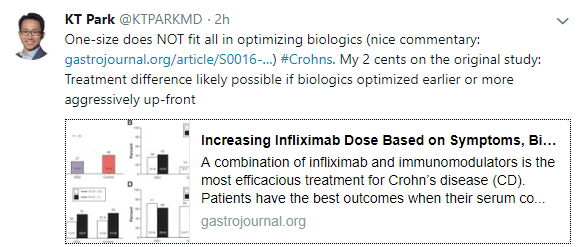
I have not independently verified the claims on this tweet