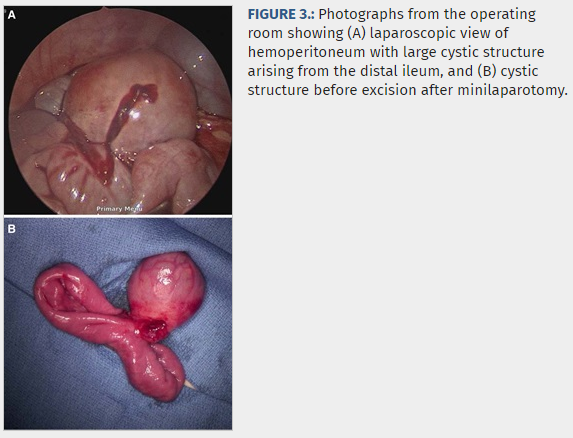
In this case report, a 2 yo with acute anemia along with acute on chronic abdominal pain was diagnosed with a Meckel’s diverticulum. After diagnostic studies, “a blood-filled mass arising from the ileum was identified and resected by the surgical team. Pathology was consistent with Meckel’s diverticulum with heterotopic gastric mucosa.”
My take: This is a rare presentation of a Meckel’s diverticulum. Besides bleeding, per the authors, “common presentations of Meckel’s diverticulum include diverticulitis/perforation (16%-20%), bowel obstruction (about 14%), and intussusception (12%).”
In a recent post regarding Next-Generation Treatment for H pylori, the authors denigrated the term “empiric” treatment and said a more accurate term would be “hopeful” therapy. There are a lot of areas in our field in which hopeful therapy is a mainstay, especially in those with non-organic abdominal pain (eg. irritable bowel syndrome). Even with the benefit of a therapeutic ‘regression to the mean,’ treatment is often unsatisfactory.
Thus, it is a very positive sign that a recent article provides an indication of which patients are most likely to benefit from dietary manipulation:
Methods: A prospective single centre case–control study recruited participants (n=56 pairs) from 2016 to 2019. The authors included adults (18–68 years of age) meeting the Rome IV criteria for diarrhoea-predominant or mixed type IBS (IBS-D and IBS-M, respectively) with respective household controls.
Key findings:
Baseline IBS cases pre-diet identified two distinct microbiota profiles, which we refer to as IBSP (pathogenic-like) and IBSH (health-like) subtypes.
IBSP microbiomes were enriched in Firmicutes and genes for amino acid and carbohydrate metabolism, but depleted in Bacteroidetes species.
IBSH microbiomes were similar to controls.
On the low FODMAP diet, IBSH and control microbiota were unaffected, but the IBSP signature shifted towards a health-associated microbiome with an increase in Bacteroidetes (p=0.009), a decrease in Firmicutes species (p=0.004) and normalization of primary metabolic genes. The clinical response to the low FODMAP diet was greater in IBSP subjects compared with IBSH (p=0.02).
50% of IBS cases manifested a ‘pathogenic’ gut microbial signature. This shifted towards the healthy profile on the low FODMAP diet; and IBSP cases showed an enhanced clinical responsiveness to the dietary therapy
A) Beta diversity analysis of IBS cases and healthy controls: principal coordinate analysis for the two first components identifies two distinct clusters among cases, described as cluster 1 (cl1, red) and cluster 2 (cl2, blue). Overall dispersion of household controls is represented in grey.
My take: Currently, what is a “pathogenic” microbiome is unclear at least to me. However, changes in the microbiome do occur with dietary manipulation and are likely involved in response to treatment for IBS and other disorders.
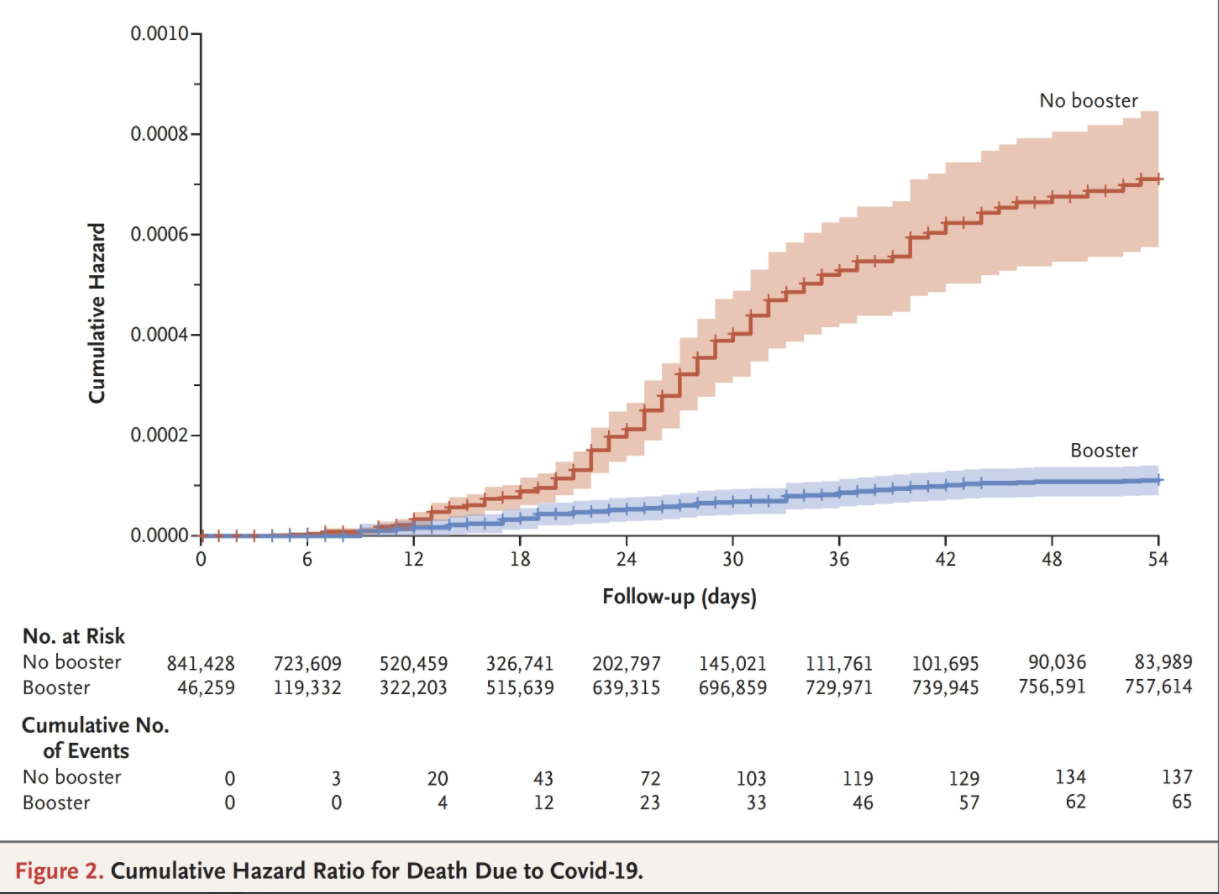
This article shows that the booster shot lowers the risk of death by 90% compared to those who did not receive the booster shot in those 50 years of age or older. R Arbel et al. NEJM 2021; DOI: 10.1056/NEJMoa2115624. Open Access: BNT162b2 Vaccine Booster and Mortality Due to Covid-19
Key Findings:
A total of 843,208 participants (50 years and older) met the eligibility criteria, of whom 758,118 (90%) received the booster during the 54-day study period. Death due to Covid-19 occurred in 65 participants in the booster group (0.16 per 100,000 persons per day) and in 137 participants in the nonbooster group (2.98 per 100,000 persons per day). The adjusted hazard ratio for death due to Covid-19 in the booster group, as compared with the nonbooster group, was 0.10 (95% confidence interval, 0.07 to 0.14; P<0.001).
This twitter thread from Ashish Jha provides insight into the current understanding of the Omicron variant.
“Evaluation for organ transplantation, a life-saving procedure, involves a multistep, highly selective process. Initially, referrals to appropriate subspecialists and a transplant center are required. During evaluation, candidates undergo formal assessment of adequate social support, psychological health, health insurance, adherence, and understanding of treatments. Each step in the transplant evaluation process is an opportunity for inequity to insert itself, resulting in disparate access to listing for transplantation. This manifests through mechanisms related to poor health literacy, lack of insurance or high copay, poor social support, and geographical location. Culture incapacity by health providers and implicit bias at the provider level and health care system level can create additional barriers. Examples of health inequities include lower referral rate for LT and inferior outcomes among Black and Latinx compared to White patients,(3) while, in addition to race/ethnicity, sex and health literacy(4) also strongly correlate with the likelihood of listing. SES [socioeconomic status] affects both waitlist mortality and post-LT survival as well.”
This article proposes policy measures to counter the deleterious effects of SDOH [social determinants of health]—identify and reduce implicit bias, expand and optimize telemedicine, and improve community outreach. “Structural racism, access to affordable insurance, health literacy, and substance abuse therapy are equally important factors that contribute to health disparities and inequities and warrant further commentary and research, but are outside the focus of this policy piece.”
Explains biologic properties -typically 10-15 g of Albumin is synthesized daily (reduced in advanced liver disease). The half-life is between 12-18 days
Main uses: beneficial in patients undergoing large-volume paracentesis or who have hepatorenal syndrome or spontaneous bacterial peritonitis.
Studies have shown possible modest benefit in long-term albumin administration in patients with cirrhosis, especially ANSWER study which showed a reduction in ascites recurrence, HRS, encephalopathy, infections, hospital admissions and death. Costs of long-term infusion and the lack of benefit in the ATTIRE trial indicate the need for more studies to determine the best approach in this population.
Main adverse effects: allergic and transfusion reactions, volume overload, antibody formation and coagulation derangements
Generally, albumin infusions are not recommend for correcting isolated hypoalbuminemia. The primary disorder (eg. acute stress, trauma, infection, malignancy) should be treated.
This great little article humanizes and summarizes the discovery of Hepatitis C with first hand accounts and anecdotes.
A couple of interesting points:
Until you know the call is from Stockholm (and not a prank), the 4 am call informing you were awarded a Nobel prized is quite irksome
All of the Nobel Laureates (none are hepatologists) advocate for a vaccine but note that making it is difficult due to so many quasispecies. Only a fraction of the estimated 72 million persons with chronic HCV infection have been diagnosed and received curative therapy
Advice for young people: “There is no elevator to success. You have to take the stairs…It’s a step-by-step, slow process”
Hepatology humor: “Is life worth living?” “It depends upon the liver.”
Key milestones in HCV virology and therapeutics. Abbreviation: SVR, sustained virological response.
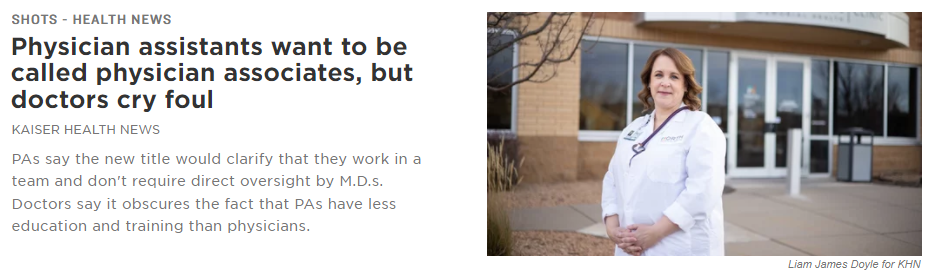
This article (link: PAs want to be called physician associates) notes that “Physician assistants, as they are still legally called, have been steadily granted greater autonomy over the years since 1967, when the Duke University School of Medicine graduated four former Navy medics as the nation’s first class of PAs.”
The authors searched MEDLINE, EMBASE and CENTRAL from inception to March 2021. Eligible studies were placebo-controlled trials of pharmacological interventions for CD
Key findings:
In 125 studies (91 induction, 46 maintenance), placebo clinical remission and response rates for induction studies were 18% [95% confidence interval (CI) 16-21%], and 32% (95%CI 29-35%), respectively, and for maintenance studies were 28% (95%CI 23-34%) and 30% (95%CI 24-37%), respectively
Endoscopic remission and response rates (for placebo) in induction studies were 8% (95%CI 4–18%), and 16% (95%CI 11–23%), respectively
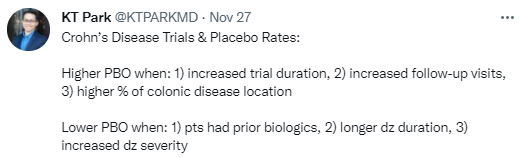
Trials enrolling patients with prior biologic exposure, longer disease duration and higher CD activity index scores were associated with lower placebo clinical remission rates
Increased duration of follow-up, more follow-up visits and a greater proportion of patients with colonic disease distribution were associated with higher clinical placebo rates
My take: These studies show fairly high placebo responses and thus they reinforce the need for well-designed trials with objective endpoints.
Recent articles indicate the possibility of preclinical disease detection of inflammatory bowel disease; perhaps this is analagous to the “precrime’ detection in The Minority Report which allowed the police to arrest people before they committed their crime.
In this study from Sweden, the authors used biobanked plasma samples from 72 individuals with ulcerative colitis (UC) and matched healthy controls (n=140). Then the findings were validated in an inception cohort (n=101 with UC and 50 healthy controls. In addition, a cohort of heathy twin siblings of patients with UC (n=41) were matched with healthy controls (n=37).
Key findings:
Six proteins (MMP10, CXCL9, CCL11, SLAMF1, CXCL11 and MCP-1) were up-regulated (P < .05) in preclinical ulcerative colitis compared with controls
MMP10, CXCL9, CXCL11, and MCP1, but not CCL11 and SLAMF1, were significantly up-regulated among the healthy twin siblings. This up-regulation is triggered by exposure to genetic and early environmental factors.
The discussion elaborates on the role of these proteins.
“MMP10 is classified as a stromelysin. Upregulated levels of stromelysin have been detected in inflamed segments of the colon from patients with ulcerative colitis….The observed preclinical upregulation of MMP10 [thought to promote wound healing] in plasma might indicate that endogenous pathways for wound healing are up-regulated several years before clinically overt ulcerative colitis to counteract disease progression and maintain mucosal homeostasis”
“Eotaxin (CCL11) is a potent chemoattractant of monocytes…eosinophilic-driven inflammation represents an early element in the pathogenesis of ulcerative colitis”
“CXCL9 and CXCL11 has been observed previously in inflamed colonic tissue specimens and blood from patients with ulcerative colitis… Both chemokines are regulated by IFN-gamma and attract CXCR3-positive CD4þ T cells and natural killer cells to the inflammatory site”
My take: This study shows up-regulation of 6 plasma proteins indicating activation of both pro-inflammatory and tissue-repairing pathways several years before clinically overt UC. It offers hope of intervention to prevent the development of UC.
In this study, the authors measured host serum antibody response to 6 microbial antigens at enrollment (Prometheus enzyme-linked immunosorbent assay test: anti-Saccharomyces cerevisiae antibodies immunoglobulin A/immunoglobulin G, anti-OmpC, anti-A4-Fla2, anti-FlaX, anti-CBir1) and derived the sum of positive antibodies (AS).
Key finding:
“High baseline AS (≥2) (43% of cases, 11% of controls) was associated with higher risk of developing CD (adjusted odds ratio, 6.5; 95% confidence interval, 3.4–12.7; P < .001). Importantly, this association remained significant when adjusted for markers of gut barrier function, fecal calprotectin, C-reactive protein, and CD-polygenic risk score, and in subjects recruited more than 3 years before diagnosis. Causal mediation analysis showed that the effect of high AS on future CD development is partially mediated (42%) via preclinical gut inflammation.
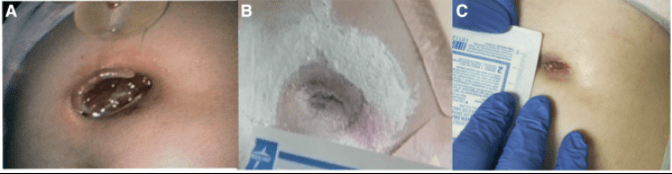
This case report describes a 10 yo with multiple medical problems with an expanding G-tube site with mucosal prolapse “where the G-tube balloon easily fell out of her gastrocutaneous fistula.”
The site was treated with three modalities, though the authors attribute the improvement to the use of sucralfate:
Nasojejunal feedings
Removal of Gastrostomy tube for 5 days
Sucralfate: “1 gram tablet, ½ tablet crushed sprinkled around the ostomy site 3 times a day. Powder was used to fill in the defect and any residual powder medication was gently cleaned off before the next application”
Images showing improvement noted below
The authors provide pathophysiological reasons for sucralfate’s effectiveness:
Treatment with sucralfate helped reduce the 2 cm x 1.5 cm site (Panel A) over 5 days to Panel B and over 4 weeks to Panel C