Public Health Laws Weakened After COVID-19

MM Mello, WE Parmet. NEJM 2021; 385: 1153-5. Open Access: Public Health Law after Covid-19 This commentary describes changes in public health law as a result of the COVID-19 pandemic.

Key points:

  • “More than 1000 suits challenged orders shuttering businesses, banning indoor worship services, restricting travel, and mandating mask wearing.”
  • “In 1905 in Jacobson v Massachusetts, the Supreme Court upheld a vaccination mandate…Judicial review, the Court found is limited to …’arbitrary and oppressive in particular cases”
  • “Most courts..have …granted considerable deference to health officials…Courts have been more receptive, however, to challenges relating to religious liberty and the scope of executive authority.”
  • “The court in an unsigned opinion ruled that the CDC had overstepped its authority [with an eviction ban] under the Public Health Service Act (PHSA)…Congress…must pass legislation to impose one or to clarify that the CDC may impose one.”
  • “The decisions with regard to free exercise of religion suggest that health orders will face strict scrutiny if they regulate religious practices more strictly than any secular activity that courts deem similar.”

My take: This article makes clear that “while emergencies can lead to abuses of authority, …in their [Courts] zeal to protect religious liberty and constrain executive action, courts may be leaving officials with fewer tools to fight Covid-19 and the next pandemic.”

Related blog post: Supreme Court Justices “Play a Deadly Game”

Related article from NY Times (10/4/21): The Supreme Court Has Gone Off the Rails by Donald Ayers

Mr. Ayer was a U.S. attorney and principal deputy solicitor general in the Reagan administration and deputy attorney general in the George H.W. Bush administration.

An excerpt:

[The Supreme Court’s] recent history suggests that it lacks a majority of justices with sufficient concern about the basic continuity and integrity of the law or the ability of government to functionit seems ready to cast aside certain constitutional rights, the court today regularly gives sweeping new interpretations to other rights and invokes them to radically narrow certain government powers that were until quite recently uncontroversial, including, for example, powers related to public safety or our democratic process...

Perhaps most unexpected and disturbing were decisions elevating rights of religious assembly over local public-safety rules related to Covid-19 that limited the ability to gather. Yet throughout our history, in matters of public health, the powers of local government have usually been at their apex. That did not matter here — nor did the fact that Chief Justice Roberts was among the dissenters.

New WIC Forms in Georgia

From Kipp Ellsworth:

“Major changes to the Georgia WIC Program effective today, announced by the @GaDPH & @GAChapterAAP, most importantly, a new WIC Request for Medical Formulas & Supplemental Foods (RMF) form replacing the MDF.”

Related blog posts:

Inconceivable!!!

Accolades: Bess Schoen

I want to recognize Dr. Bess Schoen. Bess is a colleague at Emory. I met her when I was a 4th year medical student. Since we work at different hospitals, I do not see her often but greatly respect her and her work.

From one of my colleagues, Tanya Hofmekler:

This month, we are celebrating Dr. Bess Schoen’s retirement and her long career in academic medicine.  She will be greatly missed.  Dr. Schoen has always modeled the best characteristics of a well-rounded academic physician. On top of those, she is smart, an excellent teacher and is an overall wonderful person.  She has trained and impacted many residents and fellows that have passed through Emory.  Her trainees walk away with practical medical knowledge and an example of compassionate care.  As one of her trainees, I find myself from time to time asking: “What would Dr. Schoen do?”

Dr. Schoen has also dedicated herself to improve the care of pediatric patients with Inflammatory Bowel Disease through her leadership of Improve Care Now at Emory.  This year, she will be honored by the Crohn’s and Colitis Foundation of America for her commitment and passion.

Disparity in the Care of Black Inflammatory Bowel Disease Patients

J Liu. Inflamm Bowel Dis 2021; 27: 1548-1549. Disparity in the Care of Black Inflammatory Bowel Disease Patients

This first-hand account of the challenges of IBD care for black patients comes from the first IBD specialist recruited to Grady Hospital (Atlanta) which has a predominantly Black patient population.

Key points:

  • “The clinical, endoscopic, and histologic end points…on treatment in this patient population are all largely unknown…Black people account for 13% of the U.S. population but only 1% of the patients in nearly 200 outcome-based IBD studies [and] less than 5% of the patients participating in clinical trials of IBD therapeutics.” This is important as “we just do not know how they work for Black people.” Treatment response could be much worse (author notes that prior treatments for Hepatitis C were much less effective in Black patients).
  • Yet, “the most severe forms of Crohn’s –peri-anal and fistulizing disease– are more common in Black patients.”
  • Review of emergency visits of IBD children “showed that Black children received less medication and had more repeat emergency room visits than white children.” (Inflamm Bowel Dis 2019; 25: 194-203)
  • Because IBD is not perceived to occur frequently in Black patients, the author states that some patients are not accommodated by their employers and patients are less comfortable with support groups.
  • “However, the incidence of Crohn’s disease …in Black people has risen sharply over the past 3 decades…now approaches that of non-Hispanic whites.”

My take: Inflammatory bowel disease is definitely a disease that affects Black people; it is often more severe and requires careful treatment.

Billy Goat Trail, Chesapeake and Ohio Canal National Historic Park
(outside Washington D.C.). Yes, we made it to the top!

Vedolizumab vs Adalimumab: Histology Outcomes from Varsity Trial

L Peyrin-Biroulet et al. Gastroenterol 2021; Open Access DOI:https://doi.org/10.1053/j.gastro.2021.06.015. Histologic Outcomes With Vedolizumab Versus Adalimumab in Ulcerative Colitis: Results From An Efficacy and Safety Study of Vedolizumab Intravenous Compared to Adalimumab Subcutaneous in Participants With Ulcerative Colitis (VARSITY)

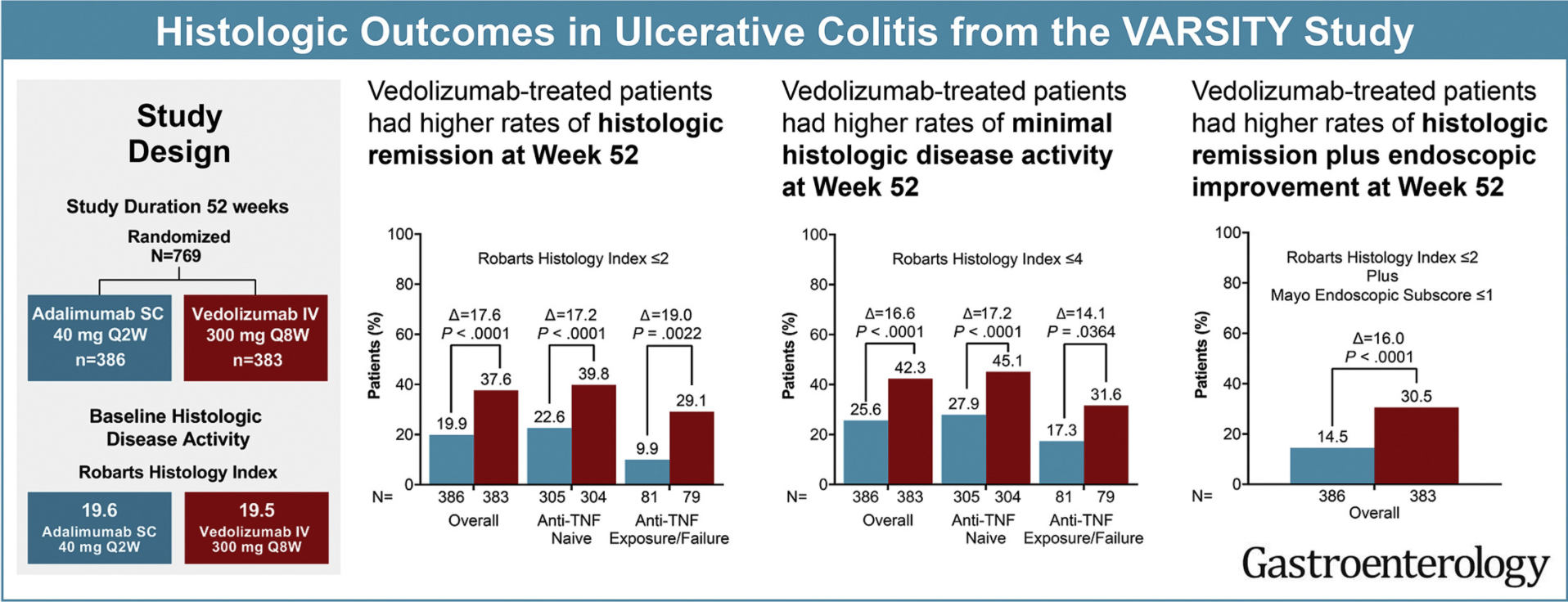
In total, 769 patients received vedolizumab (n = 383) or adalimumab (n = 386). Geboes Index and Robarts Histopathology Index (RHI) scores were used to assess prespecified histologic exploratory end points of histologic remission (Geboes <2 or RHI ≤2) and minimal histologic disease activity (Geboes ≤3.1 or RHI ≤4) at weeks 14 and 52.

Key findings:

Vedolizumab induced greater histologic remission than adalimumab:

  • week 14: Geboes: 16.7% vs 7.3%, RHI: 25.6% vs 16.1%
  • week 52: Geboes: 29.2% vs 8.3%, RHI: 37.6% vs 19.9%
  • Histologic outcomes were generally better in anti–TNF-naïve vs -failure patients

My take: This study shows that histologic outcomes with vedolizumab, similar to clinical outcomes, were better than with adalimumab. Some of this difference could be due to the trail design which did not allow optimization of adalimumab dosing.

Related posts:

Digital Messages from Patients Spiked During Pandemic

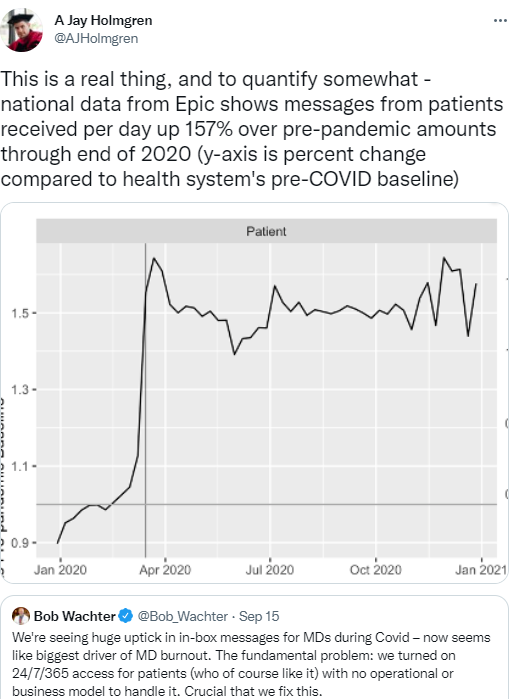
The Verge: Digital messages from patients to doctors spiked during the pandemic (Link from Bryan Vartabedian 33mail)

An excerpt:

Doctors say they’re overwhelmed by the volume of digital messages they receive from patients during the pandemic, and new data backs up their experience. The number of messages increased by over 150 percent at the start of the COVID-19 pandemic, and the levels stayed high over the course of 2020, according to an early look at data from the electronic health record company Epic.

My take: I generally prefer receiving patient information (outside the office) from my nurse rather than directly from patients. Patient messages can contribute to the feeling that you are never done with work. I do like the idea that these portals allow families to let us know if patients have trouble reaching our office.

Related blog posts:

Enteral Naloxone for Opioid-Induced Constipation

At a recent pharmacy committee meeting, we discussed the potential use of enteral naloxone for ICU patients with opioid-induced constipation.

Background:

  • Opioids bind to mu receptors within the gastrointestinal tract. Activation of the bowel opioid receptors slow gastric transit time, decreases gastric secretions, and reduces intestinal muscle tone leading to enhanced fluid absorption and subsequently dry and hard stools.
  • Naloxone (Narcan®) solution for oral/enteral use
    • Mechanism of action:
      • Pure opioid antagonist that competes and displaces opioid at opioid receptor sites
    • FDA-approved indication: Antidote; opioid antagonist
    • Mechanism of action:
      • As an antidote – pure opioid antagonist that competes and displaces opioids at opioid receptor sites
      • As an oral agent – Enteral administration of naloxone blocks opioid action at the intestinal receptor level but has low systemic bioavailability (if dosed properly) due to marked hepatic first-pass metabolism. As a result, oral naloxone only binds strong enough for a pharmacologic response at opioid receptors in the gastrointestinal tract without reducing the central effect of the opioid and precipitating systemic withdrawal.

Potential alternatives:

  • Methylnaltrexone (Relistor®) SQ 12mg/0.6mL (much more expensive)
  • Rectal treatments: Bisacodyl (Dulcolax®), Enema
  • Oral constipation medications:
    • Polyethylene glycol (Miralax®)
    • Bisacodyl (Dulcolax®)
    • Senna (Senokot®)

Administration:

  • Dose recommendations: 10 – 20 mcg/kg dose PO q8h (max dose: 400mcg) for 5 – 7 days, then re-evaluate therapy
  • Oral/enteral dose should be not administered intravenously to prevent systemic effect and withdrawal in patients

My take: Enteral naloxone (IV solution) may be helpful for opioid-induced constipation but caution is needed to assure it is administered enterally and at proper dose.

Some of the research studies:

  1. Tofil N, Benner K, Faro S, Winkler M. The Use of Enteral Naloxone to Treat Opioid-Induced Constipation in a Pediatric Intensive Care Unit. Pediatr Crit Care Med. 2006;7(3):254-272.
  2. Akkawi R, Eksborg S, Andersson A, et al. Effect of Oral Naloxone Hydrochloride on Gastrointestinal Transit in Premature Infants Treated with Morphine. Acta Paediatrica.2008;98:442-447
  3. Liu M, Wittbrodt E. Low-Dose Oral Naloxone Reverses Opioid-Induced Constipation and Analgesia. J Pain Symptom Manage. 2002;23(1):48-53
  4. Friedman J, Dello Buono F. Opioid antagonist in the Treatment of Opioid-Induced Constipation and Pruritus. Ann Pharmcother. 2001;35:85-91
  5. Meissner W, Schmidt U, Hartmann M, et al. Oral Naloxone Reverses Opioid-Associated Constipation. Pain. 2000;84:105-109

Disclaimer: This blog, gutsandgrowth, assumes no responsibility for any use or operation of any method, product, instruction, concept or idea contained in the material herein or for any injury or damage to persons or property (whether products liability, negligence or otherwise) resulting from such use or operation. These blog posts are for educational purposes only. Specific dosing of medications (along with potential adverse effects) should be confirmed by prescribing physician.  Because of rapid advances in the medical sciences, the gutsandgrowth blog cautions that independent verification should be made of diagnosis and drug dosages. The reader is solely responsible for the conduct of any suggested test or procedure.  This content is not a substitute for medical advice, diagnosis or treatment provided by a qualified healthcare provider. Always seek the advice of your physician or other qualified health provider with any questions you may have regarding a condition.

“In America: Remember”

About 10 days ago, I was in Washington D.C. The image below is from my trip.

NPR: More Than 600,000 White Flags On The National Mall Honor Lives Lost To COVID (9/17/21)

An excerpt:

For more than two weeks starting this week, more than 600,000 white flags will fill the National Mall — symbolizing the lives lost to COVID-19 in the United States.

Each of the flags, displayed across the 20 acres of grass, will hold a written personalized message from loved ones honoring their memory.

The art installation, titled In America: Remember, was created by Suzanne Brennan Firstenberg, the Washington, D.C

Smoking, Alcohol and Obesity Increase Risk of Malignancies + Staff Morale (Humor)

S-M Wang et al. The American Journal of Gastroenterology: September 2021 – Volume 116 – Issue 9 – p 1844-1852. Open Access: Population Attributable Risks of Subtypes of Esophageal and Gastric Cancers in the United States

This study examined population risks for esophageal squamous cell carcinoma (ESCC), esophageal adenocarcinoma (EAC), gastric cardia adenocarcinoma (GCA), and gastric noncardia adenocarcinoma (GNCA).

“We prospectively examined the associations for risk factors and these cancers in 490,605 people in the National Institutes of Health-the American Association of Retired Persons Diet and Health cohort Diet and Health Study cohort from 1995 to 2011.”

Key findings:

My take: Tobacco, Obesity and Alcohol are associated with increased risk for a large proportion of esophageal and gastric cancers in the United States

Related article: VK Rustgi et al. Gastroenterol 2021; 161: 171-184. Open Access: Bariatric Surgery Reduces Cancer Risk in Adults With Nonalcoholic Fatty Liver Disease and Severe Obesity

Key findings:

  • The IPTW (inverse probability of treatment weighting)-adjusted risk of any cancer and obesity-related cancer was reduced by 18% (hazard ratio, 0.82; 95% CI, 0.76–0.89) and 25% (hazard ratio, 0.65; 95% CI, 0.56–0.75), respectively, in patients with versus without bariatric surgery.
  • In cancer-specific models, bariatric surgery was associated with significant risk reductions for colorectal, pancreatic, endometrial, thyroid cancers, hepatocellular carcinoma, and multiple myeloma.

Link: Improving Morale (53 seconds)