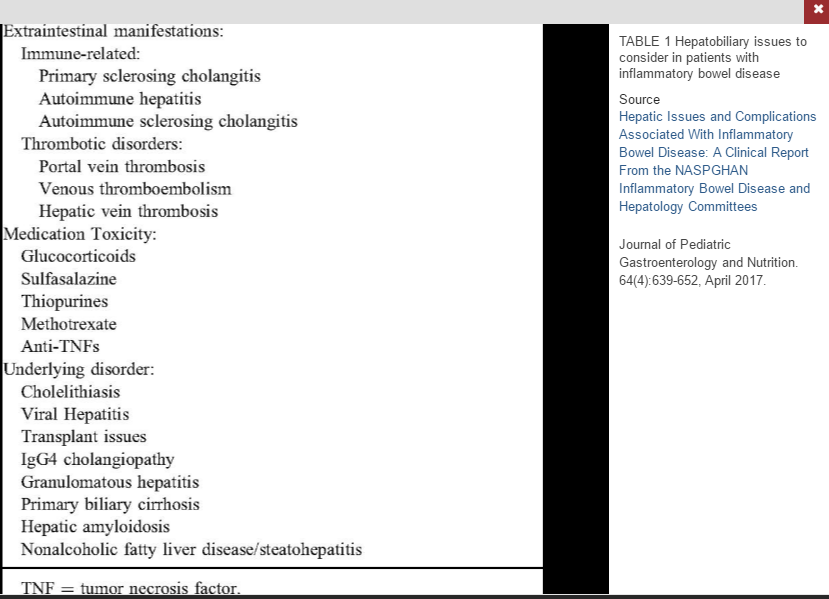
Liver Problems with Inflammatory Bowel Disease

A recent review (Full text: LJ Saubermann et al. JPGN 2017; 64: 639-52)  discusses the hepatic issues and complications associated with inflammatory bowel disease.

Key topics:

  • Primary Sclerosing Cholangitis (PSC)
  • Autoimmune Hepatitis (AIH)
  • Autoimmune Sclerosing Cholangitis (ASC)
  • Portal Venous Thrombosis/hypercoagulability
  • Cholelithiasis (more common in Crohn’s disease if diseased terminal ileum)
  • Viral hepatitis
  • Drug-Induced Liver Disease
  • Fatty Liver disease

Many of these topics have been discussed previously on this blog.  A couple of pointers in this review:

PSC:

  • Greater risk of colorectal carcinoma
  • IBD-PSC patients are at higher risk for pouchitis
  • GGT of >252 U/L “was highly sensitive (99%) and had good specificity (71%) for PSC” [or ASC]
  • The authors recommend “screening all newly diagnosed patients with IBD with ALT and GGT
  • Immunosuppressive therapy is NOT effective
  • Vancomycin therapy is currently being tested (clinical trials: NCT02137668 & NCT01802073)

AIH:

  • Less frequent in IBD patients than PSC
  • Most common treatment is prednisone/azathioprine
  • 40-80% of children have cirrhosis at AIH diagnosis, but “progression to end-stage liver disease is rare and …with appropriate treatment, 80% of patients achieve remission.”

ASC:

  • ASC is an overlap syndrome between AIH and PSC
  • “It is important that children with IBD and apparent AIH are routinely investigated for evidence of biliary disease with MRCP”
  • “ASC responds to the same immunosuppressive combination therapy used for AIH”

HAV/HBV Immunization:

  • HAV vaccination is effective in patients with IBD…although the rate [seroconversion] was significantly lower” in patients receiving anti-TNF therapy (92.4% vs 99.1% in one study).
  • In those needing HBV immunization: “One strategy evaluated to improve HBV immunity in adults with IBD is an accelerated course with double vaccine doses at 0, 1, and 2 months.”

Methotrexate (MTX):

  • “The extent of histological features of hepatotoxicity secondary to long-term MTX use in IBD has been infrequently described; however, the inicdence of significant abnormal histological findings appears to be rather low.”

My take: This article is a good starting point for liver-related issues in IBD.  For concerns regarding medications, the NIH livertox website is more useful and much more comprehensive.

Related blog entries:

DILI:

PSC:

AIH:


Increasing Incidence of Hepatocellular Carcinoma in the U.S.

A recent study (DL White et al. Gastroenterol 2017; 152: 812-20) provide data showing a striking increase in the incidence of hepatocellular carcinoma (HCC). Using data from the US Cancer Statistics Registry which covers 97% of U.S. population, the authors found the following:

  • HCC incidence rose from 4.4 per 100,000 in 2000 to 6.7 per 100,000 in 2012
  • The annual rate of increase was 4.5% from 2000-2009, but then 0.7% annually from 2010-2012
  • The greatest increase occurred in 55-59 year olds (8.9% annually) and 60-64 year olds (6.4% annually)

The main HCC risk factors are HCV, HBV, and alcoholic liver disease, though obesity-associated HCC is emerging as an important risk factor as well.  The highest rates of HCC are seen in southern and western states, with Texas having the highest rates overall.  The high rate in Texas is in part due to the higher rates of HCC in Hispanics.

Overall, the authors indicate that the rising HCC rates are most closely tied to the peak HCV cohort (1945-65) and speculate that the arrival of direct-acting antivirals may help. At the same time, this HCV cohort is composed “disproportionately [of] minorities and of lower socioeconomic status” and may have less access to these advances in treatment.  Furthermore, in states like Texas which did not adopt Medicaid expansion as part of the Affordable Care Act, there are more uninsured patients who will be less likely to identify preceding risk factors for HCC.

My take: Perhaps in 20 years, we will see HCC incidence maps that are improving as HCV treatments become more widely available.  This presumes that other HCC risk factors, including obesity and alcohol, do not worsen significantly.

Related blog posts:

Safety of Long-term Adalimumab in Pediatrics; Weighted PCDAI

A recent study (W Faubion et al. Inflamm Bowel Dis 2017; 23: 453-60) reports on the long-term safety/effectiveness of Adalimumab in pediatric patients entering the IMAgINE 2 trial (& who completed the 52 week IMAgINE 1 trial).

Patients with a PCDAI <10 were considered to be in remission and those who had a drop in PCDAI of 15 or more were considered to have had a treatment response.

Key findings:

  • Of the 100 patients enrolled in IMAgINE 2, 41% achieved remission and 48% had a treatment response at week 240.
  • >80% of patients were “able to discontinue use of corticosteroids.”
  • Adalimumab treatment was associated with growth normalization.
  • No new safety signals were identified.

While this study provides some reassurance regarding long-term adalimumab use, it should be noted that the instruments used to assess efficacy in this trial (& many others) are suboptimal.

A recent study (D Turner et al. JPGN 2017; 64: 254-60) showed that PCDAI (and several similar versions) had “poor correlation with calprotectin” and none of the PCDAI versions “can give a valid assessment of mucosal healing.”  This study had used prospectively collected data from the ImageKids study of 100 children with Crohn’s disease.  For the weighted PCDAI, the “best cut-off to identify endoscopic mucosal healing was <12.5 points” with a sensitivity of 58% and specificity of 84%.\

wPCDAI:

History: (recall 1 week):

  • Abdominal Pain  0=None, 10=Mild (does not interfere with activities, brief), 20=Moderate/Severe
  • Patient functioning 0=No limitations, 10=Occn difficulty with activities (below par), 20=frequent limitations
  • Stools per day 0=0-1 liquid stools, no blood, 7.5=up to 2 semiformed stools with blood or 2-5 liquid nonblood, 15=Gross bleeding or ≥6 liquid stools or nocturnal diarrhea

Laboratory

  • ESR 0 points if <20, 7.5 points if 20-50, 15 points if >50
  • Albumin 0 points if ≥3.5 g/dL, 10 points if 3.1-3.4 g/dL, and 20 points if ≤3.0 g/dL

Examination

  • Weight 0= Weight gain or stable or voluntary weight loss, 5=involuntary weight loss 1-9% or involuntary weight stable, 10= weight loss ≥10%
  • Perirectal Disease 0=None or asymptomatic tags, 7.5= 1-2 indolent fistula, scant drainage, no tenderness, 15=active fistula, drainage, tenderness or abscess

Extraintestinal Manifestatons: Fever for 3 days (≥38.5), definite arthritis, uveitis, erythema nodosum, or pyoderma gangrenosum

  • Points: 0=None, 10 ≥1

Total Score 0-125: ______________________

As compared with PCDAI, the weighted PCDAI drops height velocity, abdominal examination, and hematocrit.  Turner et al note “their exclusion does not mean that they have no role in reflecting disease activity, but that the other included items, as a whole, are inclusive of the contribution of the 3 items.” Also, the weighted PCDAI simplifies the “extraintestinal manifestation” into a simple choice; overall, this affects few scores due to the low frequency of these manifestations.

Related blog posts:

How Many Times Have You Done This?

Two recent studies illustrate the need for better endoscopic training for fellows:

  • AM Banc-Husu et al. JPGN 2017; 64: e88-e91.
  • EA Mezoff et al. JPGN 2017; 64: e96-e99.

In the first study from CHOP, the authors performed a retrospective review of their endosocpic database from 2009-2014.  Out of 12,737 upper endoscopies, 15 patients underwent 17 upper endoscopies which required a therapeutic intervention to control nonvariceal bleeding (1:750 procedures).  therefore, among their 24 fellows, this resulted in less than 1 therapeutic endoscopy per fellow.

In the second study, “a recent study suggests that fellows are largely unable to achieve the prescribed case volume recommended to achieve competence.”  The authors found that control of nonvariceal bleeding [and other advanced endoscopy cases] “were performed exclusively but relatively infrequently by members of this advanced endoscopy service. Fellows…participated in relatively few.”

My take: Fortunately, life-threatening nonvariceal bleeding cases are infrequent.  The downside of the rarity of these cases is the lack of subspecialty expertise, particularly in recently trained physicians.  My recommendations:

  1. Work with experience physicians (adult and pediatric) until sufficient expertise is developed.
  2. Even experienced physicians should collaborate on these difficult cases
  3. Efforts to improve simulation would be welcome –similar to aviation pilots.

Related blog posts:

Arc de Triomph

Rural Health: “And How Long Will You Be Staying, Doctor?”

A recent short commentary, (Full Text Link:“And How Long Will You Be Staying, Doctor?”) (H Kovich, NEJM 2017; 376: 1307-9), provides a great deal of insight into rural medicine.

  • “Twenty percent of the U.S. population is rural, but only 11% of physicians practice in rural settings, even though residents of rural areas are older and have worse health indicators.”
  • “Physician supply is driven by where physicians want to live, not by the health needs of the community.”
  • “The nearest tertiary care hospital is another 3 hours away. We don’t refer often.”
  • “Caring for entire families helps me understand my community.”
  • Physicians leaving:  “there is guilt for the person who left, insecurity for the one left behind…Should I leave too? It sounds nice to live in a neighborhood with Trader Joe’s, high-speed internet, and babysitting grandparents.”
  • Patients still ask me [after 7 years] “The Question at least twice a day. “You’re not leaving soon, are you?” …I tell them honestly, I have no plan. I don’t tell them that I’m undecided about buying a new dining-room table…I’m torn between buying a nice one that fits this space and getting a cheap one.  If I move, I might want something different in a new house….[my friend] “Buy a nice one for this space,” she says.”

My take: Currently there are not enough primary care physicians.  Rural settings suffer this deficit disproportionately and it increases inequities.

Related blog post: Zip Code vs. Genetic Code

Notre Dame

FDA Approves Plecanatide (Trulance) for Adults with Idiopathic Constipation

Here’s the link: FDA approves Trulance for Chronic Idiopathic Constipation (Jan 19.2017).  Plecanatide is a guanylate cyclase-C agonist.

An excerpt:

Trulance, taken orally once daily, works locally in the upper GI tract to stimulate secretion of intestinal fluid and support regular bowel function.

The safety and efficacy of Trulance were established in two 12-week, placebo-controlled trials including 1,775 adult participants. Participants were randomly assigned to receive a placebo or Trulance, once daily. Participants in the trials were required to have been diagnosed with constipation at least six months prior to the study onset and to have less than three defecations per week in the previous three months, as well as other symptoms associated with constipation. Participants receiving Trulance were more likely to experience improvement in the frequency of complete spontaneous bowel movements than those receiving placebo, and also had improvements in stool frequency and consistency and straining.

Trulance should not be used in children less than six years of age due to the risk of serious dehydration… The safety and effectiveness of Trulance have not been established in patients less than 18 years of age.

The most common and serious side effects of Trulance was diarrhea.

Related posts:

Achalasia -Updated Epidemiology

In this new era of high resolution manometry, there is an increasing incidence of achalasia.

Briefly noted:

JA Duffield et al. Clin Gastroenterol Hepatol 2017; 15: 360-5. In this study from South Australia, using a large database (2004-2013), the annual incidence of achalasia was between 2.3 and 2.8 per 100,000 persons. Mean age at diagnosis was 62 years.

S Samo et al. Clin Gastroenterol Hepatol 2017; 15: 366-73. In a similar study from Chicago, the authors estimated that the yearly city-wide incidence averaged 1.07 per 100,000; however the average in the neighborhood closest to the hospital (and possibly with better case capture) was 2.92 per 100,000.

My take: These studies identified incidence rates that are about double the rates that were reported prior to the availability of high resolution manometry.

Related blog posts:

Breastfeeding and IQ -the Latest Data

A recent study (JY Bernard et al J Pediatr 2017; 183: 43-50) takes a look at the relationship between breastfeeding, specific polyunsaturated fatty acid (PUFA) levels and intelligence quotient at age 5-6 years.

The authors used the French EDEN cohort with 1080 children.

Key findings:

  • Breastfed children had higher IQs by 4.5 points on Wechsler Scales –though this dropped to 1.3 (not significant) when adjusted for confounders
  • DHA was positively associated with higher IQ.  Children exposed to colostrum high in linoleic acid (LA)/ow in docosahexaenoic acid (DHA) had lower IQs than those exposed to colostrum high in DHA/low LA

The authors speculate that one reason that supplemental DHA has not been shown to be effective could be related to a high intake of LA.

Related article: CT Collins et al. NEJM 2017; 376: 1245-55.  In this study, the authors showed that enteral supplemental of DHA (60 mg/kg) did not result in a lower risk of physiological bronchopulmonary dysplasia in a randomized trial of 1273 born before 29 weeks gestation.

Related blog posts:

With a new ballpark in town, there are a lot of firsts: first HR, first hit, etc. And now this


A Better Budesonide for Eosinophilic Esophagitis (Part 2)

A recent study (ES Dellon et al Gastroenterol 2017; 152: 776-86) provides more data indicating that a premixed solution of budesonide improves eosinophilic esophagitis (EoE). This study complements a recent report highlighted in a blog post earlier this year:

A Better Budesonide for Eosinophilic Esophagitis

In the present study by Dellon et al, the authors performed a multicenter, randomized, double-blind, placebo-controlled, parallel-group trial of 93 EoE patients (ages 11-40).  All patients had dysphagia and active EoE. The active treatment group received 2 mg twice daily.

Key findings:

  • Dysphagia symptom questionnnaire (DSQ) scores improved more in the active treatment group compared to placebo.  At baseline, the DSQ scores were 29.3 and 29.0 respectively.  After 12 weeks, the the scores were 15.0 and 21.5 respectively.
  • Similarly, the active treatment group peak eosinophil counts improved more.  At baseline, the treatment group had a count (per hpf) of 156 and this dropped to 39; in contrast, the placebo group started at 130 and dropped to 113.
  • The overall histologic response (≤6 eos/hpf) was 39% for the treatment group and 3% for the placebo group.
  • No significant adverse effects could be attributed to budesonide.  There was 1 case of esohageal candidiasis.  “There were no notable differences between the groups in cortisol levels.”

My take: Budesonide suspension is useful for EoE but not effective in all patients. A reliable composition from a manufacturer, if not too expensive, would be a big improvement for many kids with EoE. Higher doses of budesonide may be warranted in some cases of EoE.

Related blog posts:

Statue outside the Louvre

Better to Do a Coin Toss than an ENT Examination to Determine Reflux

A recent study (R Rosen et al. J Pediatr 2017; 183: 127-31) adds additional data to the literature which has shown that ENT doctors are NOT able to tell if there is reflux by examining the airway.

Prior post on this topic: Accuracy of ENT diagnosis of Reflux Changes

This prospective, cross-sectional cohort study of 77 children correlated ENT examinations with “reflux finding score” (RFS) by three blinded otolaryngologists with objective measures of reflux: pH-metry and impedance.  All children had chronic cough and underwent bronchoscopy and esophagogastroduodenoscopy.

Key findings:

  • “There was no correlation between pH-MII variables and mean RFS”
  • The concordance correlation for RFS between ENT doctors was low (intraclass correlation coefficient =0.32)
  • Using pH-metry as a gold standard, the positive predictive value for the RFS was 29% whereas with MII as the gold standard, the positive predictive value for the RFS was 40%.

My take: ENT doctors are unable to tell if a patient has reflux.  The finding of a red or swollen airway has poor predictive value in determining the presence of reflux –a coin toss is more reliable.  Based on this study and others, starting a PPI because of an abnormal airway exam does not make sense.

Related blog posts:

Monet, Musee de l’Orangerie