Easily Overlooked Esophageal Inlet Patch

Background: In numerous articles, it is stated that an esophageal inlet patch (IP) is often missed during routine endoscopy.  IP, a salmon-colored, velvet-appearing, distinct area of heterotopic gastric mucosa, typically is located just distal to the upper esophageal sphincter and is usually a single lesion ranging from a few millimeters to >5 cm.  Estimates on prevalence ranges from 0.1% to 10%.

A recent study (G Di Nardo et al. J Pediatr 2016; 176: 99-104) examined 1000 consecutive patients <18 years. Symptoms often attributed to IP include chronic cough, sore throat, dysphagia, globus pharyngeus, hoarseness, and vocal cord dysfunction.

Key findings:

  • The authors noted an IP incidence of 6.3%.
  • 35 of the 63 patients were asymptomatic.
  • The authors state that 17 of the 63 patients had chronic IP-related symptoms and all 17 were unresponsive to PPI therapy.  All were treated “successfully” with argon plasma coagulation (APC)
  • Median size was 13.3 mm.
  • The authors state that they did not find any acid-independent episodes related to IP, though pH-MII studies did help identify several patients with underlying GERD.

My take: Since the treatment of IP was not randomized/blinded and many patient’s with IP are asymptomatic, it remains unclear to me how many patients with IP truly benefit from APC treatment.

acadiaharbo

Yoga Therapy for Abdominal Pain

A recent study (JJ Korterink et al. JPGN 2016; 63: 481-7) showed that yoga treatment may be helpful with children (8-18 years) with functional abdominal pain.  The authors studied 69 subjects who received either standard medical care or standard care with yoga therapy.  Pain intensity was followed with a pain dairy as was quality of life with KIDSCREEN-27. Key finding: At 1 year follow-up, 58% of the yoga group had a treatment response compared to 29% in the control group.  Yoga therapy was associated with reduction in school absences as well as reduced abdominal pain.

While yoga is considered helpful in stress management and has been suggested as treatment for adults with irritable bowel, an associated editorial by Yvan Vanderplas (pg 451) notes that the scientific basis for yoga therapy remains weak. He notes that yoga trials are biased due to selection bias and the results are tainted due to lack of blinding with regard to the intervention.

My take: If families are interested in yoga therapy, this should be encouraged.  Yoga therapy is safer and at least as effective as many other therapies offered for abdominal pain.

screen-shot-2016-12-12-at-8-44-13-pm


How to Undermine Value Care: Lessons from Pharmaceuticals

A brief commentary (LS Dafny et al. NEJM 2016; 375: 2013-15) helps explain how easy it is to prevent high-value care.  The authors note that one example of encouraging high-value care is to tier drugs in insurance plans.  Insurers can encourage consumers to use drugs that provide high value by providing lower copays (lower tier) and at the same time this allows the insurers some leverage with pharmaceutical manufacturers in negotiating prices of their medications.  Roughly 75% of insurance plans have at least three drug tiers.

The pharmaceutical companies have “counterattacked” by offering “copayment coupons.”  Since insurers still pay ~80% of the costs, even with these coupons, the manufacturers are able to shift spending to higher-priced medications and still make a considerable profit.  The net effect of copayment coupons:

  • “reduce the incentive for drug manufacturers to offer price concessions in exchange for preferred tier placement.”
  • With these coupons, the strategy of charging “insurers the highest price possible while remaining on the formulary” takes hold
  • The number of these “copayment coupons has skyrocketed.” By 2010, approximately half of brand-name drug revenue was derived from drugs with copayment coupons.
  • “We estimate that coupons increase the percentage of prescriptions filled with brand-name formulations by more than 60%.” Among 85 drugs facing generic competition, “between 2007-2010, the 23 drugs with coupons likely was between $700 million to 2.7 billion higher than it would have been” without these coupons.

The authors note that health care providers may ultimately pursue similar pathways to try to get around insurance companies preferred provider panels.  This could occur as insurance companies increasingly try to control costs by demanding steep discounts from providers in exchange for inclusion in more limited networks.

My take: Providing high value care is not the chief concern for private industry. Both the insurance companies and the pharmaceutical companies develop policies and countermoves to further their best interests.

Related blog posts:

Jones Bridge Trail

Jones Bridge Trail


Store Your Stool at OpenBiome

Due to concerns regarding disruption of a person’s microbiome and C diff infection, there is now an option to store your own stool –should it be needed to restore your ‘health’ microbiome.

Here’s a link to the Gastroenterology & Endoscopy News Report: OpenBiome Now Stores Your Stool

An excerpt:

Banking one’s own stool is a particularly good idea for individuals who have an elective surgery scheduled and for those who are predisposed to developing C. difficile infections, such as patients with inflammatory bowel disease, Dr. Kassam said…

“Just like banking one’s blood prior to surgery, one should be able to bank their stool in anticipation of antimicrobial exposure after admission to a hospital,” Dr. Brandt said. “This is of even greater importance in the immunocompromised patient who requires multiple courses of antimicrobials.”

Related blog posts:

Acadia Natl Park

Acadia Natl Park

Ursodeoxycholic Acid, Cystic Fibrosis, and the Problem with Surrogate Markers

A recent study (C Colombo et al. J Pediatr 2016; 177: 59-65) examined 20 patients with cystic fibrosis-associated liver disease (CFLD) who were receiving ursodeoxycholic acid (UDCA) for at least 2 years.  Specifically, they wanted to focus on the extent of biotransformation of UDCA to its hepatotoxic metabolite, lithocholic acid.  The possibility that long-term UDCA therapy could be detrimental was propelled by a primary sclerosing cholangitis study (K Lindor et al. Hepatology 2009; 50: 808) which indicated that high doses of UDCA resulted in worse outcomes despite better “liver function tests.”

Dosing of UDCA: 20 mg/kg/day

Key findings: UDCA became the predominant serum bile acid; 2 hours after UDCA administration, “both UDA and chenodeoxycholic acid significantly increase (P< .01), but no significant changes in serum lithocholic acid concentrations were observed.”

What does this study prove?

Well, not very much.  There are other potential mechanisms for UDCA toxicity and as the editorial notes, “we still lack the necessary endpoints in CF liver disease with which to assess the efficacy of UDCA or any therapy that is on the horizon.”

My take: Because our surrogate markers are unreliable for CFLD, there really is no way to know with certainty whether UDCA therapy is beneficial.

gardenpic3

Landmark Publication for Ustekinumab (Stelara)

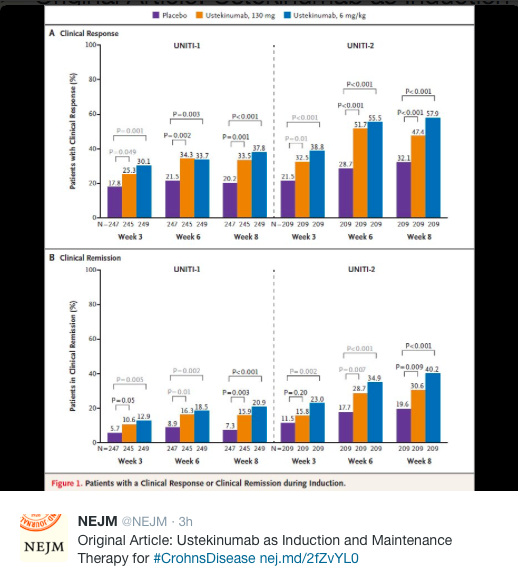
A recent study (BG Feagan, WJ Sandborn et al NEJM 2016; 375: 1946-60) provides extensive data regarding the effectiveness of ustekinumab for Crohn’s disease.

This publication combines three trials (industry-sponsored): UNITI-1, UNITI-2, and IM UNITI.  The first two trials with 741 and 628 patients respectively examined intravenous ustekinumab for induction.  Patients (18 years or older with Crohn’s disease) received either 130 mg, 6 mg/kg or placebo.  UNITI-1 were patients with primary or secondary nonresponse to TNF antagonists.  UNITI-2 were patients in whom conventional therapy failed or in which unacceptable side effects developed. The majority of UNITI-2 patients had not received a TNF antagonist.

IM UNITI with 397 patients followed patients who completed the first two trials for maintenance (90 mg SC every 8 weeks or every 12 weeks).  For this study, the primary end point was remission at week 44 (CDAI score <150).

The IM UNITI study involved 260 sites in 27 countries.

Key findings:

  • With the induction trials, ustekinumab outperformed placebo at 6 weeks.  For UNITI-1, 130 mg dosing resulted in 34.3% response, 6 mg/kg resulted in 33.7% response and placebo 21.5%.
  • For UNITI-2, 130 mg dosing resulted in 51.7% response, 6 mg/kg resulted in 55.5% response and placebo 28.7%.
  • For IM UNITI, every 8 weeks dosing resulted in 53.1% remission at week 44, compared with 48.8% dosed every 12 weeks, and 35.9% who received placebo.
  • For IM UNITI, among those who started in remission at week 0, 66.7% (q 8 weeks), 56.4% (q12 weeks) and 45.6% (placebo) remained in remission at 44 weeks.

When looking at more objective results, both UNITI-1 and UNITI-2 showed significant drops in calprotectin and CRP values; both of these objective markers favored 6 mg/kg over 130 mg fixed induction dose.

  • UNITI-1 at 6 weeks, calprotectin dropped 38.6 in 130 mg dosing group, 41.3 in 6 mg/kg group and 0 in placebo.
  • UNITI-2 at 6 weeks, calprotectin dropped 55.0 in 130 mg dosing group, 106.3 in 6 mg/kg group and 0 in placebo.
  • For the IM UNITI objective markers, it was noted that the median CRP values generally were unchanged in both treatment groups (q8 weeks, and q12 weeks) but increased in the placebo group by ~4 mg/L.  Also, calprotectin remained <250 mg in both ustekinumab treatment groups at a much higher percentage than those who received placebo.

Safety:

Extensive safety data are reported and more than 60% of all patients, including placebo-treated patients reported potential adverse effects.  Adverse effects and serious adverse effects were similar in treatment and control groups. During 1 year of therapy, there were no deaths or instances of the reversible posterior leukoencephalopathy syndrome.

Other points:

  • Response to ustekinumab was observed as early as week 3
  • UNITI-2 patients, most of whom had not failed a TNF antagonist, had higher response than UNITI-1 likely due to disease which was less refractory and of shorter duration

My take: These data support the use of ustekinumab for Crohn’s disease, particularly in patients who have not responded to other therapies.


stelarastudy


Learned Fear of Gastrointestinal Sensations Plus Two

Briefly noted: The authors of a recent study (E Ceunen et al. Clin Gastroenterol Hepatol 2016; 14: 1552-58) set out to study whether it is likely that healthy adults could learn to fear “innocuous visceral sensations.”  Fifty-two healthy subjects received  2 types of esophageal balloon distentions –one that was perceptible and non-painful and one that was painful.  Not surprisingly, when the researchers paired these two interventions in the experimental group, the experimental group learned to fear the innocuous stimulation as well as the painful distention.  This study provides theoretical support for one mechanism that could trigger ongoing functional gastrointestinal symptoms and a potential rationale for therapies, like cognitive behavioral therapy, which attempt to extinguish these symptoms.

In a retrospective study (AM Moon et al. Clin Gastroenterol 2016; 14: 1629-37) with 6451 patients with cirrhosis (mean age 60.6 yrs), the authors note that use of antibiotics during upper gastrointestinal bleeding (which is currently recommended) is associated with reduced mortality by ~30% at 30 days.  Despite its benefit, this intervention is often overlooked.  In the current study, only 48.6% of admissions received timely antibiotics; however, during the course of the study, the rate of antibiotic use improved from 30.6% in 2005 to 58.1% in 2013.

A recent retrospective study (N Goossens et al. Clin Gastroenterol 2016; 14: 1619-28) with 492 subjects showed that histologic NASH (in 12% of cohort) was associated with increased risk of death in patients who underwent bariatric surgery compared to patients without NASH.  Overall, bariatric surgery reduced the risk of death during the study period with HR of 0.54; the median follow-up was 10.2 years, with surgery taking place 1997-2004.  However, in patients with NASH the HR 0.90 which indicated that there was not a significant reduction in the risk of death.

Bar Harbor, ME (low tide)

Bar Harbor, ME (low tide)

Is there a link between the microbes in your colon and depression?

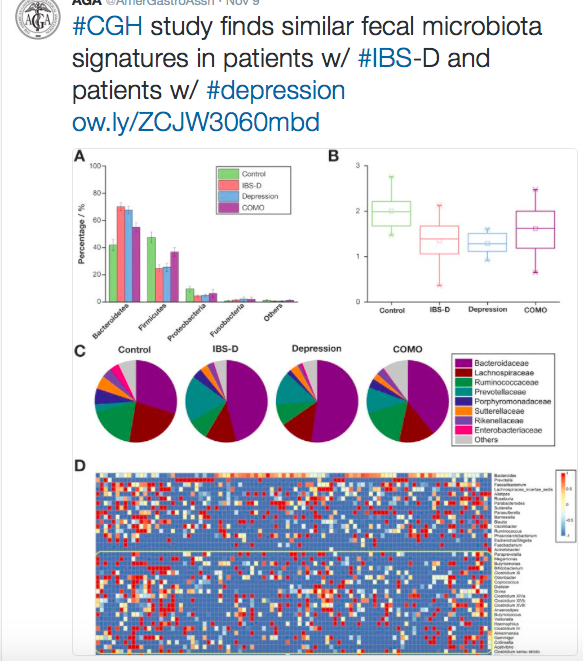
A recent study (Y Liu et al. Clin Gastroenterol Hepatol 2016; 14: 1602-11) showed that fecal microbiota signatures were similar between patients with diarrhea-predominant irritable bowel syndrome (IBS-D) and in patients with depression.

The authors analyzed stool samples from 100 Chinese subjects.  In addition to analyzed stool microbiota, the authors evaluated visceral hypersensitivity with a barostat and assessed for mucosal disease with immunohistochemical analyses of sigmoid biopsies.

In both IBS-D patients and patients with depression, the stool diversity was much less than controls and had similar abundance of many alterations, including higher proportions of Bacteroides and Prevotella (see below).

My take: It is interesting to speculate on whether changes in our microbiome could trigger/be related to the pathogenesis of not only IBS-D but other non-GI disorders like depression.

In the screenshot below, the term “COMO” refers to the 25 subjects who had both IBS and depression.

screen-shot-2016-11-14-at-12-10-03-pm

The President-Elect and the Anti-Vaccine Crowd

Multiple sources have reported that the anti-vaccine crowd is pleased with the results of the 2016 presidential election.

From Slate (11/22/16): Trump reportedly assured vaccine skeptics of of his support

An excerpt:

The president-elect has a long history of vaccine misinformation; he first began to express his beliefs that there might be a relationship between vaccines and autism nearly a decade ago—years after this association was scientifically discredited. He’s repeated these ideas over the years, and he never found it necessary to correct or refine his position during the election…

Jennifer Larson, CEO of the autism-focused Holland Center, in which she explained that she and other vaccination skeptics discussed their concerns with Trump at a donor event in August. According to her account, Trump assured them that he’s on their side.

From StatNews (11/30/16): Meeting with Trump emboldens anti-vaccine activists, who see an ally in the Oval Office

An excerpt:

“For the first time in a long time, I feel very positive about this, because Donald Trump is not beholden to the pharmaceutical industry,” movement leader Andrew Wakefield told STAT in a phone interview…

former doctor whose medical license was revoked, Wakefield launched the movement to question the safety of vaccines nearly two decades ago with a fraudulent study (which has since been retracted) suggesting that a widely administered vaccine against measles, mumps, and rubella can cause autism…

Those who seek to undercut trust in vaccines “see in Donald Trump a fellow traveler — someone who, like them, is willing to basically ignore scientific studies and say, ‘This is true. Vaccines cause autism because I believe it’s true,’” said Dr. Paul Offit, the head of the infectious diseases department at Children’s Hospital of Philadelphia.

My take: There is a reason anti-vaxxers see Donald Trump as a fellow traveler.

Acadia Natl Park

Acadia Natl Park

Nonpartisan Fear of GMOs

A recent NPR report: Americans Don’t Trust Scientists’ Take On Food Issues

This reports how frequently misinformed the US public is about is about food safety issues but at least this information is not associated with partisan political views.

An excerpt:

39 percent of the survey participants believe that genetically modified foods are worse for your health than non-GM food. However, there’s essentially no scientific evidence to support that belief — a conclusion confirmed most recently by a National Academy of Sciences report

Americans believe that there’s no scientific consensus on GMOs. Just over 50 percent of respondents believe that “about half or fewer” of scientists agree that GM foods are safe to eat. Only 14 percent’s beliefs match the reality — that “almost all” scientists agree that GM foods are safe to eat…

Roughly equal shares of Republicans and Democrats (39 percent versus 40 percent) feel that GMOs are worse for people’s health. More Democrats than Republicans (60 percent versus 50 percent) believe that organic foods are healthier. It’s significant, but not a huge difference….

Related posts:

Here’s another related link: NY Times Stop Bashing GMO Foods

Ft Knox, Maine

Ft Knox, Maine