Best Fecal Marker for Crohn’s Disease: Calprotectin

A recent study (EK Wright et al. Inflamm Bowel Dis 2016; 22: 1086-94) collected data from 135 participants in a prospective, randomized, controlled trial aimed at preventing postoperative Crohn’s disease (CD) recurrence.  As part of this study, serial stool collections enabled comparison of fecal markers: calprotectin (FC), lactoferrin (FL) and S100A12 (FS).

FC was the optimal marker and was superior to CRP and CDAI. Table 4 provides a list of sensitivity, specificity, PPV, and NPV for each of the fecal markers at various cutoffs.

For FC, using the optimal cutoff of 135 mcg/g, the sensitivity was 0.87, specificity was 0.66, PPV was 56%, and NPV 91%.  A lower cutoff (50 mcg/g) improved sensitivity to 0.96 and NPV to 94%; whereas a higher cutoff (200 mcg/g) lowered the sensitivity to 71% but improved the specificity to 0.74 along with raising the PPV% to 59%.

My take: While the yield of a test changes based on the population examined, this report indicates that it is likely that calprotectin would outperform the other fecal inflammatory markers in most settings.

Related blog posts:

Briefly noted: G Gale et al. Inflamm Bowel Dis 2016; 22: 1071-77.  This report describes more extensive disease when there is concomitant orofacial granulomatosis with Crohn’s disease.

Paris from Postcards

Paris from Postcards, Vik Muniz

ParisCaption

Identifying IBD Years Before Symptoms

A while back there was a movie called “Minority Report.”  The movie’s premise was that crimes could be predicted and stopped before they occurred.  A recent study (P Lochhead et al. Clin Gastroenterol Hepatol 2016; 14: 818-24) presents intriguing data suggesting a similar scenario for inflammatory bowel disease (IBD).

The authors used a prospective, nested case control study of participants in the Nurses’ Health Study I and II. Median age of patients with Crohn’s disease (CD) (n=83) and ulcerative colitis (UC) (n=90) was 52.7 years and 50.4 years respectively. Key findings:

  • Median prediagnostic hsCRP levels (mg/L) were 2.3 in CD, 2.2 in UC and 1.5 in controls (n=344).
  • Median prediagnostic IL6 levels (pg/mL) were 1.7 in CD, 1.2 in UC, and 1.0 in controls.
  • Median time interval between blood collection and diagnosis was 6.6 years for CD and 6.8 years for UC.
  • There was increased odds for developing disease even after adjustment for potentially confounding variables like smoking.  This analysis held up even when excluding disease that developed within 2 years of sampling.

Overall, this study suggests that there is a significant population of patients with subclinical IBD which precedes the diagnosis by several years.  This report adds to a number of other studies showing potential “preclinical phase” of many diseases including rheumatoid arthritis and type 1 diabetes.

My take: It is fascinating that bloodwork can be abnormal years before clinical symptoms. However, as in “Minority Report” the problem will be with identifying a crime/disease that might never occur.

Unrelated –Chart Depicting Car Temps:

car temp

Why some kids are short & understanding linear growth

If you want to explore the biological basis for short stature, then an excellent review (YH Jee, J Bacon. J Pediatr 2016; 173: 32-7) is worthwhile.

The article begins by explaining the reasons why linear growth is rapid in infancy, slows in childhood and accelerates in adolescence through a process of growth plate chondrogenesis.  In addition, the idea that growth plate fusion causes growth cessation is not accurate.  Fusion of the growth plate occurs because of growth cessation. In addition, in many with “catch-up growth” the “delay in maturation appears to be driven by subtle undernutrition due to diminished appetite.”

Altered Growth Plate Chondrogenesis:

  • Nutritional intake -excess and inadequate nutrient intake affects growth, often through modulation of endocrine hormones.  Overnutrition accelerates linear growth “but the adult height is not substantially affected.”
  • Hormones –thyroid hormones, growth hormone, IGF-1, androgen, and estrogen all positively regulate linear growth.  Glucocorticoids negatively regulate linear growth.
  • Inflammatory cytokines –these cytokines (including TNF-α, IL-6, IL-1β) negatively regulate chondrogenesis
  • Paracrine growth factors, Extracellular Matrix, Intracellular Proteins –local growth factors can be deficient in those with specific genetic mutations:  FGFR3 -achondroplasia, GNAS -Albright hereditary osteodystrophy, PTH1R -Blomstrand chrondrodysplasia, PTPN11 (& others) -Noonan, SHOX -Langer mesmeric dysplasia.  SHOX mutations accounts for 2-5% of children with formerly idiopathic short stature.  SHOX gene is also involved in Turner syndrome short stature. More listed in their Table (pg 35).

My take: It is cool to see the evolved understanding of the various factors affecting stature.  While the authors conclude that exome sequencing will alter the diagnostic approach to children with severe short or tall stature, it seems that a genetic panel would be quite practical and less expensive than many endocrinological evaluations.

Related blog postHere’s Why Biologic Therapy for Crohn’s Helps Adolescents …

Imodium

IBD School Videos for Patients and Families

While these “IBD School” YouTube videos have been around for several years, I only became aware of them in the past few months.  I think they are good patient education resources.

Here are some links to a few of them:

There are a lot of these videos including the following:

My take: these videos are generally ~4 minutes and a good way to get a lot of information on IBD pretty quickly.

Screen Shot 2016-05-31 at 4.48.09 PM

What is Missing in Doctors’ Toolkits

An excellent editorial provides insight into the complex interaction between social problems and health issues.  In this age of widespread information availability, the biggest problems are not solved by knowing everything and memorizing facts.  Solving problems with teamwork and identifying resources are increasingly important.

Here’s the link: NY Times: Giving New Doctors the Tolls They Need

Here’s an excerpt:

But consider the skills I would need to be more effective in just this one clinic session: understanding social issues that contribute to health; marshaling support resources like case management, social work and rehabilitation centers; exploring my patients’ values and goals and encouraging behavior change; leading interdisciplinary care teams; employing new technologies and methods of patient engagement like telemedicine; and appreciating how health systems fit together to influence an individual patient’s care — from home care and community centers to clinics and hospitals. None have traditionally been emphasized in medical education — and, unsurprisingly, doctors in training like myself are often ill-equipped to practice in today’s health care environment…

The new Dell Medical School at the University of Texas, Austin, which enrolls its first class in June, is hoping to revolutionize medical education. The school plans to focus on helping students understand how health systems, communities and social issues contribute to individual health through a variety of innovative methods.

Instead of traditional lecture halls, Dell’s students will learn in collaborative workspaces with a curriculum that emphasizes team-based management of patients. They’ll take weekly classes with pharmacy, nursing, social work and engineering students. Dell’s “Innovation, Leadership and Discovery” program affords students an entire year to pursue projects related to population health and delivery system redesign.

Dell also features a unique collaboration with the university’s College of Fine Arts — known as the Design Institute for Health — to bring design thinking to health care. Here students will learn to think about everything from better hospital gowns and more hospitable hospital rooms to how patients access services online and how to make waiting rooms obsolete.

A representative case, associated with this figure of intestinal histology, of the complexity: a lady with psychosis associated with celiac disease is not adherent with her gluten free diet

A representative case of the complexity referred to in this blog post: NEJM 2016; 374: 1875-83.  This figure of intestinal histology shows damaged surface epithelium.  This is from a lady with new-onset psychosis associated with celiac disease who is not adherent with her gluten free diet

Workplace Violence in Health Care

A recent review article (JP Phillips. NEJM 2016; 374: 1661-9) discusses the topic of workplace violence against health care workers in the U.S.  Fortunately, this is a topic of which I do not have any expertise. But, on reading, I was fascinated how common this occurs despite a high likelihood of being underreported and largely ignored.

For starters, there are four types of workplace violence.   Type II, in which the perpetrator is a customer or patient of the workplace is thought to be most common.  In hospitals, one survey indicated that this accounted for 93% of all assaults.  Other types of violence include perpetrator who has no association to workplace/employee (type 1), perpetrator who is a current or former employee (type III), or a perpetrator with a personal relationship with employee, such as ex-husband (type IV).

Two areas in medicine experience the highest rates of violence: the emergency room and the psychiatry ward.  In both situations, mental illness, narcotic-seeking behavior, and intoxication may play a role.

Statistics:

  • Nurses and nursing aides are victimized at the highest rates, likely due to increased contact time.  In the Minnesota Nurses’ Study, the annual incidence of verbal and physical assaults was 39% and 13% respectively.
  • ER nurses had a 100% reporting verbal assault and 82.1% reporting physical assault during the previous year.
  • Physicians: one-quarter of ER physicians reported being the targets of physical assault in the previous year.  A much higher rate of verbal threats were noted within the previous 12 months: 75%.
  • Weapons are used in <1% of type II episodes of violence in the health care workplace.

Solutions:

  • There are no clear solutions.
  • The author advocates not overlooking verbal threats.  “The ‘broken windows’ principle, a criminal-justice theory that apathy toward low-level crimes creates a neighborhood conducive to more serious crime, also applies to workplace violence.”  Addressing verbal threats may prevent escalation.
  • To ensure a safe environment, more reporting on this problem is needed along with investigations of potential mitigating strategies.

My take: I have had been yelled at before and I was quite shocked.  This is a topic that is not discussed widely in training and probably should be.

Gibbs Gardens

Gibbs Gardens

False-positive Tissue Transglutaminase Antibodies

While tissue transglutaminase IgA antibody is thought to have high specificity for celiac disease, other etiologies need to be considered. As an example, KR Schwartz et al. (NEJM 2016; 374: 1466-76) present a case report which describes a 12 year old who was diagnosed with lymphoma after presenting with anemia, abdominal pain, and fevers. One interesting point was the elevated tissue transglutaminase IgA antibody of 74 (0-15) at presentation; endomysial antibody was negative. The TTG IgA normalized with treatment. The authors note that the presence of TTG IgA antibodies “is not specific for celiac disease but rather is a general phenomenon related to mucosal lesions.”

Related blog posts:

EricCarleCatepillar

What to Make of a Low Alkaline Phosphatase

Every now and then I see a low alkaline phosphatase (ALP)–usually this is an inconsequential finding.  A recent study (V Saraff et al. J Pediatr 2016; 172: 181-6) provides insight into this problem.

In a retrospective study spanning 8 years, the authors identified 1526 samples from 323,064 which had an ALP <100 U/L.  Most of these were transient.  Only 18 were identified as having persistently low ALP.  In this group, 13 were tracked down. In this group, among four who had ongoing low ALP, two had mutations in the ALPL gene.

The authors propose, in Figure 3, how to manage a low ALP.  In those with an accurate ALP (not a degraded blood sample) and who were not chronically ill, they suggest looking for symptoms of hypophosphatasia:

  • respiratory failure
  • vitamin B6 responsive seizures
  • elevated calcium, phosphate and/or nephrocalcinosis
  • failure to thrive/short stature
  • fractures/bone pain
  • craniosynostosis
  • chest deformity
  • delayed walking, waddling gait
  • premature loss of teeth/late dentition

In those with likely hypophosphatasia, confirm with a pyridoxal-5′-phosphate and urinary phosphoethanolamine. If these are normal, hypophosphatasia is unlikely.  If these are elevated, the next step per the authors would be checking knee, lateral/AP skull.  If these are suggestive, then undergoing genetic testing is recommended or seeing a bone specialist.

In those with those who do not have symptoms of hypophosphatasia, the authors recommend checking for other causes.  Workup could include zinc, magnesium, thyroid function, blood counts, renal/liver assays, parathyroid hormone, vitamins B12/C/D, celiac serology, and ceruloplasmin.

My take: In those with persistently low alkaline phosphatase, keep this reference handy.

Related blog post (for high alkaline phosphatase): We still see this

Gibbs Gardens

Gibbs Gardens

Ozanimod for Ulcerative Colitis

The results of a phase 2 trial for Ozanimod have been published: WJ Sandborn et al. NEJM 2016; 374; 1754-62.

Ozanimod (RPC1063) is “an oral agonist of the sphingosine-1-phosphate receptor subtypes 1 and 5 that induces peripheral lymphocyte sequestration, potentially decreasing the number of activated lymphocytes circulating to the gastrointestinal tract.”

From the abstract:

METHODS

We conducted a double-blind, placebo-controlled phase 2 trial of ozanimod in 197 adults with moderate-to-severe ulcerative colitis. Patients were randomly assigned, in a 1:1:1 ratio, to receive ozanimod at a dose of 0.5 mg or 1 mg or placebo daily for up to 32 weeks. The Mayo Clinic score was used to measure disease activity on a scale from 0 to 12, with higher scores indicating more severe disease; subscores range from 0 to 3, with higher scores indicating more severe disease. The primary outcome was clinical remission (Mayo Clinic score ≤2, with no subscore >1) at 8 weeks.

RESULTS

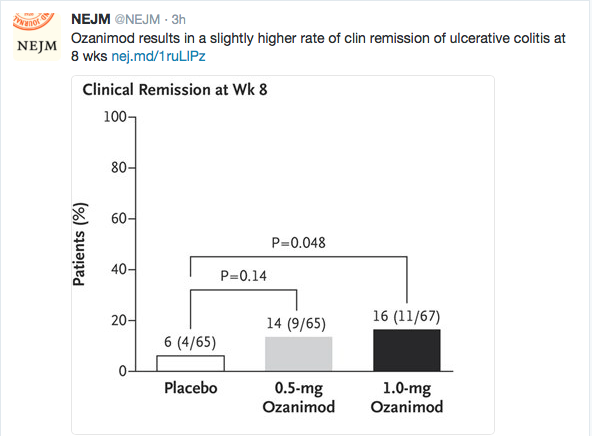
The primary outcome occurred in 16% of the patients who received 1 mg of ozanimod and in 14% of those who received 0.5 mg of ozanimod, as compared with 6% of those who received placebo (P=0.048 and P=0.14, respectively, for the comparison of the two doses of ozanimod with placebo). Differences in the primary outcome between the group that received 0.5 mg of ozanimod and the placebo group were not significant; therefore, the hierarchical testing plan deemed the analyses of secondary outcomes exploratory. Clinical response (decrease in Mayo Clinic score of ≥3 points and ≥30% and decrease in rectal-bleeding subscore of ≥1 point or a subscore ≤1) at 8 weeks occurred in 57% of those receiving 1 mg of ozanimod and 54% of those receiving 0.5 mg, as compared with 37% of those receiving placebo. At week 32, the rate of clinical remission was 21% in the group that received 1 mg of ozanimod, 26% in the group that received 0.5 mg of ozanimod, and 6% in the group that received placebo; the rate of clinical response was 51%, 35%, and 20%, respectively. At week 8, absolute lymphocyte counts declined 49% from baseline in the group that received 1 mg of ozanimod and 32% from baseline in the group that received 0.5 mg. The most common adverse events overall were anemia and headache.

CONCLUSIONS

In this preliminary trial, ozanimod at a daily dose of 1 mg resulted in a slightly higher rate of clinical remission of ulcerative colitis than placebo. The trial was not large enough or of sufficiently long duration to establish clinical efficacy or assess safety. (Funded by Receptos; TOUCHSTONE ClinicalTrials.gov number, NCT01647516.)

Ozanimod

Related blog post: CCFA Conference Notes 2016 (part 5) -Emerging Therapies …