Toronto Consensus: Practice Guidelines for Nonhospitalized Ulcerative Colitis

A group of 23 experts followed a rigorous process over a 1-year period to assess the quality of evidence and develop consensus statements regarding the medical management of ulcerative colitis (UC) in adults (Bressler B, Marshall JK et al. Gastroenterol 2015; 148: 1035-58, editorial 877-80).

The need for updated guidelines has emerged due to practice variation related in part to a wider availability of treatments and diagnostic tools. It is recognized that early institution of effective therapy is associated with the best outcomes.  In addition, due to the chronic nature of ulcerative colitis and the potential for reduced durability of biologic agents, careful decision-making can improve response.

Table 4 in the article summarizes the recommendations.  I will list a few:

1. Thiopurines:

  • “In patients with UC, we recommend against the use of thiopurine monotherapy to induce complete remission.”
  • In selected patients, “we suggest thiopurine monotherapy as an option to maintain complete corticosteroid-free remission.”

2. Anti-TNF therapy:

  • “In patients with UC who fail to respond to thiopurines or corticosteroids, we recommend anti-TNF therapy to induce complete corticosteroid-free remission.”
  • “When starting anti-TNF therapy, we recommend it be combined with a thiopurine or methotrexate rather than used as monotherapy to induce complete remission.”
  • For UC patients with suboptimal response or for those who lose response to anti-TNF therapy, “we recommend dose intensification.”  Dose optimization should be informed by therapeutic drug monitoring.

3. Vedolizumab

  • Vedolizumab is recommended with primary anti-TNF failure (rather than switching to an alternative anti-TNF), whereas either a 2nd anti-TNF or vedolizumab is recommended with secondary anti-TNF failure based on therapeutic drug monitoring.

4. Fecal microbial transplant (FMT)

  • “We recommend against FMT…outside the setting of a clinical trial.”

5. 5-ASA and Corticosteroids

  • Rectal 5-ASA is recommended at 1 g daily for mild-to-moderate ulcerative proctitis.  5-ASA enemas are recommended for mild-to-moderate left-sided ulcerative colitis.
  • In patients with moderate-to-severe UC, corticosteroids are recommended as 1st line therapy for induction of remission but not for maintaining remission.  In addition, corticosteroids are recommended as 2nd-line agents for inducing remission in those with mild-to-moderate disease who do not respond to 5-ASA products.

With all of the treatments, the authors recommend followup to assure response to therapy; this followup ranges from within 2 weeks for steroids, to 4-8 weeks with 5-ASA products, to 8-14 weeks for biologic agents.

Overall, the emphasis of this consensus statement is on maximizing the response to biologic agents.  By optimizing dosing and using combination therapy, the treatment guidelines aim to lower rates of antidrug antibody formation.  This in turn should improve results and is in agreement with data from both the SONIC study and the UC-SUCCESS study.

The editorial comments that methotrexate “may be an attractive option for young male patients;” however, “the absence of data on risk of malignancy with methotrexate in IBD may reflect lower frequency of use for this indication.”

While these guidelines will be useful, there are many unanswered questions (discussed in editorial).

  • In patients on combination therapy, what is the optimal dose of the immunomodulator?
  • When or Should the immunomodulator be withdrawn?
  • For secondary failure, should a 2nd anti-TNF be used prior to vedolizumab?
  • How should these guidelines be tailored for the pediatric population (or the elderly)?
  • What is the optimal monitoring for UC patients with regard to biomarkers and endoscopy?
  • What is the appropriate role of therapeutic drug monitoring?

Bottomline: These guidelines are likely to promote the use of more combination therapy and help define the current role of vedolizumab.

Related blog posts:

Disclaimer: These blog posts are for educational purposes only. Specific dosing of medications/diets (along with potential adverse effects) should be confirmed by prescribing physician/nutritionist.  This content is not a substitute for medical advice, diagnosis or treatment provided by a qualified healthcare provider. Always seek the advice of your physician or other qualified health provider with any questions you may have regarding a condition.

IBD Shorts -Skin, Adalimumab Kinetics

From the IMAgINE study with 192 pediatric patients (Sharma S et al. Inflamm Bowel Dis 2015; 21: 783-92), the authors determined levels for adalimumab, that at week 52, were associated with remission and response.  A cutoff level of 3.6 mcg/mL had a sensitivity of 32.7%  and specificity of 88.6% for predicting remission; the same cutoff had a sensitivity of 46.2% and specificity of 83% for predicting a response.  Overall, the authors noted dose proportionality with patients who received higher (or more frequent) doses with higher serum levels.

Related posts:

“Concomitant Use of Azathioprine/6-Mercaptopurine Decreases the Risk of Anti-TNF-Induced Skin Lesions” (Soh JS et al. Inflamm Bowel Dis 2015; 21: 832-9). Among a cohort of 500 Korean patients, the incidence of psoriaform and eczematiform lesions was 6.2%.  Concomitant use of a thiopurine was associated with a hazard ratio of 0.452 (lower risk) for developing these adverse skin reactions.

Related posts:

Withdrawing Therapy Leads To Relapse, Even if in Deep Remission

A recent study, presented as an oral abstract (thanks to Jeff Lewis for forwarding this reference), indicates that even in patients in deep remission, withdrawal of anti-TNF therapy leads to relapse in about 50% even when thiopurines are continued; this is in agreement with previous posts (see below).

Full abstract: OP007 Relapse after Deep Remission in Crohn’s disease. Here are the results and conclusion from the abstract:

Results

Sixty one patients were included and followed-up for a median of 28 months (range 7-47). After withdrawal of anti- TNFa therapy (44 infliximab and 17 adalimumab) 47 (77%) patients continued thiopurines. 32 (52.5%) patients relapsed until the end of follow-up with a median time to relapse of 8 months (range 1-25). The cumulative probability of maintaining remission was 82% at 6 months, 59% at 1 year and 51% at 2 years. Analysis of 28 patients who were in deep remission (endoscopic healing; faecal calprotectin <150mg/kg; CRP <5mg/l) revealed no better survival (82%, 64% and 40% at 6 months, 1 and 2 years, respectively). Four (8%) of relapsing CD patients required surgery 5 to 19 months after anti-TNFa cessation (2 for new stricture development, 1 for medically refractory flare and 1 for high grade dysplasia). In multivariate model only disease localization was risk factor of disease relapse (colonic vs. ileal/ileocolonic: OR 0.16, 95%CI: 0.03-0.72; p=0.02). Type of anti- TNFa preparation, smoking, disease behaviour, corticosteroid or thiopurine therapy, biological markers and anti-TNFa trough levels did not impact disease relapse.

Conclusion

Approximately half of CD patients relapsed within 2 years after anti- TNFa discontinuation despite being in endoscopic remission when anti-TNFa was stopped. The highest relapse rate was observed during the 1st year. Ileal disease increased the risk of disease flare, while no other risk factor was identified.

Related blog posts:

Bryce Canyon

Bryce Canyon

Short Takes on IBD Articles

Singh S, et al. Gastroenterol 2015; 148: 64-76.  In this study, the authors identified 21 trials with 2006 participants to examine the comparative efficacy of pharmacologic interventions to prevent relapse of Crohn’s disease (CD) after surgery.  Conclusion: “anti-TNF monotherapy appears to be the most effective strategy for postoperative prophylaxis for CD.” The relative risk of clinical relapse and endoscopic relapse with anti-TNF monotherapy was estimated to be between 0.02-0.20 and 0.005-0.04, respectively. Thus, those at highest risk for recurrence, including younger individuals, smokers, penetrating CD, perianal CD, and recurrent surgeries) are most likely to benefit.(Related blog post: More Lessons in TNF Therapy (Part 1) | gutsandgrowth)

Pariente B, et al. Gastroenterol 2015; 148: 52-63. The researchers in this cross-sectional study developed the Lémann Index which measures cumulative structural bowel damage in patients with CD.  My only complaint with this study was the associated editorial on pages 8-10, titled “The Holy Grail, or Only Half Way There?”  There are too many medical advances compared to ‘the holy grail’ and, in my opinion, this shouldn’t be one of them.

Zitomersky NL et al. Inflamm Bowel Dis 2015; 21: 307-14.  In this study the authors examine the relationship between the development of antibodies to infliximab (ATI) and the risk of surgery in a cross-sectional cohort of pediatric and young adult patients.  Not surprisingly, development of ATI, which was noted in 20% of cohort, correlated with reductions in infliximab levels and higher risk of surgery.  Interestingly, prior (but not current) immunomodulator therapy was associated with lower antibody levels (P=0.007).  Perhaps, “step-up” therapy may lower the risk of ATI. (This was a point noted by James Markowitz in a previous post: More NASPGHAN Meeting Notes: IBD Hot Topics | gutsandgrowth)

Rogler G, Vavricka S. Inflamm Bowel Dis 2015; 21: 400-08. This review article discusses the exposome in IBD.  Exposures include air pollution, diet, drugs, infections, water pollution, food additives, and smoking.  These exposures influence the gut microbiome and genetic susceptibility. “Only environmental influences…explain the rising incidence in IBD worldwide. The investigation of the exposome…is an enormous challenge…[but] of crucial importance.” (Related blog post: What do you know about the “exposome”? | gutsandgrowth)

Kalmon RS. Inflamm Bowel Dis 2015; 21: 428-35. Review article provides information when there is a prior personal or family history of malignancy (=avoid thiopurines).  Figure 2 is a suggested algorithm for those with IBD and a previous diagnosis of cancer.

  • In those in which the cancer is adequately controlled, the recommendations indicate that if it has been more than 2 years since completion of therapy to use a ‘step-up’ management and favor methotrexate over thiopurines
  • In those with less than 2 years since completion of cancer treatment and not responsive to 5-ASAs/antibiotics, then “consider monotherapy with biologic agents.”
  • In those still receiving chemotherapy, the authors suggest “hold immunosuppression and follow course of IBD.  If IBD not well controlled despite chemotherapy, 5-ASAs and antibiotics, treat flares with steroids, then consider biologic agents.”

Anti-Tumor Necrosis Factor Therapies and Cochrane Reviews

A recent article (Inflamm Bowel Dis 2014; 20: 2132-41) reviews the best available evidence on anti-TNF therapies.  This article emerged from a Cochrane collaboration session at Digestive Diseases Week (DDW) in 2013.

Key points:

  • “There is insufficient evidence to recommend ECI (early combined immunosuppression)) for every newly diagnosed patient, although it may be justifiable in some “high-risk” patients.”
  • With Crohn’s disease, combination of infliximab and azathioprine significantly improved remission, steroid-free remission, and mucosal healing rates compared with infliximab alone.
  • “A recent Cochrane review has shown that infliximab, adalimumab, and certolizumab are all effective…The choice of TNF-α antagonist depends on adherence, patient preference, mode of delivery, and cost.
  • Elective switching of TNF-α antagonists: in patients who are doing well, elective switching “may be associated with loss of both tolerance and efficacy.”  “Dose intensification or early treatment termination was observed in 47% of patients who switched to adalimumab after an ongoing response to scheduled maintenance infliximab therapy compared with 16% of patients who remained on infliximab maintenance therapy.” 28% of ADA patients discontinued therapy compared with 2% of IFX patients.
  • When to stop therapy: among patients in deep remission >6 months who stopped, relapse occurred in 43.9% over 1 year.
  • Patients who take thiopurines or biologics (IFX or ADA) have an increased risk of nonmelanoma skin cancer. Odds ratio, compared to controls, as high as 6.75 for combination therapy (>365 days).
  • Lymphoma: the Cochrane review “found no statistically significant difference in the incidence of lymphoma between biologics and control treatment…and data from the TREAT registry also demonstrated no apparent signal for TNF-α antagonist (i.e. infliximab)-related lymphoma or overall malignancy.”
  • There has been incremental risk of Non-Hodgkin’s lymphoma and hepatosplenic T-cell lymphoma with azathioprine (thiopurines).

Related blog posts:

Other articles briefly noted:

Inflamm Bowel Dis 2014; 20: 2142-50. “Approach and management of patients with chronic hepatitis B and hepatitis C during the course of inflammatory bowel disease.”

Inflamm Bowel Dis 2014; 20: 2151-56.  Use of cyclosporin and tacrolimus in inflammatory bowel disease.  Checking hepatitis B surface antigen, surface antibody, and core antibody are recommended at the time of diagnosis of IBD. Algorithm for managing hepatitis B serology is given in Figure 1.

More NASPGHAN Meeting Notes: IBD Hot Topics

The best preparation for tomorrow is to do today’s work superbly well”  –William Osler (quote cited in NEJM 2014; 371: 1565-66).

This blog entry has abbreviated/summarized the presentations. Though not intentional, some important material is likely to have been omitted; in addition, transcription errors are possible as well.

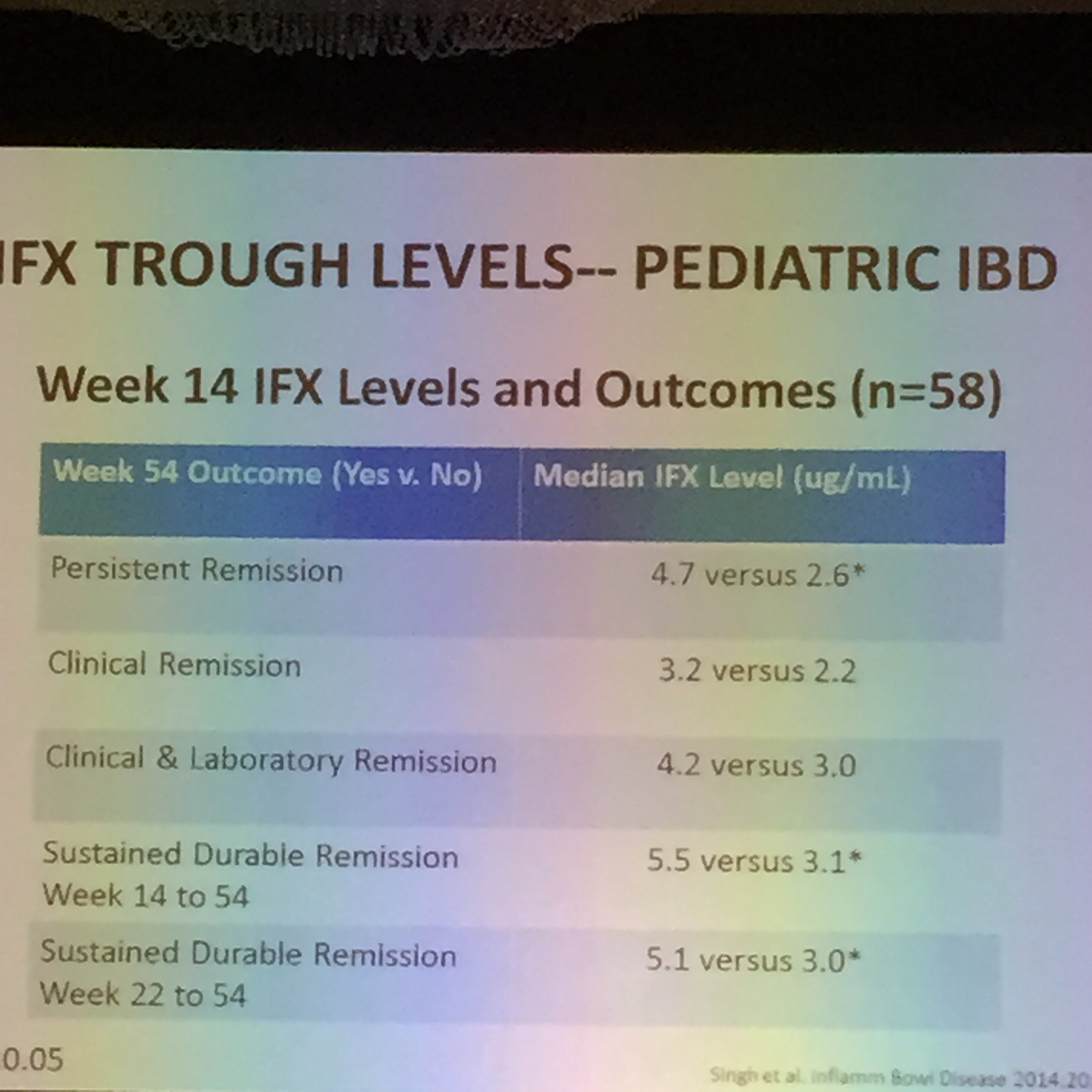
For me, these lectures were a useful review and represent an effort to achieve Osler’s objective of doing superb work.  If I had to choose a single issue that may affect my practice: when initiating infliximab, consider checking week 14 trough levels of infliximab and optimize dosing.

The role of the microbiome in IBD   –Subra Kugathasan (Emory)

This was a terrific lecture though with some overlap with a number of other presentations at the meeting. The lecture reviewed how to interpret microbiome studies and what we are learning from these studies with regard to inflammatory bowel disease.

Enteral Nutrition and Microbiota –conclusion:

  • EN may work by suppressing the entire microbiota in Crohn’s disease thus lowering antigenic effect to the gut
  • Some microbes may be pro-inflammatory and others pro-fibrotic
  • Chicken and egg: preliminary evidence suggests that dysbiosis is probably a preceding predisposing factor rather than due to the consequence of having inflammatory bowel disease.

The Role of Drug Monitoring in Inflammatory Bowel Disease –Jennifer Strople (Children’s Hospital of Chicago)

TPMT Testing/thiopurine metabolite monitoring

  • goal: minimize adverse effects and optimize thiopurine dosing.
  • those with lower (but not absent) activity may be best candidates for treatment with azathioprine/6-mercaptopurine (thiopurines).
  • normal TPMT testing does NOT exclude complications like bone marrow suppression or pancreatitis.
  • obtaining TPMT at baseline is cost-effective
  • goal of 6-thioguanine level of >235 (odds ratio favorable of responding to/remission with treatment)
  • drug levels: allows monitoring for noncompliance; limitation of costs and using levels inappropriately. Routine testing “has no role in patients who are doing well on acceptable doses of thiopurines”
  • younger patients often need higher doses

Monitoring for anti-TNF Therapy

  • Loss of response most common in first year of therapy.
  • For infliximab (IFX), IFX trough levels >3 mcg/mL predicted sustained response. Gut 2014; 63: 1721.
  • Week 14 IFX levels predict outcomes:
IFX Levels at 14 weeks

IFX Levels at 14 weeks

  • Preliminary data with ulcerative colitis shows that troughs >3.7 mcg/mL increases likelihood of mucosal healing and remission.
  • Undetectable trough levels of IFX associated with increased risk of colectomy with ulcerative colitis Gut 2010 59: 49
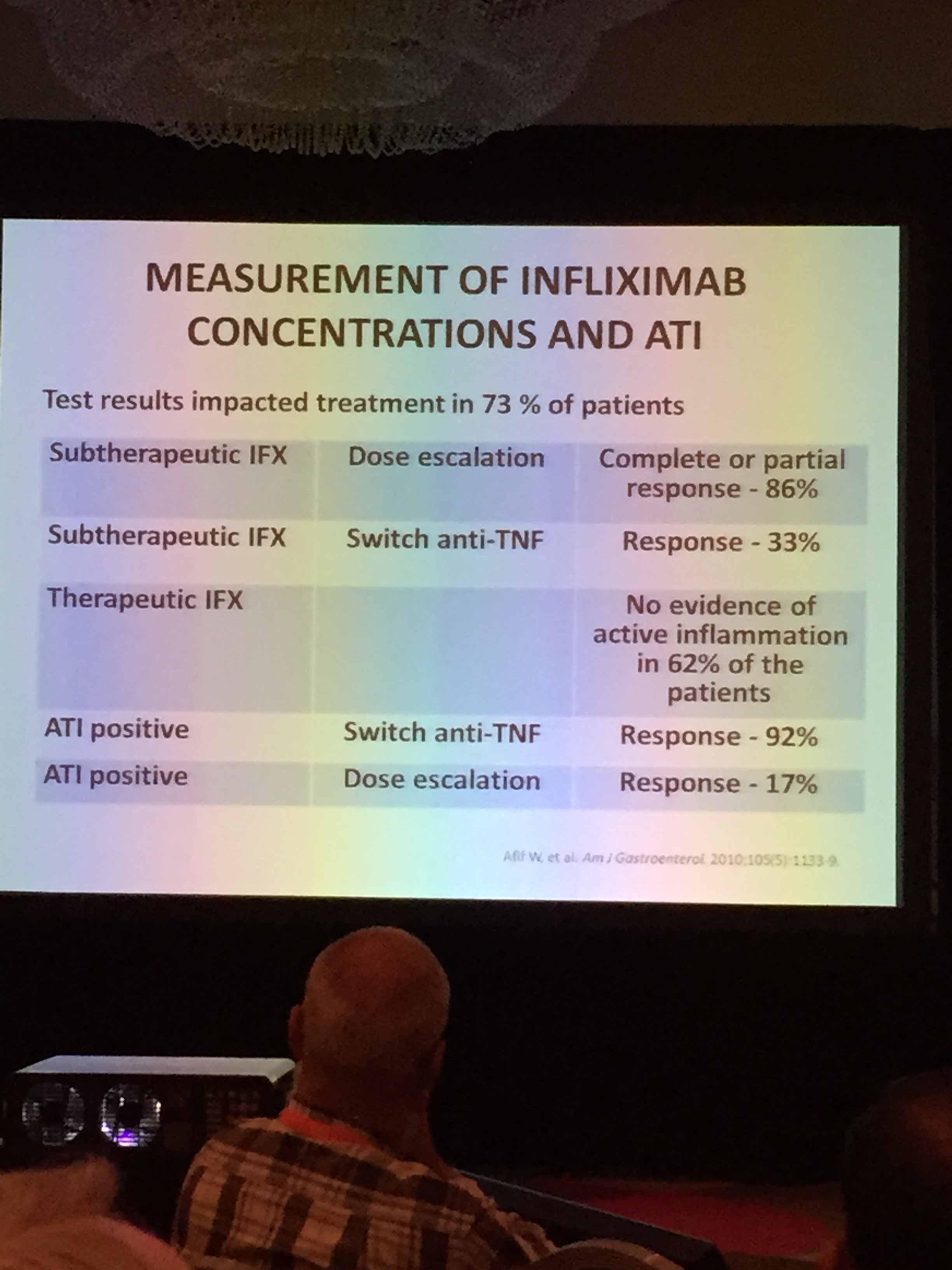
  • If a patient develops high levels of anti-drug antibodies (ADAs), this makes likelihood of response to medications unlikely. The specific ADA level is helpful; high levels of drug antibody are particularly problematic. If low levels of drug without ADAs, then increasing dose is typically effective.
IFX Algorithm

IFX Algorithm

  •  If losing response to therapy and if active disease is present, then check drug concentration. If subtherapeutic with no ADAs or low ADAs, dose escalation with or without immunomodulator is indicated.
  • If subtherapeutic with high ADA, then change drug
  • If therapeutic level, then may need to change to different anti-TNF or drug class.

Related posts on this topic:

Debate: Immunomodulators versus Biologic agents 

  • James Markowitz –consider starting with immunomodulators
  • Maria Oliva-Hemker –consider starting with biologics

In the face of the “Biologic Tsunami,” Dr. Markowitz suggested –“Don’t throw the baby out with the bathwater”

  • Reviewed infliximab data, and adalimumab data. 1-year remission rates 50-60%.
  • Durability of infliximab may be influence by immunomodulators (IMs): patients who had IM prior to IFX had better durability of response:  45% durability in those who had no IM prior to biologic, 53% durability in those who had IM for ❤ months, 66% durability in those who had IM for >6 months prior to IFX.
  • Adult data showing lack of efficacy with IMs influenced by different characteristics compared with children (eg. different disease location, ~40-50% of adults were smokers)
  • Reviewed toxicity of IMs and biologics
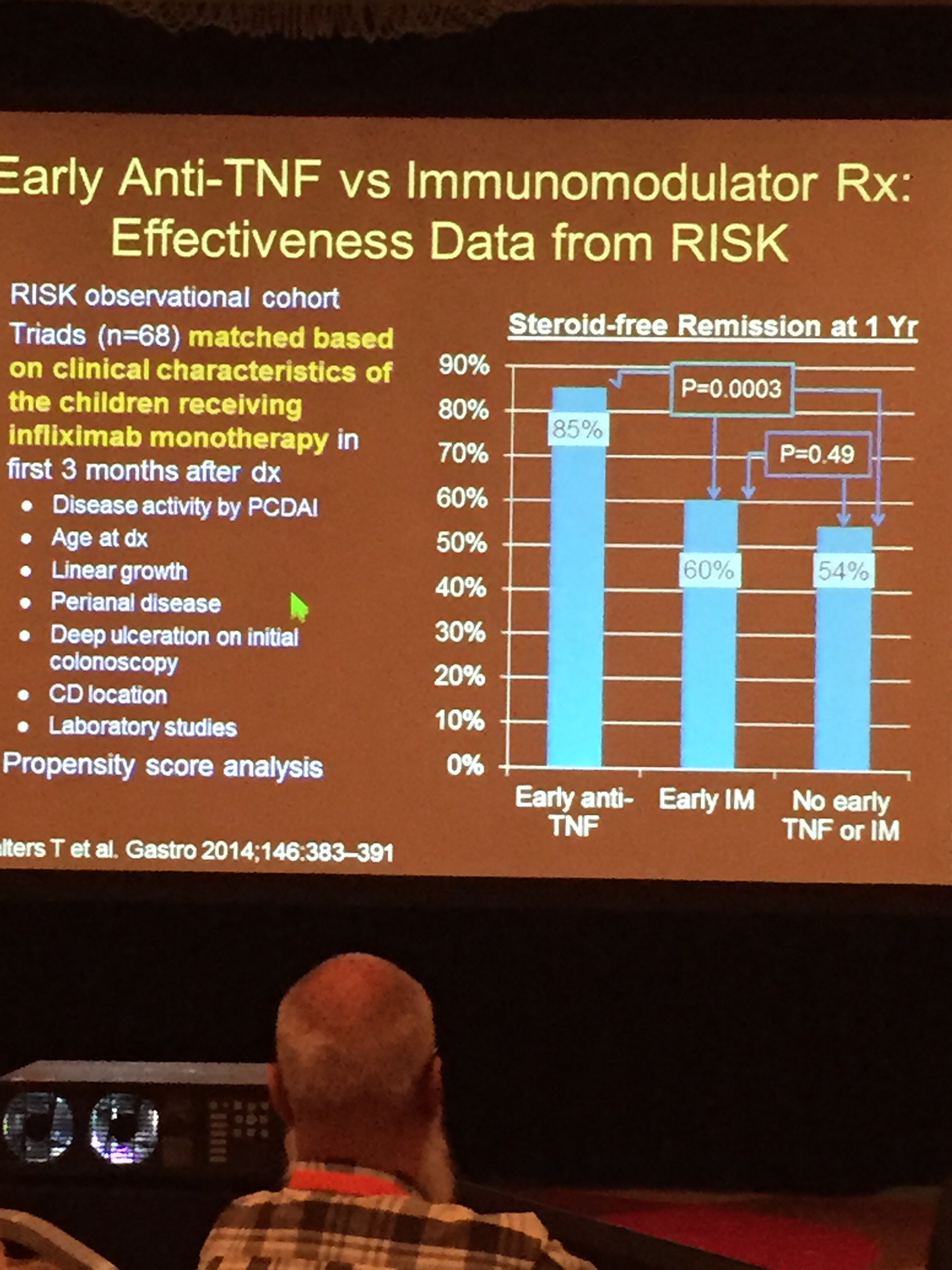
  • Children with severe disease do best with “early infliximab.”
  • IMs with 40-60% efficacy over 18 months and then relatively stable.
  • In Dr. Markowitz’ practice, IM use: girls receive thiopurines and boys receive methotrexate

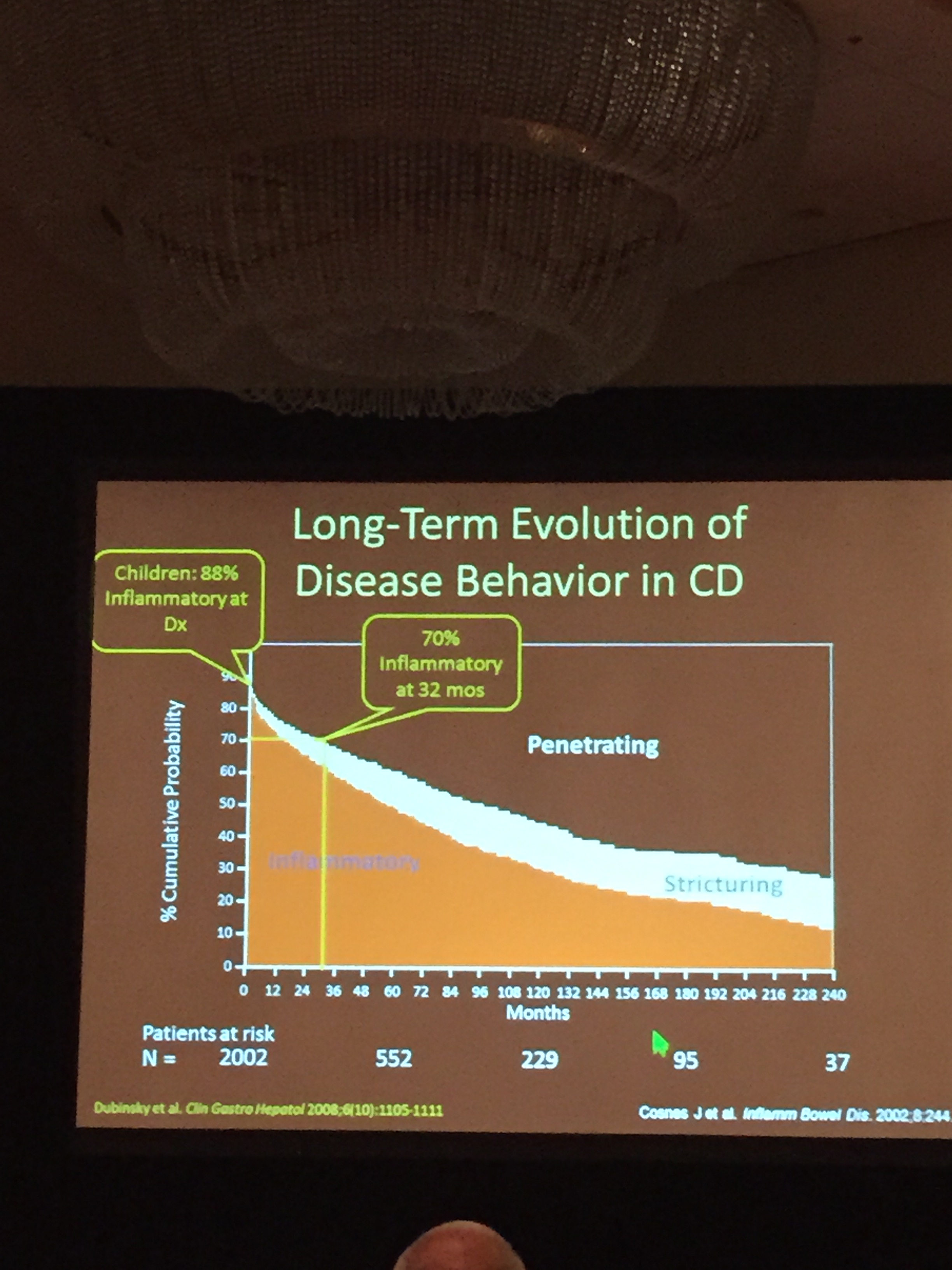
Biologics –important to start before disease phenotype changed to stricturing/penetrating disease. (See images below)

Related posts:

Early anti-TNF -RISK Cohort

Early anti-TNF -RISK Cohort


Long Term Risk of Stricturing (Cosnes et al)

Long Term Risk of Stricturing (Cosnes et al)

Safety Signal for Anti-TNFs

In a large population of inflammatory bowel disease patients, anti-tumor necrosis factor medications (anti-TNFs) did not increase the risk of cancer in a recent study from Denmark.  This link provides a summary of the study (JAMA 2014 June 17 [doi:10.1001/jama.2014.5613]) in GI & Hepatology News: Anti-TNFs -Safety Signal

Here’s an excerpt:

This study “assessed the risks of any cancer and 11 individual cancers, including malignant melanoma, in 56,146 IBD patients aged 15 and older…during 1999-2012, of whom 4,553 took TNF-alpha antagonists.  Median follow-up was 9.3 years…A total of 6.7% of the patients who never took TNF-alpha antagonists developed cancer during follow-up compared with 1.8% of patients who took the drugs…

Stratifying for cancer risk according to years since first exposure, no specific time-dependent pattern was observed in our study…an increased risk in the long term cannot be excluded.”

In another systemic review study (Clinical Gastroenterology and Hepatology Volume 12, Issue 9, Pages 1443–1451, September 2014) focused on pediatric IBD patients (n=5528), the authors found that “Two patients developed lymphoma (2.1/10,000 PYF). This value was … lower than the population of pediatric patients receiving thiopurine monotherapy (4.5/10,000 PYF; SIR, 0.47; 95% CI, 0.03–6.44)”…”the risk of lymphoma was no greater among children with IBD who received anti-TNF therapy than those treated with other IBD therapies or adults treated with anti-TNF agents. The rate of serious infection was significantly lower among pediatric patients with IBD treated with anti-TNF agents than those treated with steroids, or adults with IBD who received anti-TNF therapy.”  Here’s the link: anti-TNF therapy with lower lymphoma risk than thiopurines in pediatrics

My First Take: It is Hard to Save $$$ at a Rolls-Royce Dealership

A recent article looked at a crucial issue –trying to deliver “best care at lower cost” (Inflamm Bowel Dis 2014; 20: 946-51).  “The goal of this report is to answer the primary question: What are implementable strategies and exploratory considerations for cost-efficient anti-TNF use while maintaining the highest quality of IBD care?”

The strategies that are discussed include the following:

  • Reduce costs of avoidable dose intensification of class switching by eliminating episodic anti-TNF use and improving patient education
  • Reduce over-utilization costs by accurately determining indication for escalating anti-TNF use
  • Reduce nondrug infliximab costs through shortened infusion times after initial safety is clearly established

Exploratory considerations:

  • Self-injectable anti-TNFs
  • Combination therapy
  • Monitoring anti-TNF drug levels and autoantibodies
  • Assessing mucosal healing as a clinical endpoint

The authors discuss both the exploratory issues and the strategies.  Some of each could easily increase costs, at least in the short-term, rather than reduce them.  The authors also make note of the development of an infliximab biosimilar (Inflecta) which could be approved in U.S. by 2015.

While the review article is a good read, in my opinion the authors fail to address in a meaningful way the larger context.  The costs for hospital-based care are enormous; pediatric hospitals are like Rolls-Royce dealerships; and by the way, if you have to ask how much it costs, you probably cannot afford it.  With regard to charges/costs, there is little transparency, high variability, and little accountability.  Understanding health care costs and trying to get a good deal is much harder than buying a car.

For IBD care, as an example, the authors make note of the cost of infliximab at one pediatric tertiary care center.  At this institution, “77% of the total health care cost for each infusion encounter” was for non-drug costs.  Given how expensive the drug cost is, the expense for an infusion is very high, but probably similar to many other pediatric hospitals.

If one is interested in reducing the costs of infliximab and other infusions, the first practical step would be to consider infusion outside of a hospital-based setting, such as an infusion center.  In such a setting, the patient safety would still be excellent but the costs would be less.

In Atlanta, there have been some high-profile hospital acquisitions that have increased health care costs (When doctors sell out, hospitals cash in | www.myajc.com).  In many circumstances, when a hospital acquires a physician practice, infusion center, or endoscopy center, the charges and reimbursement increase despite no change in clinical care.  In this way and many others, the current system promotes cost-inefficient care.

Related blog entries:

Marriage, Divorce and Separation with Anti-TNF Therapy

This review article (Inflamm Bowel Dis 2014; 20: 757-66) examines the question of whether and when anti-tumor necrosis factor (anti-TNF) agents can be stopped in Crohn’s disease (CD) patients in remission.  This topic is particularly helpful since this comes up frequently in clinical practice.

As recently as a few years ago, one expert advised me that starting an anti-TNF agent (like infliximab or adalimumab) was like getting married.  Once you committed, you stayed in that relationship indefinitely.  Of course, it is well-known that individuals get divorced.  In medical terms, I guess that would be the equivalent of developing antibodies to the anti-TNF agent or other adverse reactions.  Switching from one anti-TNF to another would be equivalent to marital infidelity.

So what does this review article say about all of this?  The article examines nine studies with a little more than 500 patients.  “Current evidence suggests that a group of CD patients, possibly 30% to 40% in clinical remission while on IM (immunomodulators) and infliximab can stop the latter and maintain clinical remission for a relatively long interval.  It seems that, if followed long enough, virtually all patients (including those on IM) will eventually develop clinical recurrence.”

If tempted to separate but not divorce anti-TNF therapy, the authors recommend, in addition to clinical remission, “normal colonoscopy (and/or normal surrogate markers of disease activity) should be adopted as a criterion when stopping therapy and during follow-up….As of today, many authors do not recommend to routinely stop anti-TNF agents in patients responding to this therapy and in the absence of other issues.  Others propose to stop them after a minimum of 2 years of clinical and endoscopic remission or longer if only clinical remission can be documented…

If costs or other issues are present, we suggest to cautiously stop anti-TNF agents only in patients on combination therapy with profound (clinical, biochemical, and endoscopic) and long lasting (>1 year) remission and continuing the IM.  Such patients should be closely followed by serial determinations of fecal calprotectin and inflammatory indices, and the medication immediately restarted in the presence of a flare. When in doubt, colonoscopy should be performed.

Take-home message: Most patients are better off staying married to their anti-TNF therapy.

Also noted: Inflamm Bowel Dis 2014; 20: 742-56.  Clinical Utility of Fecal Biomarkers for the Diagnosis and Management of Inflammatory Bowel Disease.  This is a useful review with 103 references.

Superiority of Anti-TNF Therapy (Part 2)

A recent blog (Superiority of Anti-TNF Therapy in Children | gutsandgrowth) described a recent article showing that kids treated with anti-TNF therapy at the time of diagnosis had improved outcomes compared to children who were treated with other medications.  In this day of multimedia, there is a video explaining the study which may be helpful for families and clinicians alike –here’s the link:  Dr. Michael Stephens discusses the research findings: .

An excerpt from the explanation with the video:

The current research study looks at outcomes and compares three different types of treatments. The first group receives anti-TNF therapy. The second group received immune modulating therapy. The third group received no treatment within the first three months. This study was an observational study and the choice of treatment was at the discretion of the physician. In order to correct for this factor, a statistical technique was used. Patients with similar characteristics were paired within the three groups . The results showed that patients who received the anti-TNF therapy had an improved outcome, such as a higher remission rate and some indications of improved growth, at one year. All three groups had improvements in weight and body mass index but only the anti-TNF group had improvements in linear growth.