USPSTF Takes Neutral Stance on Celiac Disease Screening in Asymptomatic Individuals

Full Text: JAMA. 2017;317(12):1252-1257. doi:10.1001/jama.2017.1462

From Abstract:

Objective  To issue a new US Preventive Services Task Force (USPSTF) recommendation on screening for celiac disease.

Evidence Review  The USPSTF reviewed the evidence on the accuracy of screening in asymptomatic adults, adolescents, and children; the potential benefits and harms of screening vs not screening and targeted vs universal screening; and the benefits and harms of treatment of screen-detected celiac disease. The USPSTF also reviewed contextual information on the prevalence of celiac disease among patients without obvious symptoms and the natural history of subclinical celiac disease.

Findings  The USPSTF found inadequate evidence on the accuracy of screening for celiac disease, the potential benefits and harms of screening vs not screening or targeted vs universal screening, and the potential benefits and harms of treatment of screen-detected celiac disease.

Conclusions and Recommendation  The USPSTF concludes that the current evidence is insufficient to assess the balance of benefits and harms of screening for celiac disease in asymptomatic persons. (I statement)

Winged Victory of Samothrace, 190 BC

Celiac Diseaase and Diabetes

A recent review (B Weiss, O Pinahs-Hamiel. JPGN 2017; 64: 175-79) of the medical literature describes the various recommendations regarding celiac disease (CD) and type 1 diabetes mellitus (T1DM).

Key points:

  • Two-thirds of patients with T1DM and CD are asymptomatic for CD at diagnosis
  • Many children with T1DM and with positive CD serology may normalize the serology spontaneously.   In one study with 446 children with T1DM who were screened for CD, 38 had persistently abnormal serology whereas 27 had fluctuations in CD serology.  In another study with 738 children, of 48 patients with positive CD serology, normalization was evident in 35% at 1 year.

The authors review recommendations for CD screening.  Several guidelines have recommended soon after diagnosis (especially if >2 years of age).

screenshot-149

Their figure 1 algorithm provides guidance on evaluation.  In those patients with T1DM and positive CD serology, if they are asymptomatic, assuring that serology is persistently elevated may be worthwhile before proceeding with small bowel biopsy.  In those who initially test negative for serology, there may be a role for HLA testing and/or periodic screening every few years.

Related editorial on recent article: Celiac Disease, Gut-Brain Axis, and Behavior: Cause, Consequence or Merely Epiphenomenon (A Fasano)  Thanks to KT Park for this reference.  Excerpt:

By assessing the psychological functioning of infants enrolled in the Environmental Determinant of Diabetes in the Young trial and followed prospectively, the authors reported that 3.5-year-old children affected by celiac disease autoimmunity (CDA), defined as positive serology in children at risk, have increased reports of depression/anxiety, aggressive behavior, and sleep disturbances. Interestingly, these symptoms were significantly greater in the 66 children with CDA whose mothers were unaware of the diagnosis compared with the 440 children with CDA whose mothers were aware of the diagnosis and the 3651 children without CDA, decreasing the chance that the reported behaviors were biased by families’ subjective assessment…Prospective studies such as that reported by Smith et al may be a key approach to shedding light on how intestinal factors can influence human behavior and to identifying possible targets to ameliorate psychological symptoms caused by inappropriate gut-brain cross-talk.

Reference articleSmith L, et al.. Psychological manifestation of celiac disease autoimmunity in young children. Pediatrics. 2017;139(3):e20162848

Related blog posts:

Disclaimer: These blog posts are for educational purposes only. Specific dosing of medications (along with potential adverse effects) should be confirmed by prescribing physician.  This content is not a substitute for medical advice, diagnosis or treatment provided by a qualified healthcare provider. Always seek the advice of your physician or other qualified health provider with any questions you may have regarding a condition.

February Briefs

JM Powers et al. J Pediatr 2017; 180: 212-6. This retrospective study details a protocol for using intravenous ferric carboxymaltose (FCM) (Injectafer) in children.  This product has become available for adults in U.S. since June 2013; it had been available in Europe since 2009. In this retrospective study, 72 pediatric patients received FCM for iron deficiency anemia (off-label); there was a good safety profile and a good response with hemoglobin increasing from 9.1 to 12.3 (4-12 weeks post infusion).  FCM is a relatively costly IV iron formulation, but can be given over 15 minutes.

L Peyrin-Biroulet et al. Clin Gastroenterol Hepatol 2017; 15: 25-36.  This systemic review with more than 2800 patients showed that TNF antagonists were effective for extraintestinal manifestations of inflammatory bowel disease, including cutaneous disorders (eg.. pyoderma gangrenosum, erythema nodosum), hematologic problems (eg anemia), ocular disorders, and rheumatologic symptoms( eg. arthralgias/arthritis).

AE Mikolajczyk et alClin Gastroenterol Hepatol 2017; 15: 17-24. Useful review of the GI/Liver manifestations of autosomal-dominant polycystic kidney disease. “There is not a role for therapy [for the liver] in asymptomatic patients.” Other problems reviewed included pancreatic cysts, hernias, and diverticular disease. Related posts:

T Rajalahti et al. JPGN 2017; 64: e1-6.  Among 455 patients <18 with Celiac disease, anemia was noted in 18%. This resolved in 92% after one year of a gluten-free diet.  Anemia is associated with more severe histological and serological presentation. Related posts:

FL Cameron et al. JPGN 2017; 64: 47-55. This retrospective review of 93 children treated with infliximab and 28 children with adalimumab provides data on growth after anti-TNF therapy.  This study shows that anti-TNF therapy is more likely to be associated with growth improvement when used at earlier stages of puberty.

Related blog posts:

Chattahoochee River

Chattahoochee River

Top Posts 2016

The following posts are the ones that I think are most useful from 2016.

Gastroenterology:

Liver:

General:

Doctoring:

IBD:

Nutrition:

truth-johnpohl

Cool Microflora Translational Study with Celiac Disease

There has been a deluge of articles regarding the microbiome; yet, many aspects of microbiome derangements may have limited clinical significance.  In addition, in many circumstances, it is not clear if the changes in the microbiome represent the proverbial chicken or the egg.  How much of the changes in the microbiome are a consequence rather than a cause of a clinical problem?

One fascinating article (A Caminero et al. Gastroenterol 2016; 151: 670-83) looks at the role of the microflora with regard to gluten breakdown and immunogenicity.  Thanks to Ben Gold who prompted me to take a 2nd look at this study.

In this study, the authors took bacteria isolated from the small intestines of Celiac disease (CD) patients or controls and colonized germ-free mice.  Subsequently, “after gluten gavage, gliadin amount and proteolytic activities were measured” and characterized.

Key findings:

  • Pseudomonas aeruginosa isolated from CD patients “produced peptides that better translocated the mouse intestinal barrier.”
  • The P aeruginosa-modified gluten peptides activated gluten-specific T-cells from CD patients.
  • In contrast, Lactobacillus spp isolated from the duodenum of non-CD controls degraded gluten peptides and reduced their immunogenicity.

The others selected P aeruginosa from CD patients as it was not present in controls, though most strains were in fact within the phylum Firmicutes.  Lactobacillus spp was chosen from the healthy subjects “because it constitutes a core resident group in the human small intestine that is involved in gluten metabolism in vitro and is altered in CD patients.”

  • Figure 2 specifies the distinct gluten metabolic patterns induced by the intestinal bacteria.
  • Figure 3-6 show numerous changes in the immunogenicity of gluten peptides induced the intestinal bacteria.

Overall, the study provides some evidence that changes in microbiome could trigger intestinal inflammation.  Thus, since autoimmunity and celiac disease have an environmental trigger, this study implicates changes in the microflora as a risk factor for developing celiac disease in the susceptible host (see Figure 7 in the source article).

My take (from authors): This study identified “both pathogenic and protective microbe-gluten-host interactions that may modulate autoimmune risk in HLA-DQ2 susceptible persons.”

Acadia Natl Park

Acadia Natl Park

GI Educational Cartoons For Children

Diana Lerner and the Medical College of Wisconsin have developed additional GI educational videos.  Previously, they had developed cartoon videos explaining endoscopy (prev post: Terrific Educational Videos on Endoscopy).  Now there are several more.  All of these are in English and some in Spanish.

Topics include inflammatory bowel disease, gastroesophageal reflux, eosinophilic esophagitis, and celiac disease.

Here’s the link:  Pediatric Gastroenterology Cartoons For Kids

Related blog post:

screen-shot-2016-10-23-at-10-39-50-am


Ultra-Short Celiac Disease


It is well-recognized that obtaining a duodenal bulb biopsy increases the likelihood of making a diagnosis of celiac disease.  Another study (PD Mooney et al. Gastroenterol 2016; 150: 1125-34) has tried to quantitate the frequency of “ultra-short” celiac disease (USCD).

In this prospective study of 1378 patients (mean age 50.3 yrs) who underwent endoscopy between 2008-2014, there was a cohort who had a high clinical suspicion of celiac disease in which quadrantic biopsies of the duodenal bulb were obtained.

Key findings:

  • 268 (19.4%) were diagnosed with celiac disease
  • 26 (9.7%) of celiac population had disease identified primarily in the duodenal bulb.  These patients with USCD were younger (P=.03), had lower serologic titers of tissue transglutaminase antibody (tTG) (P=.001), and less frequently had diarrhea (P=.001).
  • In USCD, the tTG titers were a median of 4.8x ULN compared with 20x ULN in those with more extensive disease.
  • While the authors characterize 26 as having USCD, 19 of the 26 did have Marsh 1 (n=18, 69.2%) or Marsh 2 (n=1, 3.8%) lesions, indicating at least some involvement more distally. However, in these patients the duodenal bulb findings clinched the diagnosis.

Despite the protocol, the authors showed that a single biopsy from the bulb was sufficient to increase the diagnostic yield.

My take: This study reinforces the need for duodenal biopsies from both the bulb and more distally when the diagnosis of celiac disease is being considered.

Related blog posts:

Last Year at Turner Field

This is the last year at Turner Field

NYT: Educate Your Immune System

A recent commentary updates the concept of the hygiene theory and how our lack of exposures to a ‘dirtier’ environment when we are younger can make us more prone to autoimmune diseases, including celiac disease, diabetes, and multiple sclerosis.

Here’s the link: Educate Your Immune

Here’s an excerpt:

People living just over the border in Russian Karelia, as the region is known, have the same prevalence of genes linked to autoimmune disease [as in Finland]. They also live at the same latitude and in the same climate. And yet they have a much lower vulnerability to autoimmune disease. Celiac disease and Type 1 diabetes occur about one-fifth and one-sixth as often, respectively, in Russian Karelia as in Finland. Hay fever and asthma, allergic diseases that also signal a tendency toward immune overreaction, are far less common.

So in a follow-up study, the results of which appeared last month in the journal Cell, Dr. Xavier and his colleagues followed 222 children who were genetically at risk of developing autoimmune diabetes. The newborns were equally divided among Finland, Russia and Estonia, where the prevalence of Type 1 diabetes is on the rise, but still well below Finland’s.

Autoimmune diabetes can be predicted, to some degree, by the appearance of certain antibodies in the bloodstream that attack one’s own tissues. After three years, 16 Finnish children and 14 Estonian children had these antibodies; only four Russian children did. And when the scientists compared the children’s microbiomes in the three countries, they found stark differences. A group of microbes called bacteroides dominated in Finnish and Estonian infants. But in Russia, bifidobacteria and E. coli held sway….

Russian kids have more fecal oral infections, such as hepatitis A, suggesting more sharing not only of pathogens, but of microbes that may benefit health. And previous studies have found that Russian homes harbor a richer and more diverse community of microbes than Finnish ones….

The world today is very different from the one our immune system evolved to anticipate — not just in what we encounter, but in when we first encounter it. Preventing autoimmune disorders may require emulating aspects of that “dirtier” world.

Screen Shot 2016-06-03 at 6.23.18 PM

What is Missing in Doctors’ Toolkits

An excellent editorial provides insight into the complex interaction between social problems and health issues.  In this age of widespread information availability, the biggest problems are not solved by knowing everything and memorizing facts.  Solving problems with teamwork and identifying resources are increasingly important.

Here’s the link: NY Times: Giving New Doctors the Tolls They Need

Here’s an excerpt:

But consider the skills I would need to be more effective in just this one clinic session: understanding social issues that contribute to health; marshaling support resources like case management, social work and rehabilitation centers; exploring my patients’ values and goals and encouraging behavior change; leading interdisciplinary care teams; employing new technologies and methods of patient engagement like telemedicine; and appreciating how health systems fit together to influence an individual patient’s care — from home care and community centers to clinics and hospitals. None have traditionally been emphasized in medical education — and, unsurprisingly, doctors in training like myself are often ill-equipped to practice in today’s health care environment…

The new Dell Medical School at the University of Texas, Austin, which enrolls its first class in June, is hoping to revolutionize medical education. The school plans to focus on helping students understand how health systems, communities and social issues contribute to individual health through a variety of innovative methods.

Instead of traditional lecture halls, Dell’s students will learn in collaborative workspaces with a curriculum that emphasizes team-based management of patients. They’ll take weekly classes with pharmacy, nursing, social work and engineering students. Dell’s “Innovation, Leadership and Discovery” program affords students an entire year to pursue projects related to population health and delivery system redesign.

Dell also features a unique collaboration with the university’s College of Fine Arts — known as the Design Institute for Health — to bring design thinking to health care. Here students will learn to think about everything from better hospital gowns and more hospitable hospital rooms to how patients access services online and how to make waiting rooms obsolete.

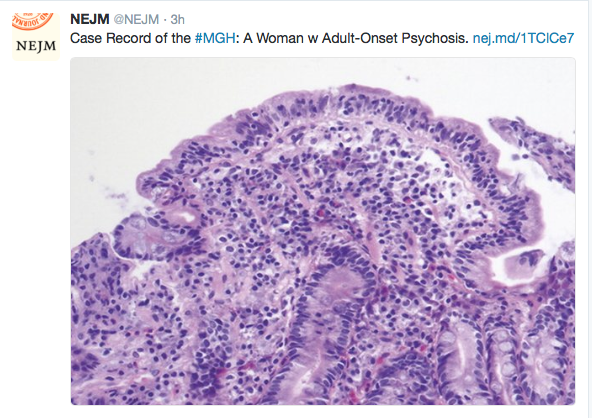
A representative case, associated with this figure of intestinal histology, of the complexity: a lady with psychosis associated with celiac disease is not adherent with her gluten free diet

A representative case of the complexity referred to in this blog post: NEJM 2016; 374: 1875-83.  This figure of intestinal histology shows damaged surface epithelium.  This is from a lady with new-onset psychosis associated with celiac disease who is not adherent with her gluten free diet