Using Ustekinumab for Crohn’s Disease

From GI & Hepatology News: New targeted Crohn’s therapy performs well in phase III trial.

This study of Ustekinumab (aka Stelara) was different than previous studies (see previous gutsandgrowth blog from 2012: Ustekinumab for Crohn’s disease) in that this study targeted patients who were NOT ant-TNF failures; however, about 80% of patients had failed corticosteroids.

An excerpt:

Ustekinumab, a monoclonal antibody targeted against interleukins 12 and 23 (IL-12 and IL-23)…

 The trial, called UNITI-2, enrolled patients with moderate to severe Crohn’s disease who had failed traditional therapies but were naive to or at least had not failed a tumor necrosis factor (TNF) inhibitor…

In UNITI-2, 628 patients were randomized to placebo, 130 mg of ustekinumab in a fixed subcutaneous dose of 130 mg, or a weight-based dose of 6 mg/kg of subcutaneous ustekinumab…The primary endpoint was a CDAI reduction of at least 100 points at 6 weeks. Clinical remission at 8 weeks, defined as CDAI less than 150, was a secondary endpoint.

The primary endpoint was reached by 28.7% randomized to placebo, 51.7% of those randomized to the fixed dose of ustekinumab, and 55.5% of those randomized to weight-based dosing. The advantage for the active treatment arms was statistically significant (both P less than .001). For the secondary endpoint of clinical remission at 8 weeks, the rates were 19.6% for placebo, 30.6% (P = .009 vs. placebo) for fixed-dose ustekinumab, and 40.2% (P less than .001 vs. placebo) for the weight-based dose…

Ustekinumab was well tolerated with similar rates and types of adverse events reported in the active treatment and placebo groups.

My take: This study indicates that ustekinumab is likely to be another treatment option for patients with Crohn’s disease.
Nutrition Symposium Georgia AAP (Part 1)

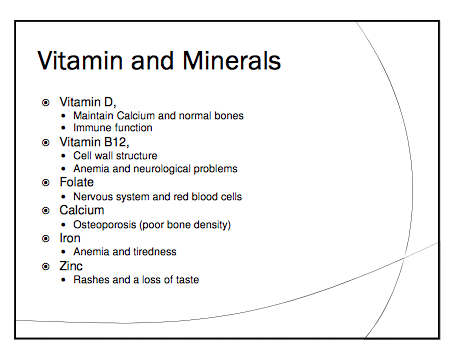
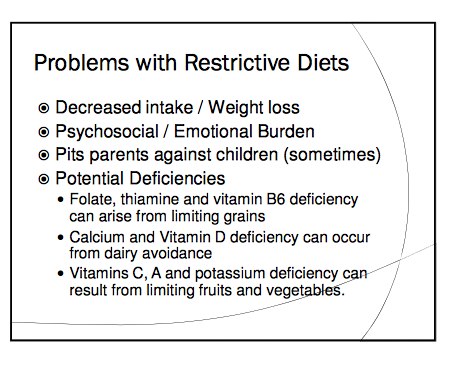
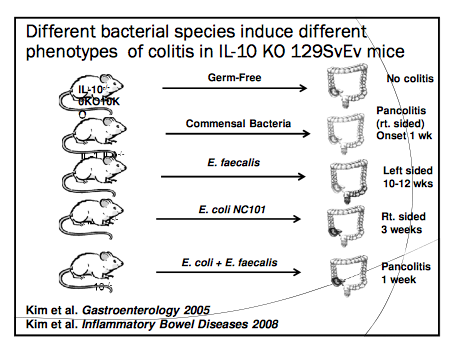
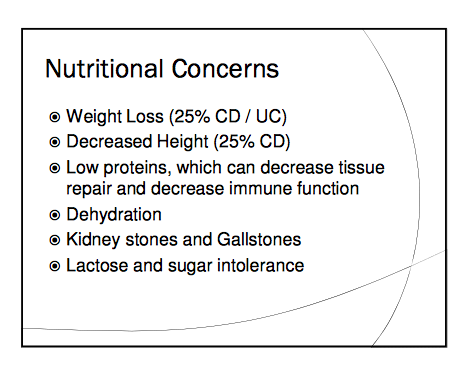
At this year’s nutrition symposium, Dr. Stan Cohen presented the latest information on nutrition and inflammatory bowel disease.  His entire presentation will be on the Nutrition4Kids website.  While I took a few pictures, my notes from his presentation were minimal, mainly because I had to give a talk afterwards.  He reviewed how the microbiome can be influenced by diet and that this in turn can result in phenotypic changes.  Specific complications from poor diet/nutrient deficiencies were discussed.  In addition, data from exclusive enteral nutrition and the specific carbohydrate diet were presented. Here are some slides from his lecture (also available at Georgia AAP Symposium Website):

Screen Shot 2015-11-13 at 5.55.55 PM

Screen Shot 2015-11-13 at 5.57.12 PM

Screen Shot 2015-11-13 at 5.57.27 PM

Screen Shot 2015-11-13 at 6.01.10 PM

Related blog posts:


Why the Genetics of Inflammatory Bowel Diseases Matter Now

A terrific update on the genetics of inflammatory bowel diseases (DPB McGovern, S Kugathasan, JH Cho. Gastroenterol 2015; 149: 1163-76) explains why and how this information matters right now.  The article is a little difficult to read due to its review of highly technical material.

Here’s what I think were the key points:

  • Big advances in understanding the genetics started with the first genome-wide association studies (GWAS) using genome-wide single nucleotide polymorphisms (SNP) chips in 2005.  “The conceptual basis of GWAS is that most complex (ie, not single-gene Mendelian) genetic disorders are polygenic, being driven by multiple common genetic polymorphisms.”
  • “Early GWAS identified the most significant loci.”  Now, more than 200 loci associated with IBD have been identified with GWAS and Immunochip data. Table 1 lists these loci over 4 pages.  About 2/3rds of these are associated with Crohn’s disease (CD) and ulcerative colitis (UC) whereas the remaining 1/3rd are unique to either CD or UC.
  • These loci provide insight into disease mechanisms. NOD2 mutations result in “impaired activation of NF-κB” This supported “the general concept that deficiencies of innate immune cell function represent a central factor in Crohn’s disease, distinguishing it from ulcerative colitis.”
  • ATG16L1 gene mutation “establish the fact that the CD risk allele is correlated with impaired autophagy.”  This is leading directly into treatment efforts.
  • IL23R.  “The most significant association is Arg381Gln…confers a 2- to 3-fold protection against development of IBD.”  The protective effect is thought to be due to “decreased numbers of interleukin (IL)-23 dependent CD4+ Th17 and CD8+ Tc17 cells…decreasing IL-23 signaling, such as through monoclonal antibody blockade of anti-p40 or anit-p19 may be beneficial.”
  • FUT2 mutations.  These mutations affect the mucus layer in Crohn’s disease.
  • Studies in non-Caucasians highlight other susceptibility regions.
  • “Currently, sequencing of the whole exome has become not only a practical method but also a cost-effective option to identify functionally relevant variants in the protein encoding regions of the genome.”

Very Early Onset IBD:

  • Whole exome sequencing (WES) identified XIAP (X-linked inhibitor of apoptosis) in a case of boy with very early onset (VEO) IBD.  XIAP is a positive regulator of NOD2 function.  WES has also identified FOXP3, and IL10RB genes.
  • “The VEO group experiences a more severe disease course and more frequently shows a positive family history for IBD in support of higher genetic load.”  Table 2 lists ~40 genes associated with VEO.  These genes are involved in epithelial barrier function, neutropenia/defects in phagocyte function, hype-and autoinflammation, and  regulatory T cells and immune regulation.

Genetic Testing Will Impact Current Therapies and Help Explain Extraintestinal Manifestations:

  • Currently testing for TPMT variations is recommended prior to use of thiopurines due to concerns of toxicity in individuals with decreased metabolism of these medications.  However, genetic testing can identify other individuals with propensity to leukopenia (eg. NUDT15 polymorphism) and those with increase risk for pancreatitis (eg. HAL-DQA1-HLA-DRB1)
  • Primary Sclerosing Cholangitis (PSC) is associated with numerous genetic loci as well. PSC “genetically is more similar to UC than to CD.” Most other extraintestinal manifestation studies have been underpowered.
  • IBD share more genetic similarity to spondyloarthropathy (SpA) than any other immune-mediated diseases.  “The vast majority of shared susceptibility loci are concordant between IBD and SpA.”
  • With regard to psoriasis, the genetic relationship to IBD is complex.  Anti-TNF agents can cause psoriaform lesions in IBD patients.  In addition, anti-IL17a therapy, “so successful in psoriasis, appears to worsen Crohn’s disease” but not in those with a TNFSF15 variant.  Specific genotyping may help identify which patients with CD are susceptible to psoriaform lesions and those who may improve with therapy typically given for psoriasis.

My take: This article shows how understanding genetics of IBD is providing insight into pathophysiology and more personalized treatment approaches.

Briefly noted: EM Stoffel, CR Boland. Gastroenterol 2015; 149: 1191-1203. Excellent review of the genetics and genetic testing for Hereditary Colorectal Cancer.  The review includes polyposis syndromes and Lynch syndrome.

Atlanta Botanical Gardens

Atlanta Botanical Gardens

What is Your Infliximab Adherence Rate?

I started thinking about this question after a recent study (DS Vitale, et al. JPGN 2015; 61: 408-10) examined adherence at a single pediatric center (2010-2012). Adherence indicated “those who attended >80% of scheduled infusions.” Key findings:

  • 91.4% adherence rate of patients (n=151 with >4 infusions)
  • Adherent patients (n=138) attended an average of 98% of their infusions. Nonadherent patients attended, on average, 76% of their infusions.
  • The study provided some preliminary evidence that there was greater acute care use in nonadherent patients.
  • There were no demographic features that could predict adherence pattern.

My take: One of the key advantages of infusion therapy is improved and documented adherence.  Infusions also provide opportunities to assess patient in a scheduled manner. This study shows that subsets of patients with scheduled infusions have suboptimal adherence  — another target for quality improvement!

Atlanta Botanical Gardens, Bruce Munro Exhibit

Atlanta Botanical Gardens, Bruce Munro Exhibit


Be Aggressive! Treating Anemia Associated with Inflammatory Bowel Disease

A number of recent publications have made the point that anemia is a biomarker for severe inflammatory bowel disease and undertreatment affects quality of life. Reading one of the more recent studies (IE Koutroubakis et al. Clin Gastroenterol Hepatol 2015; 13: 1760-66) brought to mind the high school football cheer: Be Aggressive!

This particular retrospective study involved 410 patients (245 with Crohn’s disease, 165 with ulcerative colitis) from 2009-2013.  This study is from the same group that published data on a somewhat smaller cohort and showed that IBD treatment alone often will not resolve anemia (Koutroubakis, IE et al. Inflamm Bowel Dis 2015; 21: 1587-93–see previous blog links).

Key findings:

  • Prevalence of anemia: 37.2% in 2009 and 33.2% in 2013
  • Anemia was associated with increased hospitalizations (P<.01), clinic visits (P<.001), telephone calls (P<.004), surgeries for IBD (P=.001), and lower quality of life scores (P<.03)

The associated editorial (pgs 1767-69) suggests that IBD-related anemia, if mild (w/in 1 g/L below normal) to treat with oral iron replacement and if moderate-to-severe, then to replace intravenously (using Ganzoni’s formula calculator). In addition, if anemia is not improving, looking for alternative explanations (e.g. vitamin B12 or folate deficiency) is recommended.

Ganzoni Equation: Total Iron Deficit = Weight {kg} x (Target Hb – Actual Hb) {g/l} x 2.4 + Iron stores {mg}.   Iron stores: { 500 if W > 35kg } & { 15 mg/kg if W < 35kg }

My take: Anemia is a biomarker for severe disease.  While treating the underlying inflammatory bowel disease, don’t forget to make sure the patient’s anemia is addressed.

Related blog posts:

Disclaimer: These blog posts are for educational purposes only. Specific dosing of medications/diets (along with potential adverse effects) should be confirmed by prescribing physician/nutritionist.  This content is not a substitute for medical advice, diagnosis or treatment provided by a qualified healthcare provider. Always seek the advice of your physician or other qualified health provider with any questions you may have regarding a condition.

Central Park

Central Park

Should All Pediatric Patients with Crohn’s Disease Continue Combination Therapy?

Among patients/families who are not in denial about their inflammatory bowel disease, especially Crohn’s disease, an important discussion is the use of combination therapy.  This has been discussed on this blog before (see some links below).  More data on this subject has been published and again favors the use of combination therapy (V Grossi, T Lerer, et al. Clin Gastroenterol Hepatol 2015; 13: 1748-56).

This study collected data from 2002-2014 on 502 children who participated in a prospective multicenter study. This data was derived from an observational registry rather than a randomized trial, but likely reflects real-world experience with regard to newly diagnosed patients. The authors excluded those with prior biologic therapy and prior resectional surgery.

KEY FINDINGS:

  • Children receiving combination immunomodulator (IM) treatment were more likely to have durable infliximab therapy at 1 year, 3 years, and 5 years.
  • Greater length of concomitant IMs was associated with better durability.
  • For patients who had IM > 6 months after starting infliximab (n=194), durability was 0.70 at 5 years compared with 0.55 for patients with IM <6 months (n=144), and 0.48 for those who did not receive IMs (n=135).
  • In boys, methotrexate appeared to be superior to thiopurines (P<.01): 0.98 at 5 yrs compared with 0.58.  However, there were 60 males receiving methotrexate.  In the study, only 21 females received methotrexate which limited any conclusions.

Among patients who stopped IFX, the reasons included loss of response (n=61, 43%), hypersensitivity reaction (n=41, 29%), elective (n=25, 18%), lost to f/u (n=5, 3%), and other causes (10, 7%).

The “right” dose of methotrexate as a combination agent remains unclear.  There was a wide range of dosing schedules in this study.  It is worth observing that the COMMIT study in adults found no significant difference in adults who received methotrexate in addition to infliximab compared with those receiving infliximab monotherapy.

Take-home message: In this large pediatric observational study, the use of immunomodulators increased the likely durability of infliximab.  Given prior conflicting data (particularly with regard to methotrexate), even more studies are needed to determine exactly how useful combination therapy is and when monotherapy will suffice.  From my viewpoint, I worry much more about loss of efficacy to infliximab than I worry about medication adverse effects.  As such, I will continue to inform families that combination therapy appears to improve infliximab durability.

Related blog posts:

Mount Washburn, Yellowstone

Mount Washburn, Yellowstone

1000th Tweet: GI Symptoms Preceding IBD Diagnosis

Another milestone for this blog: since 2012, the blog has been publicized on twitter; this is the 1000th tweet. It is also 1314th blog post over nearly 4 years.

A recent study (H Singh et al. Clin Gastroenterol Hepatol 2015; 13: 1302-09) indicates that children with inflammatory bowel disease (IBD) were more likely to have gastrointestinal symptoms in each of the 4 years before the diagnosis of IBD than children without IBD.

In this study, the researchers identified all children with IBD from a population-based Manitoba database; Manitoba had a population of 1.27 million in 2012.  651 children were matched with 5950 controls without IBD.  The study’s Table 1 & 2 indicates that children with IBD had increased clinic visits prior to diagnosis:

  • 54-66 months prior: standardized rate ratio for number of ambulatory visits 1.15; & for ≥1 visit due to GI symptoms odds ratio 1.44
  • 42-54 months prior: standardized rate ratio for number of ambulatory visits  1.22; & for ≥1 visit due to GI symptoms odds ratio 2.05
  • 30-42 months prior: standardized rate ratiofor number of ambulatory visits 1.19; & for ≥1 visit due to GI symptoms odds ratio 2.16
  • 18-30 months prior: standardized rate ratio for number of ambulatory visits 1.23; & for ≥1 visit due to GI symptoms odds ratio 2.93
  • 6-18 months prior: standardized rate ratio for number of ambulatory visits  1.15; & for ≥1 visit due to GI symptoms odds ratio 5.23

There was not a clear trend in increased symptoms between those who developed Crohn’s disease compared with Ulcerative Colitis. In addition, the study noted a trend towards decreased colectomy and resective surgery in Crohn’s in the time period 2002-2010 compared with 1987-2001.  One limitation of this study is the few number of pediatric gastroenterologists in Manitoba (only 1 before 2003); the lack of pediatric gastroenterology availability could impact timely diagnosis.

My take: This data shows that GI symptoms still predate diagnosis in many children and indicate a potential for diagnosis delay. The authors note that noninvasive tools like stool calprotectin have not been widely adopted (at least in Manitoba) and could be helpful in reducing diagnostic delays.

Estes Park, Colorado

Estes Park, Colorado

Head-to-Head: Nutritional Therapy versus Biological Therapy in Pediatric Crohn’s Disease

The best data to date: D Lee et al. Inflamm Bowel Dis 2015; 21: 1786-93. In this prospective study, the authors studied treatment initiation in children (N=90), comparing partial enteral nutrition (PEN, n=16), exclusive enteral nutrition (EEN, n=22), and anti-TNF therapy (n=52).

Results:

  • Clinical response, defined by PCDAI reduction ≤15 or final PCDAI ≤10, was achieved by 64% PEN, 88% EEN, and 84% anti-TNF.
  • Fecal calprotectin ≤250 noted in 14% PEN, 45% EEN, and 62% anti-TNF

Because of the discrepancy between EEN and PEN, the authors speculate that the “efficacy of EEN may be a consequence of elimination of table food rather than providing a uniquely therapeutic method of delivering nutrients.”  They note that “choice of formula has not impacted the efficacy of enteral nutrition.”

More extensive information on this subject: D Lee et al. Gastroenterol 2015; 148: 1087-1106.

Bottomline: Anti-TNF therapy was as effective or more effective than EEN. And, “for patients who prefer treatment with a nutrition-based therapy, EEN seems superior to PEN.”

Related blog posts:

Street Art, NYC

Street Art, NYC

Not Using and Stopping Therapy in IBD

Two recent articles show that a lot of patients are not receiving much therapy in inflammatory bowel disease.

  • Moreno-Rincon E et al. Inflamm Bowel Dis 2015; 21: 1564-71.
  • Melesse DY et al. Inflamm Bowel Dis 2015; 21: 1615-22.

In the first article, a multicenter retrospective study of 102 patients, the authors examined the relapse rates of patients with ulcerative colitis who had withdrawal of thiopurines.  They defined “significant clinical relapse” (SCR) as “the occurrence of UC typical signs or symptoms requiring a rescue therapy such as oral or intravenous corticosteroids, biological therapy, immunosuppressant drugs, recapture with TP [thiopurine] or surgery.”

Key findings:

  • Overall SCR was 32.35%.
  • Predictors of relapse included pancolitis (HR 5.01) and duration of treatment with thiopurines (HR 0.15).

Among those without relapse, the mean duration of remission prior to withdrawal of thiopurines was 54 months compared with 34 months in those who relapsed. In figure 2, the authors note that the rate of relapse was 19.2% for those who received >48 months of thiopurine treatment compared with a 45% rate of relapse for those who received treatment for 13-47 months.  The authors note that several studies have shown higher relapse rates than reported in this cohort and that interruption of therapy is associated with a considerable risk of relapse.

Limitations: small retrospective study and the expectation that their SCR would capture the true relapse rate.

The second study, using a Manitoba database, shows a strikingly-high rate of nonuse of medical therapy. Between 1996-2012, 3902 patients with IBD were identified; 47% with Crohn’s disease (CD) and 53% with ulcerative colitis (UC).  While only 11.7% of IBD patients did not have medication dispensed in the first year after diagnosis, beyond this period, “roughly half of all patients with IBD have not used IBD-specific medications in the previous year.”  The authors are not certain how much nonuse is due to nonadherence or nonprescription. They note that there was higher nonuse in patients with CD, possibly due to use of surgical treatment.  However, they note that multiple medications have been shown to reduce postsurgical relapse in CD.

My take: There are a lot of patients off therapy, both due to withdrawal of therapy when doing well and others due to nonadherence or nonprescription.  With or without overt symptoms, these studies make one wonder whether undertreatment will lead to long-term complications or whether there could be a significant number of patients who are overtreated.  Either way, it remains quite difficult to predict which patients will do well off medical therapy.

Broadcasters Really Know the Key Points to Winning!

Broadcasters Really Know the Key Points to Winning!

Is It Right? Anti-TNF Therapy Does Not Fix IBD-Related Anemia

A surprising study (Koutroubakis, IE et al. Inflamm Bowel Dis 2015; 21: 1587-93) of prospectively-collected data from 430 patients with inflammatory bowel disease (IBD) showed that the rate of anemia did not change after 1 year in patients treated with anti-tumor necrosis factor (anti-TNF) therapy and oral iron.

The data was derived from 2010-2012 and included 324 patients with Crohn’s disease (51.6% females) with a median age of 41 years.  Anemia was defined as hemoglobin (Hb) <13 g/dL in men and <12 g/dL in women.  Patients with Hb <10 g/dL were considered to have severe anemia. Key findings:

  • Prevalence of anemia in IBD patients treated with anti-TNF was 38.1% at baseline and then 36.6% at 1 year.
  • Severe anemia was identified in 10% at baseline and 9.9% at 1 year.
  • A hematopoietic response with a Hb ≥2 g/dL was observed in 33.6% (n=45 of 134 anemic patients) and 14 (40%) of those with severe anemia.
  • There were 45 new anemic patients at 1 year; 64.4% were nonresponders to anti-TNF treatment.
  • Using multivariate logistic regression analysis, the author noted that use of immunomodulators was associated with an odds ratio of 2.56 of improvement in hemoglobin levels.

The authors state that anemia is the most common extra intestinal manifestation of IBD and remains underappreciated.  Anemia in IBD correlates with the extent of intestinal disease and activity.

Bottomline: “Use of anti-TNF therapy had only a modest effect on patients’ Hb level.”

From related post: IBD Update January 2015 (Part 2)

Inflamm Bowel Dis 2014; 20: 2266-70.  This study with 749 patients from Sweden showed that a large number of inflammatory bowel disease patients did not receive with iron supplementation: “Only 46% of patients with anemia were treated with iron supplementation or blood transfusion.”  This study showed frequent persistence of anemia one year after diagnosis, especially in children. At time of diagnosis, 55% of children and 27% of adults had anemia and 28% and 16% at one year followup, respectively.

My take: Treatment of the underlying IBD, often helps anemia.  However, in some patients treating the anemia with iron may help improve symptoms as much or more than other aspects of treatment.

Related blog post: Microcytic Anemia Review | gutsandgrowth

Sandy Springs, Georgia

Sandy Springs, Georgia