Microbial Signature in Crohn’s

This recent study (summarized in earlier post today/Dr. Barnard’s talk) provides more information on the microbiome in patients with pediatric Crohn’s.  Here’s a link to full article: Specific transcriptome and microbiome signature in pediatric Crohn’s   Here’s the abstract:

Interactions between the host and gut microbial community likely contribute to Crohn disease (CD) pathogenesis; however, direct evidence for these interactions at the onset of disease is lacking. Here, we characterized the global pattern of ileal gene expression and the ileal microbial community in 359 treatment-naive pediatric patients with CD, patients with ulcerative colitis (UC), and control individuals. We identified core gene expression profiles and microbial communities in the affected CD ilea that are preserved in the unaffected ilea of patients with colon-only CD but not present in those with UC or control individuals; therefore, this signature is specific to CD and independent of clinical inflammation. An abnormal increase of antimicrobial dual oxidase (DUOX2) expression was detected in association with an expansion of Proteobacteria in both UC and CD, while expression of lipoprotein APOA1 gene was downregulated and associated with CD-specific alterations in Firmicutes. The increased DUOX2 and decreased APOA1 gene expression signature favored oxidative stress and Th1 polarization and was maximally altered in patients with more severe mucosal injury. A regression model that included APOA1 gene expression and microbial abundance more accurately predicted month 6 steroid-free remission than a model using clinical factors alone. These CD-specific host and microbe profiles identify the ileum as the primary inductive site for all forms of CD and may direct prognostic and therapeutic approaches.

From Cincinnati Children’s Pediatric Insights (summary of findings):

“The discovery of specific bacterial populations and a core gene signature associated with Crohn’s disease could lead to new diagnostic testing and improved treatment for inflammatory bowel disease (IBD), according to a study led by researchers at Cincinnati Children’s.

‘This study identifies a set of bacteria that are associated with symptoms, and a group of anti-inflammatory genes that are associated with intestinal damage in children with Crohn’s disease,’ says Lee (Ted) Denson, MD, Medical Director of the Inflammatory Bowel Disease Center, senior investigator for the study, published online July 8 in the Journal of Clinical Investigation. Yael Haberman Ziv, MD, was the study’s first author.

Denson’s team studied tissue samples from the ileum, the lowermost portion of the small intestine, in a large number of children with Crohn’s disease. They found specific types of bacteria and a “core” gene expression signature, both of which appear to affect inflammatory changes in the gut. Certain genes in the core signature appeared to be specifically associated with intestinal damage from deep ulcers.”


Basic Science Year in Review –#NASPGHAN 2014

John Barnard –Basic Science Year in Review

“Emerging Trends and Provocative Findings in Basic Science”

This blog entry has abbreviated/summarized this terrific presentation. Though not intentional, some important material is likely to have been omitted; in addition, transcription errors are possible as well.  To minimize these issues, I have placed a link to most of Dr. Barnard’s slides which he shared:

2014 John Barnard Slides

“Big Data” –big increase in “big data” cited in pubmed over past year.

  • Good read on this subject: Foreign Affairs: The Rise of Big Data Kenneth Cukier

Scientific fraud –more attention to this issue this past year. Two papers in Nature were retracted. One researcher committed suicide and one arrested. Scientific fraud undermines important messages & ruins credibility of other important advances.

CRISPR-Cas9: Gene editing.  CRISPRs –“RNA guides”  Cas9: “molecular scissors” (endonucleases)

“Genome editing has never been easier.”  Examples:

  • Cell Stem Cell 2013: 13: 653-58. “Functional repair of CFTR by CRISPR-Cas9”
  • Also, genome editing has been used in mouse model of tyrosinemia.

Liver regeneration in zebrafish. Implication: Liver cells will be regenerated in humans. Gastroenterol 2014; 146: 789.

Microbiome Big Data:

  • J Clin Invest 2014; 124: 3617. This was a very important and complex study.  The slides explaining this study start at slide 35.
  • Pediatric Crohn disease exhibit specific ileal transcriptome and microbiome signature.
  • RISK study (CCFA). Treatment-naïve, 28 sites.
  • 1281 ileal host genes in ileocolonic Crohn’s, 1055 in Colonic Crohn’s had ileal host genes =82% similar, 232 host genes in ulcerative colitis –18% similar to ileocolonic Crohn’s.
  • Tissue microbiomes are where changes are noted; changes are not evident in luminal microbiome.
  • Antibiotics worsen dysbiosis.
  • Microbiome at diagnosis strongly correlates with Crohn’s disease.

Microbiome –affects the entire body:

  • J Clin Invest 2014; 124: 3391. Incorporation of microbes with genetically-engineered E coli can prevent obesity in mice

Recommended Reading by Dr. Barnard: “Missing Microbes” How the overuse of antibiotics is fueling our modern plagues. Martin Blaser


NASPGHAN Awards 2014

I wanted to congratulate/recognize this year’s awardees at NASPGHAN and to summarize some of the associated presentations.

This blog entry has abbreviated/summarized the presentations. Though not intentional, some important material is likely to have been omitted; in addition, transcription errors are possible as well.

Major Awards:

  1. Harry Shwachman Award: Peter Whitington (Children’s Hospital of Chicago) This award is given for major life long scientific contribution to the field of pediatric gastroenterology.
  2. Distinguished Service Award: Melvin Heyman (UCSF Division Chief and JPGN editor). This award is given for excellence and service in the field of pediatric gastroenterology.
  3. AAP Murray Davidson Award: Jeffrey Hyams (Division Chief Connecticut Children’s)This award is given to an outstanding clinician, scientist and educator.

Fellow Research Award: “Bile Acid Signatures in Children Confer Protection From Clostridium Difficil Infection” ME Tessier et al (Baylor College of Medicine). Conclusions: Stool bile acids profiles are different in children with C difficile infection and could be a predisposing factor.  C diff toxins may alter bile acid profiles via inducing epithelial FGF-19 production.

Young Investigator Award “Analysis of Candidate Genes by Whole Exome Sequencing in Very Early-Onset IBD” J Kelsen (CHOP), et al. VEO-IBD cohort. Excellent presentation! (Related blog post: Just the Beginning: Mutations in Very Early Onset ..)

  • Children <5 years/extensive controls.
  • Mutation Findings: IL10RA/IL21R variants, RAG2/PIK3R1 variants
  • Presentation included phenotypic description (clinical and immunity/functional analysis)
  • Gut microbiome development being studied as well
  • Trying to combine microbiome data with genomic data.

William Balistreri Prize “A Prospective Newborn Screening Study for Biliary Atresia” Sanjiv Harpavat (Baylor College of Medicine) et al.   Excellent talk!

Background: 67 infants with biliary atresia (2007-2014) on retrospective review—ALL had elevated conjugated/direct bilirubin levels in first 24-48 hours of life. (Related blog post: Diagnosing biliary atresia earlier | gutsandgrowth)

Repeat testing at 2 weeks can identify those infants that need to be followed closely.  Workup needed for those who remained abnormal at 2 weeks of life.

This algorithm was studied at 4 different hospitals in Houston with 2-12% premature infants)

In newborn period:

  • N=11,636 –121 abnormal on newborn testing (based on hospital’s normative values -usually direct bilirubin >0.4)
  • When repeated at 2 weeks: 102 of these 121 were normal/only 12 continued to test high (2 with BA, 1 A1AT, 1 Rh disease, 8 resolved).  The two patients detected with biliary atresia is in line with the expected frequency of ~1 in 5000.
  • 7 missed retesting. 3 died (congenital heart disease), 2 missed followup, 2 had PCP refuse retesting.
  • Testing results: 100% sensitivity. Good specificity with repeat testing.

Baylor Workup approach to cholestasis:

  • 3-4 day evaluation
  • Day 1: liver panel, A1AT typing, U/S, CXR
  • Days 2-4: liver biopsy/percutaneous cholangiogram, +/- Kasai

Current AAP recommendation (per Ronald Sokol) is for all infants to have fractionated bilirubin.

Take-home message: How can we diagnose every infant on time? Possibly check every infant for direct/conjugated bilirubin in first 48 hours.

Young Clinical Investigator Award: “Poop-MD: A mobile health application accurately identifies acholic stools.” Douglas Mogul

Problem of delayed diagnosis has been improved in some studies with stool color cards. With emergence of smart phones (80% of 18-35 year olds have smart phones), opportunity to identify echoic stools with new technology.

  • PoopMD. Software determines whether stool is bloody, acholic, etc. Can email doctor and place reminder. FREE app.
  • Parents takes the picture of stool and then app analyzes.
  • Pilot study with 45 initial photographs reviewed by panel of 7 pediatricians
  • When at least 6 physicians agreed on stool color as being acholic (n=7), this was tested against app
  • App: 100% sensitivity for acholic stools. 89% specificity.
  • Working on Spanish version and improved interface.

Other awards:
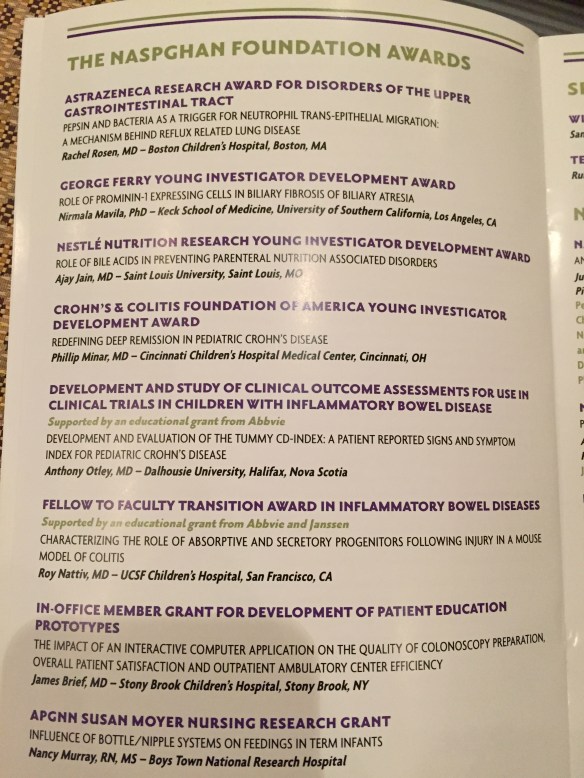
NASPGHAN Foundation Awards
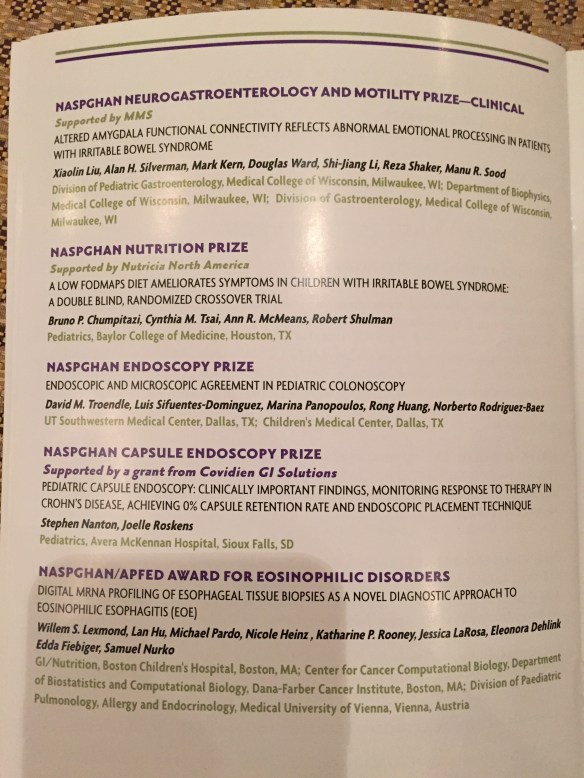
NASPGHAN Foundation Awards

Sponsored Awards

Sponsored Awards

NASPGHAN Postgraduate Course 2014 -Nutriton Module

Thanks to those who attended yesterday’s talk (10/24/14) at the clinical practice session and to those who provided helpful feedback.

This blog entry has abbreviated/summarized the presentations. Though not intentional, some important material is likely to have been omitted; in addition, transcription errors are possible as well.  If you make it to the bottom of this post, you will find some useful patient resources along with previous related blog entries.

Diet and the Microbiome –Robert Baldassano (CHOP) pg 140 in Syllabus

This was a very effective lecture; it brought together a lot of useful information.

Trying to sort out balance between health and disease and role of dysbiosis (altered microbiome)

  • Things that we ingest such as food (diet), antibiotics, and xenobiotics shape the composition of the gut microbiota and serve as substrates for the gut microbiota to produce metabolites
  • We are not the only organism consuming what we eat

Specific studies:

  • Wu G, et al. Science. 2011 Oct 7;334(6052):105-8  The Bacteroides enterotype was highly associated with animal protein and saturated fats, which equates to frequent meat consumption as in a Western diet. The Prevotella enterotype high values for carbohydrates and simple sugars, indicating association with a carbohydrate-based diet more typical of agrarian societies.
  • De Filippo C, et al. PNAS 2010: 14691-96: African children (compared with European) with more bacterial diversity & richness along with higher levels of short-chain fatty acids
  • Holmes et al. Cell Met 2012; 16: 559. Diet serves as a substrate for the microbiota to produce certain metabolites.

IBD and diet (Hou JK et al. American Journal of Gastro 2011;106:563-73)

  • High dietary intakes of total fats, PUFAs, omega-6 and meat were associated with an increased risk of CD and UC
  • High fiber and fruit intakes were associated with decreased CD risk
  • High vegetable intake was associated with decreased UC risk.
  • Consumption of meat, particularly red and processed meat increased the likelihood of relapse (Jowett et al Gut 2004)
  • Enteral diet for IBD can improve stool calprotectin within 1-2 weeks.

Take-home messages: Don’t tell your patients with non-stricturing IBD to eat a low fiber diet.  Reduced red meat and reduced oral iron may be helpful.  Vegetarian diet and Mediterranean diets may be helpful.

Related blog posts:

FODMAP: Navigating this Novel Diet –Bruno Chumpitazi, MD, MPH (Texas Children’s Hospital) -page 152 in Syllabus

  • Fermentable Oligosaccharides Disaccharides and Polyols (FODMAPs): Poorly absorbed, osmotically active, rapidly fermented (produce gas)
  • Higher FODMAPs increase breath hydrogen (Murray K et al. Am J Gastroenterol 2014;109:110-9)
  • Higher FODMAPs increase stool/ileostomy output (Barret JS et al. Aliment Pharmacol Ther 2010;31:874-882,Halmos EP J Gastroenterol Hepatol 2013;28(Suppl4):25-28)

Evidence for use of low FODMAPs diet is best in adult irritable bowel syndrome.

  • Shepherd SJ et al. Clin Gastroenterol Hepatol 2008;6:765-71
  • Staudacher HM et al J Nutr 2012;142:1510-18
  • Ong DK et al. J Gastroenterol Hepatol 2010;25:1366-1373
  • Halmos EP et al. Gastroenterology 2014;146:67-75

Limited studies in children.

  • Chumpitazi BP et al. NASPGHAN 2014 abstract n=33 pediatric IBS.  Favorable response noted to low FODMAP diet.

Dietary recommendations were reviewed along with the caveat that obtaining the assistance of a dietician/nutritionist is recommended.

Resources:

Related blog posts:

Nutrition in the Child with Neurological Disabilities –Kathleen Motil (Baylor College of Medicine) pg 162 in Syllabus

  • Nutritional disorders are highly prevalent in children with neurological disabilities: 29-46% are underweight; 8-14% are overweight.
  • Improved nutrition improves behavior, activity level, improves growth, and reduces infections.
  • Cause of nutritional disorders mostly related to inappropriate dietary intake but other factors can play a role
  • Growth/anthropometric measures are key determinant of nutritional assessment
  • Key questions: Is child taking all day to eat? Is child choking with feedings?
  • Critical BMI <12 kg/m-squared
  • Goal for BMI ~25%

Reasons for gastrostomy:

  • Flat growth >6 months/weight below curve
  • Parental request
  • Medication administration
  • Aspiration

Resource:

www.feedingtubeawareness.com  This site contains a terrific PDF download which explains enteral tubes in an easy to understand style along with good graphics. “What You Need to Know Now, A Parent’s Introduction to Tube Feeding is the guide book that every parent wished they had when they were first introduced to feeding tubes.”

Related blog posts:


Mechanism for FODMAPs diet

According to a recent study (Gut doi:10.1136/gutjnl-2014-307264 -thanks to KT Park for reference), a low FODMAPs diet changes the microbiome which in turn may relate to improvements in patients with irritable bowel syndrome.

Abstract

Objective A low FODMAP (Fermentable Oligosaccharides, Disaccharides, Monosaccharides And Polyols) diet reduces symptoms of IBS, but reduction of potential prebiotic and fermentative effects might adversely affect the colonic microenvironment. The effects of a low FODMAP diet with a typical Australian diet on biomarkers of colonic health were compared in a single-blinded, randomised, cross-over trial.

Design Twenty-seven IBS and six healthy subjects were randomly allocated one of two 21-day provided diets, differing only in FODMAP content (mean (95% CI) low 3.05 (1.86 to 4.25) g/day vs Australian 23.7 (16.9 to 30.6) g/day), and then crossed over to the other diet with ≥21-day washout period. Faeces passed over a 5-day run-in on their habitual diet and from day 17 to day 21 of the interventional diets were pooled, and pH, short-chain fatty acid concentrations and bacterial abundance and diversity were assessed.

Results Faecal indices were similar in IBS and healthy subjects during habitual diets. The low FODMAP diet was associated with higher faecal pH (7.37 (7.23 to 7.51) vs 7.16 (7.02 to 7.30); p=0.001), similar short-chain fatty acid concentrations, greater microbial diversity and reduced total bacterial abundance (9.63 (9.53 to 9.73) vs 9.83 (9.72 to 9.93) log10 copies/g; p<0.001) compared with the Australian diet. To indicate direction of change, in comparison with the habitual diet the low FODMAP diet reduced total bacterial abundance and the typical Australian diet increased relative abundance for butyrate-producing Clostridium cluster XIVa (median ratio 6.62; p<0.001) and mucus-associated Akkermansia muciniphila (19.3; p<0.001), and reduced Ruminococcus torques.

Conclusions Diets differing in FODMAP content have marked effects on gut microbiota composition. The implications of long-term reduction of intake of FODMAPs require elucidation.

Related blog posts:

“Bacterial Penetration Cycle Hypothesis”

Initially, this blog was titled: “Even More Work for Our IBD Nutritionists?”  If you get to the bottom of this post, you will know why.

A provocative study (Inflamm Bowel Dis 2014; 20: 1353-60) describes the use of partial enteral nutrition (PEN) as effective for induction of remission in children and young adults with Crohn’s disease (CD).  I’m a little wary commenting on this study as many individuals may take a glimmer of information and subject themselves to empiric trials.  In fact, a recent case report (N Engl J Med 2014; 371:668-675) described an adult who without medical advice used fecal transplant therapy (obtained from spouse and infant) to self-treat his ulcerative colitis.  In the case report, this patient ultimately was diagnosed with a secondary cytomegalovirus (CMV) infection and the fecal transplant was not effective.

With regard to the PEN study, the authors treated 47 patients (34 children) with up to 50% of their diet as a polymeric formula (Modulen or Pediasure) along with dietary counseling/changes.  The authors note that CD “may arise from a sequence of events involving changes in the microbiome, intestinal permeability leading to bacterial adherence or penetration of the epithelium, and subsequent stimulation of the adaptive immune response leading to tissue damage.  We have termed this sequence the Bacterial Penetration Cycle Hypothesis.”  Given the compelling improvements noted with exclusive enteral nutrition (EEN), the authors sought to modify the diet after an initial clinical response in two patients who could not adhere to EEN.

Design: Strict diet for 6 weeks with 50% of calories from formula, then less restricted diet for next 6 weeks (25% of calories from formula).  Also, diet required exclusion of gluten, dairy, animal fat, processed meats, products containing emulsifiers, candies, chocolates, gum, packaged snacks, sauces, and canned goods.  A more extensive listing of the foods is given in the appendix (page 1360).  The authors measured the clinical response with PCDAI, Harvey Bradshaw index, and bloodwork (eg. CRP, ESR, albumin, and hemoglobin).

Key finding:

  • 33 (70.2%) achieved a remission on this PEN diet; 78.7% (n=37) had a clinical response.
  • Normalization of CRP occurred in 21 of 30 patients (70%) of those with a clinical remission.

Take home message: A PEN diet needs more study.  I would not advise someone to radically change their diet without the instruction of a qualified nutritionist, unless the individual wants to be another case report of something gone awry.

Related Blog Posts:


Missing Bacteria in Refractory Malnutrition

A recent article in the NY Times reports on a Nature study (Link: Bacteria and Malnutrition) which showed that certain bacteria were essential in resolving malnutrition.  Here is an excerpt:

“When children are starving, the bacteria that live in their intestines may determine whether they can be saved, scientists working in Bangladesh are reporting. And they say it may become imperative to find a way to give children bacteria as well as food.

The study, done by researchers from Washington University School of Medicine in St. Louis and the International Center for Diarrheal Disease Research in Dhaka, the Bangladeshi capital, was published by Nature last week…stool samples showed that severely malnourished children often lack the needed species and do not acquire them even when they are fed nutrition-dense therapeutic foods like the peanut-based Plumpy’Nut or lentil-based porridges for weeks. As a result, they may remain stunted and mentally handicapped although they are getting enough calories to live.“

Another “chilling” story from NY Times describes E.P.R. (Link: “Emergency Preservation and Resuscitation“) which involves rapidly chilling catastrophic trauma victims by draining their blood and replacing with cold salt water.  This has the potential to dramatically improve survival and has been effective in animal models.

Related blog posts:

More on Gut Microbiome and Crohn Disease

Earlier this week on NPR there was a story summarizing the altered microbiome in Crohn disease and a related recent paper; here’s the link: Mix Of Gut Microbes May Play Role In Crohn’s Disease.  Other media outlets covered the story too:

The graphical abstract (Cell Host & Microbe, Volume 15, Issue 3, 382-392, 12 March 2014) is noted below:

Graphical Abstract

The link to the full study is listed below if you want to see the source article.  The amount of data that is presented is impressive but easy to follow with the figures:

Full link to article (from Kipp Ellsworth twitter feed): http://goo.gl/603Rbz 

Related blog posts:

Probiotics For Fatty Liver Disease

Probiotics and alterations in the microbiome are being examined for a range of ailments.  However, as noted in previous blog posts, the current evidence shows only a limited number of disorders where probiotics have been proven effective.  There is more evidence, now, that probiotics may be beneficial for nonalcoholic fatty liver disease (NAFLD).

  • Am J Clin Nutr 2014; 99: 425-6. editorial
  • Am J Clin Nutr 2014; 99: 535-42.

The referenced article examined 52 nondiabetic patients with fatty liver disease in a double-blind, randomized, placebo-controlled trial. Patients were considered to have NAFLD on the basis of an ultrasonography and an alanine aminotransferase value >60 U/L.  Those who received a probiotic were compared with a placebo group and followed for 28 weeks.

In this study, rather than a probiotic, technically, the treatment group received a synbiotic because it contained fructooligosaccharides (FOS) which are non digestible oligosaccharides in addition to a probiotic mixture.  FOS can stimulate the growth of intestinal bacteria.  The probiotic mixture included Lactobacillus case, Lactobacillus rhamnosus, Streptococcus thermopiles, Bificobacterium breve, Lactobacillus, acidophilus, B. longum, and Lactobacillus bulgaricus.

Key findings:

  • There were improvements in ALT values and in baseline mild fibrosis (estimated by Fibroscan).
  • There were decreased levels of circulating TNF-α and decreased nuclear transcription factor κβ in circulating mononuclear leukocytes –both consistent with decreased systemic inflammation

Limitations: 

  1. Study did not include liver histology (biopsy).  In addition, in nearly all subjects, the fibroscans were near normal, both before and after the intervention.  Thus, the reduction in liver stiffness is not clear cut.
  2. Small number of participants.
  3. Short study period.

Bottomline: This study along with several others points towards a potential role for modulating the microbiome to improve NAFLD along with metabolic syndrome more broadly.

Related blog posts: