Latest on Tofacitinib for Refractory Ulcerative Colitis

From Gastroenterology & Endoscopy News July 2016: Tofacitinib Effective in Refractory and Severe UC

An excerpt:

Tofacitinib (Pfizer), an oral agent already approved for certain patients with rheumatoid arthritis, can induce clinical remission in up to 25% of individuals with moderate to severe, refractory ulcerative colitis (UC) and clinical response in as many as 60% of these patients.

The results, based on two placebo-controlled trials involving more than 1,100 patients, showed the drug also increased the risk for serum lipid elevations but was otherwise safe. Researchers presented the data at the 2016 annual meeting of the European Crohn’s and Colitis Organization (ECCO; oral presentation 019)…

The new data are from the OCTAVE Induction 1 and Induction 2 trials, identically designed, randomized, double-blind and placebo-controlled Phase III studies…In the OCTAVE 1 trial, 476 patients received 10 mg of tofacitinib orally twice daily for eight weeks and 122 received an oral placebo. In OCTAVE 2, 429 and 112 patients were randomized to receive the two regimens, respectively.

Screenshot from gastroendonews.com

Screenshot from gastroendonews.com

Also from Gastroenterology & Endoscopy News August 2016: Update on Diagnosis and Treatment for Ulcerative Colitis  This article provides a succinct summary regarding diagnosis and treatments of ulcerative colitis; treatments discussed include emerging therapies like tofacitinib.
 

An Overlooked Finding in a Recent Acute Severe Ulcerative Colitis Study

A recent study (S Choshen et al. JPGN 2016; 63: 58-64) examined 283 children who were treated with IV steroids for acute severe ulcerative colitis.  This study focused on steroid dosing.  Their conclusion: “there does not seem to be a consistent superiority of high dose (>2 mg/kg/day) versus standard (1.25 mg/kg/day) or low-dose (1 mg/kg/day) methylprednisolone in pediatric acute severe colitis.”

Before looking into the details a little closer, one finding that was not even discussed in the abstract or discussion was the colectomy rate of 31%.  Previous pediatric studies of patients with ulcerative colitis had found rates generally half that rate but notably included patients with milder presentations of ulcerative colitis.  Thus, this rate of 31% (by 1 year after discharge) is useful information to reference when considering pediatric patients with acute severe colitis (ACS).

This study used datasets from the prospective Outcome of Steroid therapy in Colitis Individuals (OSCI) (n=128) and from the retrospective OSCI study (n=99).

Other results:

  • By day 5 of steroids, 45% had at most mild disease (ie PUCAI <35)
  • 31% had failed IV steroids and required salvage therapy (biologic or calcineurin inhibitor)
  • 20% had colectomy by discharge
  • When examining steroid dosage and outcomes, the authors could not discern any differences in need for salvage therapy, PUCAI <35 at day 5, or need for salvage therapy within 1 year. There was a mild difference in length of stay with 9 days in the low-dose group and 10-days in the high dose group.

My take: This large cohort provides some reassurance that current steroid dosing recommendations are probably right, in that there was no discernible improvement with higher doses.  This is in agreement with previous studies in adults which have not shown advantages of methylprednisolone >60 mg/day.  The high colectomy rate of 31% is worth keeping in mind in this population.

Related blog posts:

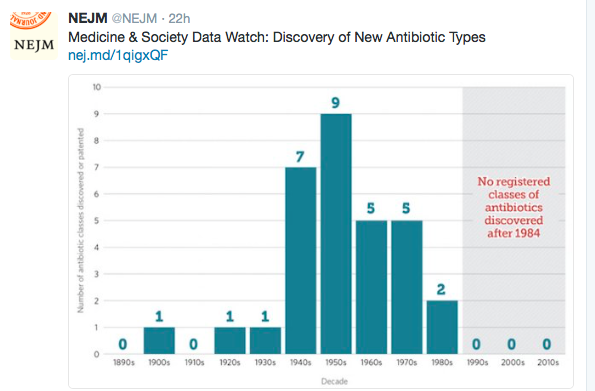
NewAbxDiscovered


IBD School Videos for Patients and Families

While these “IBD School” YouTube videos have been around for several years, I only became aware of them in the past few months.  I think they are good patient education resources.

Here are some links to a few of them:

There are a lot of these videos including the following:

My take: these videos are generally ~4 minutes and a good way to get a lot of information on IBD pretty quickly.

Screen Shot 2016-05-31 at 4.48.09 PM

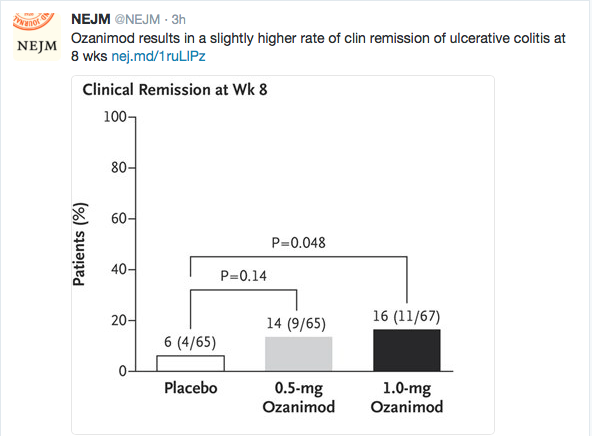
Ozanimod for Ulcerative Colitis

The results of a phase 2 trial for Ozanimod have been published: WJ Sandborn et al. NEJM 2016; 374; 1754-62.

Ozanimod (RPC1063) is “an oral agonist of the sphingosine-1-phosphate receptor subtypes 1 and 5 that induces peripheral lymphocyte sequestration, potentially decreasing the number of activated lymphocytes circulating to the gastrointestinal tract.”

From the abstract:

METHODS

We conducted a double-blind, placebo-controlled phase 2 trial of ozanimod in 197 adults with moderate-to-severe ulcerative colitis. Patients were randomly assigned, in a 1:1:1 ratio, to receive ozanimod at a dose of 0.5 mg or 1 mg or placebo daily for up to 32 weeks. The Mayo Clinic score was used to measure disease activity on a scale from 0 to 12, with higher scores indicating more severe disease; subscores range from 0 to 3, with higher scores indicating more severe disease. The primary outcome was clinical remission (Mayo Clinic score ≤2, with no subscore >1) at 8 weeks.

RESULTS

The primary outcome occurred in 16% of the patients who received 1 mg of ozanimod and in 14% of those who received 0.5 mg of ozanimod, as compared with 6% of those who received placebo (P=0.048 and P=0.14, respectively, for the comparison of the two doses of ozanimod with placebo). Differences in the primary outcome between the group that received 0.5 mg of ozanimod and the placebo group were not significant; therefore, the hierarchical testing plan deemed the analyses of secondary outcomes exploratory. Clinical response (decrease in Mayo Clinic score of ≥3 points and ≥30% and decrease in rectal-bleeding subscore of ≥1 point or a subscore ≤1) at 8 weeks occurred in 57% of those receiving 1 mg of ozanimod and 54% of those receiving 0.5 mg, as compared with 37% of those receiving placebo. At week 32, the rate of clinical remission was 21% in the group that received 1 mg of ozanimod, 26% in the group that received 0.5 mg of ozanimod, and 6% in the group that received placebo; the rate of clinical response was 51%, 35%, and 20%, respectively. At week 8, absolute lymphocyte counts declined 49% from baseline in the group that received 1 mg of ozanimod and 32% from baseline in the group that received 0.5 mg. The most common adverse events overall were anemia and headache.

CONCLUSIONS

In this preliminary trial, ozanimod at a daily dose of 1 mg resulted in a slightly higher rate of clinical remission of ulcerative colitis than placebo. The trial was not large enough or of sufficiently long duration to establish clinical efficacy or assess safety. (Funded by Receptos; TOUCHSTONE ClinicalTrials.gov number, NCT01647516.)

Ozanimod

Related blog post: CCFA Conference Notes 2016 (part 5) -Emerging Therapies …


More on Anti-TNF Drug Levels (part 2) and a Few Mentions

Another study (K Papamichael et al. Clin Gastroenterol Hepatol 2016; 14: 543-9) examined therapeutic drug levels with regard to infliximab induction and mucosal healing.

In this retrospective study with 101 patients with ulcerative colitis, 54 (53.4%) achieved mucosal healing between weeks 10-14, defined by a Mayo endoscopic score of 0 or 1.  97% of patients were treated with 5 mg/kg infusions.

Key finding:

  • Infliximab threshold concentrations of 28.3 mcg/mL at week 2, 15 mcg/mL at week 6, and 2.1 mcg/mL at week 14 were associated with mucosal healing.

My take: While this study provides information on what type of levels to expect at 2, 6, and 14 weeks, what is really important is figuring out which patients need higher doses of infusions from the start.

Unrelated, briefly noted:

R Yadlapati et al. Clin Gastroenterol Hepatol 2016; 14: 535-42. In this prospective blinded cohort study of 59 subjects, oropharyngeal pH testing (Restech Dx-pH) and salivary pepsin analysis was not able to distinguish between healthy volunteers and subjects with a combination of laryngeal and reflux symptoms.

M Moris et al. Clin Gastroenterol Hepatol 2016; 14: 585-93. This study reports increasing findings of small pancreatic cysts with more (and better) MRI imaging.

Y Kawamura et al. Clin Gastroenterol Hepatol 2016; 14: 597-605. This retrospective study shows, among almost 10,000 patients with fatty liver disease, that alcohol consumption of ≥40 g/day is an independent risk factor for hepatocellular carcinoma.

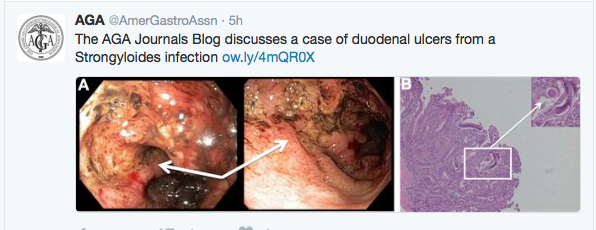
Strongloides

What happens when anti-TNF therapy is stopped

Another study (NA Kennedy et al. Aliment Pharmacol Ther 2016; 43: 910-23) has examined the issue of outcomes after anti-TNF therapy withdrawal among patients with inflammatory bowel disease.

This study included 166 UK patient cohort (117 with Crohn’s disease [median 31 yrs], 19 with ulcerative colitis [median 40 years]) as part of a retrospective observational study and a meta-analysis incorporating 11 further cohorts totalling 746 patients (624 with Crohn’s dissease, 122 with ulcerative colitis).

Key findings:

  • In the UK cohort, relapse rates were 36% at year and 56% at 2 years for Crohn’s disease
  • In the UK cohort, relapse rates were 42% at year and 47% at 2 years for ulcerative colitis
  • Increased relapse rates were noted for those with a diagnosis prior to age 22 years (hazard ratio (HR) 2.78), calprotectin >50 mcg/g (HR 2.95).
  • In meta-analysis, 1-year relapse rates were 39% for CD and 35% for UC/IBDU patients
  • Retreatment with anti-TNF was successful in 88% for CD and 76% of UC/IBDU patients

To understand this study, it is important to note some of the study criteria.  In the UK cohort, inclusion criteria required the patient to have had at least 12 months of ant-TNF therapy and be in corticosteroid-remission for at least 6 months.  In addition, the relapse rate is likely to be underestimated due to using a definition of relapse that required either commencement of steroids, immunomodulator or anti-TNF therapy.  The meta-anlaysis cohort studies also used clinical relapse rather than endoscopic or other objective markers.

My take: Relapse of clinical symptoms occur in about 40% after withdrawal in highly-selected groups who were doing well prior.  Significantly higher rates of endoscopic relapse are likely.  This study provides strong reasons for not interrupting therapy when it is working.

Related blog posts:

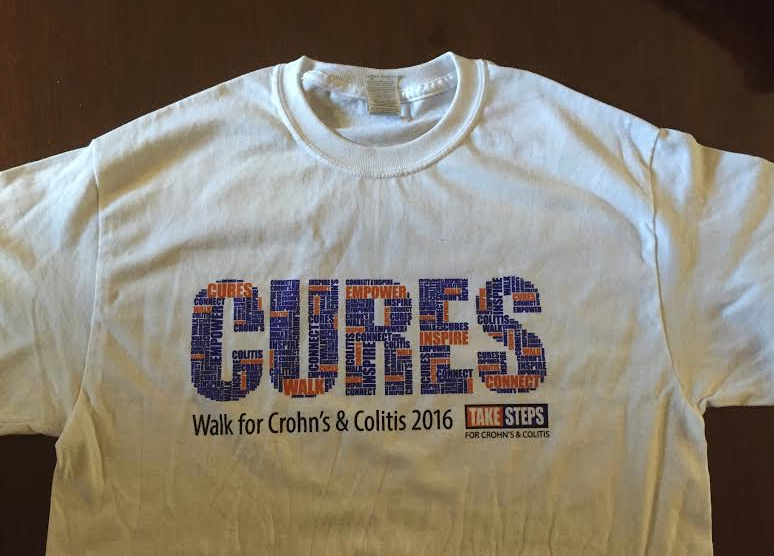
Cures Tshirt


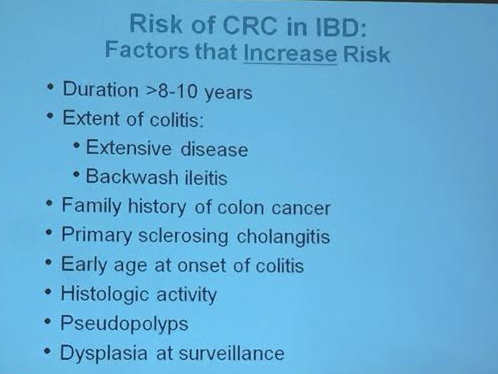
CCFA Conference Notes 2016 (part 3) -Malignancy and IBD

This blog entry has abbreviated/summarized this terrific presentation; most of the material has been covered in this blog in prior entries but still this was a useful review. Though not intentional, some important material is likely to have been omitted; in addition, transcription errors are possible as well.

3rd Lecture: Prevention and management of malignancy in IBD –Dr. Thomas Ullman

Malignancy risk (colorectal cancer [CRC]) is present with prolonged ulcerative colitis, though more recent studies have shown lower risk than in the past –not much higher than the general population.

Screen Shot 2016-04-17 at 12.02.04 PM

  • CRC surveillance–colonoscopy monitoring after 8-10 years. Typically colonoscopy every other year for most patients, every year in higher risk patients (eg. PSC).

Screen Shot 2016-04-17 at 12.01.37 PM

  • Unclear if chemoprevention is effective (5-ASA, thiopurines, others).
  • Chromoendoscopy “has not been consensus on its use in our field (yet).” It is time consuming and expensive and unclear if it will improve outcome.

Does medical therapy for IBD predispose to developing cancer?

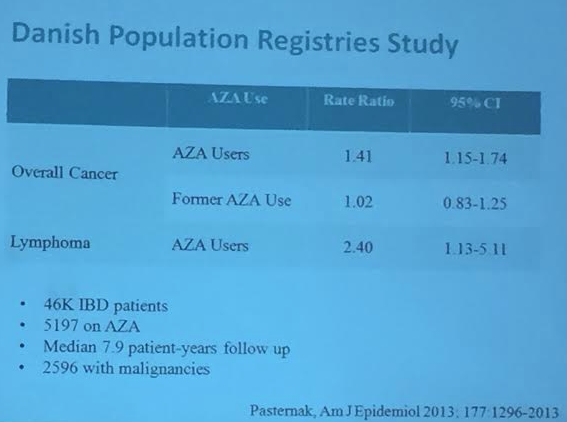
  • Thiopurines increase the risk of malignancy. (Pasternak et al) though the risk returns to near baseline when stopped according to study below.

Screen Shot 2016-04-17 at 12.03.27 PM

  • No overall increased risk with anti-TNF agents with RCTs (may not follow patients long enough) but also not seen in Danish registry either (JAMA study)
With Anti-TNFs

No increased risk of malignancy in this study with Anti-TNFs

  • Lymphoma risks: age, immunodeficiency, EBV
  • EBV negative are at risk for HLH with thiopurines
  • HTSCL ~200, >90% men and >90% <35 years. NOT EBV-related. Has not been identified in anti-TNF monotherapy.

Screen Shot 2016-04-17 at 12.02.55 PM

  • Skin cancer –main concern is in non-melanoma skin cancer (possibly melanoma too). Skin cancer increase has not been noted with methotrexate. Prevention: Skin care, and annual dermatology visits.
  • Cervical cancer—likely increased risk in IBD, probably due to thiopurine exposure and reduced immune surveillance. Prevention: HPV vaccination, Pap testing.
  • Urinary Tract cancers –especially in those >65 years with thiopurine exposure


Should Methotrexate Be Used For Ulcerative Colitis?

A recent study (F Carbonnel et al. Gastroenterol http://dx.doi.org/10.1053/j.gastro.2015.10.050, article in press; thanks to KT Park twitter feed for reference) with 111 patients provides more questions than answers.  It appears that methotrexate improved clinical remission but the overall difference is fairly small; the abstract is below.

My initial impression: Immunomodulators (including methotrexate and thiopurines) have some efficacy as monotherapy agents in patients with inflammatory bowel disease. Their role as part of combination therapy (with anti-TNF agents) has been associated with improved outcomes but how long to use combination therapy and at what dosage is still being worked out.

Here’s the abstract and a link: Methotrexate is not Superior to Placebo in Inducing Steroid-free Remission, but Induces Steroid-free Clinical Remission in a Larger Proportion of Patients with Ulcerative Colitis

Background & Aims

Parenteral methotrexate is an effective treatment for patients with Crohn’s disease but has never been adequately evaluated in patients with ulcerative colitis (UC). We conducted a randomized controlled trial to determine its safety and efficacy in patients with steroid-dependent UC.

Methods

We performed a double-blind, placebo-controlled trial to evaluate the efficacy of parenteral methotrexate (25 mg/week) in 111 patients with corticosteroid-dependent UC at 26 medical centers in Europe, from 2007 through 2013. Patients were given prednisone (10 to 40 mg/day) when the study began, and randomly assigned to groups (1:1) given placebo or methotrexate (intramuscularly or subcutaneously, 25 mg weekly) for 24 weeks. The primary endpoint was steroid-free remission (defined as a Mayo score ≤ 2 with no item > 1 and complete withdrawal of steroids) at week 16. Secondary endpoints included clinical remission (defined as a Mayo clinical subscore ≤ 2 with no item > 1) and endoscopic healing without steroids at weeks 16 and/or 24, remission without steroids at week 24, and remission at both weeks 16 and 24.

Results

Steroid-free remission at week 16 was achieved by 19/60 patients given methotrexate (31.7%) and 10/51 patients given placebo (19.6%)—a difference of 12.1% (95% confidence interval [CI], –4.0% to 28.1%; P=.15). The proportions of patients in steroid-free clinical remission at week 16 were 41.7% in the methotrexate group and 23.5% in the placebo group, for a difference of 18.1% (95% CI, 1.1%–35.2%; P=.04). The proportions of patients with steroid-free endoscopic healing at week 16 were 35% in the methotrexate group and 25.5% in the placebo group—a difference of 9.5% (95% CI, –7.5% to 26.5%; P=.28). No differences were observed in other secondary endpoints. More patients receiving placebo discontinued the study because of adverse events (47.1%), mostly caused by UC, than patients receiving methotrexate (26.7%; P=.03). A higher proportion of patients in the methotrexate group had nausea and vomiting (21.7%) than in the placebo group (3.9%; P=.006).

Conclusions

In a randomized controlled trial, parenteral methotrexate was not superior to placebo for induction of steroid-free remission in patients with UC. However, methotrexate induced clinical remission without steroids in a significantly larger percentage of patients, resulting in fewer withdrawals from therapy due to active UC.

Related blog posts:

Banning Mills

Banning Mills

Why the Genetics of Inflammatory Bowel Diseases Matter Now

A terrific update on the genetics of inflammatory bowel diseases (DPB McGovern, S Kugathasan, JH Cho. Gastroenterol 2015; 149: 1163-76) explains why and how this information matters right now.  The article is a little difficult to read due to its review of highly technical material.

Here’s what I think were the key points:

  • Big advances in understanding the genetics started with the first genome-wide association studies (GWAS) using genome-wide single nucleotide polymorphisms (SNP) chips in 2005.  “The conceptual basis of GWAS is that most complex (ie, not single-gene Mendelian) genetic disorders are polygenic, being driven by multiple common genetic polymorphisms.”
  • “Early GWAS identified the most significant loci.”  Now, more than 200 loci associated with IBD have been identified with GWAS and Immunochip data. Table 1 lists these loci over 4 pages.  About 2/3rds of these are associated with Crohn’s disease (CD) and ulcerative colitis (UC) whereas the remaining 1/3rd are unique to either CD or UC.
  • These loci provide insight into disease mechanisms. NOD2 mutations result in “impaired activation of NF-κB” This supported “the general concept that deficiencies of innate immune cell function represent a central factor in Crohn’s disease, distinguishing it from ulcerative colitis.”
  • ATG16L1 gene mutation “establish the fact that the CD risk allele is correlated with impaired autophagy.”  This is leading directly into treatment efforts.
  • IL23R.  “The most significant association is Arg381Gln…confers a 2- to 3-fold protection against development of IBD.”  The protective effect is thought to be due to “decreased numbers of interleukin (IL)-23 dependent CD4+ Th17 and CD8+ Tc17 cells…decreasing IL-23 signaling, such as through monoclonal antibody blockade of anti-p40 or anit-p19 may be beneficial.”
  • FUT2 mutations.  These mutations affect the mucus layer in Crohn’s disease.
  • Studies in non-Caucasians highlight other susceptibility regions.
  • “Currently, sequencing of the whole exome has become not only a practical method but also a cost-effective option to identify functionally relevant variants in the protein encoding regions of the genome.”

Very Early Onset IBD:

  • Whole exome sequencing (WES) identified XIAP (X-linked inhibitor of apoptosis) in a case of boy with very early onset (VEO) IBD.  XIAP is a positive regulator of NOD2 function.  WES has also identified FOXP3, and IL10RB genes.
  • “The VEO group experiences a more severe disease course and more frequently shows a positive family history for IBD in support of higher genetic load.”  Table 2 lists ~40 genes associated with VEO.  These genes are involved in epithelial barrier function, neutropenia/defects in phagocyte function, hype-and autoinflammation, and  regulatory T cells and immune regulation.

Genetic Testing Will Impact Current Therapies and Help Explain Extraintestinal Manifestations:

  • Currently testing for TPMT variations is recommended prior to use of thiopurines due to concerns of toxicity in individuals with decreased metabolism of these medications.  However, genetic testing can identify other individuals with propensity to leukopenia (eg. NUDT15 polymorphism) and those with increase risk for pancreatitis (eg. HAL-DQA1-HLA-DRB1)
  • Primary Sclerosing Cholangitis (PSC) is associated with numerous genetic loci as well. PSC “genetically is more similar to UC than to CD.” Most other extraintestinal manifestation studies have been underpowered.
  • IBD share more genetic similarity to spondyloarthropathy (SpA) than any other immune-mediated diseases.  “The vast majority of shared susceptibility loci are concordant between IBD and SpA.”
  • With regard to psoriasis, the genetic relationship to IBD is complex.  Anti-TNF agents can cause psoriaform lesions in IBD patients.  In addition, anti-IL17a therapy, “so successful in psoriasis, appears to worsen Crohn’s disease” but not in those with a TNFSF15 variant.  Specific genotyping may help identify which patients with CD are susceptible to psoriaform lesions and those who may improve with therapy typically given for psoriasis.

My take: This article shows how understanding genetics of IBD is providing insight into pathophysiology and more personalized treatment approaches.

Briefly noted: EM Stoffel, CR Boland. Gastroenterol 2015; 149: 1191-1203. Excellent review of the genetics and genetic testing for Hereditary Colorectal Cancer.  The review includes polyposis syndromes and Lynch syndrome.

Atlanta Botanical Gardens

Atlanta Botanical Gardens

Be Aggressive! Treating Anemia Associated with Inflammatory Bowel Disease

A number of recent publications have made the point that anemia is a biomarker for severe inflammatory bowel disease and undertreatment affects quality of life. Reading one of the more recent studies (IE Koutroubakis et al. Clin Gastroenterol Hepatol 2015; 13: 1760-66) brought to mind the high school football cheer: Be Aggressive!

This particular retrospective study involved 410 patients (245 with Crohn’s disease, 165 with ulcerative colitis) from 2009-2013.  This study is from the same group that published data on a somewhat smaller cohort and showed that IBD treatment alone often will not resolve anemia (Koutroubakis, IE et al. Inflamm Bowel Dis 2015; 21: 1587-93–see previous blog links).

Key findings:

  • Prevalence of anemia: 37.2% in 2009 and 33.2% in 2013
  • Anemia was associated with increased hospitalizations (P<.01), clinic visits (P<.001), telephone calls (P<.004), surgeries for IBD (P=.001), and lower quality of life scores (P<.03)

The associated editorial (pgs 1767-69) suggests that IBD-related anemia, if mild (w/in 1 g/L below normal) to treat with oral iron replacement and if moderate-to-severe, then to replace intravenously (using Ganzoni’s formula calculator). In addition, if anemia is not improving, looking for alternative explanations (e.g. vitamin B12 or folate deficiency) is recommended.

Ganzoni Equation: Total Iron Deficit = Weight {kg} x (Target Hb – Actual Hb) {g/l} x 2.4 + Iron stores {mg}.   Iron stores: { 500 if W > 35kg } & { 15 mg/kg if W < 35kg }

My take: Anemia is a biomarker for severe disease.  While treating the underlying inflammatory bowel disease, don’t forget to make sure the patient’s anemia is addressed.

Related blog posts:

Disclaimer: These blog posts are for educational purposes only. Specific dosing of medications/diets (along with potential adverse effects) should be confirmed by prescribing physician/nutritionist.  This content is not a substitute for medical advice, diagnosis or treatment provided by a qualified healthcare provider. Always seek the advice of your physician or other qualified health provider with any questions you may have regarding a condition.

Central Park

Central Park