Background: “Lynch syndrome (LS) is a prevalent hereditary cancer syndrome affecting ~1 in 300 individuals, with an overall lifetime cancer risk as high as 80%. LS is caused by germline mutations in the DNA mismatch repair genes, leading to microsatellite instability (MSI) and accumulation of shared mutations. When these occur in coding regions, they generate frameshift peptides (FSPs). Nous-209 is a neoantigen-directed immunotherapy” against these FSPS. These are “the results from cohort 1 of a phase 1b/2 single-arm trial of Nous-209 for cancer interception in LS carriers (n = 45).”
Key findings:
Neoantigen-specific immune responses were observed after vaccination in 100% of evaluable participants (n = 37), with induction of potent T cell immunity
The immune response was durable and detectable at 1 year in 85% of participants
Both CD8+ and CD4+ T cells were induced, recognizing multiple FSPs
Peptide–human leukocyte antigen predictions allowed the identification of >100 immunogenic FSPs with demonstration of cytotoxic activity in vitro
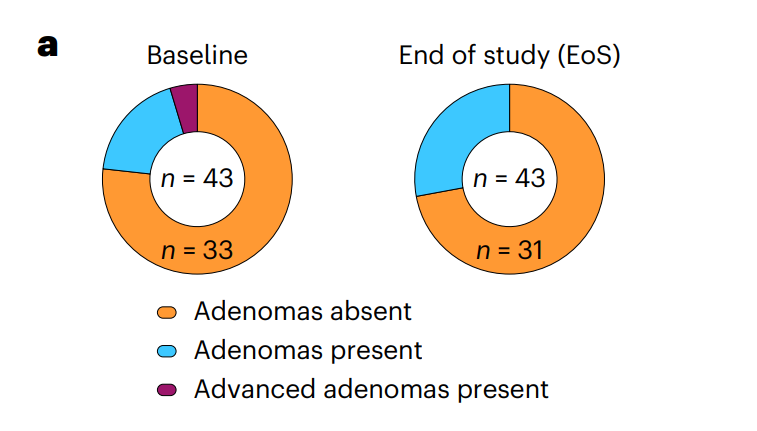
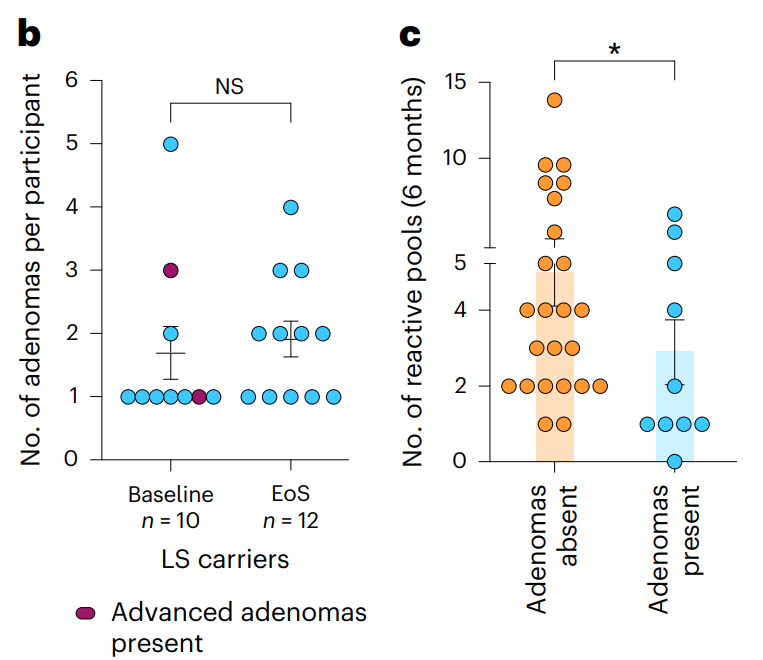
Colorectal neoplasia burden observed at end-of-study colonoscopy inversely correlates with breadth of immune response. a, Number of participants who underwent screening colonoscopy at baseline and end of study (EoS; n = 43) who had no adenomas (adenomas absent), at least one adenoma (adenomas present) and advanced adenomas (advanced adenomas present) detected.b, Number of adenomas per trial participant at baseline and end of study; comparison of baseline versus EoS was performed using a two-tailed Mann–Whitney U-test; NS, not significant. c, Number of reactive pools measured at 6 months (n = 34 evaluable subjects) between the participants with and without adenomas. Data are shown as the mean ± s.e.m.
My take (borrowed in part from authors): “Overall, this clinical trial provides important proof-of-concept data of the safety and the robustness of induced immunogenicity of Nous-209 in LS carriers…and supporting its clinical development as a valuable intervention for cancer immune interception.” Vaccines have a long history in reducing cancer (for Hepatitis B, Cervical Cancer (due to HPV), Anal Cancer, Leukemia (by boosting immunity) and Others). Until recently, this has been by preventing viral infections that increase the risk of cancer. This is a new approach.
Related article: Blood test for colorectal cancer: A Mannucci et al. Gastroenterol 2026; 170: 330-343. An Exosome-Based Liquid Biopsy for the Detection of Early-Onset Colorectal Cancer: The ENCODER Multicenter Study Methods: A panel of 6 cell-free and exosome-based circulating biomarkers were identified through small RNA sequencing from a biomarker discovery cohort (blood test). Key finding: “This study developed and independently tested a blood-based test with 97.3% sensitivity for screening-relevant CRC stages I–III and 61.5% for the noninvasive detection of high-grade dysplasia.”
I am not an expert on autism. However, I am concerned about the administration’s recent recommendations regarding acetaminophen and autism. Even scientists who have suggested a possible link have NOT recommended stopping the use of acetaminophen during pregnancy.
It is well-recognized that autism is related to multiple factors, both genetic and potential environmental factors. The use of acetaminophen, even if linked to autism, could represent an epiphenomenon in which a primary disorder (like a fever or infection) is responsible for subsequent neurodevelopmental problems rather than the medicine itself. While there has been growing concern about the increasing frequency of autism, much of this relates to changes in the definition of autism over various periods.
I recommend the following recent sources of information on this topic:
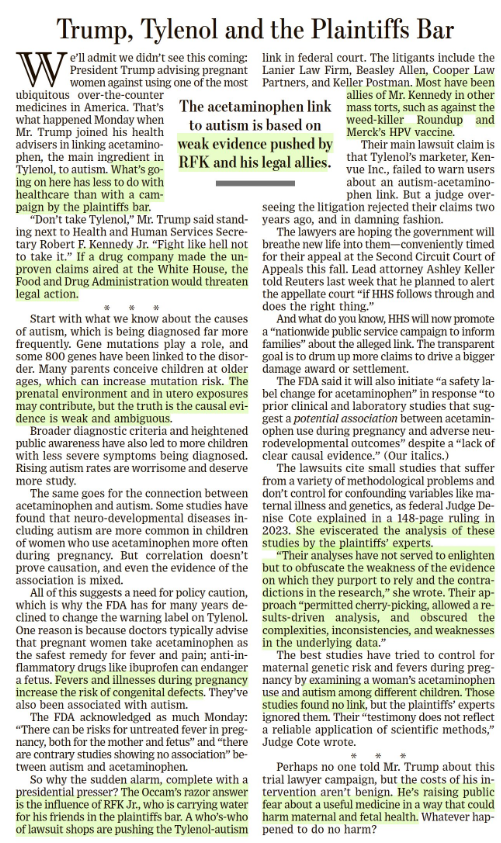
Editorial Board Wall Street Journal, 9/23/25: Trump, Tylenol and the Plaintiffs Bar “The acetaminophen link to autism is based on weak evidence pushed by RFK Jr. and his legal allies.”
“Today’s announcement by HHS is not backed by the full body of scientific evidence and dangerously simplifies the many and complex causes of neurologic challenges in children. It is highly unsettling that our federal health agencies are willing to make an announcement that will affect the health and well-being of millions of people without the backing of reliable data.
“In more than two decades of research on the use of acetaminophen in pregnancy, not a single reputable study has successfully concluded that the use of acetaminophen in any trimester of pregnancy causes neurodevelopmental disorders in children. In fact, the two highest-quality studies on this subject—one of which was published in JAMA last year—found no significant associations between use of acetaminophen during pregnancy and children’s risk of autism, ADHD, or intellectual disability.
“Acetaminophen is one of the few options available to pregnant patients to treat pain and fever, which can be harmful to pregnant people when left untreated. Maternal fever, headaches as an early sign of preeclampsia, and pain are all managed with the therapeutic use of acetaminophen, making acetaminophen essential to the people who need it. The conditions people use acetaminophen to treat during pregnancy are far more dangerous than any theoretical risks and can create severe morbidity and mortality for the pregnant person and the fetus.”
From KFF News:
In August, Bauer and her colleagues published an analysis of 46 previous studies on Tylenol, autism, and attention-deficit/hyperactivity disorder. Many found no link between the drug and the conditions, while some suggested Tylenol might occasionally exacerbate other potential causes of autism, such as genetics.
Bauer, an epidemiologist at the University of Massachusetts-Lowell, and her team called for more judicious use of the drug until the science is settled.
Autism experts at the Centers for Disease Control and Prevention were neither consulted for the White House’s long-awaited autism announcement nor asked to review a draft of the findings and recommendations…
If prenatal Tylenol has any association, which it may not, it would help account for only a fraction of cases, she said. Further, research has not deeply examined Tylenol risks in young children, and manyrigorous studies refute a link between vaccines and autism.
Bauer worries such statements will cut both ways: People may put themselves at risk to avoid vaccines and Tylenol, the only safe painkiller for use during pregnancy. And she frets that scientists might outright reject her team’s measured concerns about Tylenol in a backlash against misleading remarks from Trump and other members of his “Make America Healthy Again” movement….
Helen Tager-Flusberg, director of the Center for Autism Research Excellence at Boston University, called Trump’s comments dangerous. Fevers can harm the mother and the developing fetus, she said, adding that fevers are more strongly associated with autism than Tylenol…
Several medical and scientificassociations have called for Kennedy’s removal or resignation. Many scientists are skeptical of what he says because much of it has been misleading or wrong. For example, he’s said HIV isn’t the only cause of AIDS (it is), that antidepressant drugs cause mass shootings (they don’t), that older adults don’t have severe autism (some do), that the measles vaccine causes brain swelling (it doesn’t), that covid vaccines were the deadliest vaccines ever made (they aren’t), that vaccines aren’t safety-tested (they are), and that vaccines contribute to autism (they don’t).
From the Wall Street Journal:
Washington Post Editorial:
From TIME article: “Despite what we are now hearing from the most powerful health offices in the nation, the science on acetaminophen and autism remains unsettled. What is not unsettled is the damage done when politics masquerades as medicine. Every false certainty erodes the trust that holds the fragile bridge between patients and their doctors. Break that trust, and no study, no drug, no vaccine will be enough to save lives when the next real crisis comes. When politicians play doctor, it’s families who will pay the price.”
My take: Thinking about the damage from this press conference, I was reminded of a scene from the movie “Doubt.” In the movie Doubt, Father Flynn (played by Philip Seymour Hoffman) tells a parable about an old priest instructing a woman who has been gossiping to take a pillow, cut it open on her roof, and then return to gather up all the feathers. When she tells him it can’t be done because “the wind took them all over,” the priest responds: “And that… is gossip!”
The spreading of damaging rumors and lies, which is being done by leaders of this country, is impossible to contain or undo once released, and its impact is far-reaching and destructive.
Despite the enormous benefits of hepatitis B vaccination, it appears that this administration has its sights on changing the policy of administration at birth.
Committee members, some of whom are vaccine skeptics, are likely to recommend restricting the use of the shots at birth or delaying them until later in childhood…
“Unless the mother is hepatitis-B-positive, an argument could be made to delay the vaccine for this infection,” Martin Kulldorff, the committee’s chair, said at its previous meeting in June.
Vaccine experts at the C.D.C., who normally would be deeply involved in preparing for this week’s meeting, have been sidelined and given no more information than the public about the meeting’s agenda or possible outcomes…
Before 1991, when newborns were not all vaccinated for hepatitis B, about 20,000 babies became infected each year. Routine immunization at birth cut the number of newborn infections … There are now fewer than 20 children per year who acquire the disease from their mothers.
Only about half of the cases before 1991 were a result of transmission from an infected mother. The other half “weren’t getting it from becoming sex workers, and they weren’t getting it from being intravenous drug users,” Dr. Paul Offit, director of the Vaccine Education Center at Children’s Hospital of Philadelphia, said…
From 2015 to 2017, about 21,000 infants were born to pregnant women with hepatitis B antibodies, but fewer than half were identified through prenatal screening, according to the C.D.C.
Related news article: Jackie Fortier, NPR 9/16/25 Link to 3 minute report: RFK Jr.’s vaccine panel is expected to recommend delaying hepatitis B shot in kids “:”A vaccine advisory panel, recently reshaped by RFK Jr., is expected to vote on changing the age children should get their first hepatitis B vaccine — from right after birth to age 4”
My take: If routine immunization at birth is stopped, there will be a lot more hepatitis B infections and subsequent complications. Some infections will be acquired at birth and some later due to missed opportunities to provide protection later on.
“A team of researchers found evidence of shady organizations churning out fake or low-quality studies on an industrial scale. And their output is rising fast, threatening the integrity of many fields…“If these trends are not stopped, science is going to be destroyed,” said Luís A. Nunes Amaral, a data scientist at Northwestern University and an author of the study”
““Science relies on trusting what others did, so you do not have to repeat everything,” Dr. Amaral said….By the 2010s, journal editors and watchdog organizations were warning that this trust was under threat. They flagged a growing number of papers with fabricated data and doctored images. In the years that followed, the factors driving this increase grew more intense.”
“As more graduate students were trained in labs, the competition for a limited number of research jobs sharpened. High-profile papers became essential for success, not just for landing a job, but also for getting promotions and grants. Academic publishers have responded to the demand by opening thousands of new scientific journals every year…”
“Organizations known as paper mills are now turning scientific fraud into a lucrative business. Scientists eager to pad out their resumes can pay hundreds to thousands of dollars to be named as an author of a paper that they had nothing to do with…paper mills often use artificial intelligence to alter the text they lift from other papers…”
“The papers that Dr. Amaral and his colleagues could study came to light only because of the work of independent sleuths. To estimate how many paper mill papers have yet to be exposed, Dr. Amaral’s team created a statistical model that accurately predicted the rate at which suspicious papers surfaced. They estimate that the number of paper mill products may be 100 times greater than the ones they have identified…”
“In their new study, they calculated that the number of suspicious new papers appearing each year was doubling every 1.5 years. That’s far faster than the increase of scientific papers overall, which is doubling every 15 years.”
““We need to stop making it profitable to game the system.”
My take: This problem has preceded the widespread use of AI, although Al makes it harder to detect. Unfortunately, fake scientific reporting appears to be worsening.
Related article: Jessica Steier NY Times 8/19/25: The Playbook Used to ‘Prove’ Vaccines Cause Autism This article details very specifically how David Geier (now appointed by RFK Jr to evaluate vaccines and autism) and his father have produced multiple flawed studies regarding vaccine safety. This commentary takes a particularly deep dive into one of his articles on the preservative thimerosol. She shows that the authors likely used p-hacking to identify “atypical autism” since there was not a significant association with autism, compared different time cohorts (the control group was from a period with different diagnostic criteria/lower rates of autism), did not include confounders, and supported their arguments with “personal citing.”
Some excerpts:
There have been some 70 studies since Mr. Wakefield’s looking for any link between vaccines and autism. Of these, 26 have linked vaccines to autism in some way, and 43 found no connection between vaccines and autism.
A whopping two-thirds of studies that claimed to have found a link were written by David and Mark Geier. These studies have been heavily criticized for using deceptive research techniques and flawed data.
Among the eight other studies that found a link, four were retracted for data manipulation, flawed methods or undisclosed conflicts of interest. Most of the authors have been involved in anti-vaccination campaigns and have had other papers retracted.
One such study that Mr. Kennedy referred to in his Senate confirmation hearing was published in a WordPress blog disguised as a journal and was funded by an anti-vaccine organization, among other problems.
Fortunately, independent scientists have conducted more than 40 high-quality studies since 1998 involving over 5.6 million people across seven countries. All found no connection between vaccines and autism. These studies were rigorously designed, were reviewed by independent peers and do not contain telltale signs of data manipulation, as the Geier studies do.
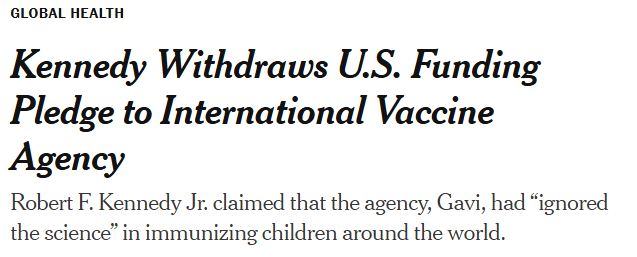
The United States will withdraw its financial support of Gavi, the global organization that helps purchase vaccines for children in poor countries, Robert F. Kennedy Jr., the United States secretary of Health and Human Services, told the group’s leaders on Wednesday, accusing them of having “ignored the science” in immunizing children around the world…
“Any decision made by Gavi with regards to its vaccine portfolio is made in alignment with recommendations by the World Health Organization’s Strategic Advisory Group of Experts on Immunization (SAGE), a group of independent experts that reviews all available data through a rigorous, transparent and independent process,” Gavi’s statement said…
Dr. Atul Gawande, a surgeon who led global health work in the Biden administration, called Mr. Kennedy’s remarks “stunning and calamitous…”
The United States was the largest donor to Gavi, whose work is estimated to have saved the lives of 17 million children around the world over the past two decades…
Gavi had hoped to raise $9 billion for the 2026-30 period, funds the organization said would allow it to purchase 500 million childhood vaccinations and to save at least eight million lives by 2030. ..
The decision to end U.S. support for Gavi — which was included in the rescission package passed by Congress and now being considered by the Senate — leaves the organization with an immense hole in its budget…The Gates Foundation is maintaining its funding at a stable level from previous years — about $350 million in each of the next four years — as is the United Kingdom.
My take: It is no exaggeration to say that the shift in U.S. vaccine policy may result in hundreds of thousands of deaths every year. In addition, U.S. travelers will be more likely to be exposed to vaccine-preventable illnesses as well.
Background: “Caution regarding live vaccine administration emerged following reports of 5 fatal outcomes following the administration of the Bacille Calmette-Guérin vaccine in biologic-exposed infants.9 This has resulted in gastroenterology guidelines recommending that biologic-exposed infants should avoid live vaccines within the first 6 to 12 months of life or until drug concentrations are no longer detectable in the infant’s blood to reduce potential risks.2,10 [J Crohns Colitis. 2023; 17:1-27, Gastroenterology. 2021; 161:669-680.e0]. Contrary to this, inadvertent administration of the live oral rotavirus vaccine in biologic-exposed individuals has not been associated with significant adverse effects.7,11 Withholding the rotavirus vaccine has implications, given that rotavirus infection in infants is a leading cause of severe, dehydrating diarrhea in children under the age of 5 years globally.12,13“
This prospective cohort study enrolled 57 biologic-exposed infants, including infliximab (n = 21), adalimumab (n = 19), vedolizumab (n = 10), and ustekinumab (n = 7), in the third trimester.
Key findings:
Immunologic assessments validated for age were normal in all infants despite median infliximab concentrations of 6.1 ug/mL, adalimumab concentrations of 1.7 ug/mL, ustekinumab concentrations of 0.6 ug/mL, and undetectable for vedolizumab at median of 10.7 weeks of age
The live oral rotavirus vaccine series was provided to 50 infants with the first dose given at a median of 13 weeks of age. No adverse effects following immunization were reported
Discussion:
“Administration of the live rotavirus vaccine appeared low-risk in biologic-exposed infants born to mothers with IBD”
“Routine drug concentration testing in the infant should not be utilized to determine the safety of live rotavirus vaccination”
“Physicians should advise patients to ‘be more concerned about active disease rather than active medications’ and to continue effective therapy through pregnancy and lactation”
My take: Given the difficulty in excluding rare adverse outcomes, it is unlikely that formal vaccine recommendations will change in infants exposed to biologics; however, inadvertent administration of a live oral rotavirus vaccine poses a very lowl risk based on current studies.
Floating flowers -seen in several places in Thailand
Disclaimer: This blog, gutsandgrowth, assumes no responsibility for any use or operation of any method, product, instruction, concept or idea contained in the material herein or for any injury or damage to persons or property (whether products liability, negligence or otherwise) resulting from such use or operation. These blog posts are for educational purposes only. Specific dosing of medications (along with potential adverse effects) should be confirmed by prescribing physician. Because of rapid advances in the medical sciences, the gutsandgrowth blog cautions that independent verification should be made of diagnosis and drug dosages. The reader is solely responsible for the conduct of any suggested test or procedure. This content is not a substitute for medical advice, diagnosis or treatment provided by a qualified healthcare provider. Always seek the advice of your physician or other qualified health provider with any questions you may have regarding a condition.
This NEJM review describes recent developments in vaccines for C difficile.
Background: “Because the pathogenesis of C. difficile infection depends on the production of the potent toxins TcdA (toxin A) and TcdB (toxin B) by vegetative C. difficile cells, there is hope that the development of vaccines targeting these virulence factors…will be successful in limiting the development of C. difficile infection in patients receiving antibiotic treatment.2“
An excerpt:
“A trial of a vaccine composed of formalin-inactivated TcdA and TcdB purified from a highly toxigenic C. difficile strain was stopped at the first planned interim analysis on the basis of clinical futility,3 and the development of this vaccine was terminated. More recently, results were published from the Clostridium difficile Vaccine Efficacy Trial (CLOVER), a phase 3, randomized trial of a genetically detoxified C. difficile vaccine composed of recombinant TcdA and TcdB (containing targeted amino-acid substitutions to limit toxic activity) that were further detoxified by chemical means.4 Although the trial did not show a benefit with respect to the primary end point of preventing a first episode of C. difficile infection, vaccinated patients in whom C. difficile infection developed had a shorter duration of symptoms and were less likely to receive medical attention for their infection than patients who had received placebo.
In this setting, a new type of C. difficile vaccine candidate, described by Alameh, Semon, and colleagues,5 is of interest. These investigators developed a multivalent nucleoside-modified messenger RNA (mRNA) vaccine (see Key Concepts) delivered in lipid nanoparticles (LNPs)…The mRNA–LNP vaccine elicited higher antibody levels to all three vaccine targets than the recombinant vaccine with alum adjuvant. Furthermore, the mRNA–LNP vaccine provided complete protection against challenge with an intraperitoneally administered high dose of purified TcdA or TcdB: all the vaccinated mice survived, whereas all the unvaccinated mice were moribund within 2 days. The recombinant–alum vaccines protected only 20% of the vaccinated animals…
However, protection was not associated with the prevention of colonization: all the vaccinated animals shed high numbers of culturable C. difficile and had histopathological damage to intestinal tissue that was equivalent to that seen in unvaccinated animals according to analyses performed 2 days after infection. This finding suggests that protection was due to blocking of the systemic effects of the C. difficile toxins. However, additional data indicated that inclusion of the PPEP-1 antigen in the multivalent vaccine resulted in more rapid clearance of luminal toxin levels.”
My take: An effective vaccine would be a welcome advance and perhaps limit the shitty treatments we have had to date.
These charts show measles data through April 7th. Some additional data through Apirl 11th is listed below.
For those interested in a deeper dive into the measles numbers, you can follow Caitlin Rivers substack. From her notes on April 11:
“Since my last update on Tuesday, Arkansas and Hawaii reported cases for the first time this year. At least five states have reported ten or more cases, which is very unusual. Texas continues to register the most cases, with 541 to date.”
“According to the CDC, 712 cases have been reported so far this year. 1 in 3 (32%) are under the age of 5, and 1 in 10 (11%) have been hospitalized.”
There is very little that Americans can agree on these days…
But one thing nearly everyone agrees on? Vaccines are good.
This simple fact has been overshadowed by fears about what will happen to vaccine policy under Robert F. Kennedy Jr., the new secretary of health and human services. He has a long history of vaccine skepticism, and critics fear his leadership could lead to interference with vaccine programs or even withdrawal of vaccines from the market. Such moves are already roiling some state health programs. In Louisiana, the Health Department will “no longer promote mass vaccination,” instead leaving vaccine education to medical providers…
Recent reports in the news media and medical journals highlight a decline in the proportion of kindergartners who have received the measles, mumps and rubella shot. In the past five years, national coverage has fallen to 93 percent, from 95 percent, and in some states like Idaho, it is as low as 80 percent. But while these numbers fall short of the national goal of 95 percent required to maintain herd immunity for measles, they remain a resounding show of confidence…
Some 92 percent of American children received the polio vaccine by age 2, and more than 90 percent were vaccinated against hepatitis B. And it’s not just because of school requirements. Nearly nine in 10 Americans — including 86 percent of Republicans — say the benefits of childhood vaccines outweigh the risks...
Emphasizing the popularity of vaccines is not merely a matter of correcting the record. Studies have shown that presenting vaccines as a subject of debate or controversy can unintentionally reinforce vaccine hesitancy by making the issue appear less settled. For instance in one study, researchers found that college students who were asked to read a news report on vaccine safety that presented both sides in a falsely balanced fashion came away with the mistaken impression that the science on vaccine safety was in flux…
Routine vaccinations are just that: routine. Nearly all children receive them, and millions have benefited by being spared painful diseases and death. Leaders who undermine this basic tool may find themselves on the wrong side of both science and voters.
My take: Caitlin Rivers provides a lot of useful advice regarding infectious diseases. She has frequent (~weekly) substack articles with up-to-date information regarding infection prevalence (eg. Flu, COVID, norovirus, etc). Link to substack: Force of Infection
Background (from MedPage Today): HEV is a leading cause of acute viral hepatitis worldwide, resulting in an estimated 20 million infections worldwide and 70,000 deaths every year. HEV primarily occurs in Africa, Central America, and Asia…U.S. incidence of HEV infection is largely unknow in part because of a lack of surveillance or an FDA-approved, commercially available HEV assay. However, an analysis of seroprevalence of HEV among blood donors in the U.S. showed approximately 10% seropositivity for HEV immunoglobulin G (IgG), reflecting past infection, and 0.58% for HEV IgM, indicating recent infection.
Genotypes HEV-1 and HEV-2 are transmitted via contaminated water and are specific to humans. However, HEV-3 and HEV-4 are zoonotically transmitted, often by eating uncooked or undercooked meat and offal of boar, deer, and pig.
Safety data of the vaccine were reported in an earlier study, showing no serious adverse effects attributed to the vaccine (though data is scarce in vulnerable populations including pregnant women and children)
In this randomized placebo-controlled study with 112 604 healthy Chinese adults aged 16–65 years, the key findings:
During the 10-year study period, there were 13 infections in the vaccine group (0·2 per 10 000 person-years) and 77 in the placebo group (1·4 per 10 000 person-years), corresponding to a vaccine efficacy of 83·1% in the modified intention-to-treat analysis and 86·6% in the per-protocol analysis.
In a subset of patients, 254 (87·3%) of 291 vaccinees had vaccine-induced antibodies detectable at the 8·5-year mark.
My take: This HEV vaccine markedly decreases the likelihood of acquiring HEV infection.












 gutsandgrowth