Vedolizumab Drug Levels –Are They Needed?

A recent retrospective study (E Dreesen et al Clin Gastroenterol Hepatol 2018; 16: 1937-46) with 179 consecutive patients (66 with ulcerative colitis, and 113 with Crohn’s disease) found that vedolizumab (VDZ) trough concentrations were correlated with response.

Key findings:

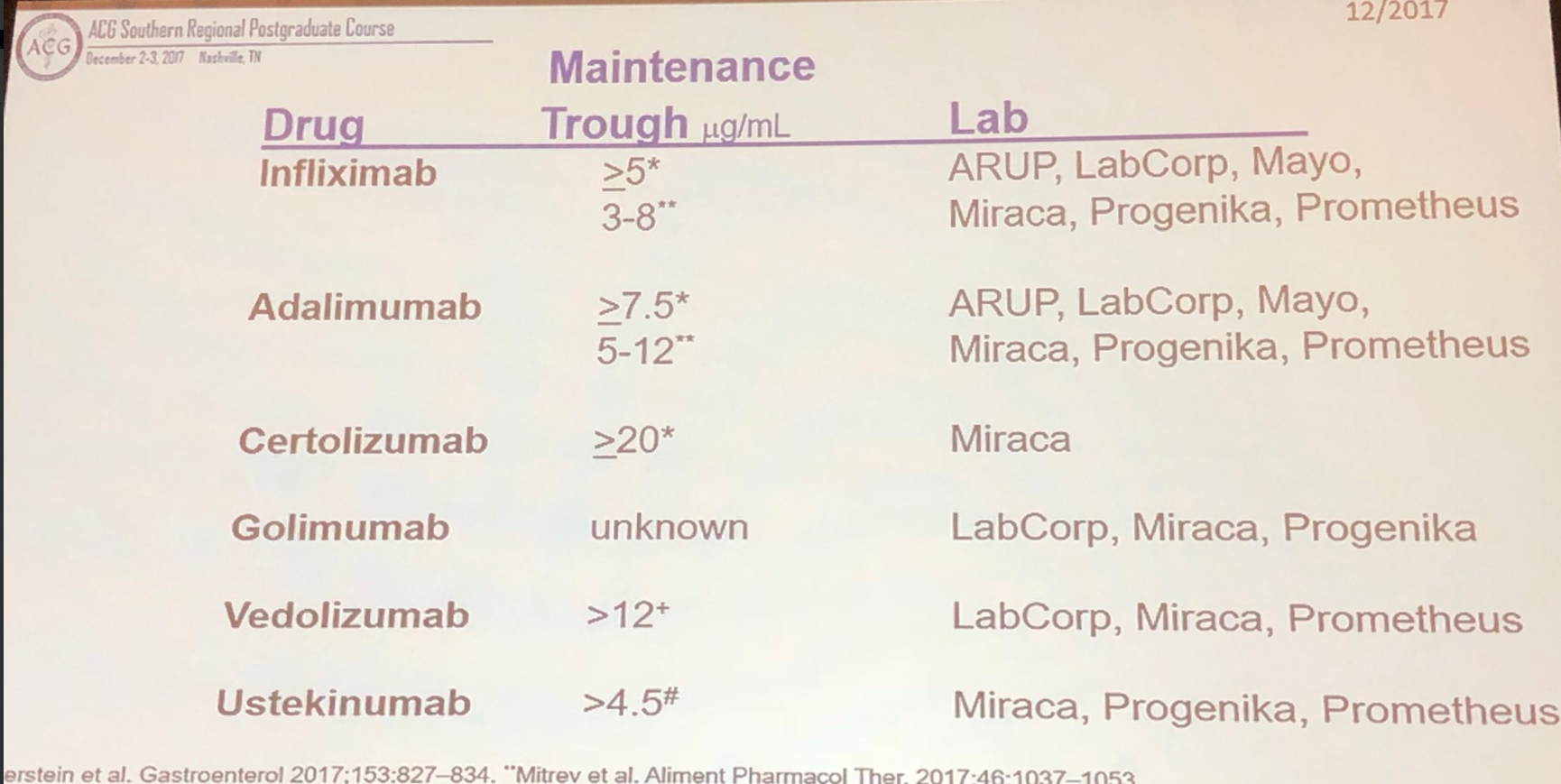
  • VDZ trough >30 mcg/mL at week 2, >24 mcg/mL at week 6, and >14 mcg/mL during maintenance were associated with effectiveness endpoints including endoscopic healing, physician global assessment and biochemical response (based on CRP).
  • Median VDZ trough levels during induction were 27.7 mcg/mL at week 2, 27.4 mcg/mL at week 6. With standard dosing, the maintenance VDZ trough was 13.5 mcg/mL at week 14
  • Higher BMI and more severe disease, based on CRP, albumin, and/or hemoglobin, were associated with lower VDZ trough levels and lower probability of mucosal healing (P<.05).

Interestingly, in the discussion the authors note that VDZ troughs above  3 mcg/mL completely saturate α4β7 intergrin.  This physiologic phenomenon is hard to reconcile with data showing better response with higher VDZ levels.  The authors note that “at present, there are not enough data in our study to support the role for TDM to guide clinical decision-making on dose escalation for vedolizumab.”

My take: This study implies that VDZ levels may help predict response but are not necessarily helpful in determining whether dose escalation is warranted.

Related blog posts:

Riverwalk, Chattanooga

A Bunch of Data on Vedolizumab

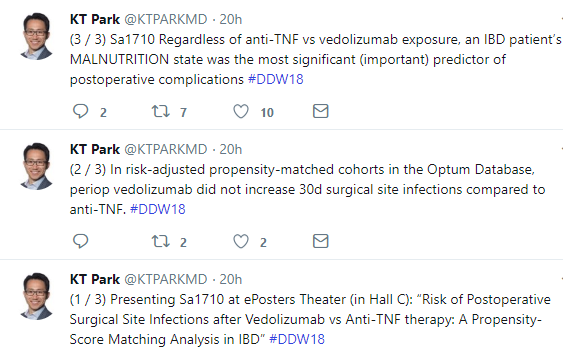
DE Yung et al. Inflamm Bowel Dis 2018; 24: 2327-38.  This systematic review and meta-analysis of four studies “did not detect an increased risk of postoperative complications with preoperative vedolizumab” (VDZ).  This study included 281 patients who received VDZ.

SC Ng et al. Inflamm Bowel Dis 2018; 24: 2431-41. The authors examined the frequency of opportunistic infection among 4 VDZ trials and postmarketing surveillance, accounting for ~114,000 patient-years of exposure. The most common infection was C difficile (0.5 per 100 patient-years); tuberculosis was reported at 0.1 per 100 patient years. This study showed “that the rate of serious opportunistic infections in patients receiving VDZ was low and most patients could continue VDZ treatment.”

SL Gold et al. Gastroenterol 2018; 155: 981-2. This clinical image showed a case of Henoch-Schonlein Purpura (HSP) that developed in a 53 year receiving VDZ.

E Shmidt et al. Inflamm Bowel Dis 2018; 24: 2461-7.  This retrospective review of a prospectively maintained IBD registry provides information of risk factors for VDZ loss of response and management. 444 patients out of 788 who received VDZ had a significant response.The majority of VDZ recipients 75) had failed prior anti-TNF Rx. Key points:

  • Loss of response (LOR) at 6 months and 12 months was 20% and 35% respectively
  • UC patients compared to Crohn’s disease (CD) patients were more likely to have LOR with R of 1.54.
  • Shortening VDZ infusion interval from q8 weeks to q4-6 weeks recaptured response in 49% and led to remission in 18% of this cohort.
  • LOR was more common (2-fold) among those who had a LOR to anti-TNF agent. Patients with primary nonresponse were less likely to have LOR with VDZ.

U Kopylov et al. Inflamm Bowel Dis 2018; 24: 2442-51. This retrospective multicenter study examined VDZ effectiveness among anti-TNF naive patients, n=184.

  • For CD, 42/50 (82%) responded by week 14, and 32 (64%) were in clnical remission. At last followup (30-52 weeks), clinical remission was noted in 24/35 (69%)
  • For UC, 116/134 (79%) responded at week 14 and 53 (40%) were in clinical remission.  At last followup (30-52 weeks), 67% were in remission (69/103)

The authors conclude that VDZ is similarly efffective for anti-TNF naive CD and UC patients.

My take: These studies show that we still have a lot to learn about the effectiveness of VDZ as its use becomes more widespread.

Related blog posts:

Jasper, Canada


IBD Shorts -November 2018

G Horneff et al. J Pediatr 2018; 201: 166-75.  This industry-funded analysis of 577 pediatric patients who received adalimumab (1440 patient-years) identified no new safety signals.  The most common serious infection was pneumonia (0.6 events per 100 patient-years).  The most common adverse events were respiratory tract infections/nasopharyngitis. Serious infections were more common in the subset of patients with Crohn’s disease (CD), (n=189), occurring in 13%.

PS Dulai et al. Gastroenterol 2018; 155: 687-95.  This study, using data from GEMINI 2 phase 3 trial with 814 patients, developed a clinical prediction tool for determining the likelihood of a clinical response to vedolizumab.  Common predictors for response:

  • No prior bowel surgery
  • No prior anti-TNF exposure
  • No prior fistulizing disease
  • Higher baseline albumin
  • Lower baseline CRP

R Matro et al. Gastroenterol 2018; 155: 696-704.  The authors performed a prospective study of women with IBD and their infants (n=72).  They “detected low concentrations of infliximab, adalimumab, certolizumab, natalizumab, and ustekinumab in breast milk samples.  We found breastfed intants of mothers on biologics, immunomodulators, or combination therapies to have similar risks of infection …compared to non-breastfed infants or infants unexposed to these drugs.”


Vedolizumab and Extraintestinal Manifestations of Inflammatory Bowel Disease

A recent retrospective study( MC Dubinsky et al. Inflamm Bowel Dis 2018; 24: 1876-82) indicates that vedolizumab (VDZ) is likely to less effective than anti-TNF agents for extraintestinal manifestations of inflammatory bowel disease (IBD).

The authors used the MarketScan database (2102-2016).  For Crohn’s disease (CD) this included 756 treated with VDZ and 19584 treated with anti-TNF.  For ulcerative colitis (UC), this included 544 treated with VDZ and 8574 treated with anti-TNF.

Key findings:

  • Compared to patients receiving anti-TNF therapy, VDZ-treated CD patients were 28% more likely to develop “any EIMs” with an adjusted rate ratio of 1.49.  The adjusted rate ratio of developing specific EIMs: erythema nodosum  4.29, aphthous stomatitis 3.71, episcleritis/scleritis 2.51, arthropathy 1.45, primary sclerosing cholangitis (PSC) 7.79, and uveitis/iritis 2.89.
  • VDZ-treated UC patients did not have a statistically-significant increase in general for EIMs; though when looked at individually, there was increased incident rate ratios for some: apthous stomatitis 3.67, pyoderma gangrenosum 4.42, and PSC 3.44.

The authors findings are counter to their hypothesis that VDZ-treated patients would not have a significantly higher incidence of EIMs and that the EIMs would parallel course with IBD. To explain their findings, the authors note the following:

  • “EIMs may be more associated with systemic inflammation than previously thought.”
  • “Alternatively, the correlation between specific EIMs and underlying intestinal disease activity may be less tight than previously described.”
  • Anti-TNFs may control intestinal inflammation better than VDZ
  • VDZ-treated patients may have had more severe disease

While EIMs are more likely to develop on VDZ therapy, this study and prior RCTs do not show whether VDZ is effective in resolving EIMs.

My take: This retrospective study indicates that EIMs, including PSC, are more likely to occur in patients receiving vedolizumab. It is unclear whether this is related to the gut-specific control of inflammation with VDZ or whether there are patient characteristics responsible for this observation.

Related blog posts:

Sunshine Meadows, Banff

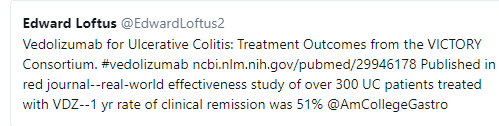
VICTORY Consortium Showing Good Results for Vedolizumab

A presentation at the 13th Congress of the European Crohn’s and Colitis Organization (ECCO, Feb 2018) indicated that Vedolizumab had similar effectiveness as anti-TNF agents for both ulcerative colitis and Crohn’s disease. This data has been presented at a recent meeting in our office, some of the GI news magazines, and also ImproveCareNow listserv.

From Takeda website: Entyvio® (vedolizumab) Shows Higher Rates of Mucosal Healing Versus TNFα-Antagonist Therapy in Ulcerative Colitis and Crohn’s Disease Patients in Comparative Effectiveness Real-World Data Analysis

These analyses observed that patients with UC treated with Entyvio compared to TNFα-antagonist therapy had statistically significant higher 12-month cumulative rates of mucosal healing (50% vs 42%, hazard ratio [HR] 1.73, 95% confidence interval [CI] 1.10‑2.73) and clinical remission (54% vs 37%; HR 1.54, 95% CI 1.08‑2.18), and numerically higher steroid-free clinical remission rates (49% vs 38%; HR 1.43, 95% CI 0.79‑2.60). In CD, results reported statistically significant higher 12-month cumulative rates of mucosal healing (50% vs 41%; HR 1.67, 95% CI 1.13‑2.47), and numerically higher rates of clinical remission (38% vs 34%; HR 1.27, 95% CI 0.91‑1.78) and steroid-free clinical remission (26% vs 18%; HR 1.75, 95% CI 0.90‑3.43) compared to TNFα-antagonist therapy. These analyses were conducted by the VICTORY (Vedolizumab Health OuTComes in InflammatORY Bowel Diseases) Consortium.

My take: While the data compare anti-TNFs to vedolizumab in a “real-world setting,” the reported outcomes for anti-TNFs are lower than in other studies.  Vedolizumab had the best results in those with colonic disease.  Patients with Crohn’s disease with isolated small bowel disease had lower response rates.

Related study: AK Waljee et al Inflamm Bowel Dis 2018; 24: 1185-95. Using phase 3 clinical trial data with 594 subjects, the authors note that the majority of patients who will respond to vedolizumab can be identified by week 6 using a laboratory algorithm based on hemoglobin, albumin, vedolizumab level and CRP. Fformula: Hgb*Albumin*VDZ level/CRP*Weight. A cutoff of 185.96 predicted success with an AuROC of 0.75.   Higher hemoglobin, higher albumin, and higher vedolizumab level, and lower CRP are associate with higher response rates.

Related blog posts:

Red Top Mountain, Homestead Trail


IBD Shorts June 2018

AL Granstrom et al. JPGN 2018; 66: 398-401. Using a nationwide Swedish registry, the authors determined that patients with a Hirschsprung disease had an increased risk of receiving a diagnosis of IBD (OR 4.99).  In total 20 of 739 HD patients, developed IBD.

T Card et al. Inflamm Bowel Dis 2018; 24: 953-9.  This article questions the ‘what is the risk of progressive multifocal leukoencephalopathy ..with vedolizumab?  The authors are not certain.  But they state that after reviewing 54,619 patient-years “there have been no cases of PML reported in association with vedolizumab use.”

LCT Buer et al. Inflamm Bowel Dis 2018; 24: 997-1004. This case report of 10 patients describes combination therapy with anti-TNF therapy with vedolizumab. “At the end of follow-up, all patients were in clinical remission, and 8 patients could discontinue anti-TNF treatment.”

OJ Adedokun et al. Gastroenterol 2018; 154: 1660-71. This study examined pharmocokinetics and response of ustekinumab in patients with Crohn’s disease from 701 patients in phase 3 studies..  “Trough concentrations was approximately threefold higher in patients given ustekinumab at 8-week intervals compared with 12-week intervals…Trough concentrations of 0.8 (or even up to 1.4 mcg/mL) or greater were associated with maintenance of clinical remission.”  Also, “concentrations of ustekinumab did not seem to be affected by cotreatment with immunomodulators.”

View from Pine Mountain

Vedozlizumab -Detectable in Breastmilk

A recent correspondence (M Julsgaard et al.Gastroenterol 2018; 154: 752-65) shows that vedolizumab is detectable in varying concentrations in breastmilk.  The authors collected samples from 5 mothers who were receiving vedolizumab (VDZ) for inflammatory bowel disease.

Key findings:

  • Peak VDZ concentration in breastmilk was 0.318 mcg/mL which was 1/179th of the corresponding concentration of the maternal serum levels.
  • The authors calculated a maximum oral dose of 0.048 mg/kg/day for breastfed infants based on this peak level. “This minute quantity is furthermore anticipated to undergo proteolysis in the stomach” and be bound/excreted in GI tract.
  • VDZ was detectable in all samples for 30 minutes prior to infusion (trough) through 14 days.

This study is in agreement with another study showing that levels in the breastmilk were minute (~1/100) of serum levels (A Lahat et al. J Crohns Colitis. 2018 Jan 5;12(1):120-123).

My take: These are low levels of VDZ –nevertheless further monitoring of infants to determine conclusively whether VDZ enterally causes any adverse effects is warranted.

Views from Mike O’Callahan -Pat Tillman Bridge


Predicting Response to Vedolizumab and Ustekinumab for Inflammatory Bowel Disease

A recent review (A Barre, JF Colmbrel, R Ungaro. Alim Pharm Ther 2018 DOI: 10.1111/apt.14550) discusses predictors of response to vedolizumab and ustekinumab for inflammatory bowel disease (IBD). Thanks to Ben Gold for this reference.

Background:

  • “Vedolizumab is a humanised monoclonal gut-selective antibody against α4β7 integrin and inhibits the trafficking of inflammatory cells to the intestine.”
  • From Vedolizumab GEMINI trials, , “primary response to vedolizumab was typically evaluated at week 14 after induction with rates of clinical remission and clinical response ranging between 24%-36% and 49%-64% in CD, and 23%-39% and 43%-57% in UC, respectively”
  • “Ustekinumab is a monoclonal IgG1 antibody against the p40 subunit of interleukin-12 (IL-12) and interleukin-23 (IL-23) that targets both the T-helper 1 and T-helper 17 pathways involved in the pathogenesis of CD.”
  • With Ustekinumab, “in real-world observational studies, patients were treated off-label and received highly variable induction and maintenance dosing, thus limiting the generalizability of results. The rates of response were reported to be as high as 84% and remission rates as high as 35% at end of induction, with loss of response in around one-third of patients during maintenance”

Key points:

  • Patients with severe disease (by clinical activity and inflammatory biomarkers), and prior anti-TNF exposure are less likely to respond to vedolizumab.
  • Ileocolonic disease, no prior surgery and uncomplicated phenotype were associated with better responses to ustekinumab in CD

With ustekinumab, in particular, there is still very limited data on its effectiveness and long-term outcomes and this is even more the case in pediatrics. This review does a good job in compiling the current available data.

My take: While this is a nice review, it does not help me much with developing an algorithm for how I will use these relatively new medications for IBD.

Related blog posts:

Bright Angel Trail

Therapeutic Drug Monitoring for Vedolizumab

A recent observational study (N Williet et al. Clin Gastroenterol Hepatol 2017; 15: 1750-7) provides some important information about where we are heading with regard to therapeutic drug monitoring (TDM) with vedolizumab (VDZ).

This study enrolled 47 consecutive patients with either Crohn’s disease (CD, n=31) or ulcerative colitis (UC, n=16). In those without a clinical response at week 6, an additional dose of 300 mg of VDZ was administered at week 10.

Key findings:

  • VDZ levels were higher in responders than in nonresponders, which is in agreement with previous studies ( (NEJM 2013; 369: 711-21, NEJM 2013; 369: 699-710)
  • A low therapeutic drug level as early as week 2 (<24.5 mcg/mL) and at the end of induction (week 6) (<18.5 mcg/mL) was associated with the need for drug optimization within 6 months in all patients
  • All patients with a level <19.0 mcg/mL at week 6, regained a secondary response after optimization at week 10.
  • The authors note that in the GEMINI trial, anti-VDZ antibodies were detected in 56 of 1434 patients (3.7%).  In this cohort, no anti-VDZ were detected using the same methods.

My take: Low trough levels of VDZ at week 6 are associated with the need for drug optimization/increased dosing.