Cool Perfusion –Better Liver Transplant Outcomes

R van Rijn et al. NEJM 2021; 384: 1391-1401. Hypothermic Machine Perfusion in Liver Transplantation — A Randomized Trial

Background: Nonanastomotic biliary strictures are a major complication after liver transplantation, and ischemia–reperfusion injury is a key mechanism in their development. Although static cold preservation provides some protection against injury, preclinical studies have shown that a short period of hypothermic oxygenated machine perfusion restores mitochondrial function and reduces damage.

Methods: In this multicenter, controlled trial, we randomly assigned patients who were undergoing transplantation of a liver obtained from a donor after circulatory death to receive that liver either after hypothermic oxygenated machine perfusion (machine-perfusion group) or after conventional static cold storage alone (control group). A total of 160 patients were enrolled, of whom 78 received a machine-perfused liver and 78 received a liver after static cold storage only (4 patients did not receive a liver in this trial).

Key points:

  • Nonanastomotic biliary strictures occurred in 6% of the patients in the machine-perfusion group and in 18% of those in the control group, risk ratio, 0.36
  •  Postreperfusion syndrome occurred in 12% of the recipients of a machine-perfused liver and in 27% of those in the control group; risk ratio, 0.43
  • Early allograft dysfunction occurred in 26% of the machine-perfused livers, as compared with 40% of control livers; risk ratio, 0.61

My take: Hypothermic oxygenated machine perfusion led to lower risk of nonanastomotic biliary strictures

Related blog posts:

Ustekinumab for Refractory Pediatric Ulcerative Colitis and Updated Adalimumab Dosing

As noted in previous blog posts (see below), adult guidelines for ulcerative colitis favor ustekinumab over vedolizumab for ulcerative colitis patients who have had anti-TNF therapy; recent pediatric guidelines appeared to do the opposite, possibly due to limited data with ustekinumab.

A recent study (J Dhaliwal et al. AP&T 2021; https://doi.org/10.1111/apt.16388. One‐year outcomes with ustekinumab therapy in infliximab‐refractory paediatric ulcerative colitis: a multicentre prospective study) provides prospective data on ustekinumab effectiveness when given to children with UC refractory to other biologics; n=25. Thanks to Ben Gold for this reference.

Key findings:

  •  All patients had failed prior infliximab therapy, and 12 (48%) also had failed vedolizumab.  Five patients discontinued ustekinumab after IV induction (four undergoing colectomy).
  • On intent to treat basis, 44% (n=11) achieved the primary endpoint of steroid‐free remission at week 52, including nine (69%) of 13 who previously treated with anti‐TNF only vs two (17%) of 12 who previously failed also by vedolizumab. Seven of 11 remitters met the criteria for endoscopic improvement.
  • Higher trough levels were not associated with a superior rate of clinical remission; the median (IQR) trough levels (μg/mL) were greater with q4 vs q8 weekly dosing (8.7 [4.6‐9.9] vs 3.8 [12.7‐4.8]) P = 0.02.
  • No adverse events were associated with therapy.

My take: Ustekinumab is a good option for pediatric patients with ulcerative colitis who are refractory to anti-TNF agents. More data are needed to help in positioning therapies.

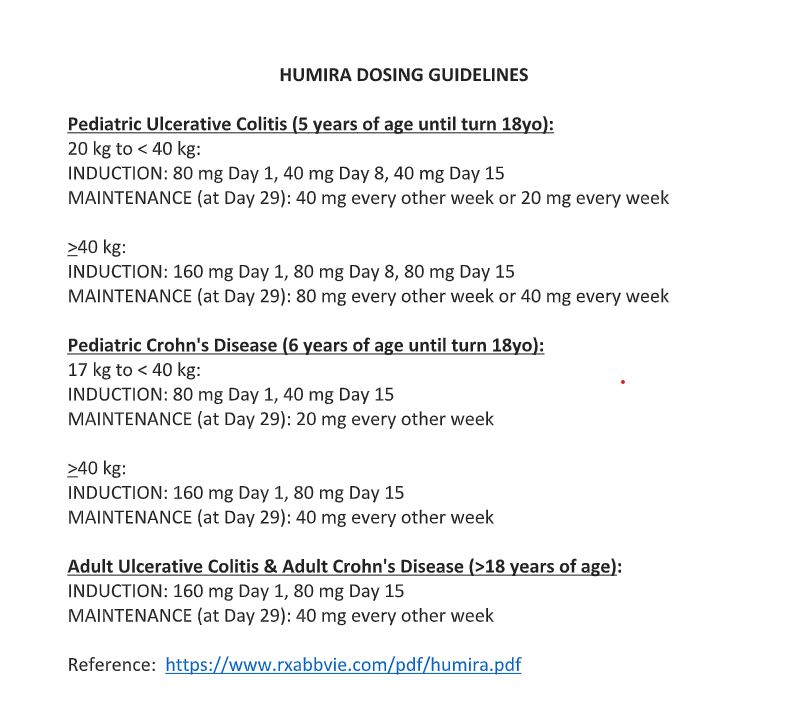
Also, Humira (adalimumab) is now FDA-approved for children as young as 5 years with ulcerative colitis: FDA Approves Adalimumab as Treatment for Children With Ulcerative Colitis (2/25/21). “This approval is based on results from the phase 3, randomized, double-blind, multicenter ENVISION I (NCT02065557) study.” Abbvie has now updated their Humira dosing recommendations (Reference:  https://www.rxabbvie.com/pdf/humira.pdf). Thanks to Clair Talmadge for this update.

Disclaimer: This blog, gutsandgrowth, assumes no responsibility for any use or operation of any method, product, instruction, concept or idea contained in the material herein or for any injury or damage to persons or property (whether products liability, negligence or otherwise) resulting from such use or operation. These blog posts are for educational purposes only. Specific dosing of medications (along with potential adverse effects) should be confirmed by prescribing physician.  Because of rapid advances in the medical sciences, the gutsandgrowth blog cautions that independent verification should be made of diagnosis and drug dosages. The reader is solely responsible for the conduct of any suggested test or procedure.  This content is not a substitute for medical advice, diagnosis or treatment provided by a qualified healthcare provider. Always seek the advice of your physician or other qualified health provider with any questions you may have regarding a condition.

No Benefit of Combination Therapy with Ustekinumab or Vedolizumab

C Yzet et al. Clin Gastroenerol Hepatol 2021; 19: 668-679. Full Text: No Benefit of Concomitant Immunomodulator Therapy on Efficacy of Biologics That Are Not Tumor Necrosis Factor Antagonists in Patients With Inflammatory Bowel Diseases: A Meta-analysis

In a systematic review, key findings:

  • Combination therapy was not associated with better clinical outcomes in patients receiving vedolizumab (16 studies: OR, 0.84; 95% CI, 0.68–1.05; I2=13.9%; Q test P = .17); n= 933 and n=2378 with combination therapy and monotherapy, respectively
  • Combination therapy was not associated with better clinical outcomes in patients receiving ustekinumab (15 studies: OR, 1.1; 95% CI, 0.87–1.38; I2 = 11%; Q test P = .28); n=856 and n=1926 patients with combination therapy and monotherapy, respectively

Why don’t immunomodulators seem to help? “Unlike anti-TNF, prospective studies as well as post hoc analysis of randomized controlled trial consistently reported a low immunogenicity [with ustekinumab and vedolizumab]…all the prospective studies available to date have shown no impact of immunomodulator on the trough serum level of vedolizumab or ustekinumab.”

Limitation: patients treated with combination therapy in the included studies could be more severe

My take: “This meta-analysis found that overall the use of combination therapy in patients treated with vedolizumab or ustekinumab was not associated with a clinical benefit in comparison with the use of monotherapy.”

————————————————————————————————————————–

It’s About Time: No Surprises Act

Pleasant surprises often don’t work out. Case in point: a colleague sent me an email to our joint email account letting me know that he would not be able to come to my wife’s surprise party (she probably knew anyway).

When it comes to medical billing, surprises are never intended to be pleasant. “As many as one in five patients visiting an emergency department or undergoing elective surgery receives an out-of-network bill from a clinician whom they had no ability to choose.”

It appears that improvement in this area is on the horizon. KR Chhabra et al. NEJM 2021; 384:1381-1383. No More Surprises — New Legislation on Out-of-Network Billing

Key points:

  • “Effective January 1, 2022, patients receiving an out-of-network emergency services, air-ambulance transportation, or out-of-network nonemergency services at in-network facilities may be billed only the amount they would owe for an in-network provider.”
  • “Out-of-network providers and insurers will have 30 days to agree on payment and then may invoke a binding arbitration process.”
  • “Three days before scheduled procedures, clinicians and insurers must inform patients of their expected out-of-pocket costs and clinicians’ network status and consenting to out-of-network bills can patients be balance-billed.
  • “This notice-and-consent doesn’t apply to emergency services [and] situations in which there are no in-network alternatives…patients cannot be balance billed in these cases…, even if they provide consent.”
  • “The Congressional Budget Office estimates that the law will reduce payments for some clinicians, reduce insurance premiums by up to 1%, and save the federal government nearly $17 billion over 10 years.”
  • “The law’s transparency provisions–particularly the requirements to provide advance price and network-participation information –may have a larger effect on day-to-day practice than its balance-billing provisions.”
  • Omission in law: ground-ambulance surprise bills
  • Potential effect: insurers may leverage the law to drop high-priced providers and potentially the law may lead to low-price providers to drop out of network

My take: This is a huge advance for patients/families; it is likely to reduce financial harm to patients and improve trust in the health care system.

Related blog posts:

Targeting on Social Media

A recent survey (n=464) study (TR Pendergrast et al. JAMA Intern Med 2021; 181: 550-552. Prevalence of Personal Attacks and Sexual Harassment of Physicians on Social Media) describes personal attacks that physicians experience due to social media presence.

Key findings:

  • 108 (23%) physicians reported being personally attacked on social media with no significant differences between males and females
  • Women were significantly more likely than men to report online sexual harassment: 44 (16%) vs. 3 (1.5%)
  • Attacks were common within some topics like vaccines and gun control

The authors note that their study is limited by potential sampling error and may not be representative of the physician workforce.

My take: Online harassment is common, particularly with controversial topics. The effects of these attacks is to create distress and reluctance to engage in social media.

Related blog posts:

What Happens With Double Switches of Infliximab Products

N Trystram et al. Alimentary Pharmacology & Therapeutics, 01 Mar 2021, 53(8):887-899 Outcomes after double switching from originator Infliximab to biosimilar CT-P13 and biosimilar SB2 in patients with inflammatory bowel disease: a 12-month prospective cohort study.

Key findings:

  • Drug persistence was high (94.9%) after 54 weeks in cohort of 158 patients
  • Double switching from the originator Infliximab to CT-P13 and then to SB2 was associated with continued effectiveness; this study did not identify issues related to immunogenicity or safety of anti-TNF therapy after 54 weeks of follow-up.

My take: There is very limited data on repeated infliximab product changes; this small study did not identify any problems. Due to mandates from insurance, more frequent switching is likely to be more widespread and more definitive outcome data will emerge.

Abstract:

Related blog posts:

Combating Anti-Drug Antibodies with Immunomodulators in Pediatric IBD

RJ Colman et al. Inflamm Bowel Dis 2021; 27: 507-515. Favorable Outcomes and Anti-TNF Durability After Addition of an Immunomodulator for Anti-Drug Antibodies in Pediatric IBD Patients

In this retrospective review with 89 patients who developed antidrug antibodies (ADAs), the authors identified 30 who started an immunomodulator (IM) within 3 months of developing an ADA and compared with 59 who did not start an IM. The main IM used was methotrexate (n= 28, 93%)

Key findings:

  • 61 of the 89 patients (69%) had quiescent disease based on physician global assessment at their previous clinic visit
  • The initial anti-TNF was stopped shortly after ADA detection in 36% of the No-IM patients vs none of the IM patients. Thus, anti-TNF agents durability was prolonged in the IM group.
  • Dose intensification was also undertaken at the time of ADA detection: 25 (83%) of IM group and 28 (48%) of non-IM group.
  • At 12 months, steroid-free clinical and biochemical remission on the same anti-TNF occurred in 53.9% of the IM group vs 26.8% in the No-IM group (P = 0.025).
  • Drug levels rose higher (P = 0.003) and ADA levels fell farther (P = 0.037) in the IM group than in the No-IM group
  • Lower ADAs often improved without IM: An ADA level <329 ng/mL had a 76.2% sensitivity and an 83.3% specificity for ADA reversal without IM.

My take: If a patient develops a significantly elevated anti-drug antibody, addition of methotrexate/immunomodulator along with dose intensification increases the likelihood that the anti-TNF agent will continue to be effective.

Related blog posts:

Seeing More MALS Publications

Anecdotally, I’ve seen more publications recently regarding median arcuate ligament syndrome (MALS). A recent study (JP Moak et al. J Pediatr 2021; 231: 141-147. Median Arcuate Ligament Syndrome with Orthostatic Intolerance: Intermediate-Term Outcomes following Surgical Intervention) prospectively examines the outcomes in patients with MALS and with orthostatic intolerance (OI).

Background: MALS is generally considered after other more common conditions. Typical symptoms include abdominal pain after eating or exercise and often weight loss due to fear of eating. The pain is often positional and may improve with leaning forward. The diagnostic finding of celiac artery compression may be identified in many healthy individuals (10-24% of population); thus, only severe compression, which is seen in a small number, can result in symptomatic MALS.

In this study, the key findings:

  • 31 patients with both MALS and OI were identified from 2014-2019. Median f/u after surgery was 22 months.
  • Based on questionnaires, gastrointestinal symptoms of abdominal pain, nausea, and vomiting improved in 63% (P = .007), 53% (P = .040), and 62% (P = .014) of patients, respectively. 
  • Based on questionnaires, cardiovascular symptoms of dizziness, syncope, chest pain, and palpitations improved in 45% (P = not significant), 50% (P = not significant), 54% (P = .043), and 54% (P = .037) of patients, respectively.
  • Importantly, the authors could not demonstrate a “statistical relationship between a postoperative decrease in celiac artery Doppler velocity and improvement in clinical symptoms.”
  • In an effort to gauge for a potential post-surgical placebo effect, the authors determined the degree of improvement in musculoskeletal symptoms. There was a 24% improvement which was much less than the improvement in GI symptoms.

One useful feature of this article is that the authors explicitly state how they arrive at the diagnosis of MALS. They start with an abdominal ultrasound with doppler. Criteria for suspected MALS include supine celiac artery peak systolic velocity of >300 cm/s, celiac artery/aoritic peak systolic ratio of >3:1, neutral position celiac artery peak systolic velocity of >200 cm/s, and a change in the celiac artery deflection angle of >50 degrees between inspiration and expiration. If ultrasound is abnormal, the authors obtained an enhanced CT to image inspiratory and expiratory changes in the celiac artery deflection angle, the area of stenosis, poststenotic dilation, and the collateral blood vessels. If there are discrepancies between U/S and CT, a celiac arterial angiogram is obtained.

The authors conclude that there “were minimal improvements in neurologic or psychological symptoms after MALS surgery, despite their common occurrence among patients with POTS.”

My take: This study, in agreement with others, showed that about 60% had improvement in GI symptoms including pain, nausea and vomiting. In those with OI, most continued with impaired health. Overall, MALS as a clinical entity remains a ‘needle in a haystack.’

Related blog posts

“Let Food Be Thy Medicine” and Microbial Nourishment

‘Let food be thy medicine’ has been to Hippocrates.

A recent study (RY Chen et al. NEJM 2021; 384: 1517-1528. Full text A Microbiota-Directed Food Intervention for Undernourished Children) shows that foods that benefit the microbiome can help reverse malnutrition.

Background: “Children with these levels of malnutrition have defects in the development of their gut microbiota, which leaves them with microbial communities that appear to be younger than those of their healthy counterparts”

Methods: After completing studies in mice and piglets, the authors developed several microbiota-directed complementary food (MDCF) prototypes. They compared three of these formulations with an existing ready-to-use supplementary food (RUSF) in a 1-month-long, randomized, controlled trial involving children between the ages of 12 months and 18 months with moderate acute malnutrition who were living in an urban slum known as Mirpur, located in Dhaka, Bangladesh. A total of 118 children (59 in each study group) completed the intervention.

Key findings:

  • The rates of change in the weight-for-length and weight-for-age z scores are consistent with a benefit of MDCF-2 on growth over the course of the study, including the 1-month follow-up.
  • Receipt of MDCF-2 was linked to the magnitude of change in levels of 70 plasma proteins and of 21 associated bacterial taxa that were positively correlated with the weight-for-length z score (P<0.001 for comparisons of both protein and bacterial taxa). These proteins included mediators of bone growth and neurodevelopment.
  • The mean weekly change in the weight-for-length z score was 0.021 (95% confidence interval [CI], 0.014 to 0.029) in the MDCF-2 group and 0.010 (95% CI, 0.003 to 0.017) in the RUSF group, for a between-group difference of 0.011 (95% CI, 0.001 to 0.021).
  • The mean weekly change in the weight-for-age z score was 0.017 (95% CI, 0.012 to 0.022) in the MDCF-2 group and 0.010 (95% CI, 0.004 to 0.015) in the RUSF group, for a between-group difference of 0.008 (95% CI, 0.001 to 0.015).

My take: This study supports the notion that alterations in the microbiome need to be restored for healthy growth and development. Further studies are needed regarding the durability of the improvements induced by the MDCF and long-term outcomes.

Options If Coverage Denied by Insurance

From GI & Hepatology News (3/27/21): Fighting back against payer coverage policies

  • Ask for the credentials of the payer representative who initially denied the request. Even when payer representatives are physicians, they are often not gastroenterologists. Ask to speak with a representative actively practicing gastroenterology.
  • Ask to record your conversation with the payer representative for documentation purposes.Ask to speak directly to the payer’s medical director.
  • Bring the complaint to the payer’s attention on social media. Using social media to bring attention to a denial can sometimes elicit quick, personal outreach from the payer to address the issue.
  • Let the AGA know what’s happening. Reach out to the AGA via the AGA Community, via Twitter, or by emailing Leslie Narramore, the director of regulatory affairs at AGA (lnarramore@gastro.org).
  • File a complaint with the State Insurance Commissioner. State Insurance Commissioners are responsible for regulating the insurance industry in their state and can investigate to ensure the laws in their state are being followed and providers and patients are being treated fairly. While insurance law and regulation are established at the state level, the insurance commissioners are members of the National Association of Insurance Commissioners (NAIC), which allows them to coordinate insurance regulation among the states and territories. Find out your state’s complaint process because many state insurance commissioners have on online complaint forms. Keep records of all interactions with the insurance company to document that you have attempted to resolve the matter with the payer first.
  • File a complaint at the federal level for states without an external review process. If your state doesn’t have an external review process that meets the minimum consumer protection standards, the federal government’s Department of Health & Human Services oversees an external review process for health insurance companies in your state. See www.healthcare.gov/appeal-insurance-company-decision/external-review/ for more information. In states where the federal government oversees the process, insurance companies may choose to participate in an HHS-administered process or contract with independent review organizations. If your plan doesn’t participate in a state or HHS-Administered Federal External Review Process, your health plan must contract with an independent review organization.

Related blog post: