I am a pediatric gastroenterologist at GI Care for Kids (previously called CCDHC) in Atlanta, Georgia. The goal of my blog is to share some of my reading in my field more broadly. In addition, I wanted to provide my voice to a wide range of topics that often have inaccurate or incomplete information.
Before starting this blog in 2011, I would tear out articles from journals and/or keep notes in a palm pilot. This blog helps provide an updated source of information that is easy to access and search, along with links to useful multimedia sources.
I was born and raised in Chattanooga. After graduating from the University of Virginia, I attended Baylor College of Medicine. I completed residency and fellowship training at the University of Cincinnati at the Children’s Hospital Medical Center. I received funding from the National Institutes of Health for molecular biology research of the gastrointestinal tract.
During my fellowship, I had the opportunity to work with some of the most amazing pediatric gastroenterologists and mentors. Some of these individuals included Mitchell Cohen, William Balistreri, James Heubi, Jorge Bezerra, Colin Rudolph, John Bucuvalas, and Michael Farrell. I am grateful for their teaching and their friendship. During my training with their help, I received a nationwide award for the best research by a GI fellow.
I have authored numerous publications/presentations including original research, case reports, review articles, and textbook chapters on various pediatric gastrointestinal problems. In addition, I have been recognized by Atlanta Magazine as a "Top Doctor" in my field multiple times.
Currently, I am the vice chair of the section of nutrition for the Georgia Chapter of the American Academy of Pediatrics. In addition, I am an adjunct Associate Clinical Professor of Pediatrics at Emory University School of Medicine. Other society memberships have included the North American Society for Pediatric Gastroenterology Hepatology and Nutrition (NASPGHAN), American Academy of Pediatrics, the Food Allergy Network, the American Gastroenterology Association, the American Association for the Study of Liver Diseases, and the Crohn’s and Colitis Foundation.
As part of a national pediatric GI organization called NASPGHAN (and its affiliated website GIKids), I have helped develop educational materials on a wide-range of gastrointestinal and liver diseases which are used across the country. Also, I have been an invited speaker for national campaigns to improve the evaluation and treatment of gastroesophageal reflux disease, celiac disease, eosinophilic esophagitis, hepatitis C, and inflammatory bowel disease (IBD). Some information on these topics has been posted at my work website, www.gicareforkids.com, which has links to multiple other useful resources.
I am fortunate to work at GI Care For Kids. Our group has 17 terrific physicians with a wide range of subspecialization, including liver diseases, feeding disorders, eosinophilic diseases, inflammatory bowel disease, cystic fibrosis, DiGeorge/22q, celiac disease, and motility disorders. Many of our physicians are recognized nationally for their achievements. Our group of physicians have worked closely together for many years. None of the physicians in our group have ever left to join other groups. I have also worked with the same nurse (Bernadette) since I moved to Atlanta in 1997.
For many families, more practical matters about our office include the following:
– 14 office/satellite locations
– physicians who speak Spanish
– cutting edge research
– on-site nutritionists
– on-site psychology support for abdominal pain and feeding disorders
– participation in ImproveCareNow to better the outcomes for children with inflammatory bowel disease
– office endoscopy suite (lower costs and easier scheduling)
– office infusion center (lower costs and easier for families)
– easy access to nursing advice (each physician has at least one nurse)
I am married and have two sons (both adults). I like to read, walk/hike, bike, swim, and play tennis with my free time.
I do not have any financial relationships with pharmaceutical companies or other financial relationships to disclose. I have helped enroll patients in industry-sponsored research studies.
Methods: This study used the NEOMUNE-NeoNutriNet cohort of VLBW infants from 13 neonatal intensive care units (NICUs) in 5 continents (n = 2831). NEC incidence was compared between infants who received early antibiotics and those who did not.
Key finding:
The incidence of NEC was 9.0% in the group of infants who did not receive early antibiotics (first 72 hrs) (n = 269), compared with 3.9% in those who did receive early antibiotics (n = 2562)
This type of study is inherently difficult due to measured and unmeasured confounders. In a related commentary, Joseph Cantey (Early Antibiotic Therapy and Adverse Outcomes in Preterm Infants: Time for a Trial!, https://doi.org/10.1016/j.jpeds.2020.07.046) notes that some previous studies have shown an association of antibiotics with increased risk of NEC, presumably due to a selection bias (eg. sicker patients getting antibiotics). Fortunately a randomized prospective trial is underway, the NICU Antibiotics and Outcomes (NANO, NCT03997266). This should help determine more carefully the risks and benefits of antibiotics in this vulnerable population.
My take: We have a lot to learn about modulating the premature infant’s microbiome to prevent necrotizing enterocolitis.
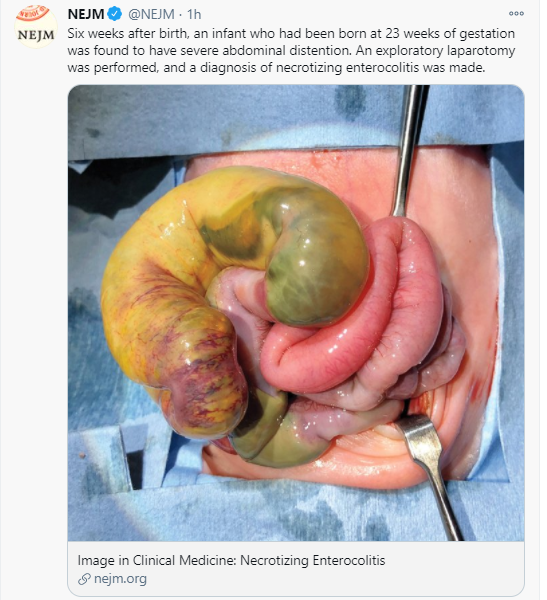
Case report: NEJM 2020; 383: 25: 2461. Patient who weighed 520 gram at birth (23 week gestation) developed NEC; she recovered and all orally fed at time of discharge.
This prospective single-institution cohort study with 73 patients had 128 Central Line-Associated Bloodstream Infections (CLBSI) in 35 patients during the study period (2015-2018).
Key findings:
The probability of a blood culture becoming positive after 24 hours was 2.3%; only 1 blood culture became positive after 30 hours (none beyond 48 hrs).
The median time from blood sampling to positive culture was 11.1 hours.
Elevated C-reactive protein and neutrophil predominance in white blood cell count were associated with positive blood cultures
My take: 98% is not good enough. For now, 48-hours is the safest policy.
Disclaimer: This blog, gutsandgrowth, assumes no responsibility for any use or operation of any method, product, instruction, concept or idea contained in the material herein or for any injury or damage to persons or property (whether products liability, negligence or otherwise) resulting from such use or operation. These blog posts are for educational purposes only. Specific dosing of medications (along with potential adverse effects) should be confirmed by prescribing physician. Because of rapid advances in the medical sciences, the gutsandgrowth blog cautions that independent verification should be made of diagnosis and drug dosages. The reader is solely responsible for the conduct of any suggested test or procedure. This content is not a substitute for medical advice, diagnosis or treatment provided by a qualified healthcare provider. Always seek the advice of your physician or other qualified health provider with any questions you may have regarding a condition.
Over a third of the respondents reported incorrectly testing patients for H. pylori while they were taking proton pump inhibitors.
17% (n=17) incorrectly preferred blood serology as testing modality
63% (n=64) relied on symptom resolution as indication of cure
My take: It would be interesting to compare pediatric gastroenterology provider responses to general pediatric providers. It is likely that a much higher percentage would be following established guidelines. One area of the guidelines that I think should be changed would be encouraging increased use of quadruple therapy in children, especially if resistance testing is not performed; this change would better align with adult guidelines. In adults, quadruple therapy has been associated with increased cure rates.
Background: Traditional pancreatic enzyme replacement therapy is not designed for use with enteral feedings. “Only 1 FDA-approved PERT (PERTZYE, Cheisi, Inc.) has a package insert with instructions on how to deliver the contents of the lowest dose capsule (4000 USP lipase unit) through gastrostomy tubes 14 French or larger…Two recently published studies demonstrated the safety, tolerability, and effect on FA absorption of a new enzyme strategy to aid fat digestion with continuous enteral feedings, a single use digestive cartridge containing immobilized lipase (RELiZORB; Alcresta Therapeutics, Newton, MA). The cartridge connects in-line with an enteral feeding set. As enteral formula flows through the cartridge, immobilized lipase enzyme hydrolyzes intact triglyceride fats within the formula into more absorbable forms, whereas the lipase is retained within the cartridge.”
Key findngs:
Weight percentiles reached 50% in 18%, 25.5%, and 28.9% of patients at 0, 6, and 12, respectively.
BMI reached 50% in 37.1%, 49.1%, and 50.0% in patients at 0, 6, and 12 months, respectively.
My take: “Immobilized lipase cartridge use demonstrated statistically significant improvements in growth in patients with cystic fibrosis requiring enteral feedings.” Newer and more effective therapies for Cystic Fibrosis may decrease the need for enteral supplementation along with lipase cartridge.
A recent study (AC Fifi et al. J Pediatr 2020; 227: 77-80.Full text PDF: Celiac Disease in Children with Functional Constipation: A School-Based Multicity Study) shows that celiac disease was not more prevalent in Colombian children with functional constipation(n=203) than in matched healthy controls (n=419). Patients were recruited from public schools.
Key finding:
The overall prevalence of celiac disease in the entire cohort was 0.6%. Of those with functional constipation, 1 (0.5%) was diagnosed with celiac disease, and 3 (0.7%) of the control patients
The authors note that some prior publications (references 11 and 12) have found a slight increase risk of celiac disease in children with constipation.
My take: In children with functional constipation, the yield from testing for celiac disease is very low and probably not significantly greater than the general population. In children with irritable bowel syndrome (which is often confused with constipation), the yield is probably a bit higher.
“The U.S. Food and Drug Administration (FDA) is alerting the public that preliminary results from a safety clinical trial show an increased risk of serious heart-related problems and cancer with the arthritis and ulcerative colitis medicine Xeljanz, Xeljanz XR (tofacitinib) compared to another type of medicine called tumor necrosis factor (TNF) inhibitors. FDA required the safety trial, which also investigated other potential risks including blood clots in the lungs and death. Those final results are not yet available….
Patients should not stop taking tofacitinib without first consulting with your health care professionals, as doing so may worsen your condition. Talk to your health care professionals if you have any questions or concerns.”
In this retrospective observational longitudinal cohort study with 3007 patients with IBD from the ImproveCareNow Network, the authors found a high rate of continued linear growth after expected growth plate closure (15 years in females, 17 years in males).
Key findings:
80% manifested continued growth beyond the time of expected growth plate closure, more commonly in CD (81%) than UC (75%; P = 0.0002)
Median height gain was greater in males with CD (1.6 cm) than in males with UC (1.3 cm; P = 0.0004), and in females with CD (1.8 cm) than in females with UC (1.5 cm; P = 0.025)
My take: This study provides additional information about delayed skeletal maturation in the pediatric population with inflammatory bowel disease. Interestingly, the rate of continued growth with ulcerative colitis was nearly as high as with Crohn’s disease.
Using more than 11 million subjects enrolled in Nationwide Korean database, the authors explored the associations between statin use and fatty liver disease in adults (20 yrs or older).
Key findings:
The use of statin was associated with a reduced risk of NAFLD development (adjusted odds ratio [AOR] 0.66; 95% confidence interval [CI] 0.65–0.67). NAFLD was diagnosed by calculating fatty liver index (FLI).
The use of statins reduced the risk of significant liver fibrosis (AOR 0.43; 95% CI 0.42–0.44). Fibrosis was based on a BARD score ≥ 2.
The effects of statins may be mediated by anti-inflammatory and antifibrotic actions, which have been evident in experimental models of chronic liver disease.
My take: Statin use appears beneficial in patients with NAFLD. Since dyslipidemia is frequent in patients with NAFLD, there should be a low threshold for using statin therapy.
NAFLD Guidance from AASLD (2018) One of the recommendations includes the following: In patients with suspected NAFLD, the authors recommend evaluation for comorbidities including dyslipidemia, diabetes, hypothyroidism, polycystic ovary syndrome, and sleep apnea.
A recent editorial (NL Schecter et al. JAMA Pediatr. 2021;175(1):7–8. doi:10.1001/jamapediatrics.2020.1798. Full text: The Golden Half Hour in Chronic Pediatric Pain—Feedback as the First Intervention -thanks to Ben Gold for this reference) notes that with pain we need to take a more holistic approach: ” Commonly, patients with chronic pain are evaluated by multiple clinicians, including pediatricians and specialists, each of whom may have addressed only one of the child’s persistent symptoms (ie, headache, abdominal pain, dizziness, nausea, or fatigue). When each symptom is addressed in isolation, it seldom provides comprehensive relief. Moreover, this process can foster a family’s belief that each symptom represents a distinct illness.”
Key points:
Brief feedback discussion following an assessment for pediatric chronic pain may be akin to the “golden hour” in trauma or neonatal care. During this critical time, there is an opportunity to connect with a family, clarify misconceptions, move toward a shared biopsychosocial understanding of pain, and engage families in a comprehensive plan for recovery.”
Tips for mastering the golden hour:
Elicit Parent and Child Expectations at the Outset “This facilitates a thorough understanding of a family’s main concerns, reduces anxiety, and improves satisfaction. For example, if a parent reports that they expect their child to undergo additional diagnostic testing, this needs to be appreciated and addressed during the feedback.”
Validate Symptoms “Explicitly stating that you do not believe the child is “faking” or that the problem is merely due to psychological stress is critical”
Offer a Positive Diagnosis “Although you are special, your symptoms are not unique or mysterious…. If the focus is on what has been ruled out, there are always additional diagnoses that you, the patient, or the internet can introduce.”
Provide Education “it can be helpful to explain that chronic pain is like a fire alarm that keeps ringing although there is no fire. “
Emphasize a Multidisciplinary Intervention Plan plan for medical intervention, psychological support, and physical activity
Offer an Optimistic Appraisal “optimistic appraisals are most effective when a clinician has first validated a child’s pain, provided a positive diagnosis and education, and outlined an evidence-based, multidisciplinary approach to care”
My take: This article offers helpful advice. However, whether there is a “golden hour” of opportunity is not clear. Having better outcomes with early intervention could easily be related, at least in part, to selection bias.
Random blinded allocation (1:1) to either 30 mg lansoprazole (n=172) twice daily or matched placebo (n=174) twice daily for 16 weeks of patients with persistent throat symptoms.
Eligible patients had persistent (>6 weeks) unexplained throat symptoms—principally hoarseness, throat pain, globus sensation, throat clearing, postnasal secretions or excess mucus, cough, or choking sensation
Primary outcome was symptomatic response at 16 weeks measured using the total reflux symptom index (RSI) score.
Key finding:
No evidence was found of benefit from PPI treatment in patients with persistent throat symptoms. RSI scores were similar between the lansoprazole and placebo groups after 16 weeks of treatment and at the 12 month follow-up.
Improvements (reduction in RSI score) were observed in both groups—score at 16 weeks: lansoprazole 17.4 (15.5 to19.4) and placebo 15.6 (13.8 to 17.3). No statistically significant difference was found between the treatment arms. Furthermore, “no trends were in favour of lansoprazole.”
Limitation: “Our trial could be criticised for lacking any objective measure of GORD within the methodology or for employing any such test as an inclusion criteria. However, we did address the use of PPIs in an empirical setting, which was a near universal practice at the time of our study.”
My take (borrowed in part from authors): “No evidence supports the empirical use of PPIs to treat persistent throat and voice symptoms.” Despite this finding, “old habits die hard” and I predict that it will be a long time before this finding is widely adopted into clinical practice.