Unknown's avatar

About gutsandgrowth

I am a pediatric gastroenterologist at GI Care for Kids (previously called CCDHC) in Atlanta, Georgia. The goal of my blog is to share some of my reading in my field more broadly. In addition, I wanted to provide my voice to a wide range of topics that often have inaccurate or incomplete information. Before starting this blog in 2011, I would tear out articles from journals and/or keep notes in a palm pilot. This blog helps provide an updated source of information that is easy to access and search, along with links to useful multimedia sources. I was born and raised in Chattanooga. After graduating from the University of Virginia, I attended Baylor College of Medicine. I completed residency and fellowship training at the University of Cincinnati at the Children’s Hospital Medical Center. I received funding from the National Institutes of Health for molecular biology research of the gastrointestinal tract. During my fellowship, I had the opportunity to work with some of the most amazing pediatric gastroenterologists and mentors. Some of these individuals included Mitchell Cohen, William Balistreri, James Heubi, Jorge Bezerra, Colin Rudolph, John Bucuvalas, and Michael Farrell. I am grateful for their teaching and their friendship. During my training with their help, I received a nationwide award for the best research by a GI fellow. I have authored numerous publications/presentations including original research, case reports, review articles, and textbook chapters on various pediatric gastrointestinal problems. In addition, I have been recognized by Atlanta Magazine as a "Top Doctor" in my field multiple times. Currently, I am the vice chair of the section of nutrition for the Georgia Chapter of the American Academy of Pediatrics. In addition, I am an adjunct Associate Clinical Professor of Pediatrics at Emory University School of Medicine. Other society memberships have included the North American Society for Pediatric Gastroenterology Hepatology and Nutrition (NASPGHAN), American Academy of Pediatrics, the Food Allergy Network, the American Gastroenterology Association, the American Association for the Study of Liver Diseases, and the Crohn’s and Colitis Foundation. As part of a national pediatric GI organization called NASPGHAN (and its affiliated website GIKids), I have helped develop educational materials on a wide-range of gastrointestinal and liver diseases which are used across the country. Also, I have been an invited speaker for national campaigns to improve the evaluation and treatment of gastroesophageal reflux disease, celiac disease, eosinophilic esophagitis, hepatitis C, and inflammatory bowel disease (IBD). Some information on these topics has been posted at my work website, www.gicareforkids.com, which has links to multiple other useful resources. I am fortunate to work at GI Care For Kids. Our group has 17 terrific physicians with a wide range of subspecialization, including liver diseases, feeding disorders, eosinophilic diseases, inflammatory bowel disease, cystic fibrosis, DiGeorge/22q, celiac disease, and motility disorders. Many of our physicians are recognized nationally for their achievements. Our group of physicians have worked closely together for many years. None of the physicians in our group have ever left to join other groups. I have also worked with the same nurse (Bernadette) since I moved to Atlanta in 1997. For many families, more practical matters about our office include the following: – 14 office/satellite locations – physicians who speak Spanish – cutting edge research – on-site nutritionists – on-site psychology support for abdominal pain and feeding disorders – participation in ImproveCareNow to better the outcomes for children with inflammatory bowel disease – office endoscopy suite (lower costs and easier scheduling) – office infusion center (lower costs and easier for families) – easy access to nursing advice (each physician has at least one nurse) I am married and have two sons (both adults). I like to read, walk/hike, bike, swim, and play tennis with my free time. I do not have any financial relationships with pharmaceutical companies or other financial relationships to disclose. I have helped enroll patients in industry-sponsored research studies.

“If this was celiac, why didn’t it stop when she cut out gluten?”

Here’s a link to a well-described case report. Her Searing Gut Pain Suggested Celiac Disease. Why Didn’t Cutting Out Gluten Help?

This 57 year old with ‘presumptive’ celiac disease did not improve with a gluten-free diet.  After an initial self-diagnosis and subsequently an endoscopy that also suggested celiac disease, she did not improve.  While the doctors involved in her care had labeled her ‘noncompliant,’ it turns out she did NOT have celiac disease and improved after the right diagnosis (diagnosis noted at bottom of this post).

My take: There are several entities that can mimic celiac disease (even histologically), including Crohn’s disease, Autoimmune enteropathy, CTLA4 deficiency, and Whipple’s disease (the diagnosis in this case).  When someone is not getting better, the diagnosis needs to be reconsidered.

Effects of Surgical Shunts on Liver Atrophy in Patients with Noncirrhotic Portal Vein Thrombosis

A recent study (AS Elnaggar et al. Liver Transplantation 2018; 24: 881-87; editorial 868-9) examine the effect of different types of surgical shunts in the setting of portal vein thrombosis (PVT).  The authors examined surgical shunts from 1998-2011 in their institution (senior author: Jean Emond).

  • 40 patients received “portal flow-preserving shunts”: 32 mesoportal and 8 selective splenorenal
  • 24 received portal flow-diverting shunts (16 nonselective splenorenal and 8 mesocaval)
  • Of these 64 patients, only 39 had preoperative and postoperative cross-sectional imaging.   In addition, only 11 patients who had mesoportal shunt (7 children and 4 adults) had preoperative and postoperative cross-sectional imaging allowing for volume comparison.

Key finding:

  • In patients receiving portal flow-preserving shunts (mainly mesoportal), this was associated with liver volume expansion (886 versus 1131 cm to the third), whereas diverting shunts were not.

The authors note that liver atrophy, especially in children, can have a “significant effect on cognitive function and somatic growth.”  Thus, restoring portal flow may improve adverse effects that PVT has caused.

Limitations:

  • Lack of validation of their formula to calculate liver volumes in the pediatric age group
  • Relatively short follow-up:5.7 months in the portal-preserving group and 11 months in the other group
  • Small numbers of patients..

Long-term followup of patients who have needed surgical shunts is needed.  For mesoportal shunts, strictures have been noted in the hepatic end in 15% of patients.

My take: This study shows that portal blood flow, which was interrupted by PVT and restored by mesoportal (Rex) shunt, is important in maintaining liver mass. So, while all shunts may stop upper GI bleeding, mesoportal shunt is likely to improve other adverse effects of PVT.

Virginia Museum of Fine Arts (Richmond) has acquired Chihuly’s Red Reeds

Are We Making Progress on Infant Sleep-Related Deaths? (Not anymore)

An interesting commentary (KP Quinlan. JAMA Pediatrics; 2018; 172: 714-6) points out the need for better surveillance and prevention efforts for sudden unexpected infant deaths (SUIDs).

Key points:

  • Since the late 1990s, there has NOT been significant improvement in SUID.  In 1999, there were 3716 SUIDs compared with 3684 in 2015.
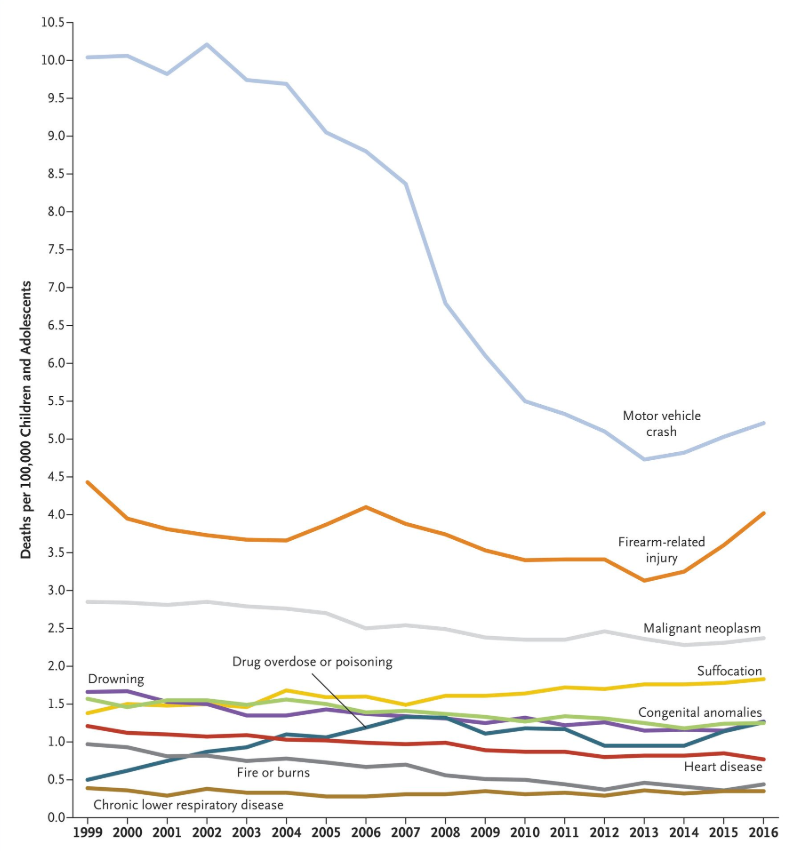
  • This rate of SUID is 9 times the rate of deaths to motor vehicle crashes for an 18 year-old driver.  The author notes the driving-related fatalities have declined by ~50% for persons younger than 20 years since 2000.
  • Promotion of safer sleeping habits is important. Bed sharing raises the SUID risk but is commonly practiced by parents from all backgrounds.
  • There is very little publicity of this problem and there is not a systematic surveillance system.  . How often do we here about a teenager involved in a crash and how often do we here about an infant with SUID? If there was more awareness of this danger, it is likely that there would be more actions taken

Related posts:

Useful website: Charlieskids.org This website has a book called “Sleep Baby Safe and Snug” which incorporates updated recommendations on safe sleep practices.

Children should sleep in the same room but on a separate surface from their parents for at least the first six months of their lives, and ideally the first year. They say that this can halve the risk of SIDS…You can read the AAP’s full guidance here. These are a few more of the pediatricians’ recommendations:

  • Infants under a year old should always sleep lying on their backs. Side sleeping “is not safe and is not advised,” the AAP says.
  • Infants should always sleep on a firm surface covered by only a flat sheet. That’s because soft mattresses “could create a pocket … and increase the chance of rebreathing or suffocation if the infant is placed in or rolls over to the prone position.”
  • Any other bedding or soft objects, like pillows or stuffed animals, could obstruct a child’s airway and increase the risk of SIDS and suffocation, according to the AAP.
  • The pediatricians say breastfeeding reduces the risk of SIDS.
  • The same goes for pacifiers at nap time and bedtime, although the doctors say the “mechanism is yet unclear.” They add that “the protective effect is observed even if the pacifier falls out of the infant’s mouth.”
  • Smoking – both during pregnancy and around the infant after birth – can increase the risk of SIDS. Alcohol and illicit drugs during pregnancy can also contribute to SIDS, and “parental alcohol and/or illicit drug use in combination with bed-sharing places the infant at particularly high risk of SIDS,” the pediatricians say.

Pain in Children with Severe Neurologic Impairment

A recent commentary (JM Hauer JAMA Pediatrics; 2018. doi: 10.1001/jamapediatrics.2018.1531) addresses a common misconception regarding children with severe neurologic impairment (SNI):

“we don’t think she experiences pain”

She notes that literature since 2002 has challenged this assumption and that this is addressed in a new AAP clinical report as well (Hauer J, Houtrow AJ. Pediatrics 2017; 139: e20171002).

Key points:

  • Children with SNI may have moaning, grimacing, changes in tone/body position in reaction to pain and treatment can make them comfortable.
  • “We can never prove that such a child does not feel pain…When parents of children with hydranencephaly were asked whether their child felt pain, 96% indicated yes.”
  • Pain can trigger changes in catecholamines, cortisol and stress hormones.  “These considerations suggest that untreated chronic pain is more harmful to the well-being of children with SNI than is treatment used for pain.”
  • Sometimes no source for pain is identified.  This may be related to a CNS etiology (alteration of CNS) and may benefit from treatment.
  • “It is time to do away with the question of whether these children feel pain and focus on how we as individuals” identify/consider pain

My take: Reframing this issue is important; pain can occur in children with SNI.  At the same time, we have to be careful that some “palliative” measures could paradoxically prolong suffering in some children.

Related blog post: Suffering


Low Adherence Rate with Polyethylene Glycol

The sentiment of wanting to get their kid off laxatives/stool softeners is frequently expressed at GI visits.  I certainly understand this.  Though, if a child is not stooling adequately when these medicines are withheld, this is usually detrimental for the child.

Given the frequency of this sentiment, it is not surprising that a recent study (IJN Koppen et al. J Pediatr 2018; 199: 132-9) reports low adherence with polyethylene glycol treatment in children with functional constipation.

In this cross-sectional survey using the Medication Adherence Report Scale (MARS-5), with scores of ≥23 indicating better adherence, the authors found that only 43 of 115 (37%) children were adherent.  The authors note that one of the determinants of adherence was treatment convenience.

The MARS-5 does not objectively measure the exact intake of medication; thus, the exact rate of adherence is unclear.  In addition, there is likely to wide variation in adherence among different populations.

My take: this study shows, at least in some populations, a low adherence with constipation therapy.  Sticking with treatment, for constipation and every other condition, usually results in better outcomes.

Related blog posts:

If someone is not taking their medication, perhaps this cereal would help. (I am not officially endorsing this product, but think the name is funny.)

Transmural Disease, Biomarkers, and Correlation between MRI and Endoscopy

A recent study (I Weinstein-Nakar et al. Clin Gastroenterol Hepatol 2018; 16: 1089-97, editorial 1037-39)) provide data from 151 children who underwent multiple modalities to assess their Crohn’s disease (CD) (ImageKids Study group).

Key findings:

  • MRE and ileocolonoscopy had concordance in 69% of cases.  55% had neither transmural nor mucosal healing, 14% had both transmural and mucosal healing.
  • MRE did not show features of active disease in 25% that was identified on ileocolonoscopy.  This is an expected finding given the ability of endoscopy (& capsule endoscopy) to identify milder mucosal lesions more precisely.
  • MRE did show evidence of disease in 6% who had unremarkable ileocolonoscopy (mucosal healing)
  • Calprotectin at a cut-off of 100 mcg/mL had 71% sensitivity and 92% specificity for diagnosing mucosal and transmural healing whereas a level of 300 mcg/mL had a sensitivity of 80% and specificity of 81%.

My take: This study confirms the complementary nature of cross-sectional imaging with endoscopy to determine healing.  In addition, in children with CD, calprotectin levels of more than 100 mcg/mL could indicate the need for further assessment (if this would affect management).

This is in agreement with another recent post: IBD Reviews: Antibiotics and Biomarkers:  “a calprotectin has a high level of excluding active inflammation/IBD. In populations with IBD, levels more than 250 mcg/g indicate a high likelihood of active inflammation whereas levels between 100-250 are indeterminate.”

Related blog posts:

Sunshine Meadows, Banff Nat’l Parke

Better Diet -Less Fatty Liver

A recent study (J Ma et al. Gastroenterol 2018; 155: 107-17) shows that a “better diet” was associated with less liver fat.

Among the 1521 participants form a Framingham Heart Study cohort (Mean age 51 years at start of study), the authors assessed diet with a 125-item Harvard food frequency questionnaire and liver fat using liver-phantom ratio (LPR) on CT images between 2002-2005 and then again 2008-2011.  They specifically looked at 2 diet scores:

  • Mediterranean-style diet score (MDS)
  • Alternative Healthy Eating Index (AHEI)

Key findings:

  • For each 1 standard deviation increase in MDS, the LPR increased (less liver fat) by 0.57 and the odds for incident fatty liver decreased by 26% (P=.002)
  • Similarly, for each 1 standard deviation increase in AHEI, LPR increased by 0.56 and the odds for incident fatty liver decreased by 21% (P=.02)

My take: This study shows that Improved diet quality over 6 years was associated with reduced liver fat accumulation

Related posts:

Lake Louise, Banff


DGAT1 Deficiency

Briefly noted: JM van Rijn et al. Gastroenterol 2018; 155: 130-43.  This study of 10 patients from 6 families (5 had consanguinity) was the largest cohort to date describing the clinical features in this disorder and used patient-derived fibroblasts and organoids to understand the pathophysiology.

Key clinical features:

  • Early-onset vomiting and/or diarrhea
  • Protein-losing enteropathy/hypoalbuminemia

Key finding in study:

  • These patients had altered lipid metabolism and were susceptible to lipid induced cell death.  Thus DGAT1 mutations cause congenital diarrhea and this is linked to fat intolerance.

Related blog posts:

Sunshine Meadows, Banff Natl Park