

Author Archives: gutsandgrowth

Tweet Week -Geographic Mortality Maps


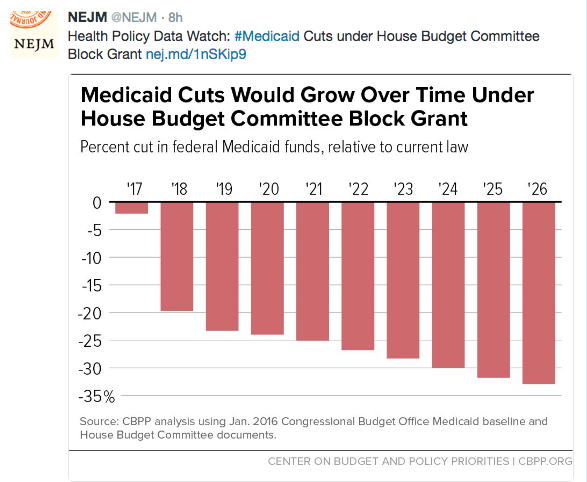
Tweet Week -Block Grants Results in Medicaid Cuts
Tweets only this week.
Tweet Week -Health Coverage & Pre-existing Conditions + IBD Tweets

Also -some tweets from IBD meeting:

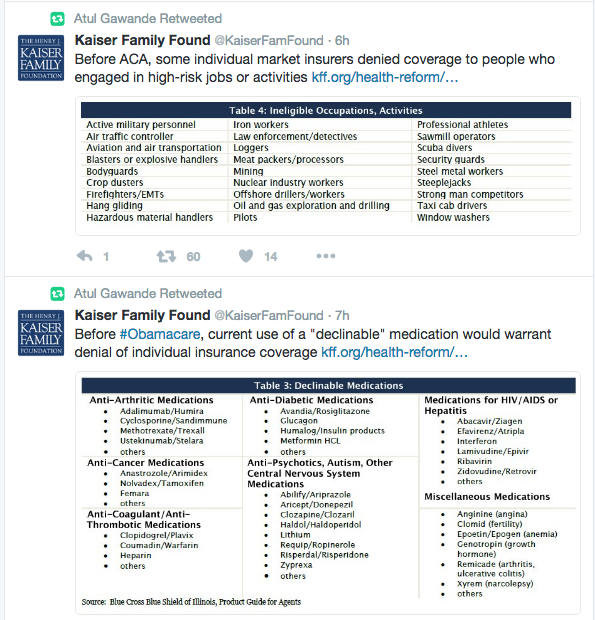
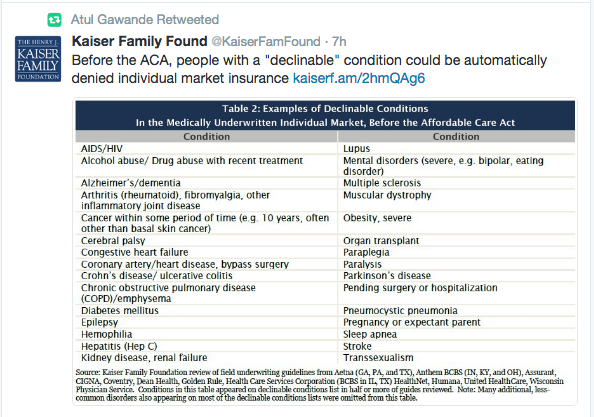
Tweet Week -Preexisting Conditions Before (? and After) Affordable Care Act
Characterizing Severe Liver Disease with Cystic Fibrosis
A recent retrospective study (JR Stonebraker et al. Clin Gastroenterol Hepatol 2016; 14: 1207-15) examined data from 561 patients (76 international centers) with cystic fibrosis (CF), liver disease and portal hypertension. The study period spanned 1999-2013. Key findings:
- Male patients were diagnosed earlier: 10 vs 11 year, p =.01. 63% of patients were males.
- Splenomegaly was noted in 99% and varices in 71%
- Levels of liver enzymes were near normal in most patients. 63% had transaminases that were less than 2 x ULN.
- 91 (16%) received liver transplants at a median age of 13.9 years. Hallmarks of those receiving liver transplants included lower platelet counts (78 vs 113, P<.0001), higher INR (1.4 vs 1.2, P<.0001), and lower albumin (3.3 vs 3.7, P =.0002).
- 99% of patients in this cohort were pancreatic insufficient
My take: In patients with CF, those with severe liver disease often present by age ~10 years. Features of portal hypertension, like splenomegaly and low platelet counts, appear to be more important than liver enzymes.
Related blog posts:

Acute Pancreatitis Review
A succinct review (CE Forsmark et al. NEJM 2016; 375: 1972-81) provides some useful pointers regarding acute pancreatitis.
The review covers the causes, epidemiology, diagnosis, prediction of severity and management. With regard to management:
- The authors advocate for aggressive fluid resuscitation during the initial 24 hrs -though care to avoid fluid overload. “One trial suggested the superiority of Ringer’s lactate as compared with normal saline in reducing inflammatory markers.”
- “Total parenteral nutrition is…more expensive, riskier, and no more effective than enteral nutrition.”
- “In patients with mild acute pancreatitis who do not have organ failure or necrosis, there is no need for complete resolution of pain or normalization of pancreatic enzyme levels before oral feeding is started.”
- “A low-fat soft or solid diet is safe and associated with shorter hospital stays than is a clear-liquid diet with slow advancement to solid foods.” Thus, most patients with mild acute pancreatitis can start a low-fat diet soon after admission, “in the absence of severe pain, nausea, vomiting and ileus.”
- By day 5, one can predict the need for enteral feeding. Early initiation of nasoenteric feeding “is not superior to a strategy of attempting an oral diet at 72 hours, with tube feeding only if oral feeding is not tolerated” by day 5.
- “Whether an elemental or semielemental formula is superior to a polymeric formula is not known”
- “Prophylaxis with antibiotic therapy is not recommended for any type of acute pancreatitis unless infection is suspected or has been confirmed.” Infection in necrotic fluid collection “is the main indication for therapy” but is rare in the first 2 weeks of illness.
- For pancreatitis triggered by gallstones, after removal of any residual stones in the ducts, “cholecystectomy performed during the initial hospitalization…reduces the rate of subsequent gallstone-related complications by almost 75%” compared to waiting for 25-30 days.
Related blog posts:
- Changing Practice Patterns with Pediatric Pancreatitis | gutsandgrowth
- Why an ERCP Study Matters to Pediatric Care | gutsandgrowth This post explains why LR may be best.
- Nutrition University / gutsandgrowth What are the nutritional management recommendations for acute pancreatitis? Justine Turner indicated that too many centers continue to rely on parenteral nutrition. Yet, guidelines recommend the use of enteral nutrition due to lower risk of poor outcomes (eg. infections when NPO and on parenteral nutrition). ‘Resting pancreas is not helpful.’ With acute pancreatitis, enzyme secretion is reduced. Her approach is to start nasogastric (NG) feedings at about 24 hours after presentation, as long as hemodynamically stable. She indicated that nasojejunal (NJ) feedings can be done if NG is not well-tolerated. NJ feedings are effective at reducing enzyme secretion. However, Praveen Goday stated that his practice was often starting with NJ feeds. “Sometimes there is only one shot” before the ICU team starts HAL. Both physicians indicated that polymeric formulas were probably acceptable; however, starting with semi-elemental or elemental feedings are often done, again as a practical matter to minimize the likelihood of reverting to parenteral nutrition.

Glacier National Park
Easily Overlooked Esophageal Inlet Patch
Background: In numerous articles, it is stated that an esophageal inlet patch (IP) is often missed during routine endoscopy. IP, a salmon-colored, velvet-appearing, distinct area of heterotopic gastric mucosa, typically is located just distal to the upper esophageal sphincter and is usually a single lesion ranging from a few millimeters to >5 cm. Estimates on prevalence ranges from 0.1% to 10%.
A recent study (G Di Nardo et al. J Pediatr 2016; 176: 99-104) examined 1000 consecutive patients <18 years. Symptoms often attributed to IP include chronic cough, sore throat, dysphagia, globus pharyngeus, hoarseness, and vocal cord dysfunction.
Key findings:
- The authors noted an IP incidence of 6.3%.
- 35 of the 63 patients were asymptomatic.
- The authors state that 17 of the 63 patients had chronic IP-related symptoms and all 17 were unresponsive to PPI therapy. All were treated “successfully” with argon plasma coagulation (APC)
- Median size was 13.3 mm.
- The authors state that they did not find any acid-independent episodes related to IP, though pH-MII studies did help identify several patients with underlying GERD.
My take: Since the treatment of IP was not randomized/blinded and many patient’s with IP are asymptomatic, it remains unclear to me how many patients with IP truly benefit from APC treatment.

Yoga Therapy for Abdominal Pain
A recent study (JJ Korterink et al. JPGN 2016; 63: 481-7) showed that yoga treatment may be helpful with children (8-18 years) with functional abdominal pain. The authors studied 69 subjects who received either standard medical care or standard care with yoga therapy. Pain intensity was followed with a pain dairy as was quality of life with KIDSCREEN-27. Key finding: At 1 year follow-up, 58% of the yoga group had a treatment response compared to 29% in the control group. Yoga therapy was associated with reduction in school absences as well as reduced abdominal pain.
While yoga is considered helpful in stress management and has been suggested as treatment for adults with irritable bowel, an associated editorial by Yvan Vanderplas (pg 451) notes that the scientific basis for yoga therapy remains weak. He notes that yoga trials are biased due to selection bias and the results are tainted due to lack of blinding with regard to the intervention.
My take: If families are interested in yoga therapy, this should be encouraged. Yoga therapy is safer and at least as effective as many other therapies offered for abdominal pain.

How to Undermine Value Care: Lessons from Pharmaceuticals
A brief commentary (LS Dafny et al. NEJM 2016; 375: 2013-15) helps explain how easy it is to prevent high-value care. The authors note that one example of encouraging high-value care is to tier drugs in insurance plans. Insurers can encourage consumers to use drugs that provide high value by providing lower copays (lower tier) and at the same time this allows the insurers some leverage with pharmaceutical manufacturers in negotiating prices of their medications. Roughly 75% of insurance plans have at least three drug tiers.
The pharmaceutical companies have “counterattacked” by offering “copayment coupons.” Since insurers still pay ~80% of the costs, even with these coupons, the manufacturers are able to shift spending to higher-priced medications and still make a considerable profit. The net effect of copayment coupons:
- “reduce the incentive for drug manufacturers to offer price concessions in exchange for preferred tier placement.”
- With these coupons, the strategy of charging “insurers the highest price possible while remaining on the formulary” takes hold
- The number of these “copayment coupons has skyrocketed.” By 2010, approximately half of brand-name drug revenue was derived from drugs with copayment coupons.
- “We estimate that coupons increase the percentage of prescriptions filled with brand-name formulations by more than 60%.” Among 85 drugs facing generic competition, “between 2007-2010, the 23 drugs with coupons likely was between $700 million to 2.7 billion higher than it would have been” without these coupons.
The authors note that health care providers may ultimately pursue similar pathways to try to get around insurance companies preferred provider panels. This could occur as insurance companies increasingly try to control costs by demanding steep discounts from providers in exchange for inclusion in more limited networks.
My take: Providing high value care is not the chief concern for private industry. Both the insurance companies and the pharmaceutical companies develop policies and countermoves to further their best interests.
Related blog posts:
- Drug Waste Costing Billions. Pharmaceutical Companies Benefit
- Deriving Measures of High Value Pediatric Care | gutsandgrowth
- More Cents in Value-Added Care | gutsandgrowth
- Cornering the Generic Markup | gutsandgrowth
- 5000% Increase for Well-Established Drug | gutsandgrowth
- Upside Down Incentives in Pharmaceutical Development -Profit …
- “This Is A Stick Up — Your Money or Your Life” | gutsandgrowth
- New Math on Drug Cost-Effectiveness” | gutsandgrowth

Jones Bridge Trail

