Gluten-Free –No Evidence It is Helpful for Healthy Individuals

A recent study (ID Croall, et al. Gastroenterol 2019; 157: 881-3) provides additional data indicating that a gluten-free diet does not confer health benefits to healthy individuals.

A double-blind randomized placebo 2-week trial with 30 healthy adults divided subjects into two groups –some received flour sachets to consume with organic gluten (14 g) and some received a gluten-free blend (rice, potato, tapioca, maize, buckwheat flour). Both groups were instructed to take their flour sachets twice a day along with a gluten-free diet (GFD).

Key finding: The group receiving gluten did not experience any increase in gastrointestinal symptoms or fatigue compared to the placebo group.

My take: While this study lasted only 2 weeks and had a small sample size, nevertheless, it adds to the literature indicating that a GFD is unlikely to be beneficial in otherwise healthy individuals. Those who stick with a GFD should seek the help of a well-qualified dietician.

Related blog posts:

Portland, OR. Portland aerial trams –between the city’s South Waterfront district and the main Oregon Health & Science University (OHSU) .

Combination Therapy Still Works for Inflammatory Bowel Disease (Part 1)

There is speculation that the use of therapeutic drug monitoring (TDM) may obviate the advantages of combination therapy. However, there is plenty of data supporting combination therapy including a recent retrospective population-based study (LE Targownik et al. Clin Gastroenterol Hepatol 2019; 17: 1788-98).

This ‘real-world’ study (2001-2016) utilized the Manitoba IBD database and included 852 persons with Crohn’s disease (CD) and 303 with ulcerative colitis (UC).

Key findings: 

  • In persons with CD, combination therapy (immunomodulator with a TNF antagonist) was associated with lower treatment ineffectiveness with an adjusted hazard ratio (aHR) for ineffectiveness at 0.62.  The ineffectiveness in UC persons was lower at 0.82 but did not reach statistical significance.
  • When looking at specific time frames, among patients with CD, at 1 year, combination therapy the rate of ineffectiveness-free treatment was 74.2% for combination therapy compared to 68.6% for monotherapy; at 2 years, the rates were 64.0% and 54.5% respectively.
  • Combination therapy in CD was associated with increased time to first IBD-related hospitalization with aHR of 0.53 and with lower rates of switching anti-TNF agents (aHR 0.63).  Lower rate of surgery (aHR 0.76) did not reach statistical significance.
  • The choice of immunomodulator (6-MP/AZA vs MTX) and the choice of anti-TNF agent (IFX or ADA) did not significantly influence the overall benefit of combination therapy.  Though, AZA was the main concomitant treatment (92%).
  • 90% of the patients in the study who received combination therapy had received immunomodulator therapy prior to combination therapy.  This is in contrast to the SONIC study in which patients were naive to both agents.
  • 57% of IFX users and 43% of ADA users received concomitant therapy.

My take: Combination therapy has been associated with higher response rates to IBD therapy.  This advantage has to be weighed against potential adverse effects.

Related blog posts:

Disclaimer: These blog posts are for educational purposes only. Specific dosing of medications/diets (along with potential adverse effects) should be confirmed by prescribing physician/nutritionist.  This content is not a substitute for medical advice, diagnosis or treatment provided by a qualified healthcare provider. Always seek the advice of your physician or other qualified health provider with any questions you may have regarding a condition.

Wizard Island. Crater Lake, OR

Appropriate Proactive Therapeutic Drug Monitoring

This blog post and tomorrow’s post highlights two articles on proactive therapeutic drug monitoring (pTDM) for inflammatory bowel disease.  The first article (K Papmichael et al.  Clin Gastroenterol Hepatol 2019; 17: 1655-68) summarizes a meeting of 13 international IBD specialists who reached consensus on 24 statements after a review of the literature.

Full Text Link:  Appropriate Therapeutic Drug Monitoring of Biologic Agents for Patients With Inflammatory Bowel Diseases

Key Recommendations:

  • For anti-tumor necrosis factor (anti-TNF) therapies, proactive TDM was found to be appropriate after induction and at least once during maintenance therapy, but this was not the case for the other biologics.
  • Reactive TDM was appropriate for all biologic agents both for primary non-response and secondary loss of response

Background/Rationale for pTDM:

  • “Numerous studies have demonstrated a positive correlation between serum biologic drug.concentrations and favorable therapeutic outcomes”
  • “Low or undetectable drug concentrations can lead to immunogenicity and treatment failures”
  • “TDM…is an important tool for optimizing biologic therapy…Data suggest that pTDM, with drug titration to a target trough concentration, performed in patients with clinical response/remission can also improve the efficacy of anti-TNFs”

Table 4  Scenarios of Applying Therapeutic Drug Monitoring of Biological Therapy in Patients With Inflammatory Bowel Disease

1-4: Anti-TNFs:

  • It is appropriate to order drug/antibody concentration testing in responders at the end of induction for all anti-TNFs.
  • It is appropriate to order drug/antibody concentration testing at least once during maintenance for patients on all anti-TNFs.
  • It is appropriate to order drug/antibody concentration testing of anti-TNFs at the end of induction in primary non-responders.
  • It is appropriate to order drug/antibody concentration testing for all anti-TNFs in patients with confirmed secondary loss of response.

5-8: Vedolizumab -agreement only on ordering TDM in non-responders or those with loss of response

9-12: Ustekinumab  -agreement only on ordering TDM in non-responders or those with loss of response

From Table 5: Biological Drug Concentrations and Anti-Drug Antibodies When Applying Therapeutic Drug Monitoring in Inflammatory Bowel Disease

  • Infliximab: 15. In the presence of adequate trough drug concentrations, anti-drug antibodies are unlikely to be clinically relevant.
  • Infliximab: 19. The minimal trough concentration for infliximab post-induction at week 14 should be greater than 3 μg/mL, and concentrations greater than 7 μg/mL are associated with an increased likelihood of mucosal healing.
  • Adalimumab: 22. The minimum drug concentration at week 4 for adalimumab should at least be 5 μg/mL. Drug concentrations greater than 7 μg/ml are associated with an increased likelihood of mucosal healing.
  • Certolizumab: 24 & 25: The minimum concentrations for certolizumab pegol at week 6 should be greater than 32 μg/mL and 15 μg/mL during maintenance.
  • Golimumab 26 & 27: The minimum drug concentration at week 6 for golimumab should at least be 2.5 μg/mL and 1 μg/mL.during maintenance

My take: This article provides extensive literature to reinforce their recommendations.  Most of the trough levels mentioned are minimum levels that need to be achieved.


“Intestinal Microbiota Transplant” -New Terminology for Fecal Transplant

A recent letter to the editor (A Khoruts, LJ Brandt, Am J Gastroenterol 114: 1176) suggests that the terms “Fecal Transplant” or “Fecal Microbiota Transplantation” (FMT) should be abandoned in favor of “intestinal microbiota transplant.”

  • First of all, the authors argue that the word “fecal” is no longer accurate as some transplants occur by swallowing capsules of purified microbiota and the days of “blending raw stool near the bedside are largely over.”
  • Secondly, the term “fecal” is highly problematic.  “We are hard-wired to perceive feces to be disgusting.”
  • Third, the media sensation from the terms FMT or fecal transplant “has not translated into substantial positive consequences, such as funding research…[or] philanthropic fundraising.”

Thus, the authors advocate “Intestinal Microbiota Transplant” or IMT.

My take: (borrowed from authors) It is time to “abandon the scatologic humor that is arguably threatening further development of this promising therapeutic approach.”

Related blog posts:

Sunrise at Crater Lake, OR

MZRW for Constipation -Effective in Double-Blind Randomized Control Trial

A recent study (LLD Zhong et al. Clin Gastroenterol Hepatol 2019; 17: 1303-10) shows that a Chinese remedy MaZiRenWan (MZRW) which is a combination of 6 herbs is an effective agent for constipation based on a double-blind, double-dummy trial of 291 patients with functional constipation. Thanks to Ben Gold for this reference.

MZRW was dosed at 7.5 mg BID and Senna was dosed at 15 mg per day. Mean age of study participants was 45 years.

Key findings:

  • Complete response, defined as an increase of stooling by 1 or more BM per week, was similar between MZRW (68%) and Senna (58%) at week 8.  Both were superior to placebo which had a 33% complete response.
  • At week 16, MZRW had better response than senna or placebo, with complete responses of 47%, 21%, and 18% respectively.
  • No serious adverse effects were reported and there were no significant differences in renal or liver function between the groups.

My take: The authors note that this remedy has been around for 2000 years.  Their data show it appears to be a well-tolerated alternative for the management of constipation in adults.

Mount Batchelor, OR

Dust Mites and Eosinophilic Esophagitis

Given seasonal fluctuation in the activity of eosinophilic esophagitis (EoE), aeroallergens have been considered a trigger in some patients.

Briefly noted: A recent study (A Ravi et al. Gastroenterol 2019; 157: 255-6, editorial 17) showed that dust mite antigen was present in esophageal biopsy specimens at a greater level in adult patients with EoE compared to controls.  With active EoE, patients had dust mite staining in 1.6% of the field which was significantly greater than patients with inactive EoE (0.7). The control group had a complete absence of epithelial dust mite staining.

The editorial (Seena Aceves) notes that these investigators have also shown gluten accumulation in the EoE esophagus.  Whether dust mite antigens or other specific postulated aeroallergens plays a causative role is unclear.  This study shows the presence of these antigens in the esophagus but does not show whether this is an epiphenomenon due to increased permeability or whether these antigens activate the local immune system.

A second study (T Patton et al. JPGN 2019; 69: e43-e48) describes the outcome of coexisting celiac disease and eosinophilic esophagitis in 22 children (from a cohort of 350 children with celiac disease. 17 had repeat biopsies.  Four of 17 (23.5%) had resolution of EoE with a gluten-free diet.  Related blog post: Is there a Link Between Eosinophilic Esophagitis and Celiac Disease?

Sagrada Familia, Barcelona

Is There a Way to Prove Which Dietary Factors Trigger Irritable Bowel Syndrome?

In a recent study (A Fritscher-Ravens et al. Gastroenterol 2019; 157: 109-18) uses confocal laser endomicroscopy (CLE) for “real-time detection and quantification of changes in intestinal tissues” related to food challenges. The authors previously had used this technique in a feasibility study (Gastroenterol 2014; 147: 1012-20). In this study, two-thirds of patients with CLE+ IBS showed improvement of IBS symptoms after a 12-month exclusion diet.

In the current study, the authors prospectively examined patients (n=108 completed study) who had irritable bowel syndrome and were convinced that this was triggered by foods (with negative IgE food allergy testing).  The CLE testing evaluated four food components

Key findings:

  • 76 of 108 (70%) had abnormal CLE; 46 of these reactions were to wheat
  • In those with CLE+ reactions, intraepithelial lymphocytes were significantly higher compared to those with CLE-negative (normal evaluations).
  • Other biomarkers associated with CLE+ included increased claudin-2 expression from crypt to villous tip, lower levels of occludin, and higher eosinophilic cationic protein.

Abnormal CLE indicated abnormal mucosal appearance including formation of epithelial leaks/gaps and widening of the intervillous spaces after food challenge.

My take: This study shows that in individuals with a strong suspicion of food-triggered IBS, immediate reactions in the mucosa can be detected with CLE in more than 50%. Whether this type of approach could/should be developed for wider use in targeting a specific diet is unclear.  More studies are needed.

Related blog posts:

Sagrada Familia, Barcelona


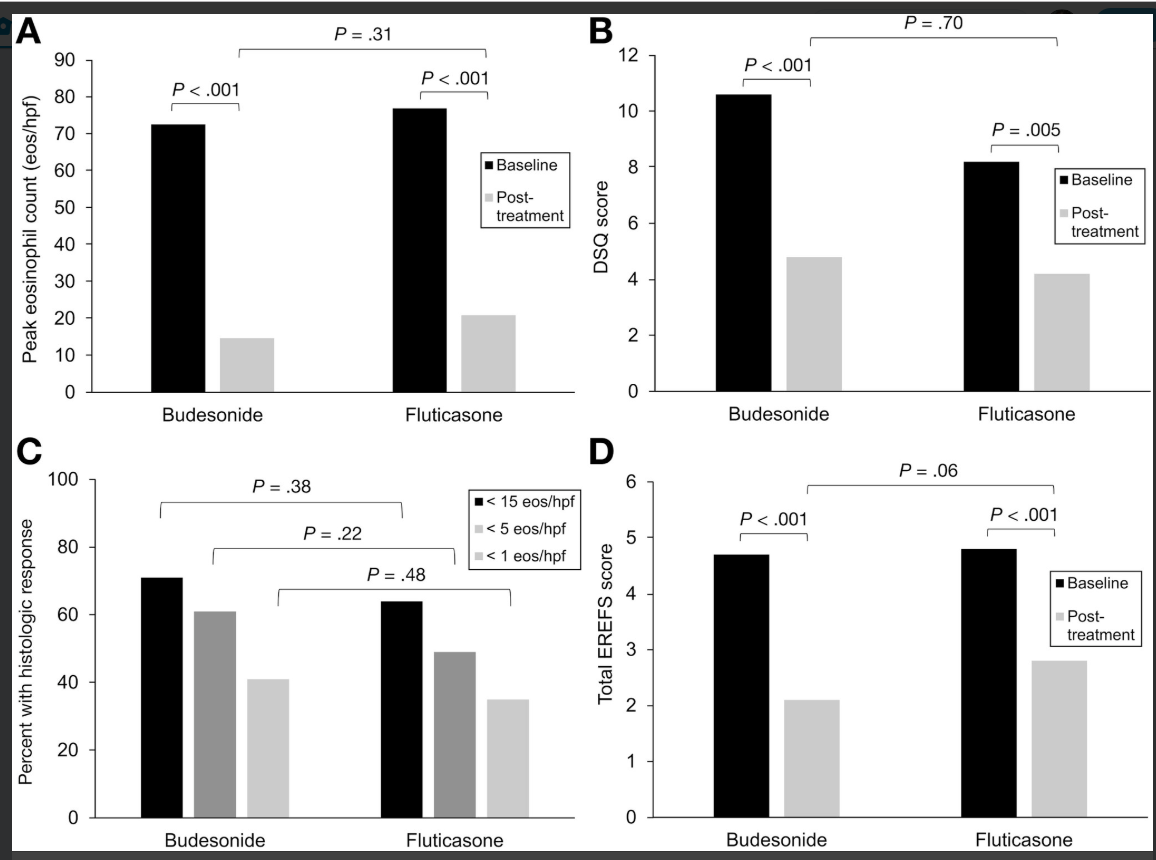
Head-to-Head: Budesonide vs Fluticasone for Eosinophilic Esophagitis

A recent double-blind, double-dummy study (ES Dellon et al. Gastroenterol 2019; 157: 65-73) found similar efficacy between budesonide and fluticasone for newly-diagnosed eosinophilic esophagitis. They had hypothesized that an oral viscous budesonide would be more effective due to increased esophageal contact time.

Methods: The authors compared an oral viscous budesonide OVB) at 1 mg BID (n=56) to fluticasone (swallowed) MDI dosed at 880 mcg BID (n=55).  Patients aged 16-80 years, with mean of 37 years.

Baseline characteristics:

  • ~95% in both groups with dysphagia
  • ~75% with any atopic condition
  • ~50% with dilatation required at baseline

Key findings:

  • Similar drop in eosinophil count: 73 (OVB) and 77 (MDI) eos/hpf at baseline to 15 and 21 respectively
  • Histologic response (<15 eos/hpf) rates of 71% (OVB) and 64% (MDI).
  • Response to <5 eos/hpf occurred in 61% OVB and 49% MDI; response to <1 eos/hpf was noted in 41% and 35% respectively
  • Symptom scores (DSQ) responded similarly as well
  • Similar degree of candidiasis 12% for OVB and 16% for MDI

In the associated editorial, the authors speculate that one reason for similar efficacy was the detailed instructions given for patients taking the MDI.

My take: This study supports both topical steroid therapies; practical issues like cost and insurance coverage could be influential in selecting the specific treatment for an individual patient.

Related blog posts:


From AGA twitter feed

Is There Renal Toxicity with Mesalamine Therapy for IBD?

A recent study (V Jairath et al. AP&T 2019; https://doi.org/10.1111/apt.15408) provides evidence that 5-aminosalicylic acid therapy for IBD does NOT increase the risk of nephrotoxicity.  This paper’s findings run counter to more than thirty years of teaching on this medication.

Full Free Link: No increased risk of nephrotoxicity associated with 5‐aminosalicylic acid in IBD: a population‐based cohort and nested case‐control study

Abstract (bold highlighted by blog author):

Background

There is conflicting evidence about nephrotoxicity risk associated with 5‐aminosalicylates for treatment of IBD.

Methods

Retrospective cohort and nested case‐control study, using the Health Improvement Network primary care database linked to hospital discharge coding for patients in England, 1996‐2017. Nephrotoxicity risk analysis was a first recorded renal impairment diagnosis adjusted for key variables and was assessed between 2008 and 2017.

Results

A total of 35 601 patients with prevalent UC or CD were included. The proportion of patients prescribed 5‐aminosalicylates fell from 83% in 1996‐1999 to 71% in 2012‐2015 for UC patients and 64% to 45% for CD patients. Thirty per cent of patients had prolonged 5‐aminosalicylate use. Between 2008 and 2017, the incident rate of nephrotoxicity was similar and stable for UC (12.6/1000 person‐years) and CD (10.9/1000 person‐years) patients. Multivariate analysis showed no evidence for association between current prescription of 5‐aminosalicylate and nephrotoxicity in UC or CD patients, comparing ≤ 30 days prescription prior to index vs 31‐≤180 days. However, active disease, disease duration, concomitant cardiovascular disease or diabetes and nephrotoxic drug use were independently associated with development of nephrotoxicity in UC and CD.

Conclusions

Despite the paucity of evidence for their benefit, 5‐aminosalicylates were prescribed to approximately half of CD patients (30% prolonged therapy). Nephrotoxicity was rare in this patient cohort, and was not associated with 5‐aminosalicylate use, but rather with disease status, comorbidity and use of nephrotoxic drugs.

Related blog posts:

Park Guell, Barcelona

Disclaimer: These blog posts are for educational purposes only. Specific dosing of medications/diets (along with potential adverse effects) should be confirmed by prescribing physician/nutritionist.  This content is not a substitute for medical advice, diagnosis or treatment provided by a qualified healthcare provider. Always seek the advice of your physician or other qualified health provider with any questions you may have regarding a condition


PPIs: Good News on Safety

When someone gets bitten by a shark, it often makes the news.  Yet, the frequency of shark attacks is rare and it is probably much more dangerous driving to the beach than getting into the water.

For proton pump inhibitors, it seems that they get similar press coverage as shark bites.  Many times potential adverse effects are covered heavily by the media even though many of these effects are unproven or very infrequent.

A recent study (“Safety of Proton Pump Inhibitors Based on a Large, Multi-year, Randomized Trial of Patients Receiving Rivaroxaban or Aspirin” Moayyedi, Paul et al. Gastroenterology DOI: https://doi.org/10.1053/j.gastro.2019.05.056) shows that 3 years of pantoprazole had an excellent safety profile.

Here is the abstract:

Background & Aims

Proton pump inhibitors (PPIs) are effective at treating acid-related disorders. These drugs are well tolerated in the short term, but long-term treatment was associated with adverse events in observational studies. We aimed to confirm these findings in an adequately powered randomized trial.

Methods

We performed a 3×2 partial factorial double-blind trial of 17,598 participants with stable cardiovascular disease and peripheral artery disease randomly assigned to groups given pantoprazole (40 mg daily, n=8791) or placebo (n=8807). Participants were also randomly assigned to groups that received rivaroxaban (2.5 mg twice daily) with aspirin (100 mg once daily), rivaroxaban (5 mg twice daily), or aspirin (100 mg) alone. We collected data on development of pneumonia, Clostridium difficile infection, other enteric infections, fractures, gastric atrophy, chronic kidney disease, diabetes, chronic obstructive lung disease, dementia, cardiovascular disease, cancer, hospitalizations, and all-cause mortality every 6 months. Patients were followed up for a median of 3.01 years, with 53,152 patient years of follow up.

Results

There was no statistically significant difference between the pantoprazole and placebo groups in safety events except for enteric infections (1.4% vs 1.0% in the placebo group; odds ratio, 1.33; 95% CI, 1.01–1.75). For all other safety outcomes, proportions were similar between groups except for C difficile infection, which was approximately twice as common in the pantoprazole vs the placebo group, although there were only 13 events, so this difference was not statistically significant.