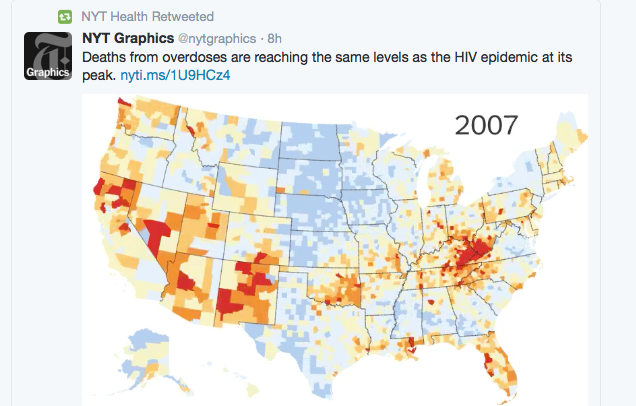
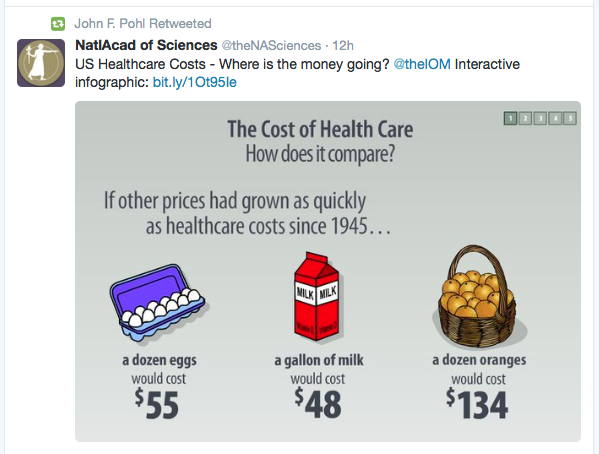
How the Epidemic of Drug Overdose Deaths Ripples Across America -The New York Times.
Graphics from NY Times Health Twitter Feed and Related Article :
How the Epidemic of Drug Overdose Deaths Ripples Across America -The New York Times.
Graphics from NY Times Health Twitter Feed and Related Article :
I learned this week that the Crohn’s & Colitis Foundation of America (CCFA) was founded in part based on a love story:
From CCFA: Irwin M. Rosenthal, one of the visionary co–founders of CCFA, and Suzanne were due to be married in a few months time when suddenly Suzanne became very ill. Motivated by her struggle with Crohn’s disease, Irwin, along with William and Shelby Modell, and Dr. Henry D. Janowitz, established the Foundation for Research in Ileitis, now known as the Crohn’s & Colitis Foundation of America.
To send an CCFA eValentine: CCFA Valentine E-card
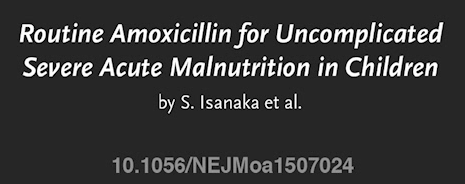
Another terrific summary of an NEJM article on the use of amoxicillin for acute uncomplicated severe malnutrition in Niger. Link: 86 second Quick Take on Antibiotics for Malnutrition
Related blog posts:
A recent commentary from the NY Times (A Healthy Diet’s Main Ingredients? Best Guesses) explores some of the failed efforts to improve health by reducing fat or eliminating eggs and explains why these are no longer recommended. The article has a 12 minute video which reviews some of the confusion regarding dietary recommendations.
Here’s an excerpt:
Conventional wisdom held that fat was bad, period, with relatively few Americans distinguishing between saturated fats (meat, eggs, dairy products) and healthier unsaturated fats (fish, vegetable oils, nuts). Typically, people turned to breads, cereals and potatoes — and to sugary soft drinks — for the calories they no longer got from protein-rich foods…The result? Carbo-loading Americans grew fatter. “We put the whole country on a low-fat diet,” Mr. Taubes said, “and, lo and behold, we have an obesity epidemic.”…
New guidelines are expected to be issued this month by the Departments of Agriculture and of Health and Human Services, which tend to follow the recommendations of an advisory committee. One likely eye-catcher is a new assessment of cholesterol, long an archvillain. It seems destined for rehabilitation to some degree. Months ago, the advisory committee concluded that the dietary intake of cholesterol (the body produces this waxy, artery-obstructing matter on its own) had no real effect on blood levels of LDL, the so-called bad cholesterol. “Cholesterol,” the committee said, “is not a nutrient of concern for overconsumption.”
There is a conspicuous American tendency to cling to a favored diet as the gateway to good health, keeping weight down, staving off cancers and banishing heart attacks. A consequence is an abundance of regimens — vegan, gluten-free, Paleolithic, fruitarian and many more — each promoted by its adherents as the one true path.
But nutrition experts, including those in this Retro Report, caution that life is complex, and that we are more than what we eat.
Related blog posts:
I found a recent perspective (Y Tache. Gastroenterol 2015; 149: 1662-65) on mentoring of interest, particularly on the historic basis which I had forgotten.
“In Homer’s book, the Odysseus, Mentor was a loyal friend and adviser to Odusseus (Ulysses), King of Ithaca. When Ulysses left his kingdom to participate in the Trojan War, he entrusted Mentor with the education of his son, Telemachus…This character of Greek mythology became famous only at the beginning of the 18th century in the context of the didactic French novel entitled “Les Aventures de Telemaque.”
My take: it is interesting to understand where the term “mentor” comes from. I feel fortunate to have had some terrific mentors.
The Institute of Medicine’s (now called the National Academy of Medicine) “Improving Diagnosis in Health Care” (the link includes a link to a 1-hour briefing) is receiving a lot of attention. One recent commentary (H Singh, ML Graber. NEJM 2015; 373: 2493-95) elaborates on this issue. The IOM reports notes that “diagnostic errors affect at least 1 in 20 U.S. adults in outpatient settings each year, or 12 million adults per year.”
The report recommends “strengthening teamwork, reforming the teaching of diagnosis, ensuring that health information technology (IT) supports the diagnostic process, measuring and learning from errors in real-world practice, promoting a culture of diagnostic safety, reforming the malpractice and reimbursement systems, and increasing research funding.”
My take: This report highlights an enormous challenge for the healthcare system. While IT support in theory sounds like it could help, right now IT isn’t helping much. Many physicians are bogged down inputting data and trying to find enough time for critical thinking. There is a lot of work ahead.
Happy New Year!
———————–
“Adults are just obsolete children” –Theodor Seuss Geisel
So, begins an interesting commentary (B Kinnear. JAMA pediatrics 2015; 169: 1081-2 -thanks to Ben Gold for this reference).
This editorial discusses a growing problem of patients older than 21 years of age seeking care in pediatric institutions. Currently, ~15,000 admissions occur annually in the U.S.. At the author’s institution (Cincinnati Children’s), the average daily hospital census was 15.7 patients between 2012-2014. In fact, at Cincinnati, which has an adult care hospital across the street, they have developed a team to care for these patients: “the Hospital Medicine Adult Care team.” In addition, they have established protocols to recognize and initiate treatment on problems like acute coronary syndrome, pulmonary embolism, and acute stroke.
The author argues that age should not be the only factor determining which institution would offer the best care. Some cognitively impaired adults with cerebral palsy may be better-suited at a pediatric facility and some obese teenagers with type 2 diabetes and hypertension may fit better at an adult care hospital.
Common barriers to transitioning to adult care hospitals:
These adults in pediatric care settings do have increased length of stays and greater odds of mortality than adolescents, even when adjusting for the increased number of chronic conditions. Thus, it is not entirely clear that outcomes will be improved by retaining this vulnerable population at pediatric institutions. Much of this question will be determined by the institutional resources available for their care.
My take: I worry that keeping adults (patients >21 years) in pediatric institutions is a mistake. There are increasing numbers of vulnerable patients and their needs should be addressed by adult care providers.

In September, this blog (Does Staying Up All Night Affect Surgery the Next Day …) noted a recent study indicating that adverse surgical outcomes with elective daytime procedures were similar irrespective of whether the surgeon had operated overnight. Some of the letters to the editor on this study were of interest. In one, the authors note that sleep deprivation was associated with a lower adenomatous polyp detection rate on colonoscopy but was not associated with major complications like death or perforation (M Benson et al. Am J Gastroenterol 2014; 109; 1133-7). Thus, the letter contends that there are likely to be subtle effects of sleep deprivation on physician performance that could require more sensitive quality metrics.
Another letter notes that extended work was associated with an increased risk of motor vehicle accidents by interns. The monthly risk increased 16.2% for every extended work shift (LK Barger et al. NEJM 2005; 352: 125-34). Thus, sleep deprivation could represent a hazard for the physician themselves as well as their patients.
My take: I’m sorry I didn’t quite follow this post. (I was on-call last night.)