Bariatric Surgery Survival – 5 Countries, 500,000 Participants

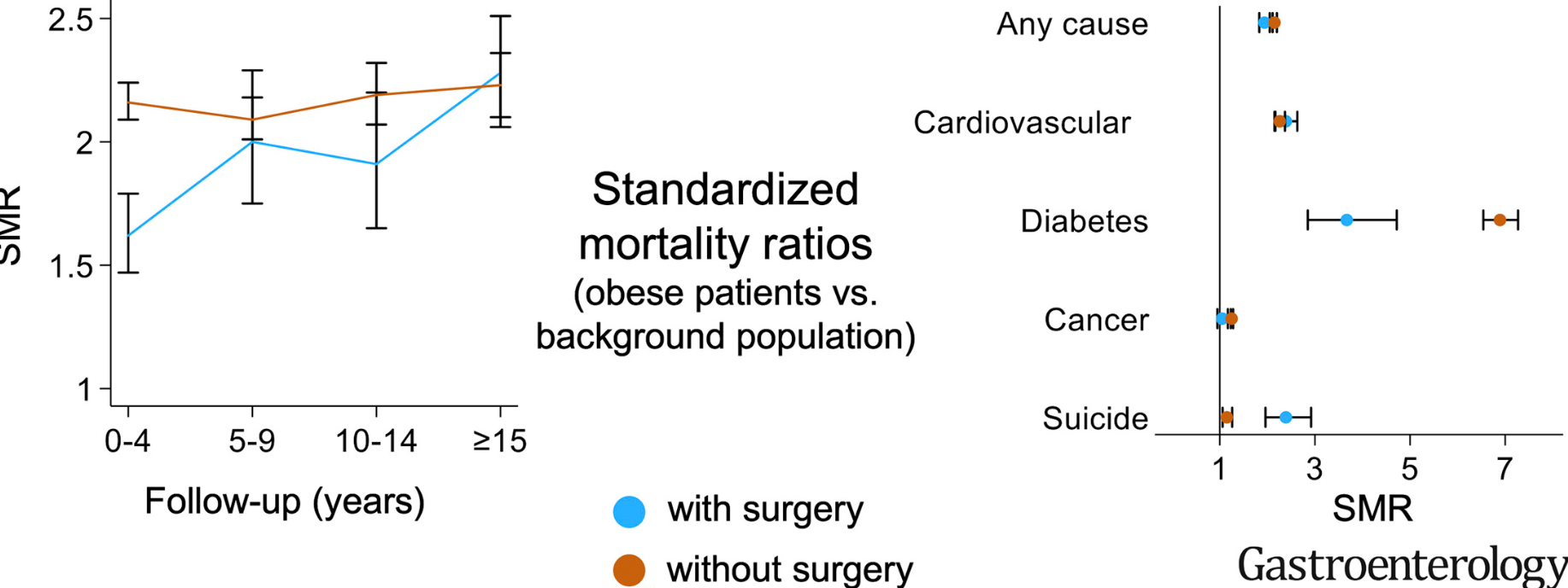
A recent population-based cohort study (JH Kauppila et al. Gastroenterol 2019; 157: 19-27) examined the effects of bariatric surgery on survival from Nordic countries between 1980-2012.

Link: Effects of Obesity Surgery on Overall and Disease-Specific Mortality in a 5-Country Population-Based Study

Among 505,258 obese individuals, 49,977 had bariatric surgery.

Key findings:

  • Overall mortality rates were lower in the surgery group during the first 14 years but higher after 15 years (HR 1.20 with CI 1.02-1.42).  Thus, overall, obese patients who underwent bariatric surgery had longer survival times than obese patients who did not have surgery.  Both groups had higher mortality than the general population
  • The improved survival compared to those without surgery was related to decreased mortality from cardiovascular mortality, diabetes and cancer.  However mortality due to suicide was increased.
  • Limitations: lack of detailed data including BMI, smoking and alcohol consumption

Graphical abstract (available online)

Related blog posts:

Red Meat for Dietary Cynics

A recent randomized study (L Albenberg et al. Gastroenterol 2019; 157: 128-36) examined whether a diet low in red or processed meats could reduce rates of Crohn’s disease (CD) flares.

Methods: Adults with CD were recruited into the FACES (Food and Crohn’s Disease Exacerbation Study) trial from 2013 to 2015. Participants were recruited from an internet-based cohort (n=15,600).  Eligible participants (consumed red meat at least once a week & in remission) were randomly assigned to high meat, n=118 (minimum of 2 servings per week) or low meat, n=96 (no more than 1 serving per month).  Outcomes were based on changes in sCDAI scores or need for treatment (new medication or surgery)

Key findings:

  • Any relapse occurred in 62% of participants in the high meat group compared to 42% in the low meat group.  This was not statistically significant.
  • At week 20, 18 participants in each arm had a stool calprotectin with the high meat group having a higher median: 74.5 mcg/g compared to 36.0 mcg/g (P=.13)
  • The high meat group did consume at least 2 servings per week in 98.5% of observed weeks compared to 18.8% of the low meat group.

Limitations:

  • Small number of diet participants
  • Study was not blinded and only a subset included more objective markers of response
  • Whether complete avoidance of red meat/processed meats would be more effective is unclear
  • In those in remission at baseline, it could take longer for the benefits of a dietary intervention to become evident

My take:  Limiting consumption of red and processed meats (particularly if meat is not lean) has been shown to have cardiovascular benefits.  While this study does not show a statistically-significant improvement in relapse rates in this cohort with Crohn’s disease, there are still strong arguments that a diet with increased fruits/vegetables and less red/processed meats would be beneficial.

Related Blog Posts:

Disclaimer: These blog posts are for educational purposes only. Specific dosing of medications/diets (along with potential adverse effects) should be confirmed by prescribing physician/nutritionist.  This content is not a substitute for medical advice, diagnosis or treatment provided by a qualified healthcare provider. Always seek the advice of your physician or other qualified health provider with any questions you may have regarding a condition.

Sagrada Familia, Barcelona

Gluten in Medicine Act 2019

Link: The Gluten in Medicine Disclosure Act of 2019 Introduced in the House

An excerpt:

On April 3, 2019, Representatives Tim Ryan (D-OH) and Tom Cole (R-OK) introduced H.R. 2074, the Gluten in Medicine Disclosure Act of 2019. The bill intends to make it easier to identify gluten in prescription medications by requiring drug manufacturers to label medications with the list of ingredients, their source, and whether gluten is present.

The Celiac Disease Foundation has been working with Representative Ryan’s staff since 2012 on the need for labeling of gluten in medication and is proud to endorse this bill. The Gluten in Medicine Disclosure Act of 2019 was introduced in the House of Representatives and referred to the House Committee on Energy and Commerce. If passed by the House, the bill will move forward for review by the Senate.

Read the full text of the Gluten in Medicine Disclosure Act of 2019 here.

Take a minute to send our letter to your Members of Congress to urge them to cosponsor this bill.

Vitamin D Supplementation Did Not Improve Postsurgical Outcomes in Patients with Crohn’s Disease

Link from Kipp Ellsworth Twitter Feed: Healio Gastro: Vitamin D does not prevent Crohn’s recurrence after resection

Re: Duijvestein M, et al. Abstract 144. Presented at: Digestive Disease Week; May 18-21, 2019; San Diego.

Background: “Researchers conducted a placebo-controlled trial comprising 143 patients with CD to assess the potential anti-inflammatory effects of vitamin D. Patients were randomly assigned to receive either 25,000 International Units of vitamin D3 (n = 72) or placebo (n = 71) weekly for 6 months after their first or second ileocolonic resection.”

Key Finding: “While serum vitamin D levels increased in the vitamin D group and remained unchanged in the placebo group, investigators found no difference in the incidence or severity of endoscopic recurrence at week 26 between the two groups. Cumulative clinical recurrence rates at week 26 were also comparable.”

Related blog posts:

Disclaimer: These blog posts are for educational purposes only. Specific dosing of medications/diets (along with potential adverse effects) should be confirmed by prescribing physician/nutritionist.  This content is not a substitute for medical advice, diagnosis or treatment provided by a qualified healthcare provider. Always seek the advice of your physician or other qualified health provider with any questions you may have regarding a condition

Madrid view from Círculo de Bellas Artes


Improving Obesity Trend in Young Children?

Link (YouTube): William Meyers Inaugural Conference Lecture

Related blog post: William Meyers

———————————

CBS News: Study shows declining obesity rate for preschoolers who receive government food aid

An excerpt:

The obesity rate for preschoolers who receive government food aid has declined, according to a study released Tuesday in the Journal of the American Medical Association. Obesity rates dropped steadily to about 14% in 2016 — the latest data available — from 16% in 2010, the Centers for Disease Control and Prevention reported.

The improvement affected youngsters ages 2 through 4 who receive food vouchers and other services in the federal Women, Infants and Children nutrition program. About 1 in 5 U.S. kids that age were enrolled in 2016…

My take:  This is good news. Hopefully, this report will be one of many indicating that the rates of obesity could actually improve.

Related blog posts:

Is Red Meat More Likely to Cause High Cholesterol than White Meat?

A recent study -full text link: N Bergeron et al. Effects of red meat, white meat, and nonmeat protein sources on atherogenic lipoprotein measures in the context of low compared with high saturated fat intake: a randomized controlled trial. The American Journal of Clinical Nutrition, nqz035, https://doi.org/10.1093/ajcn/nqz035

This study which randomized 177 patients to 4 week trials of each protein source: red meat, white meat, or non-meat protein found no significant differences in cholesterol levels.

From CNN:  White meat is just as bad for you as red beef when it comes to your cholesterol level, study says

An excerpt:

The red meat or white meat debate is a draw: Eating white meat, such as poultry, will have an identical effect on your cholesterol level as eating red beef, new research indicates.

The long-held belief that eating white meat is less harmful for your heart may still hold true, because there may be other effects from eating red meat that contribute to cardiovascular disease, said the University of California, San Francisco researchers. This needs to be explored in more detail, they added.
Non-meat proteins such as vegetables, dairy, and legumes, including beans, show the best cholesterol benefit, according to the new study published Tuesday in the American Journal of Clinical Nutrition.
From Twitter -CDC Messaging on Dangers of Smoking While Pregnant:


It Can’t Hurt Right? Complimentary and Alternative Medicine and Gluten-Related Disorders

A recent study (G Boyer et al. Am J Gastroenterol 2019; 114: 786-91) examined the promotion of testing and treatment of gluten-related disorders among complementary and alternative medicine (CAM) practitioners. Thanks to Ben Gold for this reference.

Background: CAM expenditures in 2016 by Americans was $30.2 billion in 2016. “Studies have found that it is not uncommon for CAM clinics to make wide-reaching claims as to their abilities to diagnose a plethora of conditions.”  In the present study, the authors reviewed the advertising content of 500 CAM clinic websites with regard to gluten-related disorders..

Key points:

  • The authors further identified 232 claims from 114 clinic websites; 138 (59.5%) were judged as unproven or false.
  • “Some clinics advertised treatments that pose potential harm;” this includes the sale of digestive enzymes promoted to digest gluten and which purport to allow the person with celiac or nonceliac gluten sensitivity (NCGS) to ingest gluten safely.  “This is a baseless claim that could lead to serious harm.”
  • “Other clinics falsely claimed that everyone should be on a gluten-free diet regardless of a diagnosis of celiac disease or NCGS.”

My take: Given the popularity of CAM along with the frequency of misleading claims, this suggests the need for increased regulation.  These websites are likely to increase confusion about the diagnosis and management of gluten-related disorders (which can  be confusing without any help!)

Related blog posts:

Comparing Gastric Bypass Outcomes in Adolescents and Adults

Studies have shown that adults with obesity who were obese as adolescents have worse medical outcomes than persons who became obese in adulthood (Nat Rev Endocrinol 2018; 14: 183-8; NEJM 2011; 365; 1876-85). Thus, the question is whether earlier intervention would improve outcomes.

A recent study (TH Inge et al. NEJM 2019; 380: 2136-45, editorial TD Adams, pgs 2175-7) compares the 5-year outcomes of adolescents (n=161) and adults (n=396) who underwent Roux-en-Y gastric bypass (RYGB). The two prospectively enrolled cohorts were participants in two related but independent studies.

Key findings:

  • There was similar weight loss in both groups at the 5-year mark: -26% in adolescents and -29% in adults
  • Adolescents had greater remission in both type 2 diabetes (86% vs 53%) and in hypertension (68% and 41%).
  • Three adolescents (1.9%) and seven adults (1.8%) died in the 5-years after surgery.  Two of the adolescents deaths were consistent with overdose.
  • Reoperations were significantly higher in adolescents than adults (19 vs 10 reoperations per 500 person years). The authors comment that the reason for this finding is unclear, possibly related to recall bias or closer monitoring of the adolescents.
  • Nutrient deficiencies were common in adolescents at followup. After 2 years, 48% of adolescents had low ferritin compared with 29% of adults (98% of participants had normal ferritin prior to RYGB. The authors note that  this is likely related to adherence to vitamin/mineral supplementation (which is needed lifelong).

Limitations: observational study design

The associated commentary::

  • “Almost 6% of adolescents in the U.S. are severely obese and  bariatric surgery is now the only successful long-term management…Negative health outcomes of bariatric surgery reported in adolescents mirror those reported in adults — including, for example, potential for self-harm (including suicide) and increased risk of alcohol or drug abuse.”
  • “Adolescent patients may not have fully developed the capacity for decision making, especially about a procedure that will have lifetime consequences.”

My take: This study and commentary point out some clear health benefits for adolescents who undergo RYGB. Given the lifelong need for monitoring and adherence with medical treatment as well as some of the negative health outcomes, it is also clear how challenging it is to proceed with RYGB in teenage years.

Related blog posts:

Square in Toledo, Spain


NAFLD Outcomes After Bariatric Surgery

A recent systematic review and meta-analysis (Y Lee, et al. Clin Gastroenterol Hepatol 2019; 17: 1040-60) included 32 cohort studies with 3093 liver biopsy specimens from patients with nonalcoholic fatty liver disease (NAFLD).

Key findings:

  • Bariatric surgery resulted in a biopsy-confirmed resolution of steatosis in 66%, inflammation in 50%, ballooning degeneration in 76%, and fibrosis in 40%.
  • Bariatric surgery resulted in worsening features of NAFLD in 12%.
  • The authors note that Roux-en-Y Gastric Bypass (RYGB) “showed greater reduction of liver side effects and higher: resolution of NAFLD.”
  • Jejejnoileal bypass (JIB) and biliopancreatic diversion (BPD) “both have been associated with higher liver function morbidity.”
  • The overall GRADE quality of evidence was considered very low.

My take: Though better studies are needed, the majority of patients’ livers appear to benefit from bariatric surgery.

Related blog posts:

Rural Areas Main Driver for Increasing Obesity

Nature volume 569pages260–264 (2019) : Full Text: Rising rural body-mass index is the main driver of the global obesity epidemic in adults

From Abstract:

  • Here we use 2,009 population-based studies, with measurements of height and weight in more than 112 million adults, to report national, regional and global trends in mean BMI segregated by place of residence (a rural or urban area) from 1985 to 2017.
  • We show that, contrary to the dominant paradigm, more than 55% of the global rise in mean BMI from 1985 to 2017—and more than 80% in some low- and middle-income regions—was due to increases in BMI in rural areas.
  •  In high-income and industrialized countries, we noted a persistently higher rural BMI, especially for women.