How Food Advertising Works On Children’s Brains and Preferences

Newsflash: Advertising usually works!  That’s the quick conclusion from two studies that looked closer at the influence of food advertising on children.

  • AS Bruce et al. J Pediatr 2016; 177: 27-32.
  • LS McGale et al. J Pediatr 2016; 177: 33-8.

The first study recruited 209 children aged 4-8 years and asked them to rate their taste preferences  for 3 matched food pairs, presented with or without a brand equity character displayed on packaging.  Key finding: “Children were significantly more likely to show a preference for foods with a brand equity character  displayed on the packaging.” Thus, the authors conclude that these characters promote unhealthy food choices (foods high in fat, salt, and sugar) in children.

As an aside, the reverse of this type of branding happened with Obamacare: Jimmy Kimmel Obamacare vs Affordable Care Act

So how do televised food commercials work to change children’s preferences? The second study examined 23 children aged 8-14 years with functional magnetic resonance imaging while they were making food choices.  Children assessed 60 food items. Key finding: After commercials, children placed significantly more importance on taste of these food items.  “The ventromedial prefrontal cortex, a reward valuation brain region, showed increased activity during food choices after watching food commercials compared with after watching nonfood commericals.”

My take: Watching food commercials probably increases the likelihood of consumption of a less healthy diet.

Related blog posts:

Berry College, 42 ft Wood Wheel

Berry College, 42 ft Wood Wheel

What’s Often Missing in Vegan Diets

From NPR: Can A Vegan Diet Give You All You Need? German Nutritionists Say ‘Nein’

An excerpt:

“With a pure plant-based diet, it is difficult or impossible to attain an adequate supply of some nutrients,” states the German Nutrition Society’s new position on the vegan diet. “The most critical nutrient is B-12,” which is found in eggs and meat. The group says if you follow a vegan diet, you should take supplements to protect against deficiencies.

According to the German nutritionists, other “potentially critical nutrients” that may be a challenge to get in a vegan diet include omega-3s — found in fatty fish — as well as minerals such as calcium, iron, iodine, zinc and selenium. So the group recommends that vegans get advice from a nutrition counselor and be “regularly checked by a physician.” In addition, the society recommends against a vegan diet for pregnant women, women who are breast-feeding, children and adolescents…

“B-12 only comes from animal products,” says Cimperman. “It’s necessary for proper red blood cell formation, as well as normal neurological function.”

Many foods — including some breakfast cereals, as well as some nondairy creamers and milks — are fortified with B-12. So it’s possible to get all the nutrition you need this way, if you eat enough of these fortified foods regularly.

But to make sure you’re covering all your bases, “I would recommend [taking] a standard multivitamin,” Cimperman says. It’s a good insurance policy for vegans.

Pat O'Brien's Patio, New Orleans

Pat O’Brien’s Patio, New Orleans


Biotin Supplementation and Thyroid Laboratory Results

Biotin, which is a water-soluble vitamin, is given in several genetic conditions and often used as a supportive treatment in mitochondrial disorders.  A recent report (S Kummer et al. 2016; 375: 704-6 Letter to Editor) noted six children ages 1 mo-9 yrs with markedly abnormal thyroid studies who were receiving biotin.  The results mimicked Graves’ disease with high free thyroxine levels, low thyrotropin levels, and elevated anti-thyrotropin receptor antibodies.

After stopping biotin, these biochemical abnormalities resolved in 48 hrs for free T4/TSH and 7 days for anti-thyrotropin receptor antibodies.

My take: High-dose biotin can create concerning laboratory profile of Graves’ disease. Awareness of this phenomenon is important for endocrinologists and pediatric gastroenterologists as well.

Glacier Nat'l Park

Glacier Nat’l Park

Deceptive Research: When Sugar Leaves A Bitter Taste

screen-shot-2016-09-13-at-6-51-28-pm

This study was covered widely including USA Today, NBC News and other outlets.

From NY Times, an excerpt:

The sugar industry paid scientists in the 1960s to play down the link between sugar and heart disease and promote saturated fat as the culprit instead, newly released historical documents show.

The internal sugar industry documents, recently discovered by a researcher at the University of California, San Francisco, and published Monday in JAMA Internal Medicine, suggest that five decades of research into the role of nutrition and heart disease, including many of today’s dietary recommendations, may have been largely shaped by the sugar industry…

he Sugar Association, paid three Harvard scientists the equivalent of about $50,000 in today’s dollars to publish a 1967 review of research on sugar, fat and heart disease. The studies used in the review were handpicked by the sugar group, and the article, which was published in the prestigious New England Journal of Medicine, minimized the link between sugar and heart health and cast aspersions on the role of saturated fat…

The New England Journal of Medicine did not begin to require financial disclosures until 1984.

Eosinophilic Disease in Children with Intestinal Failure

Last week, this blog posted an abstract regarding the use of “real foods” for short gut kids.  This post looks into whether certain foods may provoke an allergic response.

A large (n=105) single center retrospective study (C Duggan et al. JPGN 2016; 63: 336-39) examined the histology from 208 endoscopic procedures to determine the frequency of eosinophilic disease in children with intestinal failure.

Key findings:

  • 37% of patients had evidence of eosinophilic inflammation in at least one section of the GI tract.
  • Most common sites for eosinophilic disease: colon/rectosigmoid 18/68 (26%), esophagus 17/83 (20%), ileum 9/54 (17%) and duodenum 4/83 (5%)
  • Both peripheral eosinophilia and hematochezia correlated with eosinophilic colitis
  • The authors state that “a strict elemental diet for 3 months before endoscopy was not associated with a decreased frequency of eosinophilic inflammation.”

While a strict elemental diet was not shown to be effective in this study, the limitations of the study design (eg. retrospective, small number on amino acid diet) preclude a definitive answer about the utility of these diets.  Other confounders, including ongoing parenteral nutrition support, also ‘muddy’ the picture.  A prospective study would be able to determine more conclusively how effective elemental diets are at minimizing eosinophilic inflammation and to allow for a more uniform definition of abnormal tissue eosinophilia.

Given the frequency of elemental diets early in life along with prior GI insults, the propensity to eosinophilic disease may have its origins well before this study period.  In healthy children, the LEAP, LEAP-ON, and EAT studies indicated that earlier exposure to allergens reduces the risk of allergic disease.

My take: This study shows a high prevalence of GI eosinophilic inflammation among children with intestinal failure.  Thus, in children with hematochezia and intestinal failure, eosinophilic colitis needs to be considered.

Related blog posts:

Grinnell Glacier, Glacier Natl Park

Glacier Natl Park

Real Foods in Short Gut Kids

Screen Shot 2016-08-17 at 7.31.27 AM

 Reference from Kipp Ellsworth:

Transition to a Tube Feeding Formula With Real Food Ingredients in Pediatric Patients With Intestinal Failure K Samela et al. NCP: Published online before print August 4, 2016, doi:10.1177/0884533616661011

AbstractDue to concerns related primarily to allergic response and malabsorption, enteral nutrition therapy has traditionally relied on the use of elemental formulas in children with intestinal failure (IF). Blended food diets via a gastrostomy tube have been reported to improve feeding tolerance in pediatric populations receiving long-term enteral nutrition therapy. Complex macronutrients have been shown to stimulate intestinal adaptation in animal models. We report on our experience in children with IF who had an overall improvement in stool output when transitioned from an elemental formula to a tube feeding formula with real food ingredients (TFRF). Data were collected in a retrospective chart review of children with IF, >1 year of age, who were receiving enteral nutrition via continuous infusion, bolus feeding, or both. Indications for the TFRF trial were diarrhea or inconsistent stooling patterns. Ten children with a mean small bowel length of 48.3 cm were trialed on TFRF. Nine of 10 (90%) children tolerated the transition to 100% TFRF, of which 7 of 9 (78%) had their entire colon in continuity. The average age at successful transition was 29.2 months, and the average length of time to transition to 100% TFRF was 67.3 days. TFRF is well tolerated in children >1 year of age with IF; it also improves their stooling patterns. A commercially available TFRF is a cost-effective and nutritionally adequate means of providing nutrition to this patient population.


Prevalence of Diabetes with Pediatric NAFLD

Prevalence of Prediabetes and Type 2 Diabetes in Children With Nonalcoholic Fatty Liver Disease  (JAMA Pediatr. Published online August 01, 2016. doi:10.1001/jamapediatrics.2016.1971)

According to a a multicenter, cross-sectional study at 12 pediatric clinical centers across the United States participating in the National Institute of Diabetes and Digestive and Kidney Diseases NASH Clinical Research Network and with 675 participants (mean age 12.6 yrs):

Screen Shot 2016-08-05 at 7.31.17 AM

Understanding Sodium Intake and Cardiovascular Risk

A recent review (ME Cogswell et al. NEJM 2016; 375: 580-5) helps sort out some of the confusion regarding sodium intake and cardiovascular disease. In brief, the authors point out the excessive sodium intake is clearly linked to heart disease, stroke and death.  The importance has been questioned by some due to a few studies suggesting that low sodium intake could also increase the risk of cardiovascular disease.

The authors note that these studies have shown only weak associations & were likely a matter of reverse causation due to the low sodium group having increased numbers of participants with numerous health issues (eg diabetes, hypertension, chronic illness and cardiovascular disease).

By looking at these results based on “Hill’s Criteria” to assess whether an association is causal, the authors show that the association of low sodium intake and cardiovascular disease indicates that this association is NOT causal.

Hill’s criteria:

  • Strength -degree which the exposure is associated with the outcome
  • Consistency -is this finding observed by different persons, in different places/times
  • Specificity -is observation limited to the exposure and the outcome
  • Temporality -did observation cause the outcome or did the outcome affect changes that lead to observation
  • Biologic gradient -?dose-response noted
  • Plausibility -is there a physiologic basis
  • Coherence -does this association conflict with other known facts
  • Experiment -is the finding affected by actions to prevent the exposure
  • Analogy -does an exposure with a similar physiologic action cause the outcome

The authors note that population exposure to sodium correlates better than individual exposure, perhaps due to measurement issues. Key points:

  • “There is strong evidence of a linear, dose-response effect of sodium reduction on blood pressure.  In addition, the evidence shows that sodium reduction prevents cardiovascular disease.”
  • “Reducing the average sodium intake by just 400 mg per day could potentially avert as many as 28,000 deaths and save $7 billion in health care costs annually in the United States.”
  • “Yet sodium levels are high before food reaches the kitchen or table, and the sodium density of the U.S. diet has changed little despite consumer education encouraging individual behavior change.”

My take: If we are to take advantage of the science to reduce cardiovascular deaths, we need to convince manufacturers and restaurants to reduce sodium.

Related blog posts:

Highline Trail, Glacier Nat'l park

Highline Trail, Glacier Nat’l park

Pediatric Nutritionist/Scott Pentiuk: Update on two topics: Blenderized diets and Eosinophilic Esophagitis

From the Pediatric Nutritionist blog –two lectures from Dr. Scott Pentiuk:

Two Lectures: Blenderized diets and Eosinophilic esophagitis

These lectures feature a lot of useful references and practical advice.

Related blog posts:

Shem Creek, SC

Shem Creek, SC


Antibiotics Given Early in Life Linked to Childhood Obesity…Again

While yesterday’s post discussed quadruple therapy for H pylori/need for multiple antibiotics, today’s post will focus on one of the downsides of antibiotic usage. For several years, this blog has highlighted numerous studies which show a link between antibiotics and later obesity (see related blog posts below).  Another study (FI Scott et al. Gastroenterol 2016; 151: 120-29), using a large database, quantifies this risk further.

This retrospective study used prospectively collected data from The Health Improvement Network (THIN), using a cohort of 21,714 children from the UK.

Key findings:

  • In the cohort, 1306 (6.4%) were obese at age 4 years.
  • Antibiotic exposure was associated with an increased risk of obesity at 4 years, with odds ratio of 1.21. The OR went to 1.41 for 3-5 prescriptions.
  • Antifungal agents were not associated with an increased risk of obesity., OR 0.81

In the discussion the authors make a number of useful points:

  • In the U.S. between 2006-2008, there “were >10 million antibiotic prescriptions…annually for children without clear indication.” Thus, this is modifiable contributing factor to obesity.
  • The risk is modest with “approximately 1.2% absolute and 25% relative increase in the risk of early childhood obesity. This relationship is strongest when considering repeat exposures.”
  • Though this is a large study, the authors had many limitations, as expected in a retrospective study.  These included a lack of awareness of the indication for the antibiotic, potential selection bias, and difficulty adjusting for some confounders like breast feeding and physical activity.

The study is in agreement with data from agriculture.  Numerous studies have highlighted how antibiotics can improve weight gain in industry.  Here are some useful references:

  • Gaskins HR, et al. Antibiotics as growth promotants: mode of action. Animal Biotechnol 2002; 13: 29-42
  • Lassiter CA. Antibiotics as growth stimulants for dairy cattle: a review. J Dairy Sci 1955; 38: 1102-38.
  • Moore P, et al. Use of sulphasuccidine, streptothricin and streptomycin in nutrition studies with the chick. J Biol Chem 1946; 165: 437-41.
  • Cho I, et al. Antibiotics early in life alter the murine colonic microbiome and adiposity. Nature 2012; 488 (7413): 621-26.
  • Cox LM, et al. Altering the intestinal microbiota during a critical developmental window has lasting metabolic consequences. Cell 2014; 158: 705-21.

My take: Farmers have understood that antibiotics fatten up young animals for 70 years.  Yet, this basic information is NOT commonly understood by parents and many physicians. If this risk for obesity were widely known, it would help limit the use of antibiotics for well-recognized indications.

Related blog posts:

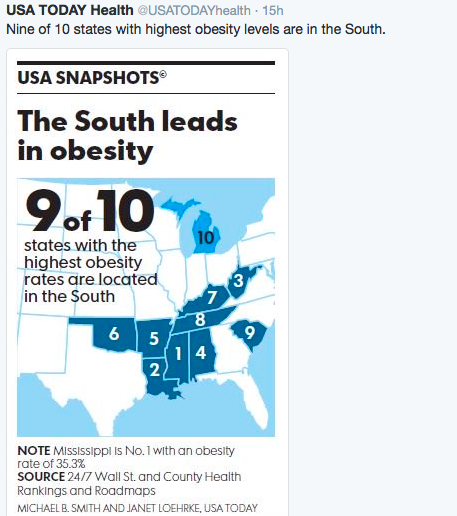
South Leads Obesity