Understanding Sodium Intake and Cardiovascular Risk

A recent review (ME Cogswell et al. NEJM 2016; 375: 580-5) helps sort out some of the confusion regarding sodium intake and cardiovascular disease. In brief, the authors point out the excessive sodium intake is clearly linked to heart disease, stroke and death.  The importance has been questioned by some due to a few studies suggesting that low sodium intake could also increase the risk of cardiovascular disease.

The authors note that these studies have shown only weak associations & were likely a matter of reverse causation due to the low sodium group having increased numbers of participants with numerous health issues (eg diabetes, hypertension, chronic illness and cardiovascular disease).

By looking at these results based on “Hill’s Criteria” to assess whether an association is causal, the authors show that the association of low sodium intake and cardiovascular disease indicates that this association is NOT causal.

Hill’s criteria:

  • Strength -degree which the exposure is associated with the outcome
  • Consistency -is this finding observed by different persons, in different places/times
  • Specificity -is observation limited to the exposure and the outcome
  • Temporality -did observation cause the outcome or did the outcome affect changes that lead to observation
  • Biologic gradient -?dose-response noted
  • Plausibility -is there a physiologic basis
  • Coherence -does this association conflict with other known facts
  • Experiment -is the finding affected by actions to prevent the exposure
  • Analogy -does an exposure with a similar physiologic action cause the outcome

The authors note that population exposure to sodium correlates better than individual exposure, perhaps due to measurement issues. Key points:

  • “There is strong evidence of a linear, dose-response effect of sodium reduction on blood pressure.  In addition, the evidence shows that sodium reduction prevents cardiovascular disease.”
  • “Reducing the average sodium intake by just 400 mg per day could potentially avert as many as 28,000 deaths and save $7 billion in health care costs annually in the United States.”
  • “Yet sodium levels are high before food reaches the kitchen or table, and the sodium density of the U.S. diet has changed little despite consumer education encouraging individual behavior change.”

My take: If we are to take advantage of the science to reduce cardiovascular deaths, we need to convince manufacturers and restaurants to reduce sodium.

Related blog posts:

Highline Trail, Glacier Nat'l park

Highline Trail, Glacier Nat’l park

Pediatric Nutritionist/Scott Pentiuk: Update on two topics: Blenderized diets and Eosinophilic Esophagitis

From the Pediatric Nutritionist blog –two lectures from Dr. Scott Pentiuk:

Two Lectures: Blenderized diets and Eosinophilic esophagitis

These lectures feature a lot of useful references and practical advice.

Related blog posts:

Shem Creek, SC

Shem Creek, SC


Antibiotics Given Early in Life Linked to Childhood Obesity…Again

While yesterday’s post discussed quadruple therapy for H pylori/need for multiple antibiotics, today’s post will focus on one of the downsides of antibiotic usage. For several years, this blog has highlighted numerous studies which show a link between antibiotics and later obesity (see related blog posts below).  Another study (FI Scott et al. Gastroenterol 2016; 151: 120-29), using a large database, quantifies this risk further.

This retrospective study used prospectively collected data from The Health Improvement Network (THIN), using a cohort of 21,714 children from the UK.

Key findings:

  • In the cohort, 1306 (6.4%) were obese at age 4 years.
  • Antibiotic exposure was associated with an increased risk of obesity at 4 years, with odds ratio of 1.21. The OR went to 1.41 for 3-5 prescriptions.
  • Antifungal agents were not associated with an increased risk of obesity., OR 0.81

In the discussion the authors make a number of useful points:

  • In the U.S. between 2006-2008, there “were >10 million antibiotic prescriptions…annually for children without clear indication.” Thus, this is modifiable contributing factor to obesity.
  • The risk is modest with “approximately 1.2% absolute and 25% relative increase in the risk of early childhood obesity. This relationship is strongest when considering repeat exposures.”
  • Though this is a large study, the authors had many limitations, as expected in a retrospective study.  These included a lack of awareness of the indication for the antibiotic, potential selection bias, and difficulty adjusting for some confounders like breast feeding and physical activity.

The study is in agreement with data from agriculture.  Numerous studies have highlighted how antibiotics can improve weight gain in industry.  Here are some useful references:

  • Gaskins HR, et al. Antibiotics as growth promotants: mode of action. Animal Biotechnol 2002; 13: 29-42
  • Lassiter CA. Antibiotics as growth stimulants for dairy cattle: a review. J Dairy Sci 1955; 38: 1102-38.
  • Moore P, et al. Use of sulphasuccidine, streptothricin and streptomycin in nutrition studies with the chick. J Biol Chem 1946; 165: 437-41.
  • Cho I, et al. Antibiotics early in life alter the murine colonic microbiome and adiposity. Nature 2012; 488 (7413): 621-26.
  • Cox LM, et al. Altering the intestinal microbiota during a critical developmental window has lasting metabolic consequences. Cell 2014; 158: 705-21.

My take: Farmers have understood that antibiotics fatten up young animals for 70 years.  Yet, this basic information is NOT commonly understood by parents and many physicians. If this risk for obesity were widely known, it would help limit the use of antibiotics for well-recognized indications.

Related blog posts:

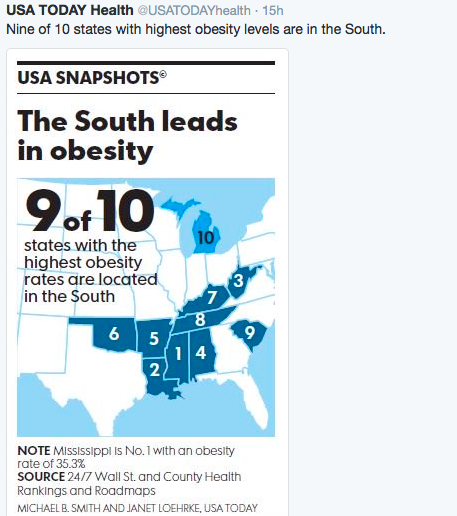
South Leads Obesity

Better Hydration –Less Obesity?

Perhaps the Dos Equis’ guy’s slogan “Stay Thirsty My Friends” is not such great advice.

According to a study, summarized by NPR, inadequate hydration was associated with increased odds of obesity.  While an association does not prove causation, it adds another potential reason to drink plenty of water.

NPR Story: Thirsty? New Study Links Good Hydration with Slimmer Waistlines

Here’s an excerpt:

A new study published in the Annals of Family Medicineadds to the evidence that hydration may play a role in weight management.

“What we found was that people who were inadequately hydrated had increased odds of being obese,” says study author Tammy Chang of the Department of Family Medicine at the University of Michigan.

The study was based on data collected by a federal health survey, in which researchers had documented weight and height of participants. They also conducted urine tests to establish an objective measure of participants’ level of hydration.

Chang and her colleagues found the odds of being obese were 1.59 times higher for people who were not well-hydrated. And overall, they found that a lack of proper hydration was associated with higher body mass index.

On a neighborhood walk

On a neighborhood walk

Bioactive Components of Breastmilk

An entire supplement (J Pediatr 2016; 173: S1-S65) provides an in-depth review of the bioactive components of breastmilk.  The two components reviewed most extensively were lactoferrin and milk fat globule membrane (MFGM).

Lactoferrin: this glycoprotein is present in high concentrations in human milk, compared to formulas and cow’s milk.  It is highest in concentration in early lactation.  Its importance lies in its direct antibacterial effects.  It is likely to reduce the risk of necrotizing enterocolitis and sepsis in preterm infants, which has been shown as well with bovine lactoferrin.

MFGM: this triglyceride is derived from a triple phospholipid membrane is absent from infant formulas.  It has a role in both gastrointestinal and immune development.  It appears to convey benefits in “terms of cognitive, metabolic, and health outcomes.”

My take: this supplement provides data that lactoferrin and MFGM “isolated from bovine milk retain bioactivity and are safe and efficacious additions to infant formula”

Related blog posts:

Arthur Ravenel Jr Bridge

Arthur Ravenel Jr Bridge


Ultra-Short Celiac Disease


It is well-recognized that obtaining a duodenal bulb biopsy increases the likelihood of making a diagnosis of celiac disease.  Another study (PD Mooney et al. Gastroenterol 2016; 150: 1125-34) has tried to quantitate the frequency of “ultra-short” celiac disease (USCD).

In this prospective study of 1378 patients (mean age 50.3 yrs) who underwent endoscopy between 2008-2014, there was a cohort who had a high clinical suspicion of celiac disease in which quadrantic biopsies of the duodenal bulb were obtained.

Key findings:

  • 268 (19.4%) were diagnosed with celiac disease
  • 26 (9.7%) of celiac population had disease identified primarily in the duodenal bulb.  These patients with USCD were younger (P=.03), had lower serologic titers of tissue transglutaminase antibody (tTG) (P=.001), and less frequently had diarrhea (P=.001).
  • In USCD, the tTG titers were a median of 4.8x ULN compared with 20x ULN in those with more extensive disease.
  • While the authors characterize 26 as having USCD, 19 of the 26 did have Marsh 1 (n=18, 69.2%) or Marsh 2 (n=1, 3.8%) lesions, indicating at least some involvement more distally. However, in these patients the duodenal bulb findings clinched the diagnosis.

Despite the protocol, the authors showed that a single biopsy from the bulb was sufficient to increase the diagnostic yield.

My take: This study reinforces the need for duodenal biopsies from both the bulb and more distally when the diagnosis of celiac disease is being considered.

Related blog posts:

Last Year at Turner Field

This is the last year at Turner Field

More Than 100 Leading Scientists: “Stop Bashing GMO Foods”

“Scientific and regulatory agencies around the world have repeatedly and consistently found crops and foods improved through biotechnology to be as safe as, if not safer than those derived from any other method of production,” the group of laureates wrote. “There has never been a single confirmed case of a negative health outcome for humans or animals from their consumption. Their environmental impacts have been shown repeatedly to be less damaging to the environment, and a boon to global biodiversity.”

Here’s the link: NY Times Stop Bashing GMO Foods

Related posts:

Sullivan's Island, SC

Sullivan’s Island, SC

Even Normal Body Mass Index Could Be a Problem

A recent study (G Twig et al. NEJM 2016; 374: 2430-40) which had more than 42 million person-years of followup (1967-2010) showed that adolescents with a BMI in the 50th to 74th percentile (CDC values), well within the accepted normal range, had increased cardiovascular and all-cause mortality.

The study involved more than 2.3 million Israeli adolescents with up to 40 years of followup information. The study utilized data obtained from 17 year olds who were seen 1 year prior to mandatory military service. There was increasing mortality associated with higher BMI subgroups.

Key findings:

  • For those between the 50-74% in adolescence: the hazard ratios for coronary heart disease 1.49, for stroke 1.18, and total cardiovascular causes was 1.32.
  • For those ≥95% (obese) in adolescence: the hazard ratios for coronary heart disease 4.89, for stroke 2.64, and total cardiovascular causes was 3.46.

My take: this study shows that even modest increases in BMI are associated with modest increase in cardiovascular mortality over 40 years.  Whether the BMI itself plays a causal role or is more of an epiphenomenon of other risk factors (eg. sedentary risk factors) is not clear.


Screen Shot 2016-06-27 at 1.05.47 PM

Elafibranor Study & “My compliments to the photographer”

A while back, I remember seeing a cartoon with a dissatisfied patron leaving a restaurant and saying “my compliments to the photographer.”

Sometimes reading journal titles has the same feel.  The title does not always indicate what you are really going to get.  A recent study (V Ratziu et al. Gastroenterol 2016; 150: 1147-59) has the following title: “Elafibranor, an Agonist of the Peroxisome Proliferator –Activated Receptor –α and –β, Induces Resolution of Nonalcoholic Steatohepatitis Without Fibrosis Worsening.”  Sounds great –a new effective treatment for NASH, right?

Here’s are the results:

  • “In intention-to-treat analysis, there was no significant difference between elafibranor and placebo groups in the protocol-defined primary outcome.”
  • However, based on a post-hoc analysis with a modified definition, the treatment group had  a 19% NASH resolution compared with 12% of the placebo group.

This study examined 276 patients in a randomized double-blind placebo-controlled trial.

To me these results are not impressive.  The associated editorial (pg 1073) expresses more optimism and indicates that there have been evolving outcome measures in NASH studies to look for the combination of NASH resolution without worsening fibrosis.  Thus, prior studies that used only NASH resolution, such as pioglitazone (47%), vitamin E (36%) and obeticholic acid (22%) cannot be compared to his current study.

My take: Pretty picture or not, what this really means -is that we need more studies, including the outcome of phase III studies of this medication.

Georgia Terrace

The Georgian Terrace

Concise Review: Fatty Liver in Pediatrics

A recent review (J Schwimmer. Hepatology 2016; 1718-25) provides a succinct up-to-date approach to the common problem of Nonalcoholic Fatty Liver Disease.

As this was a review, much of the material has been covered by this blog and previous publications.  The review discusses the upper limit of normal for alanine aminotransferase and its utility.  Liver imaging is discussed: “MRI is well suited for use in clinical research” whereas “ultrasound does not meet the standard clinical threshold required to be used to diagnose fatty liver…or used as an outcome measure.”

Dr. Schwimmer reviews a prospective study of 347 overweight or obese children with suspected NAFLD (blog review of this study: Screening for NAFLD).  He notes that 24% (n=61) of those who underwent liver biopsy ultimately had other diagnoses, especially autoimmune liver disease (n=11) and celiac disease (n=4). “The clinical challenge is to determine who needs how much of a workup. The greater potential for hepatotoxicity and the more advanced the disease is believed to be, the greater the need to be certain of the diagnosis and to properly grade and stage the disease.”  Currently, “no other diagnostic modality has shown sufficient accuracy to be appropriate for clinical use in the place of biopsy.”

He reviews associated health conditions with NAFLD including obesity, dyslipidemia, hypertension, cardiac dysfunction, and obstructive sleep apnea (~60% of NAFLD patients).

What about treatment? “There is not an available, proven, safe, and effective [pharmacologic] treatment for NAFLD in children…Current treatment is …focused on optimizing lifestyle, including nutrition, physical activity, and mental well-being.”

My take: Despite 20 years of clinical practice, the workup for NAFLD remains a vexing problem.  It is not practical to offer a liver biopsy to 10% of the pediatric population.  So determining who (besides those with more severe presentations) will benefit from an exhaustive workup remains unclear.  In the meanwhile, at a minimum, we need to keep looking for treatable liver conditions (eg. autoimmune hepatitis, celiac disease, Wilson’s disease, and viral hepatitis).

An article with a similar focus (Dr. Schwimmer is the corresponding author): J Pediatric 2016; 172: 9-13.  This report and Dr. Schwimmer’s review both tout the safety of liver biopsy.  Neither report presents much data on costs of either liver biopsies or MRI.

Related blog posts:

Zoo Atlanta 2016

Zoo Atlanta 2016