2/17/22: Today, the U.S. Food and Drug Administration announced it is investigating consumer complaints of Cronobacter sakazakii and Salmonella Newport infections. All of the cases are reported to have consumed powdered infant formula produced from Abbott Nutrition’s Sturgis, Michigan facility ..The FDA is investigating complaints of four infant illnesses from three states.
The FDA is advising consumers not to use Similac, Alimentum, or EleCare powdered infant formulas if:
the first two digits of the code are 22 through 37; and
the code on the container contains K8, SH or Z2; and
the expiration date is 4-1-2022 (APR 2022) or later.
Products that do not contain the information listed above are not impacted. The FDA advisory does not include liquid formula products or any metabolic deficiency nutrition formulas. Consumers should continue to use all products not covered by the advisory.
Methods: The Rochester Epidemiology Project (REP) was used to identify Olmsted County, Minnesota residents aged <19 years who had 25-hydroxyvitamin D [25(OH)D] levels measured between January 2, 2002 and December 31, 2017. Using each patient’s first 25(OH)D measurement during this period, patients were categorized as vitamin D deficiency/insufficiency if Vit 25(OH)D level was <20 ng/mL.
To convert nmol/L to ng/mL= nmol/L x 0.401 OR nmol/L =ng/mL x 2.496
Key finding:
There was a 42-fold increase in the proportion of the county’s pediatric population tested each year, starting at 3.7 per 10,000 persons in 2002 and increasing to 156.1 per 10,000 persons in 2017
During the 16-year period, the incidence of vitamin D deficiency/insufficiency (per 10,000 persons) increased from 1.7 in 2002-2003 to 19.9 in 2016-2017, but the proportion that were tested and had vitamin D deficiency/insufficiency remained stable –rates of 21.9% in 2006-2007 and 18.5% in 2016-2017
There was a higher rate of Vit D deficiency/insufficiency in females (22.8%) vs males (16.9%) (P<.001)
There was a significant association with obesity and Vit D deficiency/insufficiency (32.7% with moderate and 32.9% with severe obesity). It is unclear whether this is a causal link or an association (perhaps associated with less outdoor activity)
Limitation: Study was performed in Olmstead county which is 90-95% white; this limits generalizability (though other reports have noted increased testing rates as well in other locations)
My take: Clearly more kids are being screened for vitamin D deficiency. More data is needed on whether this results in any meaningful improvements in outcomes and the associated costs. In addition, it is important to recognize that vitamin D levels can be inversely proportional to inflammatory conditions and can improve without supplementation by addressing these disorders.
In this prospective cohort of infants (in France) with food protein-induced allergic proctocolitis (FPIAP) (n=76), all infants had rectal bleeding (RB) which resolved with cow’s milk protein (CMP) elimination. After the initial oral food challenge (OFC) which took place 2 to 8 weeks after resolution of rectal bleeding, OFC was repeated every 2 months.
Key findings:
Only 31% failed the initial OFC
The median age of tolerance, for those with a confirmed FPIAP based on OFC, was 6.8 months, with >75% of the cohort tolerant by 10 months of age
My take:
This study shows that the majority of infants with RB probably do not have FPIAP. In those that do have FPIAP, earlier challenge is reasonable in the majority.
FPIAP is generally mild and self-limited. Diagnosis is hampered by lack of validated criteria.
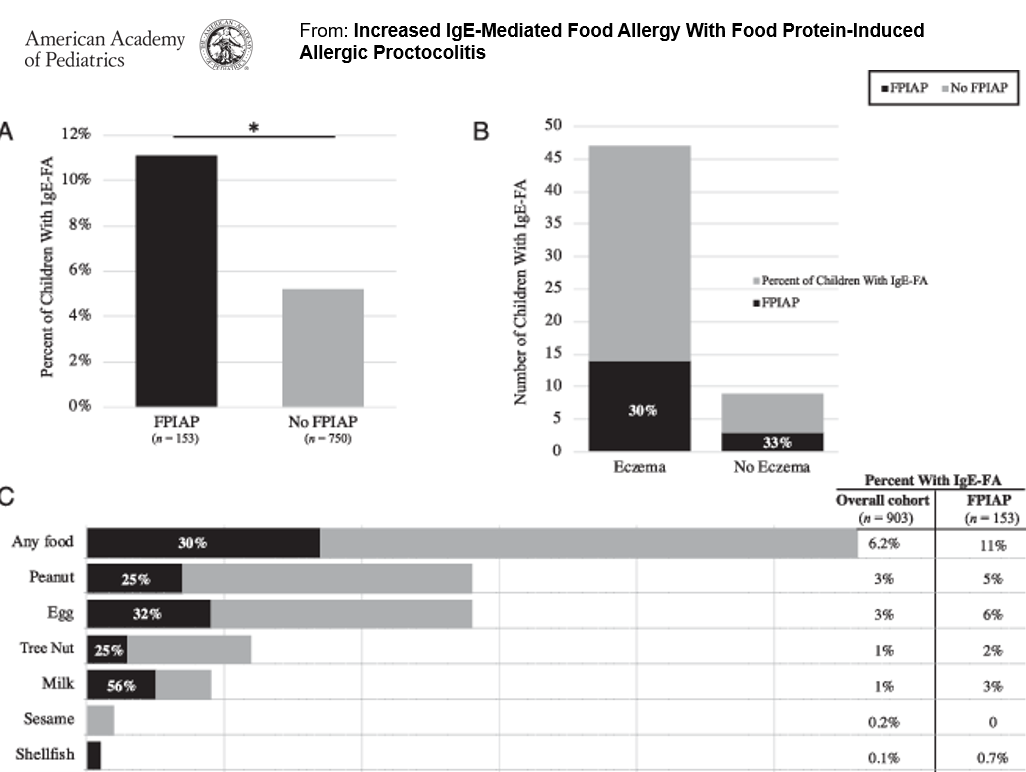
In this study of 153 infants with food protein-induced allergic proctocolitis (FPIAP) with documented blood in the stool, more children with FPIAP developed IgE-Food Allergy (IgE-FA) (11%) compared with healthy children.
Key points (from commentary by MT Kraft and D Stukus):
“Although conventional teaching is to wait until 12 months of age to reintroduce dairy to infants with FPIAP, it can likely be introduced much earlier.”
The diagnosis of FPIAP was associated with with an increased risk of IgE-FA, “although diagnosis was not confirmed through oral food challenges”
My take: Children with FPIAP are more likely to receive a diagnosis of IgE-FA. Prolonged restriction of milk, when no longer required, could contribute to this; in addition, some children are mislabeled as food allergic without appropriate confirmation (based on faulty testing).
“Major changes to the Georgia WIC Program effective today, announced by the @GaDPH & @GAChapterAAP, most importantly, a new WIC Request for Medical Formulas & Supplemental Foods (RMF) form replacing the MDF.”
Advances in Cystic Fibrosis (CF) have led to improvement in longevity, now ~46 years in 2019
Newer CFTR modulator therapies need to be aligned to the specific mutations. With new therapies, a high calorie diet may not be required and instead follow a standard healthy balanced diet.
These agents appear to be driving a big drop in hospitalizations
Now some patients need counseling for obesity and NAFLD
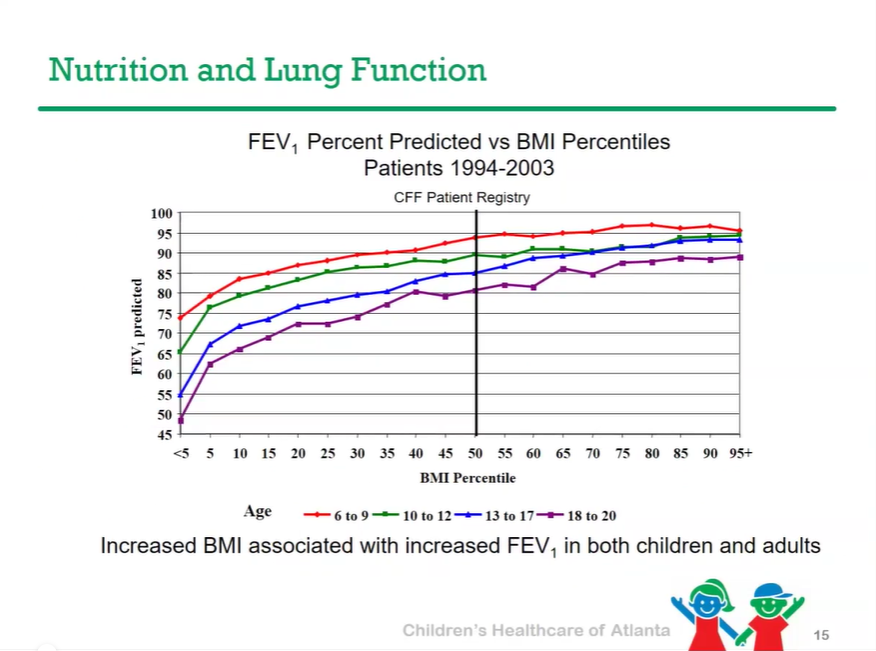
Better nutrition has been linked to better lung outcomes.
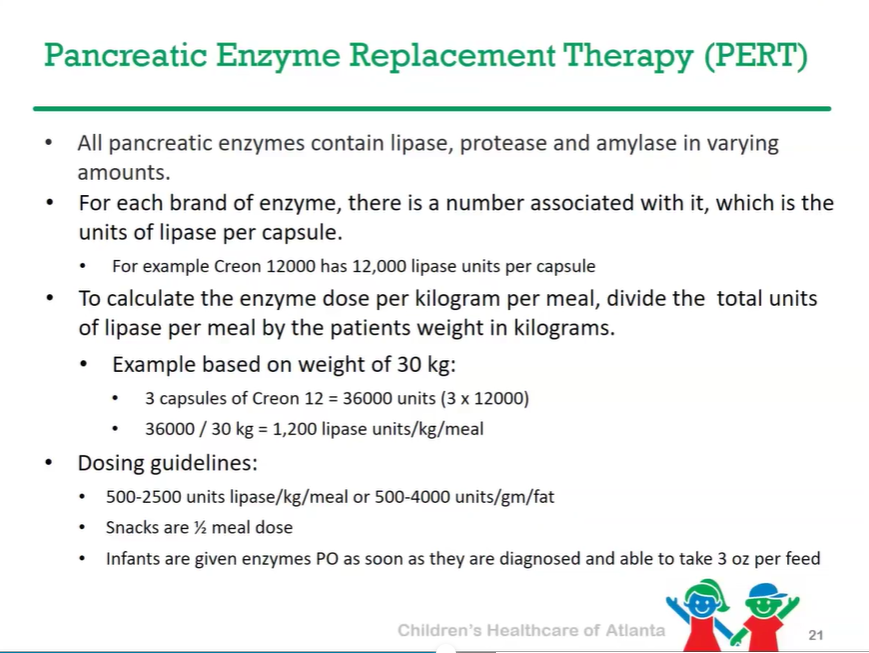
Pancreatic enzyme replacement therapy needed for 85-90% of patients with CF
CFTR modulator therapies may allow lower dosing PERT dosing
Fat soluble vitamin supplementation (A, D, E, K) is needed
Vitamin D (25-OH) goal (by CF Foundation) is >30 ng/mL
High salt diet is recommended due to excessive losses
Targeted nutritional support needs to be based on nutritional status; some patients may need G-Tube placement. CHOA algorithm developed.
High sugar diet may increase the development of CF related diabetes (CFRD)
Fibrosing colonopathy is a very rare effect of high dose pancreatic enzymes and may have been in part due to impurities in older preparations of panrcreatic enzymes.
As noted in previous blog posts (see below), allergy testing can lead to unnecessary food restrictions which can in turn lead to numerous subsequent problems. Case in point: YV Virkud et al (NEJM 2020; 383: 2462-2470) report on A 29-Month-Old Boy with Seizure and Hypocalcemia
This boy presented with severe hypocalcemia, rickets, and seizures one year after allergy testing led to additional dietary restrictions. Also, his mother was a vegetarian. At time of allergy testing, IgE testing suggested allergies to milk, cashews, pistachios, egg whites, almonds, soybeans, chickpeas, green peas, lentils, peanuts, and sesame seeds. Many of these foods caused no symptoms with food challenges.
Besides working through the potential reasons for hypocalcemia, the authors make several key points:
Nutritional rickets is NOT a historical relic. Vitamin D deficiency appears to be increasing in high-income countries despite food-fortification strategies.
There are frequent misdiagnosis of food allergies. “Clinical and laboratory testing is severely limited by poor specificity…approximately 20 to 25% of children have positive IgE blood tests to specific food allergens, even though the true prevalence of IgE-mediated food allergy is likely closer to 6 to 8%.”
Avoid indiscriminate use of IgE blood testing. Allergen panels are “particularly problematic, because they often uncover false positives and lead to unnecessary food avoidance.” Individual IgE testing can be used to help confirm a diagnosis after an allergic reaction to a food trigger.
The most accurate diagnostic tool is an oral food challenge.
In children with food allergies, supplements are often needed to avoid micronutrient deficiencies and a low threshold is needed for involvement of dieticians.
Early introduction of foods can reduce incidence of allergies and periodic reassessment is needed to determine if a child has outgrown an allergy.
Xrays show generalized demineralization. The metaphyses show flaring (dashed arrow) and cupping (arrowbead). The physes are radiolucent and widened (asterisks).
Disclaimer: This blog, gutsandgrowth, assumes no responsibility for any use or operation of any method, product, instruction, concept or idea contained in the material herein or for any injury or damage to persons or property (whether products liability, negligence or otherwise) resulting from such use or operation. These blog posts are for educational purposes only. Specific dosing of medications (along with potential adverse effects) should be confirmed by prescribing physician. Because of rapid advances in the medical sciences, the gutsandgrowth blog cautions that independent verification should be made of diagnosis and drug dosages. The reader is solely responsible for the conduct of any suggested test or procedure. This content is not a substitute for medical advice, diagnosis or treatment provided by a qualified healthcare provider. Always seek the advice of your physician or other qualified health provider with any questions you may have regarding a condition