We recently visited a nearby house with more than 25,000 lights which were synchronized to music. Cool stuff! Here’s a 1 minute clip: Holiday Lights 2019



We recently visited a nearby house with more than 25,000 lights which were synchronized to music. Cool stuff! Here’s a 1 minute clip: Holiday Lights 2019
Most readers of this blog will recognize that one focus has been on delivering high value medical care. In pediatric gastroenterology, there is a great deal of variability in the use of endoscopy as a tool. When there are individuals with high-use/low-value endoscopy, some might question whether this is due to training, expediency, financial motivation, or a lack of clinical confidence.
There have been a number of studies looking at diagnostic yield with pediatric colonoscopy but none on individual provider variation. To look into this issue, we examined our outpatient experience with colonoscopy among 16 providers. This work has now been published:
Digestive Diseases (Full Text): Diagnostic Yield Variation with Colonoscopy among Pediatric Endoscopists
Key points:
Comments:
My take: Goals for pediatric endoscopy to provide high-value care could include ileal intubation rates of >90% and provider diagnostic yields of >40%. High-value also includes the actual cost of the procedure; most of our outpatient endoscopies are performed in a pediatric ambulatory center with much lower costs than hospital-based endoscopy.
Related blog posts:

Death Valley, Zabriskie Point at Sunrise
Several years ago, a small study showed that bolus feeds were as well-tolerated in premature infants as drip feeds: Which is Safer -Drip Feeds of Bolus Feeds for Preterm Infants?
Now, a retrospective study (LB Mahoney, E Liu, R Rosen. JPGN 2019; 69: 678-81) found no difference in the rate of reflux in 18 children who were with gastrostomy-tube dependent.
In this study, 24-hour multichannel intraluminal impedance with pH monitoring (MII-pH) examine reflux events in children receiving exclusive enteral nutrition with a combination of daytime bolus feeds and overnight continuous feeds; each patient served as their own control. this included 6 with prior fundoplication.
Key finding:
The limitations in this study include the small sample size and retrospective design. The authors estimate that to achieve adequate power (80% power) to detect a risk ratio of 1.2 would require 211 patients.
My take: This study and other small studies challenge the assumption that drip feedings are safer. Though, until a larger prospective study is performed, we will not know.

Quebec City
Disclaimer: This blog, gutsandgrowth, assumes no responsibility for any use or operation of any method, product, instruction, concept or idea contained in the material herein or for any injury or damage to persons or property (whether products liability, negligence or otherwise) resulting from such use or operation. These blog posts are for educational purposes only. Specific dosing of medications (along with potential adverse effects) should be confirmed by prescribing physician. Because of rapid advances in the medical sciences, the gutsandgrowth blog cautions that independent verification should be made of diagnosis and drug dosages. The reader is solely responsible for the conduct of any suggested test or procedure. This content is not a substitute for medical advice, diagnosis or treatment provided by a qualified healthcare provider. Always seek the advice of your physician or other qualified health provider with any questions you may have regarding a condition.
A recent retrospective study (N Ibrahimi et al. JPGN 2019; 69: 668-72) reviewed juvenile polyp characteristics over a 14 year period (2003-17) from 213 pediatric subjects who underwent 326 procedures. The authors state their review was intended for nonsyndromic juvenile polyps, though 23 of the patients had ≥5 polyps (which is incongruous with their presented methods of including children with less than 5 polyps).
Key findings:
It is possible that some of the ‘recurrent’ polyps were missed polyps, as polyps can be easily overlooked. I had a recent experience of removing numerous polyps (14) from a child recently and some were identified in part due repeated visualization of several colonic segments. The recent ESPGHAN position paper is useful in children with multiple polyps; their recommendations include: In a child with a single JP, a repeat colonoscopy is not routinely required. (Weak recommendation, very low quality of evidence).
My take: This report is notable for the following:
Related blog posts:

Quebec City
Disclaimer: This blog, gutsandgrowth, assumes no responsibility for any use or operation of any method, product, instruction, concept or idea contained in the material herein or for any injury or damage to persons or property (whether products liability, negligence or otherwise) resulting from such use or operation. These blog posts are for educational purposes only. Specific dosing of medications (along with potential adverse effects) should be confirmed by prescribing physician. Because of rapid advances in the medical sciences, the gutsandgrowth blog cautions that independent verification should be made of diagnosis and drug dosages. The reader is solely responsible for the conduct of any suggested test or procedure. This content is not a substitute for medical advice, diagnosis or treatment provided by a qualified healthcare provider. Always seek the advice of your physician or other qualified health provider with any questions you may have regarding a condition.




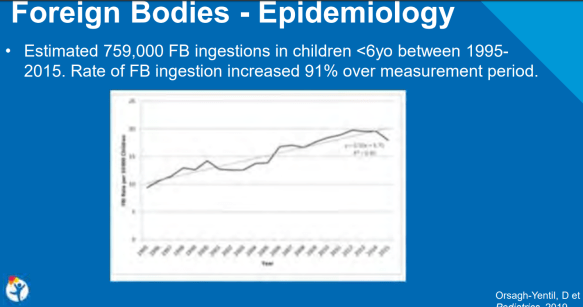
A recent retrospective study (D Orsagh-Yentis) Pediatrics 2019; 143: pii:320181988) examined children <6 years of age (n=759,054) and presentation to an emergency department in the U.S. for a foreign body ingestion (FBI) from 1995-2015. This study was reviewed at our recent national meeting by David Brumbaugh -related blog post: #NASPGHAN19 Postgraduate Course (Part 1) (Slides below).
Key findings:
Related blog posts:

A recent analysis (MG Warren et al J Pediatr 2019; 214: 41-6) examined gastrostomy tube (GT) placement among 4569 extremely low birthweight (ELBW) infants (birth wt <1000 gm) who were enrolled in the National Instittue of Child Health and Human Development Neonatal Research Network (25 centers).
Key findings:
In the discussion, the authors note the well-recognized associations between feeding difficulties and language delays in ELBW infants. In addition, “behavioral and emotional problems have …been described in children with feeding problems.”
The authors also state, without evidence, that the high rate of GT placement after discharge suggests that “a large proportion of ELBW infants were first discharged from the NICU orally feeding but could not maintain these skills.” Alternative explanations include the following:
My take: This study indicates that 7% of ELBW infants undergo GT placement and that about one-third out-grow the need for GT supplementation after ~2 years.
Related blog posts:

Quebec City
A recent retrospective study (N Nguyen et al. Clin Gastroenterol Hepatol 2019; 17: 2455-2462) describe the feasibility of unsedated transnasal endoscopy (TNE) for monitoring eosinophilic esophagitis (EoE) in children (n=190, subject ages 3-22 years).
TNE was facilitated by distraction with either video google or virtual reality (starting 2016). NPO time was 2 hours before the TNE.
Key points:
The authors recommend that TNE be offered starting at age 5 years in those without a known stricture.
My take: I am looking forward to less invasive/less costly ways of monitoring treatment response in EoE. I think TNE can lower costs –though I am a little surprised that the cost of TNE in their institution was still more than $4000. In our outpatient endoscopy center, costs for an upper endoscopy/biopsy with anesthesia are typically about one-third the cost of an EGD in their study and about three-fourths the cost of a study TNE.
Related study: A Krigel et al. Clin Gastroenterol Hepatol 2019; 17: 2489-96. This study showed increasing use of anesthesia assistance (AA) for colonoscopy in adults from 16.7% in 2006 to 58.1% in 2015. This data was derived from the Premier Perspective database with more than 4.6 million patients who had an outpatient colonoscopy. AA was associated with a median increase in cost of $182 for patients with commercial insurance.
Related blog post: Waiting for the String Test for EoE

“80 percent of success is just showing up” —Woody Allen
Reading a recent (brief) study (BA Blansky et al. Clin Gastroenterol Hepatol 2019; 17: 2503-4) reminded me of the quote from Woody Allen. This study of children with Celiac disease (CD) demonstrates a high rate of children who were lost to follow-up at a leading Children’s hospital.
Key findings:
My take: These numbers should not be surprising to most clinicians. If clinicians want to improve follow-up and outcomes, then families will need more nudging; EMRs can be configured to help in this task.
Related blog posts:

Quebec City
SR Gupta et al. JPGN 2019; 69: 544-50. This article reports on preliminary experience in 54 children who received external (non-hospital) infliximab infusions. The average age was 17.6 years. The authors noted no serious safety concerns. Prior to arranging these infusions, the authors insisted on the following:
BN Limketkai et al. Inflamm Bowel Dis 2019; 25: 1828-37. This study, using Truven Health MarketScan database (2007-16) reviewed proactive or reactive mucosal monitoring after biologic initiation in IBD. Early (< 6 months) proactive monitoring (88% endoscopy-based) was performed in 11% (n=2195/19,899) of patients with Crohn’s and 12.8% (925/7247) of patients with ulcerative colitis.
RZ Cohen, BT Schoen, S Kugathasan, CG Sauer. JPGN 2019; 69: 551-6. In this chart review, the authors identified anti-drug antibodies (ADA) in 24.8% (n=58) of patients undergoing therapeutic drug monitoring (n=234) with both infliximab and adalimumab. 54% of this group had antibody suppression with dose optimization. Of note, 37 patients had detectable ADA at time of initial drug monitoring. Dose optimization was 10 mg/kg every 4 weeks with infliximab or 40 mg weekly with adalimumab. Patients who were switched to a second anti-TNF agent (n=23) were not more likely to develop ADA to the second agent (small sample size). Also, the authors caution that in the five patients with ADA levels (>10 U/mL), dose optimization failed and patients required a therapeutic switch. My take: This study provides some useful information about the frequency of ADA. My view is that the actual drug level is more critical than the presence of ADA; though, the presence of high ADA often precludes the ability to deliver a therapeutic drug level.
Related blog posts:
Disclaimer: This blog, gutsandgrowth, assumes no responsibility for any use or operation of any method, product, instruction, concept or idea contained in the material herein or for any injury or damage to persons or property (whether products liability, negligence or otherwise) resulting from such use or operation. These blog posts are for educational purposes only. Specific dosing of medications (along with potential adverse effects) should be confirmed by prescribing physician. Because of rapid advances in the medical sciences, the gutsandgrowth blog cautions that independent verification should be made of diagnosis and drug dosages. The reader is solely responsible for the conduct of any suggested test or procedure. This content is not a substitute for medical advice, diagnosis or treatment provided by a qualified healthcare provider. Always seek the advice of your physician or other qualified health provider with any questions you may have regarding a condition.

