Increasing Cost/Use of Biologic Therapies for Inflammatory Bowel Disease

As noted in a previous blog post (Changes in the Use of IBD Biologic Therapy), there has been an increased use of biologic therapy early in the course of patient’s with inflammatory bowel disease (IBD). Another retrospective study (H Yu et al AP&T 2018; 47: 364-70 -thanks to Ben Gold for this reference) examines the market share and costs of biologic therapy for IBD using the Truven Marketscan Commercial Claims and Encounters database (2007-2015).  This database consists of out-patient and in-patient pharmaceutical claims of approximately 40-50 million privately insured patients each year from patients from all 50 states (U.S.).

Key findings:

  • Among 415,405 patients with IBD (188,842 with Crohn’s, 195,183 with ulcerative colitis, 31,380 with indeterminate IBD), the proportion using biologics increased over the 9-year period (2007-2015); overall, the market share increase was from 7.1% (2007) to 20.5% (2015).
  • There were 28,797 pediatric patients with IBD (17,296 with Crohn’s, 9368 with ulcerative colitis, and 2133 with indeterminate colitis). The overall market share in pediatric patients was the highest, increasing from 19.1% to 45.9%.
  • For all patients with Crohn’s disease (CD) the proportion receiving biologic therapy increased from 21.8% to 43.8%.  For patients with ulcerative colitis (UC), the proportion increased from 5.1% to 16.2%.
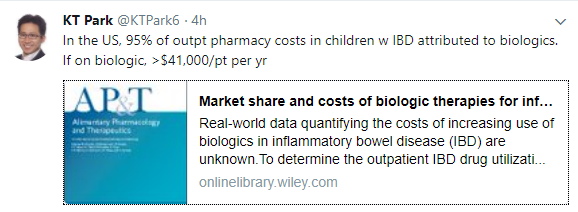
  • Per-member per-year (PMPY) costs increased. “The average biologic-taking patient accounted for $25,275 PMPY in 2007 and $36,051 PMPY in 2015.”  This was similar in the pediatric population, going from $23,616 PMPY in 2007 to $41,109 PMPY in 2015.
  • The share of costs of medicines: the costs of biologics as a share of the total increased from 72.9% in 2007 to 85.7% in 2015. 95% of the pharmacy costs in children with IBD are attributed to biologics.

My take: This trend of increasing use of biologics and their associated costs is going to continue due to their effectiveness. While there are direct costs related to these medications, the net cost is unclear as they can prevent hospitalizations and surgeries. In addition, by helping to spare corticosteroids and increasing response rates, biologic therapies improve quality of life, minimize opportunity loss, and optimize long-term health outcomes.

Bright Angel Trail, Grand Canyon


Ketchup Packet Ingestion–Crohn’s Disease Mimic

In the category of –“I have not seen that before”…

Link: NY Daily News Women diagnosed with Crohn’s disease actually had ketchup packet in her intestines for six years (Thanks to my son for pointing out this story)

An excerpt:

A woman believed she was suffering from Crohn’s disease for six years until doctors performed surgery and discovered a ketchup packet in the lining of her intestine.

The 41-year-old patient had symptoms consistent with the serious bowel disease — including acute abdominal pain and bloating lasting up to three days — but she did not respond to the standard treatments.

Case study reference: Visagan R, et al. BMJ Case Rep 2013. doi:10.1136/bcr-2013-009603

Related blog post: Add it to the list


CALM Study: Tight Control Improves Outcomes in Crohn’s Disease

A recent study (JF Colombel et al. Lancet 2017; http://dx.doi.org/10.1016/S0140-6736(17)32641-7 ) shows that “tight control” improves outcomes in Crohn’s disease.  This study was alluded to in a previous post: CCFA 2017 Updates (part 2)

Background: The CALM study was an open-label, randomized study.  122 adult patients were randomized to typical clinical management and 122 patients received “tight control” in which treatment was modified by fecal calprotectin (≥250 mcg/g) and CRP (≥ 0.5 mg/dL) values in addition to clinical symptoms.

Treatment was escalated in both groups in a stepwise manner.  Initial treatment was with adalimumab induction and then every other week. If patient did not meet treatment objectives, which differed in the groups, then adalimumab would be given every week, and then, if still needed, azathioprine would be added. Interestingly, both groups had ~25% of participants who were smokers which is known to worsen outcomes.

Key Findings:

  • Mucosal healing (CDEIS <4) was significantly improved in tight control group at week 48: 46% vs. 30%.
  • Similarly, steroid-free remission based on CDAI <150 was better in tight control group compared with standard treatment at week 48: 59.8% vs. 39.3%.  Endoscopic response was 50.8% compared with 40.2% respectively.

My take (1st part borrowed from authors): “Tight control of inflammation in patients with Crohn’s disease, with objective markers of disease activity  and clinical symptoms to drive treatment decisions, achieved better endoscopic and clinical outcomes than conventional care based on symptoms alone.” Yet, there are a large number who do not respond adequately and better treatments in these patients are needed.

As an aside, these response rates based on objective markers are far lower than the remission rates claimed by ImproveCareNow; thus, while ImproveCareNow is forward-thinking and helping improve outcomes with inflammatory bowel disease, we need to be careful about citing remission rate trends that are not directly linked to objective markers.

NY Times: Humira’s Best-Selling Drug Formula: Start at a High Price. Go Higher.

NY Times: Humira’s Best-Selling Drug Formula: Start at a High Price. Go Higher.

An excerpt:

Humira is the best-selling prescription drug in the world…The price of Humira, an anti-inflammatory drug dispensed in an injectable pen, has risen from about $19,000 a year in 2012, to more than $38,000 today, per patient, after rebates, according to SSR Health, a research firm. That’s an increase of 100 percent…

How much you actually pay out of pocket, and whether you can afford Humira at all, depend on your insurance and eligibility for discounts…

Humira, which accounted for nearly two-thirds of AbbVie’s $25.6 billion in revenue in 2016, was not simple to develop. It is among a new class of drugs known as biologics, which are made from living cells rather than synthetic chemicals…

Looking at the international picture tells its own story about drug costs. A prefilled carton with two syringes costs $2,669 in the United States, compared with $1,362 in Britain, $822 in Switzerland and $552 in South Africa…

An analysis by the Institute for Clinical and Economic Review found that Humira’s list price would need to be discounted by at least 55 percent to be cost effective for rheumatoid arthritis, its originally approved use.

Dr. Steven D. Pearson, the founder of the institute, which provides cost benefit data to health plans, said competing drugs were overpriced as well.

“Even in a space like this, where there is a lot of competition, we don’t see the prices coming down,” he said. “That speaks to the fact that it doesn’t often function like a free market usually would.”..

AbbVie joined a few of its rivals in saying it would limit price increases to single digits this year, and so only raised Humira by another 9.7 percent this month, roughly four and a half times the inflation rate. For the drug industry, that counts as generosity.

My take: Humira is a very important and effective medication, particularly for inflammatory bowel disease and rheumatoid arthritis. I infer from this article which compares the Humira pricing strategy to that used by Martin Shkreli that if U.S. consumers are to have more affordable pharmaceuticals, government intervention will be needed. AbbVie, like many other pharmaceutical companies, will continue to aggressively price Humira; after all, 8 billion in profits is not as good as 10 billion.

Related blog posts:

Therapeutic Drug Monitoring for Vedolizumab

A recent observational study (N Williet et al. Clin Gastroenterol Hepatol 2017; 15: 1750-7) provides some important information about where we are heading with regard to therapeutic drug monitoring (TDM) with vedolizumab (VDZ).

This study enrolled 47 consecutive patients with either Crohn’s disease (CD, n=31) or ulcerative colitis (UC, n=16). In those without a clinical response at week 6, an additional dose of 300 mg of VDZ was administered at week 10.

Key findings:

  • VDZ levels were higher in responders than in nonresponders, which is in agreement with previous studies ( (NEJM 2013; 369: 711-21, NEJM 2013; 369: 699-710)
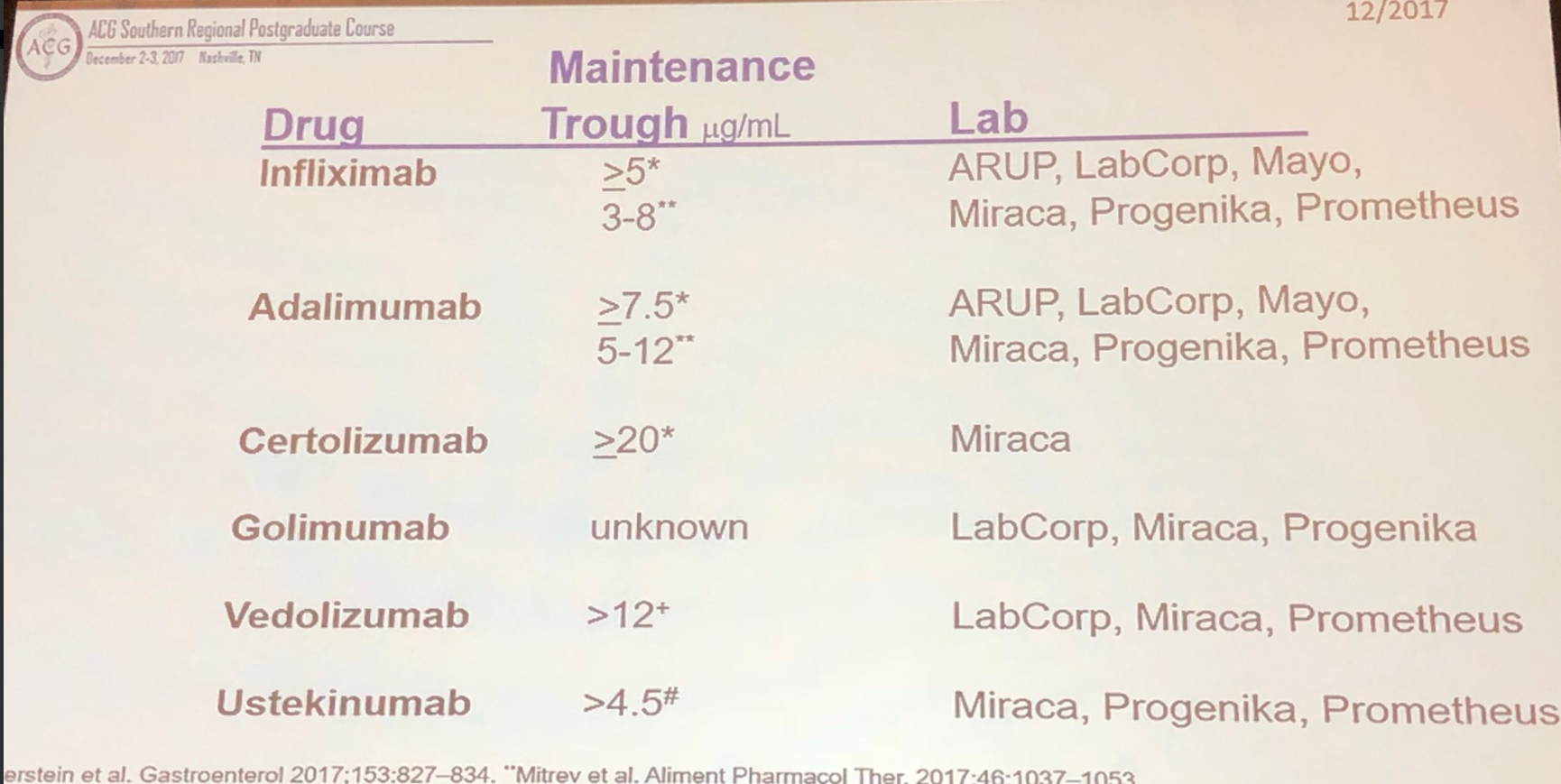
  • A low therapeutic drug level as early as week 2 (<24.5 mcg/mL) and at the end of induction (week 6) (<18.5 mcg/mL) was associated with the need for drug optimization within 6 months in all patients
  • All patients with a level <19.0 mcg/mL at week 6, regained a secondary response after optimization at week 10.
  • The authors note that in the GEMINI trial, anti-VDZ antibodies were detected in 56 of 1434 patients (3.7%).  In this cohort, no anti-VDZ were detected using the same methods.

My take: Low trough levels of VDZ at week 6 are associated with the need for drug optimization/increased dosing.

Fatty Acid Intake and Risk of Ulcerative Colitis Flare

A recent study (Barnes EL et al. Clin Gastroenterol Hepatol 2017; 15: 1390-6) found an association between the intake of certain fatty acids and the risk of an ulcerative colitis flare.  This is nicely summarized in the AGA Journals Blog.

Here’s the link: Does Consumption of Certain Fatty Acids Increase Risk of Ulcerative Colitis Flares?

Here’s an excerpt:

Diets with high levels of fatty acids such as myristic acid (found in palm oil, coconut oil, and dairy fats) increased risk of flare in patients with ulcerative colitis (UC), researchers report in the September issue of Clinical Gastroenterology and Hepatology. Their findings, from a prospective study of more than 400 patients in remission during treatment with aminosalicylates, could guide future studies of supplements or compounds that reduce risk of flares in patients with UC in remission…

Edward L. Barnes et al performed a prospective study of dietary patterns among 412 patients, from 25 sites, with UC in remission during monotherapy with an aminosalicylate (mesalamine, sulfasalazine, or balsalazide for at least 3 months before enrollment). Patients completed a validated food frequency questionnaire (on consumption of dairy, fruits, vegetables, eggs, meat, fish, cereals, breads, and starches, beverages, sweets, and baked goods) at enrollment and were followed for 12 months…

Forty-five patients (11%) had a relapse of UC within 1 year of study enrollment… In multivariable analysis, higher intake of myristic acid (odds ratio, 3.01) and alpha linolenic acid (odds ratio, 5.50) were associated with increased risk of relapse, although a dose–response relationship was retained only for myristic acid intake.

Other foods previously implicated in flares of UC, such as processed meat, alcohol, and foods high in sulfur, were not associated with an increased risk of flare.

Related blog posts:

From Andy Warhol Exhibit at the High Museum

Costs of Biologics for Inflammatory Bowel Disease

A recent study examines the market share and costs of biologic therapies for inflammatory bowel disease:

Excerpt from abstract:

The average biologic-taking patient accounted for $25 275 PMPY in 2007 and $36 051 PMPY in 2015. The average paediatric biologic-taking patient accounted for $23 616 PMPY in 2007 and $41 109 PMPY in 2015. In all patients, the share of costs for biologics increased from 72.9% in 2007 to 85.7% in 2015 (81.7% in 2007 to 94.9% in 2015 in paediatrics).

Conclusion

The vast majority of costs allocated to out-patient IBD medications in the USA is attributed to increasing use of biologic therapies despite the relative minority of biologic-taking patients.

My take: Biologic therapies are costly but also very effective.

Related Blog Posts:


The Original Anti-TNF Therapy: Thalidomide

A recent study (M Lazzerini et al. Clin Gastroenterol Hepatol 2017; 15: 1382-9) used data from 2 multicenter trials of 70 children to assess the efficacy of thalidomide in pediatric patients with refractory inflammatory bowel disease (37 with Crohn’s disease, 23 with ulcerative colitis)

Key findings:

  • 42 patients (60%) had clinical remission & 45 (64%) had clinical response at week 8
  • 38 patients (54%) had clinical remission or response at week 52. 29 of these patients had mucosal healing (no erosions or ulcerations) & 20 patients had histologic healing
  • 7 patients dropped out from study prior to 52 weeks due to side effects (n=5) or clinical relapse (n=2)

My take: I have not used thalidomide therapy and remain concerned about long term side effects (eg. peripheral neuropathy).  Though, the authors are correct that its safety “may be acceptable compared with the safety of other” treatments, especially if there are few remaining options.

Related blog posts:

IBD Short Takes -Fall 2017

From ImproveCareNow: Real-World Experience with Adalimumab

An excerpt:

A total of 174 children and adolescents were treated with adalimumab as their first anti-TNF therapy…The mean age at the time of Crohn’s disease diagnosis was 13 years and, on average, they started adalimumab at 14.5 years of age…

  • At 3 months after adalimumab was started, all 174 were still on the medication, and 69-71% were in steroid-free remission
  • At 6 months after adalimumab was started, of the 174 who had a clinic visit, 95% were still on the medication, and 75-77% were in steroid-free remission
  • At 12 months after adalimumab was started, of the 154 who had a clinic visit, 94% were still on the medication, and 79-80% were in steroid-free remission
  • At 24 months after adalimumab was started, of the 71 who had a clinic visit, 97% were still on the medication, and 91-94% were in steroid-free remission
  • At 36 months after adalimumab was started, of the 39 who had a clinic visit, 80-86% were still on the medication, and 81-86% were in steroid-free remission

No positive or negative effect on remission was seen with concomitant immunomodulator therapy. However, the number of patients studied during the retrospective analysis is too small to detect all but the greatest impact of this approach.

EC Maxwell et al. JPGN 2017; 65: 299-305  CHOP experience with diverting ileostomy for severe IBD (2000-2014).

  • In this retrospective study, a diverting ileostomy in 24 patients had improvement: 71% –>22% on chronic steroids, improved growth, hemoglobin, blood transfusion and hospitalization.
  • 10 patients underwent subsequent colectomy, 7 had successful reanastomosis, and 7 remain diverted.
  • Diversion allowed a definitive diagnosis in 7 subjects (initially 13 patients were considered IBD-U).
  • Surgical complications were common (n=13 in 7 subjects) and included stoma obstruction, stoma prolapse, and resection of ischemic bowel.
  • One notable feature regarding this cohort was that 50% were 5 or younger when diagnosed with IBD.
  • The authors conclude that a diverting ileostomy can induce clinical stability and allow time to clarify diagnosis.

A Assa et al. JPGN 2017; 65: 293-98. In this study involving findings from 234 patients extracted from the ImageKids database (prospective multicenter cohort), the authors found that pediatric patients with perianal Crohn’s disease have a greater inflammatory burden; however, this was driven mainly by those who had fistulizing disease.

L Lian et al. Clin Gastroenterol Hepatol 2017; 15: 1226-31. This retrospective study from the Cleveland Clinic compared outcomes of endoscopic balloon dilation (EBD) (n=176) or surgery (n=131) for Crohn’s disease-related strictures (1998-2013). Patients who had EBD had an “average time to surgery delayed by 6.45 years.” Immediate success rate for EBD was 91.3%; the perforation rate was 1.1%.. Ultimately, 52% of patients who had EBD required surgery.  Earlier surgery lowered the risk of further surgery but also was associated with significant perioperative complications. In the operative group, 8.8% of patients experienced complications, mainly intra-abdominal abscesses and enterocutaneous fistula. Thus, in the right hands and with careful selection, EBD may be useful.

I Lawrance et al. Clin Gastroenterol Hepatol 2017; 15: 1248-55. This study reported the results of 11 patients who received rectal tacrolimus for resistant ulcerative proctitis. Dosing: The concentration of tacrolimus was 0.5 mg/mL and 3 mL was administered twice a day.Clinical response, using the Mayo Clinic score, was achieved in 73% of tacrolimus subjects compared with 10% (n=1) of placebo-treated subjects.  Mucosal healing at week 8 was noted in 73% of tacrolimus-treated patients, as well.

Soapes Creek Trail

Therapeutic Drug Monitoring: Ustekinumab (Stelara)

The ability to measure drug levels has changed how we think about refractory medical disease, particularly in patients with inflammatory bowel disease.  Prior to the availability of therapeutic drug monitoring (TDM), in some situations poor response to therapy could be ascribed to variability in host immune response. Now, it is clear that many cases of refractory medical disease are due to insufficient drug level.  TDM allows for dose individualization to target the right amount of medication.

TDM has an accepted role in anti-TNF therapy.  Now, a study (R Battat et al. Clin Gastroenterol Hepatol 2017; 15: 1427-34) extends the concept of TDM to ustekinumab.  This study which took place between 2014-2015 examined ustekinumab use in 62 patients with refractory Crohn’s disease (CD).  Ustekinumab dosing: 90 mg SC at weeks 0, 1, and 2 for induction, then 90 mg every 4 or 8 weeks for maintenance.

Key findings:

  • At week 26, 80.7% of patients had a clinical response, 66.1% had a clinical remission, and 58.9% had an endoscopic response.
  • In those with an endoscopic response, the mean trough concentration of ustekinumab was 4.7 mcg/mL compared with 3.8 mcg/mL those without an endoscopic response.
  • Using a trough threshold of 4.5 mcg/mL at week ≥26, 75.9% had an endoscopic response whereas those with a level below this trough had a 40.7% endoscopic response
  • The authors did not detect antibodies to ustekinumab in any patient. The authors note that ustekinumab has low immunogenicity and prior UNITI studies indicated antibody formation in 0.2% after induction and 2.3% at 1 year.
  • Unlike combination therapy with anti-TNF therapy, “concurrent immunosuppressive therapy does not explain low immunogenicity, as only 25.8% of patients received these and had neither improved clinical outcomes nor higher drug concentrations.”

Thus far, no clinical studies have demonstrated improved clinical outcomes with dose escalation in the setting of low ustekinumab levels.  A prospective trial would be helpful.

My take: This study shows promising results for ustekinumab for refractory CD.  The low immunogenicity indicates that monotherapy is likely appropriate.  A target level of >4.5 mcg/mL indicates a higher likelihood of response.

Related blog posts: